


Industrial Control System Market Size
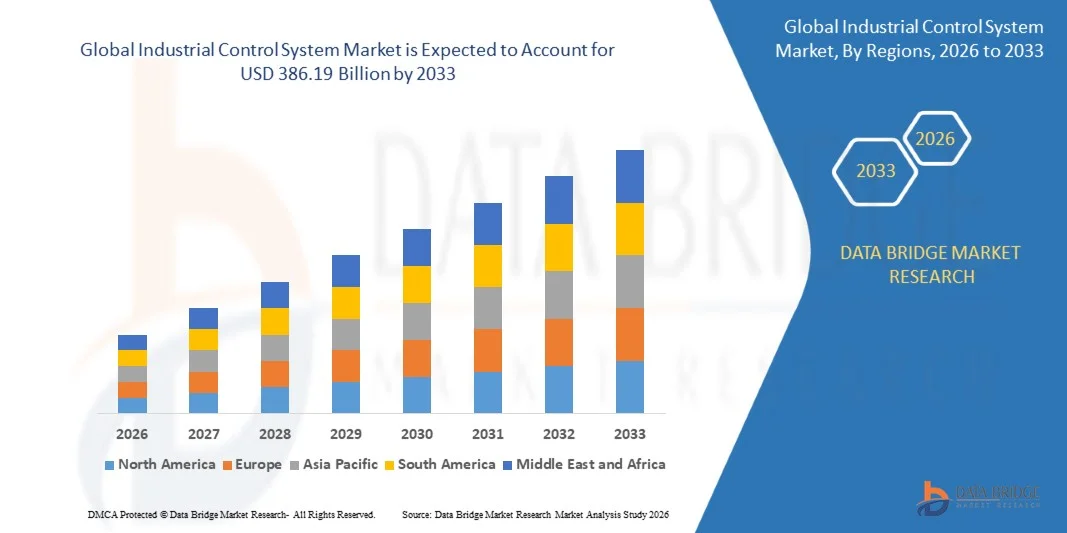
- The global industrial control system market size was valued at USD 189.6 billion in 2025and is expected to reach USD 386.19 billion by 2033, at a CAGR of 9.3% during the forecast period.
- Market growth is primarily driven by increasing industrial automation, rising adoption of Industry 4.0 technologies, and growing demand for real-time monitoring and control systems.
- Additionally, expansion of smart manufacturing, digital transformation initiatives, and increasing investments in energy and utilities infrastructure are significantly accelerating market growth.
Industrial Control System Market Analysis
- Industrial Control Systems (ICS), which include integrated hardware and software solutions, play a critical role in automating industrial processes and ensuring operational efficiency, safety, and reliability.
- Demand is increasing due to the need for improved productivity, reduced downtime, and enhanced process optimization across industries.
- Asia-Pacific dominated the ICS market with a revenue share of 41.18% in 2025, driven by rapid industrialization in China, India, and Southeast Asia.
- North America is expected to witness significant growth, supported by strong adoption of smart manufacturing, IIoT, and cybersecurity solutions.
- The distributed control systems (DCS) segment dominated the market with 34.72% share in 2025, owing to its extensive use in process industries such as oil & gas and power generation.
Report Scope and Industrial Control System Market Segmentation
|
Attributes |
Industrial Control System Key Market Insights |
|
Segments Covered |
|
|
Countries Covered |
North America · U.S. · Canada · Mexico Europe · Germany · France · U.K. · Netherlands · Switzerland · Belgium · Russia · Italy · Spain · Turkey · Rest of Europe Asia-Pacific · China · Japan · India · South Korea · Singapore · Malaysia · Australia · Thailand · Indonesia · Philippines · Rest of Asia-Pacific Middle East and Africa · Saudi Arabia · U.A.E. · South Africa · Egypt · Israel · Rest of Middle East and Africa South America · Brazil · Argentina · Rest of South America |
|
Key Market Players |
|
|
Market Opportunities |
· Increasing adoption of Industrial Internet of Things (IIoT) and smart sensors · Growing demand for cybersecurity solutions in industrial environments |
|
Value Added Data Infosets |
In addition to the market insights such as market value, growth rate, market segments, geographical coverage, market players, and market scenario, the market report curated by the Data Bridge Market Research team includes in-depth expert analysis, import/export analysis, pricing analysis, production consumption analysis, and pestle analysis. |
Industrial Control System Market Trends
“Integration of IIoT and Smart Automation”
- A key trend shaping the global industrial control systems (ICS) market is the rapid integration of Industrial Internet of Things (IIoT), cloud computing, and artificial intelligence (AI) into control system architectures. These technologies enable seamless connectivity between machines, systems, and operators, allowing industries to transition toward fully digital and intelligent operations.
- Smart factories are increasingly adopting connected and automated control systems that support real-time monitoring, predictive maintenance, and data-driven decision-making. This transformation helps reduce downtime, optimize resource utilization, and improve overall operational efficiency.
- Traditional systems such as SCADA (Supervisory Control and Data Acquisition) and PLC (Programmable Logic Controllers) are evolving with advanced capabilities, including remote accessibility, cloud integration, and enhanced analytics, enabling operators to monitor and control industrial processes from centralized or remote locations.
- The adoption of edge computing is significantly improving system responsiveness by processing data closer to the source, reducing latency, and enabling faster and more accurate operational decisions in time-sensitive industrial environments.
- The growing use of digital twin technology is another important trend, allowing organizations to create virtual replicas of physical assets and processes for simulation, testing, and optimization. This enhances predictive maintenance and reduces operational risks.
- With increased connectivity, there is a rising focus on cybersecurity measures, as industrial infrastructures are becoming more vulnerable to cyber threats. Companies are investing in secure ICS frameworks to protect critical operations and data.
Industrial Control System Market Dynamics
Driver
“Growing Industrial Automation and Smart Manufacturing”
- The increasing adoption of automation across industries such as oil & gas, manufacturing, power generation, and chemicals is a major factor driving the growth of the Industrial Control Systems market. Organizations are focusing on automating processes to enhance productivity, improve precision, and reduce operational costs.
- ICS solutions are widely deployed to enable real-time monitoring, process control, and system optimization, helping companies minimize downtime and improve overall efficiency. Automation also reduces dependency on manual labor and enhances workplace safety.
- The rising demand for real-time data visibility and operational control is accelerating the adoption of SCADA and DCS systems, particularly in industries that require continuous monitoring and high reliability.
- The expansion of Industry 4.0 initiatives is further driving market growth, as companies integrate advanced technologies such as AI, machine learning, and IoT into industrial processes to enable intelligent automation and predictive analytics.
- Increasing investments in energy infrastructure, utilities, and smart grids are also contributing to the demand for ICS solutions, as these systems are essential for managing complex and large-scale operations.
- Additionally, stringent safety regulations and compliance requirements across industries are encouraging the adoption of advanced control systems to ensure operational safety, reliability, and adherence to regulatory standards.
Restraint/Challenge
“Cybersecurity Risks and High Implementation Costs”
- One of the major challenges in the ICS market is the rising threat of cyberattacks targeting industrial systems, which can lead to operational disruptions, data breaches, and financial losses. As ICS systems become more interconnected, their vulnerability to cyber threats increases.
- The high initial investment cost associated with deploying ICS solutions, including hardware, software, and integration services, remains a significant barrier, particularly for small and medium-sized enterprises (SMEs).
- Integration of modern ICS technologies with legacy systems is complex and time-consuming, often requiring extensive system upgrades and customization, which increases implementation costs and timelines.
- There is a shortage of skilled professionals capable of managing, operating, and maintaining advanced ICS solutions, creating a talent gap in the industry.
- Ongoing maintenance, upgrades, and system optimization costs can also be substantial, impacting long-term affordability for organizations.
- Additionally, industries such as energy, defense, and critical infrastructure face strict regulatory and compliance requirements, which can delay implementation and increase operational complexity.
Industrial Control System Market Scope
The market is segmented on the basis of type, component, and end-user.
- By type
On the basis of type, the global industrial control systems market is segmented into Distributed Control Systems (DCS), Supervisory Control and Data Acquisition (SCADA), Programmable Logic Controllers (PLC), Manufacturing Execution Systems (MES), and Others.
The Distributed Control Systems (DCS) segment dominated the market with the largest revenue share in 2025, driven by its extensive adoption across process industries such as oil & gas, chemicals, power generation, pharmaceuticals, and food & beverages. DCS solutions are widely used for continuous process monitoring, centralized control, and operational optimization due to their high reliability, scalability, and ability to manage complex industrial operations efficiently. Their capability to provide real-time monitoring, improved safety, reduced downtime, and enhanced process automation significantly improves operational productivity and minimizes human intervention. Additionally, the integration of advanced technologies such as artificial intelligence (AI), Industrial Internet of Things (IIoT), predictive analytics, and cloud connectivity is further accelerating the adoption of DCS solutions in smart manufacturing environments.
The SCADA segment is expected to witness the fastest growth during the forecast period, fueled by increasing demand for remote monitoring, infrastructure automation, and real-time data acquisition across industries such as utilities, transportation, water & wastewater, and energy. SCADA systems are gaining traction due to their ability to provide centralized visibility, remote accessibility, and efficient management of geographically distributed assets. The growing investments in smart grids, renewable energy projects, and industrial digitalization initiatives are significantly accelerating the adoption of SCADA solutions globally.
- By component
On the basis of component, the industrial control systems market is segmented into hardware, software, and services.
The hardware segment dominated the market in 2025, driven by the increasing demand for industrial controllers, sensors, communication devices, Human Machine Interfaces (HMIs), and field instruments across manufacturing and process industries. Hardware components form the backbone of industrial automation systems by enabling accurate data collection, process control, and equipment monitoring. Increasing industrial automation and expansion of smart factories are major factors supporting the growth of this segment. Furthermore, advancements in sensor technologies and industrial networking devices are enhancing system efficiency and operational reliability.
The software segment is expected to witness the fastest growth during the forecast period, fueled by increasing adoption of AI-powered analytics, cloud-based industrial platforms, and advanced monitoring solutions. Industrial control software enables predictive maintenance, process optimization, real-time analytics, and centralized management of industrial operations. The growing focus on Industry 4.0, digital twins, and IIoT integration is significantly accelerating the demand for intelligent industrial software solutions globally.
- By end-user
On the basis of end-user, the Industrial Control Systems market is segmented into oil & gas, power generation, manufacturing, chemicals, water & wastewater, and others.
The oil & gas segment accounted for the largest market revenue share in 2025, owing to the extensive use of industrial control systems in upstream, midstream, and downstream operations. ICS solutions are essential for monitoring drilling activities, pipeline management, refining operations, and distribution networks, ensuring operational safety, efficiency, and reliability. The increasing demand for automation to reduce operational risks, improve productivity, and maintain regulatory compliance is further strengthening the adoption of industrial control systems in this segment.
The power generation segment is expected to witness significant growth during the forecast period, supported by increasing investments in renewable energy projects, smart grid infrastructure, and modernization of power plants. Industrial control systems enable efficient monitoring, load management, and real-time control of power generation and distribution networks. The growing demand for reliable energy management systems and increasing integration of renewable energy sources are significantly contributing to the expansion of this segment globally.
Industrial Control System Market Regional Analysis
- Asia-Pacific dominated the market with a 41.18% share in 2025, driven by rapid industrialization, expanding manufacturing activities, and increasing investments in automation technologies across countries such as China, India, and Japan.
- The region benefits from a strong industrial base, availability of cost-effective labor, and government initiatives promoting digital transformation and smart manufacturing.
- Increasing adoption of ICS in industries such as automotive, electronics, energy, and chemicals is further strengthening regional growth. The presence of major manufacturing hubs and continuous infrastructure development are key factors supporting Asia-Pacific’s leadership in the global ICS market.
U.S. Industrial Control System Market Insight
The U.S. industrial control systems market accounted for the largest share in North America in 2025, driven by strong adoption of automation technologies across manufacturing, energy, and utilities sectors. The increasing implementation of IIoT-enabled solutions, along with growing investments in smart factories and cybersecurity infrastructure, is significantly contributing to market growth.
U.K. Industrial Control System Market Insight
The U.K. market is expected to grow at a steady pace during the forecast period, supported by rising adoption of digital technologies and automation in manufacturing and utility sectors. Government initiatives promoting industrial digitalization and innovation are further accelerating market expansion.
Germany Industrial Control System Market Insight
Germany remains a key market in Europe due to its strong focus on Industry 4.0 and advanced manufacturing capabilities. The country’s well-established industrial base and emphasis on automation and precision engineering are driving the adoption of ICS solutions across multiple industries.
Asia-Pacific Industrial Control System Market Insight
Asia-Pacific is projected to grow at the fastest CAGR during the forecast period, driven by rapid industrialization, urbanization, and increasing investments in infrastructure and automation technologies. Countries such as China, India, and South Korea are leading the adoption of ICS solutions.
Japan Industrial Control System Market Insight
Japan’s ICS market is growing steadily due to its technological expertise and leadership in automation. The country’s aging workforce and focus on operational efficiency are driving the adoption of advanced industrial control systems across manufacturing and service industries.
India Industrial Control System Market Insight
India is expected to witness significant growth in the ICS market, driven by increasing industrial automation, infrastructure development, and government initiatives such as Make in India and digital transformation programs. The expansion of manufacturing and energy sectors is further boosting demand for ICS solutions.
Industrial Control System Market Share
The industrial control system industry is primarily led by well-established companies, including:
- Siemens AG (Germany)
- ABB Ltd. (Switzerland)
- Schneider Electric (France)
- Honeywell International Inc. (U.S.)
- Emerson Electric Co. (U.S.)
- Rockwell Automation Inc. (U.S.)
- Yokogawa Electric Corporation (Japan)
- Mitsubishi Electric Corporation (Japan)
- General Electric Company (U.S.)
- Omron Corporation (Japan)
Recent Developments in Global Industrial Control System Market
- In April 2026, major industrial automation companies introduced advanced AI-powered industrial control systems (ICS) platforms with predictive maintenance and real-time analytics capabilities. These solutions enable industries to optimize operational efficiency, reduce downtime, and improve process reliability through intelligent automation and data-driven decision-making.
- In March 2026, leading market players expanded their IIoT-enabled SCADA and Distributed Control System (DCS) solutions for smart infrastructure and industrial automation applications. These advancements enhanced remote monitoring, process visualization, and centralized operational control across manufacturing, utilities, and energy sectors.
- In February 2026, significant investments were announced in industrial cybersecurity technologies aimed at protecting critical infrastructure and connected industrial environments from increasing cyber threats. Companies focused on strengthening network security, threat detection, and secure industrial communication systems.
- In January 2026, major technology providers launched cloud-based industrial control systems platforms designed to improve remote operations, system scalability, and industrial process integration. These platforms support real-time data accessibility and advanced analytics for smart manufacturing environments.
- In December 2025, advancements in Programmable Logic Controllers (PLCs) and edge computing technologies were introduced with enhanced processing capabilities, faster response times, and improved connectivity features, enabling more efficient and intelligent industrial automation operations.

- Interactive Data Analysis Dashboard
- Company Analysis Dashboard for high growth potential opportunities
- Research Analyst Access for customization & queries
- Competitor Analysis with Interactive dashboard
- Latest News, Updates & Trend analysis
- Harness the Power of Benchmark Analysis for Comprehensive Competitor Tracking
Data collection and base year analysis are done using data collection modules with large sample sizes. The stage includes obtaining market information or related data through various sources and strategies. It includes examining and planning all the data acquired from the past in advance. It likewise envelops the examination of information inconsistencies seen across different information sources. The market data is analysed and estimated using market statistical and coherent models. Also, market share analysis and key trend analysis are the major success factors in the market report. To know more, please request an analyst call or drop down your inquiry.
The key research methodology used by DBMR research team is data triangulation which involves data mining, analysis of the impact of data variables on the market and primary (industry expert) validation. Data models include Vendor Positioning Grid, Market Time Line Analysis, Market Overview and Guide, Company Positioning Grid, Patent Analysis, Pricing Analysis, Company Market Share Analysis, Standards of Measurement, Global versus Regional and Vendor Share Analysis. To know more about the research methodology, drop in an inquiry to speak to our industry experts.
Data Bridge Market Research is a leader in advanced formative research. We take pride in servicing our existing and new customers with data and analysis that match and suits their goal. The report can be customized to include price trend analysis of target brands understanding the market for additional countries (ask for the list of countries), clinical trial results data, literature review, refurbished market and product base analysis. Market analysis of target competitors can be analyzed from technology-based analysis to market portfolio strategies. We can add as many competitors that you require data about in the format and data style you are looking for. Our team of analysts can also provide you data in crude raw excel files pivot tables (Fact book) or can assist you in creating presentations from the data sets available in the report.













