What is the Industrial Edge Market Size and Growth Rate?
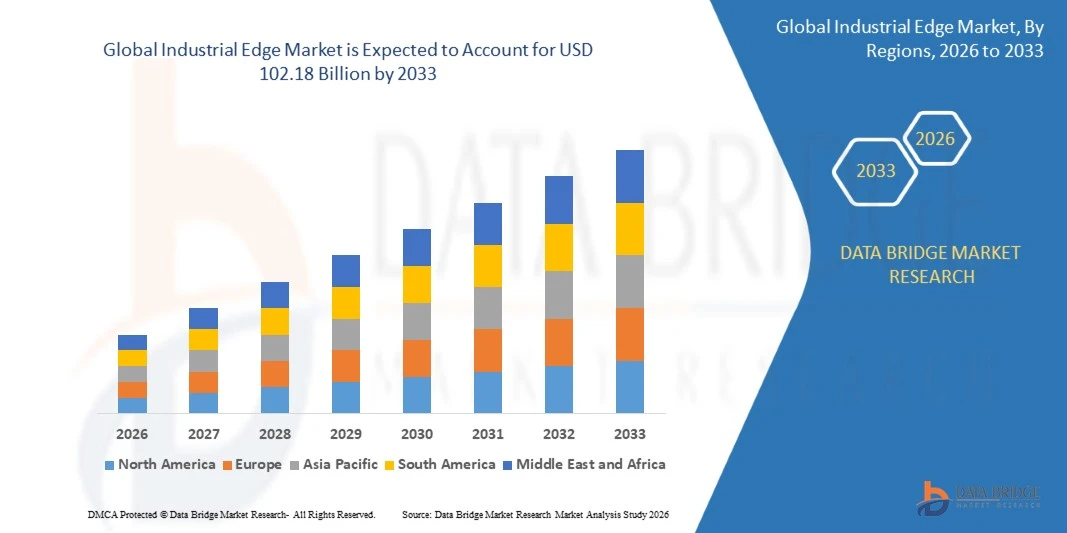
- As per Data Bridge Market Research analysis, the industrial edge market was valued at USD 28.90 billion in 2025 and is projected to reach USD 102.18 billion by 2033, growing at a CAGR of 17.10% from 2026 to 2033.
- The market is experiencing strong growth driven by rising demand for real-time data processing, low-latency analytics, and AI inference close to machines, alongside expanding deployment across manufacturing, energy and utilities, transportation, and process industries.
- The increasing convergence of operational and information technology, combined with growing integration of edge platforms with controllers, sensors, and enterprise software, is supporting market adoption. Edge solutions are being applied across industrial IoT, predictive maintenance, machine vision, and process optimization, using edge AI hardware and an industrial IoT platform to deliver faster, more resilient operations.
Market Size & Forecast
- Global Market Value (2025): USD 28.90 Billion
- Expected Market Value (2033): USD 102.18 Billion
- Forecast CAGR (2026–2033): 17.10%
- Leading Region in 2025: North America
- Fastest Growing Region: Asia Pacific
What are the Major Takeaways of the Industrial Edge Market?
- North America dominated the industrial edge market with the largest revenue share of 33.82% in 2025, supported by early adoption of AI-enabled manufacturing, strong presence of edge hardware and software providers, and sustained factory modernization investment.
- Asia-Pacific is expected to be the fastest-growing region at a CAGR of 19.60% from 2026 to 2033, fueled by large manufacturing bases, smart factory programs, and rising adoption of industrial automation.
- The hardware segment led the market with a 52.38% share in 2025, driven by deployment of industrial PCs, edge gateways, and ruggedized compute nodes on production floors.
- Software is the fastest-growing component, projected to register a CAGR of 20.10%, reflecting rising demand for edge orchestration, device management, and AI application platforms.
- The on-premise segment dominated the deployment category with a 58.73% revenue share in 2025, led by the need for local control, low latency, and data sovereignty in production environments.
- Predictive maintenance accounted for 31.84% of the market share in 2025, preferred for its ability to reduce unplanned downtime using locally processed equipment data.
- The quality inspection and machine vision segment is the fastest-growing application category, with a CAGR of 20.60%, driven by real-time defect detection and AI-based inspection on production lines.
Report Scope and Industrial Edge Market Segmentation
|
Attributes |
Industrial Edge Key Market Insights |
|
Segments Covered |
|
|
Countries Covered |
North America
Europe
Asia-Pacific
Middle East and Africa
South America
|
|
Key Market Players |
|
|
Market Opportunities |
|
|
Value Added Data Infosets |
In addition to the market insights such as market value, growth rate, market segments, geographical coverage, market players, and market scenario, the market report curated by the Data Bridge Market Research team includes in-depth expert analysis, import/export analysis, pricing analysis, production consumption analysis, and pestle analysis. |
What is the Key Trend in the Industrial Edge Market?
- Industrial edge platforms are evolving from simple data gateways into AI-enabled operational infrastructure, running analytics, machine-vision models, and control-adjacent applications directly on the factory floor with centralized lifecycle management across distributed sites.
- For instance, in January 2025, according to Siemens AG, the company announced at CES 2025 that its Siemens Industrial Copilot would be integrated with the Industrial Edge ecosystem, which was enhanced with AI for deploying, operating, and managing AI models within the production environment, bringing industrial AI closer to the machines that generate the data.
- Edge-based AI inference is reducing dependence on cloud connectivity, allowing latency-sensitive tasks such as defect detection and equipment monitoring to run locally and securely.
- Hybrid architectures that combine on-premise edge nodes with centrally managed software ecosystems are gaining preference, as manufacturers seek to scale AI models across plants while retaining local control of operational data.
- For instance, in April 2026, according to Siemens AG, the company announced at Hannover Messe 2026 that its Industrial AI Suite, based on Industrial Edge, and WinCC Unified had reached general availability, while UL Solutions awarded Industrial Edge and the virtual PLC a “Smart Systems Verified – Platinum” certification, reflecting the growing maturity of edge-based industrial AI platforms.
- As edge hardware performance, AI acceleration, cybersecurity features, and ecosystem partnerships continue to advance, industrial edge solutions are expected to expand beyond monitoring into real-time optimization, quality assurance, and autonomous operations across industries.
What are the Key Drivers of the Industrial Edge Market?
- The growing need for real-time decision-making in production environments has significantly increased demand for computing capacity located close to machines, where cloud round-trip delays can limit responsiveness and process stability.
- For instance, in December 2024, according to Mathematics (MDPI), researchers compared edge computing models of industrial subprocesses with traditional cloud computing using real manufacturing scenarios, demonstrating that processing data locally at the point of collection reduces latency and improves processing efficiency for real-time industrial decision-making.
- Manufacturers, utilities, and logistics operators are adopting edge platforms to reduce data-transfer volumes, improve operational continuity during network disruptions, and keep sensitive production data within local infrastructure.
- For instance, in April 2026, according to Process Online, Siemens announced a turnkey industrial edge AI solution developed with NVIDIA and in collaboration with Palo Alto Networks, combining NVIDIA accelerated computing and BlueField data processing units at the edge to run production-critical AI applications while separating IT networks from OT environments.
- With industrial companies increasingly deploying AI models in production, edge infrastructure that combines local processing, centralized management, and built-in security is becoming a core requirement for smart manufacturing programs.
What Factors Are Challenging the Growth of the Industrial Edge Market?
- Industrial edge deployments connect operational technology with enterprise networks, expanding the attack surface and creating security responsibilities for devices that were often designed for functionality rather than protection.
- For instance, in August 2025, according to arXiv, researchers analyzing publicly accessible operational technology found nearly 70,000 exposed OT devices worldwide, with significant concentrations in North America and Europe, many exposing outdated firmware with known critical vulnerabilities that remained unpatched for years after disclosure.
- Securing, patching, and monitoring large fleets of distributed edge nodes across multiple plants requires specialized skills and dedicated tooling, which can increase operating costs and slow adoption among smaller manufacturers.
- Integration with legacy controllers, proprietary protocols, and heterogeneous hardware also adds complexity, as edge platforms must interoperate with equipment that may be decades old and was not designed for open connectivity.
- For instance, in December 2022, according to Electronics (MDPI), researchers studying radio interference in industrial wireless networks on a simulated 80 m × 80 m factory shop floor noted that growing numbers of connected devices and AR/VR applications supported by edge computing raise spectral noise density and introduce new constraints in interference, latency, and bandwidth, highlighting connectivity challenges that can limit edge deployments.
- The combination of cybersecurity exposure, integration complexity, and infrastructure requirements can constrain adoption among cost-sensitive organizations, particularly where existing cloud-based analytics or conventional controllers already meet basic monitoring needs.
How is the Industrial Edge Market Segmented?
The industrial edge market is segmented on the basis of component, deployment, application, and end user.
- By Component
On the basis of component, the industrial edge market is segmented into hardware, software, and services. The hardware segment dominated the market with 52.38% share in 2025, supported by widespread deployment of industrial PCs, edge gateways, and ruggedized servers. These devices provide the local compute, wide-temperature operation, and long lifecycle required on production floors. Increasing AI acceleration capabilities, higher I/O bandwidth, and compatibility with existing controllers are further strengthening demand. Rising investment in smart factory upgrades continues to expand the installed base of edge nodes.
The software segment is projected to register the fastest growth at a CAGR of 20.10% from 2026 to 2033, driven by increasing demand for edge orchestration, remote device management, containerized applications, and AI model lifecycle platforms. Software allows manufacturers to deploy, update, and monitor applications consistently across distributed plants. Integration with industrial controllers, SCADA systems, and enterprise IT environments is improving operational efficiency. Subscription-based licensing and ecosystem app marketplaces are also supporting recurring revenue growth in this segment.
- By Deployment
On the basis of deployment, the industrial edge market is segmented into on-premise and cloud-connected. The on-premise segment dominated the market with 58.73% share in 2025, supported by requirements for deterministic latency, local data control, and continued operation during network interruptions. Manufacturers prefer to keep time-critical analytics and control-adjacent workloads inside the plant boundary. On-premise edge infrastructure also aligns with data-sovereignty and cybersecurity policies in regulated industries. Standardized hardware platforms and centrally managed software are making local deployments easier to scale across multiple sites.
The cloud-connected segment is projected to register the fastest growth at a CAGR of 20.30% from 2026 to 2033, supported by increasing use of cloud-managed edge fleets, remote monitoring, and centralized model training with local inference. Cloud connectivity enables manufacturers to distribute updates, analyze data across plants, and manage devices from a single console. Integration with hyperscale platforms and hypervisor-based IT infrastructure is broadening deployment options.
- By Application
On the basis of application, the industrial edge market is segmented into predictive maintenance, quality inspection & machine vision, process optimization, asset monitoring & tracking, and others. The predictive maintenance segment dominated the application category with 31.84% share in 2025, supported by the need to reduce unplanned downtime using locally processed vibration, temperature, and current data. Edge analytics allow faults to be detected in near real time without sending raw data to the cloud. Integration with maintenance management systems improves work-order planning and spare-parts availability. Manufacturers are increasingly scaling these programs across entire production networks.
The quality inspection & machine vision segment is projected to register the fastest growth at a CAGR of 20.60% from 2026 to 2033, driven by real-time defect detection, AI-based visual inspection, and the need to process high-resolution image streams at line speed. Edge compute avoids the bandwidth and latency limits of transmitting continuous video to remote servers. Partner ecosystems offering vision software and industrial cameras are accelerating adoption.
- By End User
On the basis of end user, the industrial edge market is segmented into discrete manufacturing, process industries, energy & utilities, transportation & logistics, oil & gas, and others. The discrete manufacturing segment dominated the end-user category with 36.92% share in 2025, supported by high automation density in automotive, electronics, and machinery production. These plants generate large volumes of machine and quality data that benefit from local processing. Adoption of robotics, machine vision, and flexible production lines is strengthening demand for resilient edge infrastructure. Standardization of edge platforms across multi-site operations is further supporting deployment.
The energy & utilities segment is projected to register the fastest growth at a CAGR of 20.40% from 2026 to 2033, driven by grid modernization, distributed renewable assets, and remote substations that require local analytics with limited connectivity. Edge platforms support decentralized monitoring, protection, and data acquisition across geographically dispersed assets. Growing cybersecurity requirements for critical infrastructure are also encouraging adoption of certified, centrally managed edge devices
Which Region Holds the Largest Share of the Industrial Edge Market?
- North America dominated the industrial edge market with the largest revenue share of 33.82% in 2025, supported by early adoption of AI-enabled manufacturing, a strong base of edge hardware and software providers, and sustained investment in factory modernization.
- The region also benefits from advanced industrial automation, widespread use of industrial IoT platforms, and active partnerships between automation vendors, chipmakers, and cybersecurity providers. Increasing deployment of edge AI for quality inspection, predictive maintenance, and energy optimization, along with growing emphasis on securing operational technology, continues to strengthen North America’s position in the global market.
U.S. Industrial Edge Market Insight
The U.S. industrial edge market is witnessing strong growth due to rising adoption of AI-enabled manufacturing, reshoring of production, and modernization of aging plants. Manufacturers, utilities, and logistics operators are increasingly deploying edge platforms to run analytics close to machines and reduce dependence on cloud connectivity. The country’s mature technology ecosystem, along with active participation of automation vendors, semiconductor companies, and cybersecurity providers, is driving demand for secure, centrally managed edge infrastructure across industrial and critical-infrastructure applications.
Asia-Pacific Industrial Edge Market Insight
The Asia-Pacific industrial edge market is expected to witness rapid growth, driven by large manufacturing bases, government-backed smart factory initiatives, and rising adoption of industrial automation across countries such as China, Japan, and India. Growing demand for real-time quality inspection, predictive maintenance, and energy-efficient operations is supporting regional expansion. In addition, the region’s strong electronics and industrial PC manufacturing ecosystem and increasing deployment of private 5G and connected equipment are accelerating demand for edge platforms.
Japan Industrial Edge Market Insight
The Japan industrial edge market is witnessing consistent growth due to its advanced robotics and machinery sector, focus on precision manufacturing, and efforts to address labor shortages through automation. Manufacturers are increasingly adopting edge computing for real-time machine monitoring, vision inspection, and process control. Moreover, strong demand for reliability, long product lifecycles, and integration with established factory automation systems is further contributing to market growth in Japan.
China Industrial Edge Market Insight
The China industrial edge market is growing rapidly, driven by large-scale manufacturing, government support for industrial internet and smart factory programs, and expanding domestic production of edge hardware and industrial software. Growing use of AI-based inspection, equipment monitoring, and connected production lines across electronics, automotive, and heavy industry is significantly boosting demand. In addition, strong domestic technology suppliers and rapid adoption of 5G-connected industrial equipment are positioning China as a key growth market in Asia-Pacific.
U.K. Industrial Edge Market Insight
The U.K. industrial edge market is experiencing steady growth, supported by increasing adoption of digital manufacturing, advanced engineering, and energy-sector modernization. Manufacturers, utilities, and infrastructure operators are utilizing edge platforms to improve operational efficiency, resilience, and asset visibility. Furthermore, growing focus on industrial cybersecurity, net-zero initiatives, and integration of edge analytics with existing control systems is supporting wider adoption across the U.K.
Germany Industrial Edge Market Insight
The Germany industrial edge market is expanding steadily due to the country’s strong industrial base, leadership in automation, and early adoption of Industry 4.0 concepts. Automotive, machinery, and chemical manufacturers are increasingly deploying edge platforms for AI-based quality assurance, flexible production, and data processing within the plant. Continuous advancements in industrial AI, cybersecurity standards, and ecosystem partnerships, along with Germany’s focus on data protection and reliability, are further driving market growth in the country.
Which are the Top Companies in Industrial Edge Market?
The industrial edge industry is primarily led by well-established companies, including:
- Siemens AG (Germany)
- Schneider Electric SE (France)
- Rockwell Automation, Inc. (U.S.)
- ABB Ltd. (Switzerland)
- Advantech Co., Ltd. (Taiwan)
- Cisco Systems, Inc. (U.S.)
- Dell Technologies Inc. (U.S.)
- Hewlett Packard Enterprise Company (U.S.)
- Intel Corporation (U.S.)
- NVIDIA Corporation (U.S.)
- Honeywell International Inc. (U.S.)
- Emerson Electric Co. (U.S.)
- Mitsubishi Electric Corporation (Japan)
- Moxa Inc. (Taiwan)
- Microsoft Corporation (U.S.)
- Amazon Web Services, Inc. (U.S.)
- Red Hat, Inc. (U.S.)
- Beckhoff Automation GmbH & Co. KG (Germany)
- Hitachi, Ltd. (Japan)
- MSI Computer Corp. (Taiwan)
What are Latest Developments in Industrial Edge Market?
- In October 2025, Advantech announced that its industrial motherboards, modular IPCs, and compact IPCs support the latest Intel Core 200S processors (Bartlett Lake-S), offering up to 24 cores, PCIe 5.0 connectivity, and DDR5 memory, with supply guaranteed until 2034 for edge applications in smart manufacturing, factory automation, robotics, and machine vision.
- In June 2025, InHand Networks showcased its edge portfolio at Edge Computing Expo 2025 in Santa Clara, including AI edge computers scalable from 1 to 100 TOPS with TPM 2.0 and secure boot, an edge gateway supporting more than 80 industrial protocols, and its DeviceLive platform for remote device and application management.
- In February 2025, ASRock Industrial announced its participation in Embedded World 2025, scheduled for March 11–13 in Nuremberg, where it planned to unveil its Robust Edge AIoT Platform, Industrial IoT Controller, mini PCs, and motherboards designed for rugged environments and demanding industrial edge AI applications.
- In March 2026, MSI announced that it would showcase a complete edge AI ecosystem at Embedded World 2026 in Nuremberg, integrating edge computing platforms and vertical industry solutions to support real-world AI applications, highlighting the shift toward packaged, application-ready edge infrastructure for industrial customers.
- In March 2026, Innodisk unveiled a scalable, integrated edge AI portfolio at Embedded World 2026, presenting a comprehensive range of products designed to accelerate real-world edge AI deployment in industrial environments, reflecting growing supplier focus on end-to-end edge AI hardware and software stacks.
- Interactive Data Analysis Dashboard
- Company Analysis Dashboard for high growth potential opportunities
- Research Analyst Access for customization & queries
- Competitor Analysis with Interactive dashboard
- Latest News, Updates & Trend analysis
- Harness the Power of Benchmark Analysis for Comprehensive Competitor Tracking
Data collection and base year analysis are done using data collection modules with large sample sizes. The stage includes obtaining market information or related data through various sources and strategies. It includes examining and planning all the data acquired from the past in advance. It likewise envelops the examination of information inconsistencies seen across different information sources. The market data is analysed and estimated using market statistical and coherent models. Also, market share analysis and key trend analysis are the major success factors in the market report. To know more, please request an analyst call or drop down your inquiry.
The key research methodology used by DBMR research team is data triangulation which involves data mining, analysis of the impact of data variables on the market and primary (industry expert) validation. Data models include Vendor Positioning Grid, Market Time Line Analysis, Market Overview and Guide, Company Positioning Grid, Patent Analysis, Pricing Analysis, Company Market Share Analysis, Standards of Measurement, Global versus Regional and Vendor Share Analysis. To know more about the research methodology, drop in an inquiry to speak to our industry experts.
Data Bridge Market Research is a leader in advanced formative research. We take pride in servicing our existing and new customers with data and analysis that match and suits their goal. The report can be customized to include price trend analysis of target brands understanding the market for additional countries (ask for the list of countries), clinical trial results data, literature review, refurbished market and product base analysis. Market analysis of target competitors can be analyzed from technology-based analysis to market portfolio strategies. We can add as many competitors that you require data about in the format and data style you are looking for. Our team of analysts can also provide you data in crude raw excel files pivot tables (Fact book) or can assist you in creating presentations from the data sets available in the report.