


What is the Industrial IoT Market Size and Growth Rate?
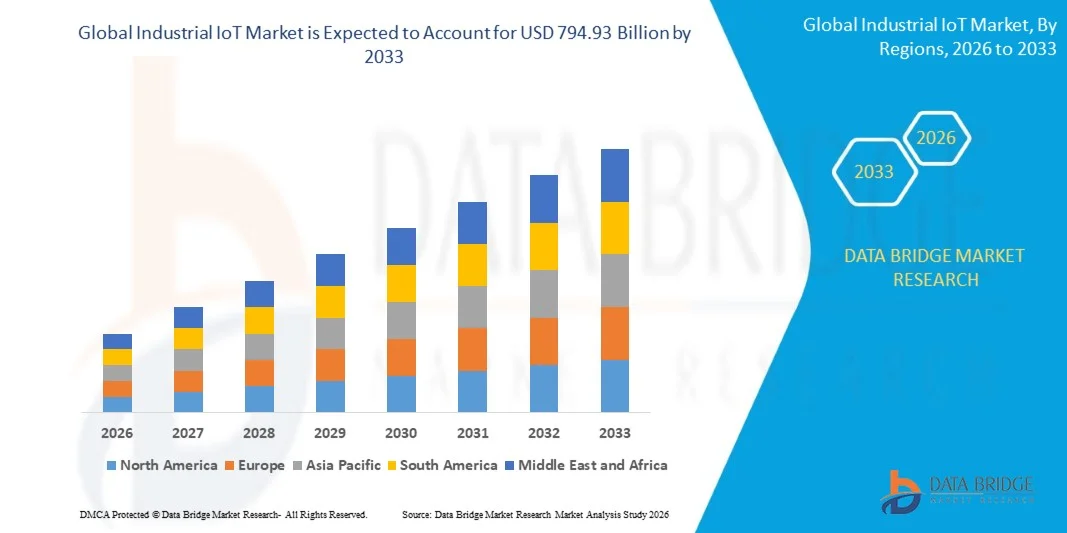
- As per Data Bridge Market Research analysis, the industrial IoT market was valued at USD 368.15 billion in 2025 and is projected to reach USD 794.93 billion by 2033, growing at a CAGR of 10.10% from 2026 to 2033.
- The market is experiencing strong growth driven by the increasing adoption of artificial intelligence (AI) and machine learning (ML) across end-user industries, the surge in implementation of sensors and distributed control systems in business operations, and accelerating global adoption of Industry 4.0 initiatives.
- Rising enterprise investment in predictive maintenance, digital twin technology, and edge computing infrastructure, combined with expanding 5G connectivity and growing demand for real-time operational visibility, is further accelerating market expansion across manufacturing, energy, and logistics sectors.
Market Size & Forecast
- Global Market Value (2025): USD 368.15 Billion
- Expected Market Value (2033): USD 794.93 Billion
- Forecast CAGR (2026–2033): 10.10%
- Leading Region in 2025: North America
- Fastest Growing Region: Asia-Pacific
What are the Major Takeaways of the Industrial IoT Market?
- North America dominated the global industrial IoT market with the largest revenue share of 36.40% in 2025, supported by early adoption of Industry 4.0 technologies, strong enterprise IT budgets, and the presence of leading IIoT technology providers.
- Asia-Pacific is expected to be the fastest-growing region at a CAGR of 13.50% from 2026 to 2033, fueled by rapid industrialization, expanding smart manufacturing initiatives, and rising government support for digital transformation across China and India.
- The hardware segment led the market with a 46.70% share in 2025, driven by sustained investment in sensors, gateways, and controllers required to physically connect industrial equipment to IoT networks.
- The services segment is the fastest-growing component, projected to register a CAGR of 13.20%, reflecting rising demand for systems integration and managed services in complex, multi-vendor deployments.
- The sensors segment dominated the technology category with a 32.50% revenue share in 2025, as this remains the most effective technology for extracting real-time operational data from industrial components.
- The manufacturing end-use industry accounted for 31.80% of the market share in 2025, driven by widespread adoption of smart factory initiatives, predictive maintenance, and digital twin technology.
- The edge computing data processing segment is the fastest-growing category, with a CAGR of 16.80%, driven by rising demand for sub-millisecond, deterministic-latency processing in real-time industrial control applications.
Report Scope and Industrial IoT Market Segmentation
|
Attributes |
Industrial IoT Key Market Insights |
|
Segments Covered |
|
|
Countries Covered |
North America
Europe
Asia-Pacific
Middle East and Africa
South America
|
|
Key Market Players |
|
|
Market Opportunities |
|
|
Value Added Data Infosets |
In addition to the insights on market scenarios such as market value, growth rate, segmentation, geographical coverage, and major players, the market reports curated by the Data Bridge Market Research also include in-depth expert analysis, geographically represented company-wise production and capacity, network layouts of distributors and partners, detailed and updated price trend analysis and deficit analysis of supply chain and demand. |
What is the Key Trend in the Industrial IoT Market?
- Enterprises are increasingly integrating AI and generative AI capabilities directly into industrial platforms to enable natural-language troubleshooting, predictive analytics, and autonomous anomaly detection across factory floors.
- For instance, in 2025, Microsoft expanded its strategic collaboration with Rockwell Automation to integrate Azure IoT Operations with Rockwell's FactoryTalk Optix platform, enabling manufacturers to use AI-guided instructions and natural language prompts for troubleshooting on the factory floor.
- Leading automation vendors are increasingly embedding AI co-pilot features directly into engineering and design tools to accelerate development and reduce dependence on specialized programming expertise.
- For instance, at SPS 2025, Rockwell Automation announced the integration of an AI co-pilot feature within its Design Studio engineering tool, leveraging NVIDIA technology to explain ladder code and assist with documentation locally on a PC's GPU.
- As enterprises continue to prioritize AI-driven automation and natural-language interfaces for industrial operations, vendors are expected to accelerate investment in generative AI-enabled IIoT platforms, reinforcing intelligent automation as a core market trend.
What are the Key Drivers of the Industrial IoT Market?
- The increase in adoption of artificial intelligence (AI) and machine learning (ML) across end-user industries, combined with the surge in implementation of sensors and distributed control systems in business operations, are major factors driving the industrial IoT market.
- For instance, in March 2025, Siemens revealed an expanded partnership with Microsoft regarding Siemens Xcelerator, its open digital business platform, to ease the integration of information technology (IT) and operational technology (OT) for corporate clients.
- Growing enterprise focus on reducing unplanned downtime and improving asset reliability is driving sustained investment in predictive maintenance and industrial monitoring technology.
- For instance, in December 2025, ABB entered into an agreement to acquire IPEC, a UK-based technology company specializing in early detection of electrical equipment failures, to strengthen its predictive maintenance service portfolio designed to cut downtime by up to 90% and maintenance costs by up to 85%.
- With industries increasingly relying on connected systems to optimize operations, enhance productivity, and enable predictive maintenance, sustained investment in industrial IoT infrastructure is expected to remain a key growth driver for the market.
Which Factors are Challenging the Growth of the Industrial IoT Market?
- The lack of standardization in IoT protocols across different vendors and platforms creates interoperability gaps that complicate large-scale, multi-vendor industrial IoT deployments.
- Industrial IoT systems remain susceptible to cyberattacks, as connecting previously isolated operational technology environments to broader networks expands the potential attack surface for critical infrastructure.
- Integrating IoT technology with legacy industrial infrastructure requires substantial capital investment and specialized expertise, creating a shortage of skilled operational technology (OT) and information technology (IT) professionals capable of managing these hybrid environments.
- The combination of interoperability gaps across industrial protocols, rising cybersecurity risks, and a shortage of skilled OT/IT professionals continues to constrain the pace of industrial IoT deployment despite strong underlying demand.
How is the Industrial IoT Market Segmented?
The industrial IoT market is segmented on the basis of component, technology, connectivity, deployment mode, end-use industry, application, organization size, platform layer, data processing, and distribution channel.
- By Component
On the basis of component, the global industrial IoT market is segmented into hardware, software, and services. The hardware segment dominated the market with a 46.70% share in 2025, driven by sustained investment in sensors, gateways, and controllers required to physically connect industrial equipment to IoT networks.
The services segment is projected to register the fastest growth at a CAGR of 13.20% from 2026 to 2033, driven by rising demand for systems integration, consulting, and managed services as enterprises navigate increasingly complex, multi-vendor IIoT deployments.
- By Technology
On the basis of technology, the global industrial IoT market is segmented into sensors, RFID, industrial robotics, machine vision systems, and others. The sensors segment dominated the market with a 32.50% share in 2025, as this technology remains the most effective option for extracting real-time operational data directly from industrial components and equipment.
The machine vision systems segment is expected to witness the fastest CAGR of 14.80% from 2026 to 2033, driven by rising adoption of AI-powered visual inspection for quality control and defect detection in smart manufacturing environments.
- By Connectivity
On the basis of connectivity, the global industrial IoT market is segmented into Wi-Fi, cellular (4G/5G), Bluetooth Low Energy (BLE), wired/Ethernet, and LPWAN. The Wi-Fi segment dominated the market with a 38.60% share in 2025, supported by its widespread availability, high bandwidth, and established integration across existing factory and facility networks.
The Bluetooth Low Energy (BLE) segment is anticipated to witness the fastest CAGR of 15.10% from 2026 to 2033, driven by its energy efficiency and growing suitability for battery-powered sensors deployed across large industrial and warehouse environments.
- By Deployment Mode
On the basis of deployment mode, the global industrial IoT market is segmented into on-premises, cloud-based, and hybrid. The on-premises segment dominated the market with a 52.00% share in 2025, reflecting continued enterprise preference for direct control over sensitive operational technology data and legacy infrastructure integration requirements.
The cloud-based segment is projected to witness the fastest CAGR of 16.40% from 2026 to 2033, driven by rising enterprise adoption of scalable, subscription-based IIoT platforms that reduce upfront infrastructure investment.
- By End-Use Industry
On the basis of end-use industry, the global industrial IoT market is segmented into manufacturing, energy & utilities, oil & gas, transportation & logistics, and healthcare. The manufacturing segment dominated the market with a 31.80% share in 2025, driven by widespread adoption of smart factory initiatives, predictive maintenance, and digital twin technology across global production facilities.
The transportation & logistics segment is expected to witness the fastest CAGR of 13.90% from 2026 to 2033, driven by rising demand for real-time fleet tracking, cold-chain monitoring, and supply chain visibility solutions.
- By Application
On the basis of application, the global industrial IoT market is segmented into predictive maintenance, asset tracking & management, supply chain management, smart manufacturing/digital twin, and remote monitoring. The predictive maintenance segment dominated the market with a 28.40% share in 2025, driven by growing enterprise focus on reducing unplanned downtime and maintenance costs through AI-based failure prediction.
The remote monitoring segment is anticipated to witness the fastest CAGR of 14.20% from 2026 to 2033, driven by rising demand for real-time visibility into geographically dispersed industrial assets and infrastructure.
- By Organization Size
On the basis of organization size, the global industrial IoT market is segmented into large enterprises and small & medium enterprises (SMEs). The large enterprises segment dominated the market with a 68.00% share in 2025, supported by greater capital availability for large-scale IIoT infrastructure investment and digital transformation initiatives.
The small & medium enterprises (SMEs) segment is expected to witness the fastest CAGR of 13.60% from 2026 to 2033, driven by falling hardware costs and growing availability of affordable, subscription-based IIoT platforms tailored to smaller operations.
- By Platform Layer
On the basis of platform layer, the global industrial IoT market is segmented into device management, connectivity management, application enablement, and analytics & data management. The analytics & data management segment dominated the market with a 33.20% share in 2025, reflecting the central role of data processing and insight generation in delivering measurable value from connected industrial systems.
The application enablement segment is projected to witness the fastest CAGR of 14.50% from 2026 to 2033, driven by rising demand for low-code and no-code development tools that accelerate custom IIoT application deployment.
- By Data Processing
On the basis of data processing, the global industrial IoT market is segmented into edge computing and cloud computing. The cloud computing segment dominated the market with a 57.00% share in 2025, supported by its scalability, centralized data management capabilities, and integration with major enterprise analytics and AI platforms.
The edge computing segment is anticipated to witness the fastest CAGR of 16.80% from 2026 to 2033, driven by rising demand for sub-millisecond, deterministic-latency processing for real-time industrial control and safety-critical applications.
- By Distribution Channel
On the basis of distribution channel, the global industrial IoT market is segmented into direct sales, system integrators & value-added resellers, and online/cloud marketplace. The system integrators & value-added resellers segment dominated the market with a 46.50% share in 2025, reflecting the complex, multi-vendor nature of most enterprise IIoT deployments, which typically require specialized implementation expertise.
The online/cloud marketplace segment is expected to witness the fastest CAGR of 15.90% from 2026 to 2033, driven by growing enterprise procurement of IIoT software and platform capacity directly through major cloud provider marketplaces.
Which Region Holds the Largest Share of the Industrial IoT Market?
- North America dominated the industrial IoT market and accounted for the largest revenue share of 36.40% in 2025, supported by early adoption of Industry 4.0 technologies, strong enterprise IT budgets, and the presence of leading IIoT platform and technology providers.
- The region also benefits from robust investment in automation technologies, mature cloud and edge computing infrastructure, and continued expansion of AI-driven predictive maintenance and digital twin platforms, which continues to reinforce North America's leadership position in the global market.
U.S. Industrial IoT Market Insight
The U.S. industrial IoT market is experiencing strong growth, supported by robust enterprise investment in automation technologies and continued modernization of outdated industrial control systems. Leading technology providers continue to introduce AI-enhanced predictive maintenance, digital twin, and edge computing platforms tailored to manufacturing, energy, and logistics operations. Growing integration of generative AI into industrial platforms is further contributing to market growth in the U.S.
Germany Industrial IoT Market Insight
The Germany industrial IoT market is expanding steadily, anchored by an advanced industrial base, strong Industry 4.0 adoption, and robust government investment in manufacturing digitalization. Leading domestic automation vendors continue to introduce connected industrial platforms, edge computing solutions, and data-driven automation technologies tailored to the country's strong manufacturing sector.
Asia-Pacific Industrial IoT Market Insight
The Asia-Pacific industrial IoT market is expected to witness the fastest growth globally, driven by rapid industrialization, expanding smart manufacturing initiatives, and rising government support for digital transformation across China, India, and Japan. Growing domestic manufacturing capacity, combined with expanding 5G-enabled industrial IoT networks, continues to support strong regional market expansion.
Japan Industrial IoT Market Insight
The Japan industrial IoT market is witnessing consistent growth, supported by the country's advanced manufacturing base and strong focus on robotics and automation. Domestic and international vendors continue to introduce advanced sensor, connectivity, and analytics solutions tailored to Japan's precision manufacturing and industrial automation requirements.
China Industrial IoT Market Insight
The China industrial IoT market is growing rapidly, driven by large-scale government investment in smart manufacturing and industrial digitalization initiatives. Growing domestic technology manufacturing capacity, combined with rapid 5G network expansion, is improving the affordability and availability of industrial IoT infrastructure, supporting strong market growth across China.
Which are the Top Companies in Industrial IoT Market?
The industrial IoT industry is primarily led by well-established companies, including:
- Siemens AG (Germany)
- General Electric Company (U.S.)
- IBM Corporation (U.S.)
- Cisco Systems, Inc. (U.S.)
- Microsoft Corporation (U.S.)
- Robert Bosch GmbH (Germany)
- Schneider Electric SE (France)
- Rockwell Automation, Inc. (U.S.)
- Honeywell International Inc. (U.S.)
- ABB Ltd. (Switzerland)
- Huawei Technologies Co., Ltd. (China)
- Intel Corporation (U.S.)
- SAP SE (Germany)
- Hitachi, Ltd. (Japan)
- PTC Inc. (U.S.)
What are Latest Developments in Industrial IoT Market?
- In December 2025, ABB entered into an agreement to acquire IPEC, a UK-based technology company with more than 30 years of expertise in electrical diagnostics, strengthening its predictive maintenance service portfolio designed to cut downtime by up to 90% and maintenance costs by up to 85%.
- In December 2025, at the SPS 2025 trade show, Rockwell Automation announced the integration of an AI co-pilot feature within its Design Studio engineering tool, leveraging NVIDIA technology to explain ladder code and assist with documentation locally on a PC's GPU, alongside its FactoryTalk Analytics LogixAI predictive analytics tool.
- In 2025, Microsoft expanded its strategic collaboration with Rockwell Automation to integrate Azure IoT Operations with Rockwell's FactoryTalk Optix platform, enabling manufacturers to use AI-guided instructions and natural language prompts for troubleshooting on the factory floor.
- In March 2025, Siemens revealed an expanded partnership with Microsoft regarding Siemens Xcelerator, the open digital business platform by Siemens, to ease the integration of IT and OT for corporate clients.
- ABB continued to expand its Genix Industrial Analytics and AI Suite, its flagship industrial platform integrating OT, IT, and engineering technology, through a strategic partnership with Microsoft using Azure cloud infrastructure and OpenAI services alongside ABB's own industrial domain expertise.

- Interactive Data Analysis Dashboard
- Company Analysis Dashboard for high growth potential opportunities
- Research Analyst Access for customization & queries
- Competitor Analysis with Interactive dashboard
- Latest News, Updates & Trend analysis
- Harness the Power of Benchmark Analysis for Comprehensive Competitor Tracking
Global Industrial Iot Market, Supply Chain Analysis and Ecosystem Framework
To support market growth and help clients navigate the impact of geopolitical shifts, DBMR has integrated in-depth supply chain analysis into its Global Industrial Iot Market research reports. This addition empowers clients to respond effectively to global changes affecting their industries. The supply chain analysis section includes detailed insights such as Global Industrial Iot Market consumption and production by country, price trend analysis, the impact of tariffs and geopolitical developments, and import and export trends by country and HSN code. It also highlights major suppliers with data on production capacity and company profiles, as well as key importers and exporters. In addition to research, DBMR offers specialized supply chain consulting services backed by over a decade of experience, providing solutions like supplier discovery, supplier risk assessment, price trend analysis, impact evaluation of inflation and trade route changes, and comprehensive market trend analysis.
Data collection and base year analysis are done using data collection modules with large sample sizes. The stage includes obtaining market information or related data through various sources and strategies. It includes examining and planning all the data acquired from the past in advance. It likewise envelops the examination of information inconsistencies seen across different information sources. The market data is analysed and estimated using market statistical and coherent models. Also, market share analysis and key trend analysis are the major success factors in the market report. To know more, please request an analyst call or drop down your inquiry.
The key research methodology used by DBMR research team is data triangulation which involves data mining, analysis of the impact of data variables on the market and primary (industry expert) validation. Data models include Vendor Positioning Grid, Market Time Line Analysis, Market Overview and Guide, Company Positioning Grid, Patent Analysis, Pricing Analysis, Company Market Share Analysis, Standards of Measurement, Global versus Regional and Vendor Share Analysis. To know more about the research methodology, drop in an inquiry to speak to our industry experts.
Data Bridge Market Research is a leader in advanced formative research. We take pride in servicing our existing and new customers with data and analysis that match and suits their goal. The report can be customized to include price trend analysis of target brands understanding the market for additional countries (ask for the list of countries), clinical trial results data, literature review, refurbished market and product base analysis. Market analysis of target competitors can be analyzed from technology-based analysis to market portfolio strategies. We can add as many competitors that you require data about in the format and data style you are looking for. Our team of analysts can also provide you data in crude raw excel files pivot tables (Fact book) or can assist you in creating presentations from the data sets available in the report.













