


What is the Industrial Paper Sacks Market Size and Growth Rate?
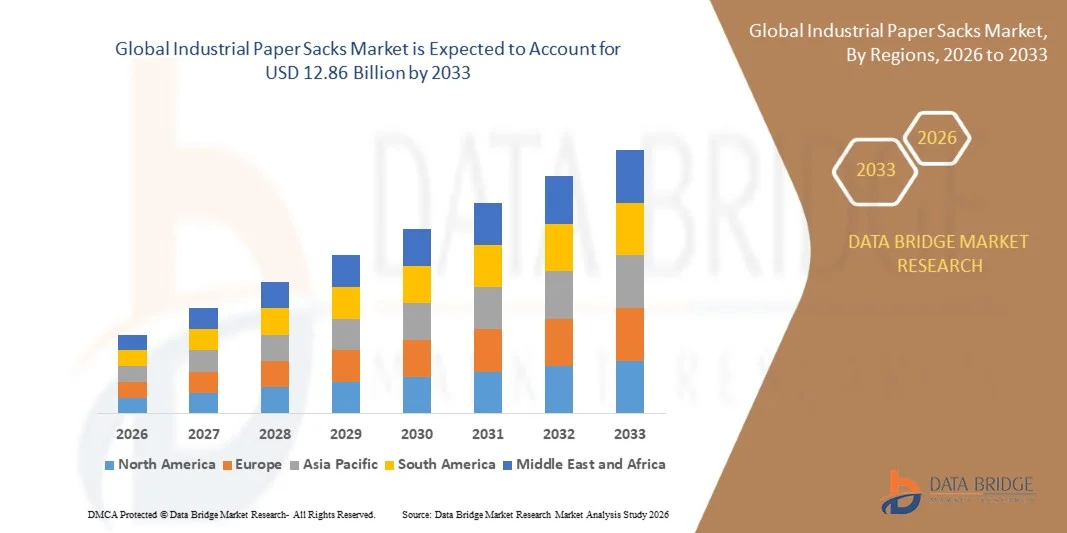
- As per Data Bridge Market Research analysis, the industrial paper sacks market was valued at USD 8.45 billion in 2025 and is projected to reach USD 12.86 billion by 2033, growing at a CAGR of 5.40% from 2026 to 2033.
- The market is experiencing steady growth driven by rising demand for sustainable and recyclable packaging solutions, expanding cement and building materials production, and growing regulatory pressure to phase out single-use plastic packaging.
- The increasing global emphasis on circular-economy packaging, combined with stricter environmental regulations across Europe and North America, is compelling cement manufacturers, fertilizer producers, and food processors to shift from polypropylene woven sacks to multi-wall kraft paper sacks. Valve sacks and extensible kraft paper formats are increasingly replacing conventional plastic bags in many markets, offering biodegradable, cost-effective, and high-strength packaging for bulk powders and granular materials.
Market Size & Forecast
- Global Market Value (2025): USD 8.45 Billion
- Expected Market Value (2033): USD 12.86 Billion
- Forecast CAGR (2026–2033): 5.40%
- Leading Region in 2025: Europe
- Fastest Growing Region: Asia-Pacific
What are the Major Takeaways of the Industrial Paper Sacks Market?
- Europe dominated the global industrial paper sacks market with the largest revenue share of 31.62% in 2025, supported by strong recycling infrastructure and stringent packaging-waste regulations.
- Asia-Pacific is expected to be the fastest-growing region at a CAGR of 6.9% from 2026 to 2033, fueled by rising cement production, expanding agrochemical manufacturing, and growing packaging investments in China, India, and Indonesia.
- The 3-ply sacks segment led the market with a 38.24% share in 2025, driven by its balance of strength, cost-efficiency, and suitability for cement and chemical packaging.
- The building & construction segment dominated the end-use category with a 42.38% revenue share in 2025, led by cement, plaster, and mortar manufacturers adopting paper sacks for bulk-material packaging.
- Valve sacks accounted for 46.15% of the market share in 2025, preferred for automated high-speed filling lines used by cement and fertilizer producers.
- Extensible sack kraft paper is the fastest-growing segment in the industrial paper sacks market, projected to register a CAGR of 7.6% during the forecast period. Growth is driven by increasing demand for high-strength, lightweight, and sustainable packaging across the cement, chemicals, food, and agricultural industries.
Report Scope and Industrial Paper Sacks Market Segmentation
|
Attributes |
Industrial Paper Sacks Key Market Insights |
|
Segments Covered |
|
|
Countries Covered |
North America
Europe
Asia-Pacific
Middle East and Africa
South America
|
|
Key Market Players |
|
|
Market Opportunities |
|
|
Value Added Data Infosets |
In addition to the insights on market scenarios such as market value, growth rate, segmentation, geographical coverage, and major players, the market reports curated by the Data Bridge Market Research also include import export analysis, production capacity overview, production consumption analysis, price trend analysis, climate change scenario, supply chain analysis, value chain analysis, raw material/consumables overview, vendor selection criteria, PESTLE Analysis, Porter Analysis, and regulatory framework. |
What is the Key Trend in the Industrial Paper Sacks Market?
- Cement manufacturers are increasingly adopting high-strength multi-wall paper sacks to improve product protection, enhance shelf visibility, and reduce packaging-related carbon emissions while supporting circular economy initiatives.
- For instance, in April 2025, Mondi partnered with Evonik to launch a recyclable two-ply paper bag for chemical powders, eliminating a plastic-coated paper layer and reducing packaging weight by nearly 30% while lowering the product's carbon footprint.
- Advanced flexographic and digital printing technologies are enabling high-resolution branding on kraft paper without compromising recyclability, helping manufacturers strengthen product differentiation while maintaining sustainable packaging formats.
- Fertilizer manufacturers are increasingly adopting moisture-resistant coated kraft papers to protect hygroscopic materials during storage and transportation while eliminating conventional plastic film laminates.
- For instance, Billerud's Performance Barrier sack paper provides moisture resistance through a coated paper structure rather than plastic film, making sacks easier to recycle through conventional paper recycling streams while maintaining product protection.
- Growing regulatory pressure to reduce plastic waste, combined with rising investments in recyclable fiber-based industrial packaging, is expected to accelerate adoption of paper sacks across construction chemicals, cement, minerals, and agricultural products. According to the European paper recycling industry, paper packaging already achieves significantly higher recycling rates than plastic packaging in many developed markets, reinforcing the shift toward fiber-based industrial packaging.
What are the Key Drivers of the Industrial Paper Sacks Market?
- The expansion of global cement production and infrastructure investments continues to increase demand for durable multi-wall paper sacks capable of high-speed filling, automated handling, and long-distance transportation.
- Cement, fertilizer, and food manufacturers are increasingly replacing woven polypropylene sacks with recyclable kraft paper alternatives to comply with Extended Producer Responsibility (EPR) regulations and corporate sustainability commitments.
- For instance, in October 2024, Sonoco Products Company introduced a fully recyclable paper can with 95% paper content for Nestlé coffee products. The innovation replaces the conventional metal bottom with a fibre-based alternative, demonstrating the industry's continued investment in fiber-based, recyclable packaging solutions that support circular economy goals.
- Government regulations aimed at reducing plastic waste, combined with growing investments in sustainable paper packaging technologies, are expected to sustain long-term demand for industrial paper sacks across construction materials, chemicals, agriculture, and food ingredients.
Which Factors are Challenging the Growth of the Industrial Paper Sacks Market?
- Manufacturing high-performance industrial paper sacks requires substantial investment in multi-ply converting, barrier coating, and precision printing technologies to meet demanding strength, puncture resistance, and moisture protection requirements.
- These capital-intensive production processes increase manufacturing costs, limiting adoption among small and medium-sized packaging converters, particularly in developing economies where price competitiveness remains critical.
- For instance, in April 2025, Billerud, in its Interim Report (January–March 2025), reported that input costs increased primarily due to higher wood costs in the Nordic region and higher energy costs in North America, while average selling prices for sack and kraft paper declined compared with the previous quarter. This highlights the cost pressures facing manufacturers of industrial paper sacks.
- Continued volatility in kraft pulp prices, energy costs, and transportation expenses is expected to pressure converter margins, slowing the transition from plastic to paper packaging in price-sensitive markets despite increasing regulatory support for sustainable packaging solutions..
How is the Industrial Paper Sacks Market Segmented?
The industrial paper sacks market is segmented on the basis of layer type, paper grade, closure type, capacity, end-use industry, and distribution channel.
- By Layer Type
Based on layer type, the global industrial paper sacks market is segmented into 2-ply, 3-ply, 4-ply, and 5-ply & above sacks. The 3-ply sacks segment accounted for the largest market share of 38.24% in 2025, as it offers an ideal combination of mechanical strength, cost-effectiveness, and material efficiency. These sacks are widely used for packaging cement, dry mortar, chemicals, and animal feed, where reliable load-bearing performance is required without significantly increasing packaging costs. Their compatibility with high-speed filling lines and automated palletizing systems has further strengthened their adoption among large industrial manufacturers.
The 5-ply & above sacks segment is projected to register the fastest CAGR of 6.8% from 2026 to 2033. Growth is primarily driven by increasing demand for heavy-duty packaging in fertilizer, industrial minerals, specialty chemicals, and export-oriented applications. These sacks provide superior puncture resistance, burst strength, and moisture protection, making them suitable for handling products under challenging transportation and storage conditions. The growing adoption of bulk handling systems and stricter product protection requirements are expected to further support demand for higher-ply industrial paper sacks.
- By Paper Grade
Based on paper grade, the market is segmented into kraft paper, extensible sack kraft paper, semi-extensible kraft paper, and recycled kraft paper. The kraft paper segment dominated the market with a 44.10% share in 2025, supported by its excellent tensile strength, durability, and consistent performance during high-speed filling and transportation. Virgin kraft paper remains the preferred material for cement, food ingredients, chemicals, and agricultural products because it offers high burst strength while maintaining relatively low packaging weight. Its widespread availability and established manufacturing infrastructure also contribute to its leading market position.
The recycled kraft paper segment is expected to register the fastest CAGR of 7.1% from 2026 to 2033. Increasing environmental regulations, corporate sustainability initiatives, and growing investments in circular packaging solutions are encouraging manufacturers to incorporate recycled fiber into industrial sack production. Advancements in fiber recovery and paper processing technologies are also improving the strength and printability of recycled kraft paper, making it increasingly suitable for a wider range of industrial packaging applications.
- By Closure Type
Based on closure type, the market is segmented into valve sacks, open-mouth sacks, pasted sacks, and sewn sacks. The valve sacks segment held the largest market share of 46.15% in 2025 due to their widespread use in automated packaging operations for cement, lime, gypsum, and chemical products. Valve sacks enable high-speed filling while minimizing dust emissions and product loss, making them highly suitable for modern production facilities. Their ability to improve operational efficiency, reduce labor requirements, and support clean filling processes has made them the preferred packaging format for large industrial manufacturers.
The open-mouth sacks segment is expected to grow at the fastest CAGR of 6.5% from 2026 to 2033. These sacks remain popular for packaging food grains, flour, sugar, animal feed, seeds, and specialty chemicals because they offer greater flexibility during manual and semi-automated filling operations. Rising investments in agricultural processing, particularly across emerging economies, along with the expansion of regional food manufacturing industries, are expected to accelerate demand for open-mouth industrial paper sacks.
- By Capacity
On the basis of capacity, the market is segmented into up to 25 Kg, 25–50 Kg, and above 50 Kg. The 25– Based on capacity, the market is segmented into up to 25 Kg, 25–50 Kg, and above 50 Kg. The 25–50 Kg segment dominated the market with a 51.30% share in 2025, as it represents the industry standard for packaging cement, fertilizers, construction materials, and industrial chemicals. This weight range provides an effective balance between logistics efficiency, worker handling requirements, and transportation regulations. Standardization across manufacturing plants, warehouses, and distribution networks has further reinforced the widespread adoption of 25–50 Kg paper sacks globally.
The above 50 Kg segment is projected to expand at the fastest CAGR of 6.3% from 2026 to 2033. Growth is being driven by increasing demand for bulk packaging of industrial minerals, specialty chemicals, and agricultural products, particularly in regions with mechanized material handling systems. The expansion of mining, infrastructure development, and industrial manufacturing activities is also contributing to higher demand for large-capacity industrial paper sacks.
- By End-Use Industry
Based on end-use industry, the market is segmented into building & construction, chemicals & fertilizers, food & agriculture, pharmaceuticals & personal care, and others. The building & construction segment accounted for the largest market share of 42.38% in 2025, owing to the extensive use of paper sacks for packaging cement, dry mortar, gypsum, tile adhesives, and plaster products. Rising investments in residential, commercial, and infrastructure construction projects, particularly across Asia-Pacific and the Middle East, continue to support demand for industrial paper sacks. In addition, increasing sustainability initiatives within the construction sector are encouraging manufacturers to replace plastic packaging with recyclable paper-based alternatives.
The chemicals & fertilizers segment is expected to witness the fastest CAGR of 6.7% from 2026 to 2033. Growing global fertilizer consumption, increasing production of specialty chemicals, and expanding agricultural activities are creating strong demand for moisture-resistant, high-strength paper sacks. The shift toward sustainable packaging solutions, combined with stricter environmental regulations on plastic packaging, is expected to further accelerate adoption across chemical and agrochemical supply chains.
- By Distribution Channel
Based on distribution channel, the market is segmented into direct sales, distributors & wholesalers, and online/e-commerce. The distributors & wholesalers segment held the largest market share of 49.85% in 2025, supported by well-established regional distribution networks that provide faster product availability, technical assistance, and localized inventory management. Industrial packaging customers often rely on distributors for flexible order quantities, shorter delivery lead times, and after-sales support, particularly in developing markets where manufacturers may not have a direct sales presence.
The online/e-commerce segment is expected to register the fastest CAGR of 7.4% from 2026 to 2033. Rapid digitalization of industrial procurement, the growing adoption of B2B e-commerce platforms, and increasing preference for digital purchasing systems are transforming the way industrial packaging materials are sourced. Features such as real-time inventory visibility, transparent pricing, simplified reordering, and broader supplier access are making online procurement increasingly attractive for small and medium-sized manufacturers. As digital supply chain platforms continue to expand globally, online sales are expected to play a larger role in the industrial paper sacks market.
Which Region Holds the Largest Share of the Industrial Paper Sacks Market?
- Europe dominated the industrial paper sacks market and accounted for the largest revenue share of 31.62% in 2025, supported by stringent packaging-waste regulations, well-established recycling infrastructure, and the presence of leading kraft paper and sack manufacturers.
- The region also benefits from strong cement and construction industries, high adoption of recyclable and mono-material packaging formats, and growing use of paper sacks across chemicals, fertilizers, and food applications. Increasing focus on circular-economy packaging targets continues to strengthen Europe's leadership position in the global market.
Germany Industrial Paper Sacks Market Insight
The Germany industrial paper sacks market is expanding steadily due to the country's strong cement and chemical manufacturing base, advanced recycling infrastructure, and increasing adoption of mono-material recyclable sack formats. Cement producers, agrochemical companies, and food processors are increasingly utilizing paper sacks to meet packaging-waste directives. Continuous advancements in barrier coating and flexographic printing technologies, along with strong government focus on circular packaging, are further driving market growth in Germany.
U.K. Industrial Paper Sacks Market Insight
The U.K. industrial paper sacks market is experiencing steady growth, supported by rising adoption of sustainable packaging in construction and agricultural sectors. Increasing investments in recycled kraft paper production and growing demand for cost-effective, plastic-alternative packaging solutions are contributing to market growth. Furthermore, integration of enhanced barrier coatings and digital printing technologies is improving sack performance and brand differentiation, positioning the U.K. as a key innovation hub in the paper sacks industry.
Asia-Pacific Industrial Paper Sacks Market Insight
The Asia-Pacific industrial paper sacks market is expected to witness rapid growth, driven by expanding cement production, rising fertilizer consumption, and increasing investments in packaging infrastructure across countries such as China, India, and Indonesia. Growing awareness regarding sustainable packaging, rising adoption of recyclable kraft paper sacks, and increasing demand for cost-effective bulk packaging solutions are supporting regional market expansion. Additionally, the growing presence of domestic paper sack manufacturers is accelerating adoption across construction and agricultural sectors.
India Industrial Paper Sacks Market Insight
The India industrial paper sacks market is witnessing consistent growth due to rising cement production capacity, expanding fertilizer manufacturing, and increasing government emphasis on reducing single-use plastic packaging. Cement manufacturers, fertilizer producers, and food processors are increasingly adopting multi-wall kraft paper sacks for bulk-material packaging. Moreover, increasing investment in domestic pulp and paper capacity is further contributing to market growth.
China Industrial Paper Sacks Market Insight
The China industrial paper sacks market is growing rapidly, driven by expanding construction activity, rising chemical and fertilizer production, and increasing government focus on plastic-reduction policies. Growing adoption of recyclable and barrier-coated paper sacks across cement, chemical, and food sectors is significantly boosting market demand. In addition, rising investments in domestic kraft paper production and rapid technological advancements are positioning China as one of the fastest-growing markets for industrial paper sacks globally.
Which are the Top Companies in Industrial Paper Sacks Market?
The industrial paper sacks industry is primarily led by well-established companies, including:
- Mondi Group (Austria)
- Smurfit WestRock (Ireland)
- Segezha Group (Russia)
- BillerudKorsnäs AB (Sweden)
- Sonoco Products Company (U.S.)
- Coveris Holdings S.A. (Luxembourg)
- Rondo Ganahl AG (Austria)
- Grupo Nervion (Spain)
- LC Packaging International B.V. (Netherlands)
- Gascogne Sacs (France)
- Sharp Packaging Systems (U.S.)
- Palm Packaging Solutions Pvt. Ltd. (India)
- Emin Leydier (France)
- Rajapack Ltd. (U.K.)
- Rex Paper Sacks Pvt. Ltd. (India)
- Yanhua Packaging Co., Ltd. (China)
- Zhejiang Guanhua Packaging Co., Ltd. (China)
- Al Rajhi Packaging Co. (Saudi Arabia)
- GWP Group (U.K.)
- DS Smith Packaging (U.K.)
- Halim Group (Indonesia)
What are Latest Developments in Industrial Paper Sacks Market?
- In September 2025, Mondi Group unveiled a new mono-material valve sack range designed for full recyclability without compromising strength, setting a new benchmark for sustainable cement and building-material packaging across Central Europe. The upgraded format delivers enhanced moisture resistance, compact design, and sustained load-bearing performance, reflecting modernized production processes. This new product strengthens Mondi's market leadership in sustainable sack technology by boosting recyclability, efficiency, and customer adoption.
- In January 2025, Smurfit WestRock acquired a regional kraft paper converter in Latin America, strengthening its manufacturing and distribution capabilities in multi-wall sack production. The deal integrates the converter's regional distribution network with Smurfit WestRock's paper and packaging platforms, broadening product offerings for cement, chemical, and agricultural customers. This strategic acquisition accelerates the company's expansion in high-growth Latin American markets while reinforcing its position as a leading global packaging provider.
- In November 2025, BillerudKorsnäs launched an upgraded barrier-coated kraft paper sack line offering improved moisture and grease resistance for food and animal feed applications. The new release enhances protective performance while maintaining full recyclability, allowing food processors to replace plastic-laminated packaging with paper-based alternatives. This development strengthens BillerudKorsnäs's position in the industrial paper sacks market by enabling customers to meet sustainability targets without compromising product protection.
- In June 2024, EUROSAC and CEPI Eurokraft joined a European alliance led by construction and packaging companies to improve the circularity of kraft paper sacks used in the construction industry. The initiative focuses on increasing paper sack recycling, promoting efficient industrial waste management, reducing raw material consumption, and supporting circular economy practices across the paper sack value chain.

- Interactive Data Analysis Dashboard
- Company Analysis Dashboard for high growth potential opportunities
- Research Analyst Access for customization & queries
- Competitor Analysis with Interactive dashboard
- Latest News, Updates & Trend analysis
- Harness the Power of Benchmark Analysis for Comprehensive Competitor Tracking
Global Industrial Paper Sacks Market, Supply Chain Analysis and Ecosystem Framework
To support market growth and help clients navigate the impact of geopolitical shifts, DBMR has integrated in-depth supply chain analysis into its Global Industrial Paper Sacks Market research reports. This addition empowers clients to respond effectively to global changes affecting their industries. The supply chain analysis section includes detailed insights such as Global Industrial Paper Sacks Market consumption and production by country, price trend analysis, the impact of tariffs and geopolitical developments, and import and export trends by country and HSN code. It also highlights major suppliers with data on production capacity and company profiles, as well as key importers and exporters. In addition to research, DBMR offers specialized supply chain consulting services backed by over a decade of experience, providing solutions like supplier discovery, supplier risk assessment, price trend analysis, impact evaluation of inflation and trade route changes, and comprehensive market trend analysis.
Data collection and base year analysis are done using data collection modules with large sample sizes. The stage includes obtaining market information or related data through various sources and strategies. It includes examining and planning all the data acquired from the past in advance. It likewise envelops the examination of information inconsistencies seen across different information sources. The market data is analysed and estimated using market statistical and coherent models. Also, market share analysis and key trend analysis are the major success factors in the market report. To know more, please request an analyst call or drop down your inquiry.
The key research methodology used by DBMR research team is data triangulation which involves data mining, analysis of the impact of data variables on the market and primary (industry expert) validation. Data models include Vendor Positioning Grid, Market Time Line Analysis, Market Overview and Guide, Company Positioning Grid, Patent Analysis, Pricing Analysis, Company Market Share Analysis, Standards of Measurement, Global versus Regional and Vendor Share Analysis. To know more about the research methodology, drop in an inquiry to speak to our industry experts.
Data Bridge Market Research is a leader in advanced formative research. We take pride in servicing our existing and new customers with data and analysis that match and suits their goal. The report can be customized to include price trend analysis of target brands understanding the market for additional countries (ask for the list of countries), clinical trial results data, literature review, refurbished market and product base analysis. Market analysis of target competitors can be analyzed from technology-based analysis to market portfolio strategies. We can add as many competitors that you require data about in the format and data style you are looking for. Our team of analysts can also provide you data in crude raw excel files pivot tables (Fact book) or can assist you in creating presentations from the data sets available in the report.













