


What is the Industrial Protective Footwear Market Size and Growth Rate?
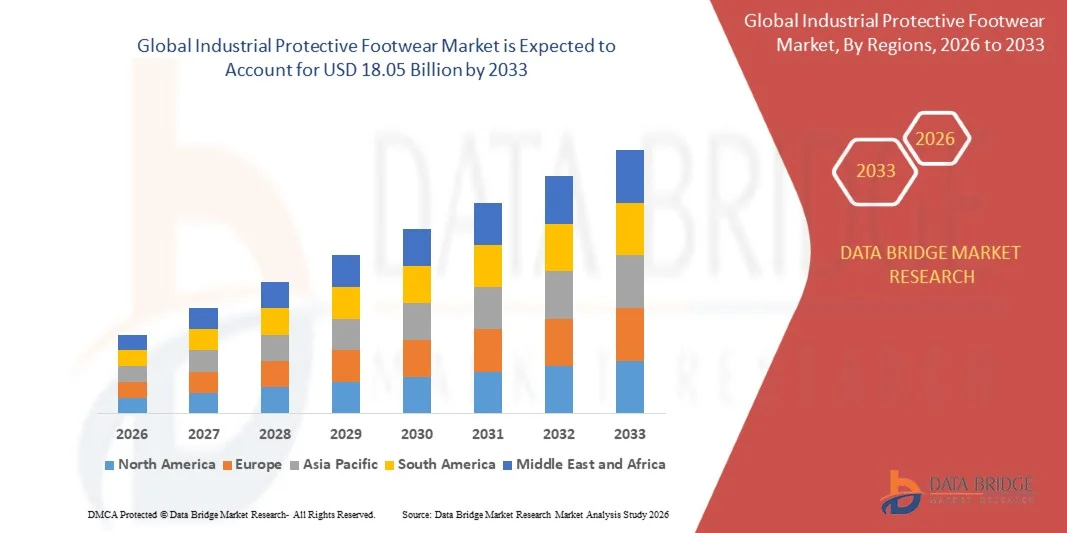
- As per Data Bridge Market Research analysis, the industrial protective footwear market was valued at USD 11.20 billion in 2025 and is projected to reach USD 18.05 billion by 2033, growing at a CAGR of 6.11% from 2026 to 2033.
- The market is experiencing consistent growth driven by the increasing demand for protective footwear that provides enhanced safety, durability, comfort, and protection across construction, manufacturing, mining, oil and gas, chemicals, transportation, logistics, and other industrial environments. Advancements in safety footwear materials, composite toe protection, slip-resistant soles, waterproof technologies, lightweight polymers, breathable fabrics, and ergonomic designs are improving the ability of industrial protective footwear to provide reliable protection while supporting worker comfort and mobility.
- The growing need to reduce workplace injuries, comply with occupational safety regulations, improve worker protection, and enhance comfort during prolonged working hours is compelling organizations to adopt industrial protective footwear solutions. Protective footwear is increasingly being integrated across construction, manufacturing, mining, oil and gas, chemicals, food and beverages, pharmaceuticals, transportation and logistics, and utilities, where features such as steel or composite toe caps, puncture resistance, electrical hazard protection, chemical resistance, and slip resistance provide advantages over conventional footwear.
Market Size & Forecast
- Global Market Value (2025): USD 11.20 Billion
- Expected Market Value (2033): USD 18.05 Billion
- Forecast CAGR (2026–2033): 6.11%
- Leading Region in 2025: Europe
- Fastest Growing Region: Asia Pacific
What are the Major Takeaways of the Industrial Protective Footwear Market?
- Europe dominated the global industrial protective footwear market with the largest revenue share of 31.9% in 2025, supported by stringent occupational safety regulations, established manufacturing and construction industries, and strong awareness regarding workplace injury prevention.
- Asia-pacific is expected to be the fastest-growing regional market, registering a CAGR of 7.5% from 2026 to 2033, driven by rapid industrialization, infrastructure development, expanding construction and manufacturing activities, increasing workplace safety requirements, and rising adoption of protective footwear in high-risk industries.
- Leather footwear dominated the type category of the global industrial protective footwear market 35.2% in 2025, supported by its durability, abrasion resistance, comfort, and suitability for demanding industrial environments. Leather remains widely adopted across construction, manufacturing, mining, and other high-risk applications.
- Safety boots dominated the product category for 66.92% of the market in 2025, supported by their ability to provide extended ankle coverage, impact resistance, puncture protection, slip resistance, and protection against harsh working conditions.
- Manufacturing represented the largest end-user segment with a 27.8% market share in 2025, supported by extensive use of protective footwear across production facilities, machinery operations, material handling, and industrial processing environments.
Report Scope and Industrial Protective Footwear Market Segmentation
|
Attributes |
Industrial Protective Footwear Key Market Insights |
|
Segments Covered |
|
|
Countries Covered |
North America
Europe
Asia-Pacific
Middle East and Africa
South America
|
|
Key Market Players |
|
|
Market Opportunities |
|
|
Value Added Data Infosets |
In addition to the insights on market scenarios such as market value, growth rate, segmentation, geographical coverage, and major players, the market reports curated by the Data Bridge Market Research also include import export analysis, production capacity overview, production consumption analysis, price trend analysis, climate change scenario, supply chain analysis, value chain analysis, raw material/consumables overview, vendor selection criteria, PESTLE Analysis, Porter Analysis, and regulatory framework. |
What is the Key Trend in the Industrial Protective Footwear Market?
- The development of lightweight, ergonomic, and high-performance protective footwear is becoming a key trend in the industrial protective footwear market, as manufacturers increasingly focus on reducing footwear weight while maintaining impact, compression, puncture, slip, and electrical protection. The use of composite materials, lightweight soles, breathable uppers, and ergonomic designs is supporting greater mobility and comfort for workers who wear protective footwear for extended periods.
- For instance, in September 2024, osha updated its construction personal protective equipment requirements to explicitly require PPE to properly fit affected employees. The requirement reinforces the importance of appropriate fit and ergonomics in protective equipment selection, including protective footwear.
- The growing integration of specialized protection features, including slip resistance, puncture resistance, metatarsal protection, electrical protection, and chemical resistance, is gaining momentum as industries require footwear tailored to specific workplace hazards. This trend is particularly relevant in construction, manufacturing, logistics, chemicals, utilities, and other hazardous working environments.
- For instance, in 2024, the occupational safety and health administration (osha) continued to specify protective footwear requirements for workplaces where employees face hazards from falling or rolling objects, objects piercing the sole, and electrical hazards. Osha guidance also identifies applications requiring impact, compression, puncture, electrical, chemical, and slip-resistant footwear.
- The increasing focus on slip-resistant and water-resistant protective footwear is also influencing product development, particularly in applications where workers operate around liquids, chemicals, wet surfaces, or other conditions that increase slip risks. Manufacturers are incorporating specialized outsole designs and water-resistant constructions to improve worker protection in challenging environments.
What are the Key Drivers of the Industrial Protective Footwear Market?
- The increasing emphasis on occupational safety and prevention of workplace foot injuries is driving demand for industrial protective footwear across hazardous working environments. Employers are required to provide appropriate foot protection when workers are exposed to hazards such as falling or rolling objects, puncture hazards, and electrical risks.
- For instance, in December 2024, the U.S. Occupational safety and health administration (osha) published its construction PPE requirements in the federal register, reinforcing requirements for protective equipment and safety-toe footwear in construction environments. The requirements emphasize appropriate PPE selection and protection against workplace hazards.
- The expansion of construction, manufacturing, logistics, warehousing, mining, and other industrial activities is supporting demand for protective footwear because workers in these environments can be exposed to impact, compression, puncture, chemical, electrical, and slip hazards.
- For instance, in 2024, osha's shipyard employment guidance identified material handling, heavy equipment, forklifts, heavy pipes, sharp objects, chemicals, and slippery surfaces as examples of workplace conditions requiring specific forms of foot protection. The guidance highlights the need for protective footwear designed according to the hazards present in different industrial tasks.
- The growing demand for specialized protective footwear for different industrial hazards is supporting product adoption. Safety shoes and boots can be designed with impact-resistant toes, compression protection, puncture-resistant soles, electrical insulation or conductivity, chemical resistance, and slip-resistant outsoles according to application requirements.
Which Factors are Challenging the Growth of the Industrial Protective Footwear Market?
- The high cost of specialized protective footwear can remain a challenge, particularly for products incorporating advanced composite materials, specialized protective components, chemical-resistant materials, waterproof construction, and high-performance outsole technologies. Higher product costs can affect adoption among cost-sensitive businesses and smaller industrial employers.
- Raw material price fluctuations can also create challenges for manufacturers because industrial protective footwear uses materials such as leather, rubber, polyurethane, PVC, synthetic materials, composites, adhesives, and specialized protective components. Changes in material prices can increase manufacturing costs and place pressure on product pricing.
- The need to comply with occupational safety standards and product-performance requirements can increase testing, certification, and development requirements for manufacturers. Protective footwear must provide appropriate protection for the specific hazards for which it is designed.
- For instance, in 2024, osha's general-industry foot-protection requirements continued to require protective footwear to comply with specified consensus standards or demonstrate equivalent effectiveness. These requirements create performance and compliance considerations for manufacturers supplying protective footwear to regulated workplaces.
- Balancing protection, durability, comfort, and weight remains another challenge because highly reinforced footwear can increase weight and reduce flexibility, while lightweight footwear must still provide adequate protection against workplace hazards. Manufacturers therefore need to optimize protective performance without compromising worker mobility and comfort.
How is the Industrial Protective Footwear Market Segmented?
The Industrial Protective Footwear market is segmented on the basis of type, product, protection type, material, application, distribution channel, and end user.
- By Type
On the basis of type, the industrial protective footwear market is segmented into leather footwear, waterproof footwear, rubber footwear, and plastic footwear. The leather footwear segment dominated the market with a 62.74% share in 2025, supported by its extensive use across construction, manufacturing, mining, oil and gas, and other industrial applications. Leather provides durability, abrasion resistance, flexibility, and compatibility with protective features such as reinforced toe caps, puncture-resistant midsoles, and slip-resistant outsoles. Increasing demand for durable and comfortable protective footwear for prolonged industrial use is further supporting the segment.
The waterproof footwear segment is projected to witness significant growth during the forecast period, driven by increasing demand for protective footwear in construction, mining, oil and gas, utilities, and other industries where workers are exposed to water, moisture, mud, and wet operating conditions. Waterproof footwear provides protection while supporting worker comfort in demanding outdoor and wet environments.
- By Product
On the basis of product, the industrial protective footwear market is segmented into safety shoes, safety boots, gumboots, clogs, and others. The safety boots segment dominated the market with a 66.92% share in 2025, supported by their higher ankle protection and suitability for construction, mining, manufacturing, oil and gas, and other high-risk industrial environments. Safety boots commonly incorporate reinforced toe protection, puncture-resistant midsoles, slip-resistant outsoles, and waterproof or chemical-resistant features depending on the application. The segment is also benefiting from the development of lightweight materials and ergonomic designs that improve mobility and comfort during extended working hours.
The safety shoes segment is projected to grow at a CAGR of 5.46% during the forecast period, driven by increasing adoption across manufacturing, logistics, warehousing, and other indoor industrial environments where workers require protection combined with greater mobility and comfort
- By Protection Type
On the basis of protection type, the Industrial Protective Footwear market is segmented into steel toe, composite toe, alloy toe, and metatarsal protection. The steel toe segment dominated the protection type category with a 45.3% market share in 2025, supported by its high impact and compression resistance and extensive use across construction, manufacturing, mining, oil and gas, and other hazardous industrial environments.
Composite toe footwear is gaining adoption because of its lightweight and non-metallic construction CAGR of 7.0% from 2026 to 2033, while alloy toe protection provides a lighter alternative to steel. Metatarsal protection is increasingly used in applications where the upper portion of the foot requires additional protection from heavy objects and machinery.
- By Material
On the basis of material, the industrial protective footwear market is segmented into leather, rubber, polyvinyl chloride (PVC), polyurethane (PU), and others. The leather segment dominated the market with a 62.74% share in 2025, supported by its durability, abrasion resistance, flexibility, and established use across construction, manufacturing, mining, and other industrial applications. Leather footwear can also be combined with steel or composite toe caps, puncture-resistant midsoles, and slip-resistant soles to provide application-specific protection.
The rubber segment is projected to grow at a CAGR of 6.49% during the forecast period, driven by demand for waterproof, chemical-resistant, and oil-resistant protective footwear in oil and gas, chemical processing, food processing, and other wet or hazardous working environments
- By Application
On the basis of application, the industrial protective footwear market is segmented into construction, manufacturing, mining, oil and gas, chemicals, pharmaceuticals, food and beverages, transportation and logistics, and others. The construction segment dominated the market with a 20.61% share in 2025, supported by the extensive use of protective footwear against falling objects, puncture hazards, electrical risks, slips, and other workplace hazards. Construction workers frequently require safety shoes and boots with reinforced toe protection, slip-resistant soles, puncture resistance, and durable materials suitable for demanding work environments.
The oil and gas segment is projected to grow at a CAGR of 6.68% during the forecast period, supported by the requirement for footwear capable of providing protection against slips, chemicals, oils, electrical hazards, and other risks associated with exploration, extraction, processing, and maintenance activities.
- By Distribution Channel
On the basis of distribution channel, the industrial protective footwear market is segmented into offline and online. The offline segment accounted for the majority of market revenue in 2025, supported by the importance of physical product inspection, proper fitting, size selection, product demonstrations, and technical guidance when purchasing industrial protective footwear. Industrial distributors, specialty safety-equipment retailers, and direct manufacturer sales remain important procurement channels for large industrial buyers.
The online segment is projected to grow at a CAGR of 6.11% during the forecast period, supported by the increasing digitalization of industrial procurement, wider product availability, convenient ordering, competitive pricing, and improved B2B e-commerce infrastructure.
- By End User
On the basis of end user, the industrial protective footwear market is segmented into construction, manufacturing, oil and gas, mining, chemicals, food and beverages, pharmaceuticals, transportation and logistics, utilities and energy, and others. The construction segment accounted for a 20.61% share in 2025, reflecting the extensive requirement for certified protective footwear across construction sites where workers face impact, puncture, electrical, slip, and other occupational hazards.
The oil and gas segment is projected to grow at a CAGR of 6.68% during the forecast period, driven by continued demand for specialized footwear providing resistance to oil, chemicals, water, slips, and other hazards encountered across upstream, midstream, and downstream operations.
Which Region Holds the Largest Share of the Industrial Protective Footwear Market?
- Europe dominated the global industrial protective footwear market with the largest revenue share of 31.9% in 2025, supported by stringent occupational safety regulations, established manufacturing and construction industries, and strong awareness regarding workplace injury prevention.
- Asia-pacific is expected to be the fastest-growing regional market, registering a CAGR of 7.5% from 2026 to 2033, driven by rapid industrialization, infrastructure development, expanding construction and manufacturing activities, increasing workplace safety requirements, and rising adoption of protective footwear in high-risk industries.
U.S. Industrial Protective Footwear Market Insight
The U.S. industrial protective footwear market is witnessing steady growth due to stringent occupational safety requirements and strong demand across construction, manufacturing, oil and gas, mining, transportation, logistics, and utilities. The country's established industrial infrastructure and emphasis on worker protection are supporting the adoption of safety shoes, safety boots, waterproof footwear, rubber footwear, and specialized protective products. In addition, increasing demand for footwear offering impact resistance, puncture protection, slip resistance, electrical protection, and improved worker comfort is contributing to market expansion. Regulatory requirements for protective footwear in workplaces with foot-injury hazards are also supporting product adoption across the U.S.
Asia-Pacific Industrial Protective Footwear Market Insight
The Asia-Pacific industrial protective footwear market is expected to witness rapid growth at a CAGR of 7.5% during 2026–2033, driven by expanding construction and manufacturing activities, infrastructure development, mining operations, oil and gas activities, and increasing industrial employment across countries such as China, Japan, South Korea, and India. Growing awareness of occupational safety and increasing adoption of protective equipment are supporting regional expansion. In addition, rising investments in industrial infrastructure, logistics networks, and manufacturing facilities are accelerating demand for safety shoes, safety boots, waterproof footwear, rubber footwear, and other application-specific protective products across the region.
Japan Industrial Protective Footwear Market Insight
The Japan industrial protective footwear market is witnessing consistent growth due to the country's established manufacturing sector, construction activities, transportation infrastructure, and strong focus on workplace safety. Manufacturing, automotive production, logistics, construction, and other industrial operations are supporting demand for safety shoes and boots designed to provide protection against impact, compression, puncture, slipping, and other workplace hazards. Furthermore, increasing preference for lightweight, ergonomic, durable, and comfortable protective footwear is supporting product development and adoption across Japanese industrial workplaces.
China Industrial Protective Footwear Market Insight
The China industrial protective footwear market is growing rapidly, supported by the country's large manufacturing base, expanding construction activities, infrastructure development, mining operations, and growing logistics industry. Increasing adoption of occupational safety equipment and rising awareness of workplace hazards are creating new opportunities for protective footwear manufacturers. In addition, China's expanding industrial workforce and demand for application-specific protection are supporting the use of leather footwear, waterproof footwear, rubber footwear, and plastic footwear across construction, manufacturing, mining, chemicals, oil and gas, and other industrial applications.
U.K. Industrial Protective Footwear Market Insight
The U.K. industrial protective footwear market is experiencing steady growth, supported by construction, manufacturing, chemicals, transportation, logistics, utilities, and other industrial activities. Companies are increasingly adopting protective footwear designed to address specific workplace hazards, including impact, puncture, chemical exposure, electrical risks, and slipping. Furthermore, the country's established workplace safety practices and emphasis on appropriate personal protective equipment are supporting demand for safety shoes, safety boots, and specialized protective footwear across industrial workplaces.
Germany Industrial Protective Footwear Market Insight
The Germany industrial protective footwear market is expanding steadily due to the country's strong manufacturing capabilities, advanced industrial sector, construction activities, chemical production, transportation infrastructure, and established occupational safety practices. Increasing demand for protective footwear across manufacturing, construction, chemicals, logistics, automotive, and other industrial applications is supporting market growth. Germany's focus on worker safety, product quality, ergonomic design, and application-specific protection is also encouraging the adoption of lightweight, durable, slip-resistant, puncture-resistant, and protective safety footwear.
Which are the Top Companies in Industrial Protective Footwear Market?
The industrial protective footwear industry is primarily led by well-established companies, including:
- Bata Corporation (India)
- Honeywell International Inc. (U.S.)
- Wolverine World Wide, Inc. (U.S.)
- Protective Industrial Products, Inc. (U.S.)
- Dunlop Protective Footwear (Portugal)
- VF Corporation (U.S.)
- uvex group (Germany)
- COFRA Holding AG (Switzerland)
- ELTEN GmbH (Germany)
- Rahman Group (India)
- Rock Fall Ltd. (U.K.)
- U-Power Group S.p.A. (Italy)
- JAL Group (France)
- OFRICH Holdings Co., Ltd. (Taiwan)
- Saina Corporation Co., Ltd. (China)
- Giasco S.r.l. (Italy)
- Hillson Footwear Pvt. Ltd. (India)
- Jallatte (France)
What are Latest Developments in Industrial Protective Footwear Market?
- In February 2025, UVEX safety group introduced new developments in its safety footwear portfolio, focusing on lightweight construction, ergonomic design, improved wearer comfort, and enhanced protective performance. The development reflects the industry's increasing focus on combining occupational protection with comfort and mobility for workers across industrial environments.
- In January 2025, Bata Industrials expanded its safety footwear portfolio with products incorporating lightweight materials, slip-resistant outsoles, and ergonomic construction for demanding workplace environments. The development highlights the growing emphasis on combining durability, protection, and all-day comfort in industrial safety footwear.
- In March 2024, COFRA expanded its protective footwear offerings with safety footwear designed for industrial applications, incorporating features such as lightweight construction, slip resistance, and enhanced wearer comfort. The development demonstrates the continued advancement of application-specific footwear for workers exposed to demanding industrial conditions.
- In June 2024, Dunlop Protective Footwear highlighted developments in its professional footwear portfolio, including waterproof and protective boots designed for demanding working environments. The development reflects increasing demand for waterproof, durable, and protective footwear across agriculture, food processing, construction, and other wet or hazardous workplaces.
- In December 2024, the U.S. Occupational Safety and Health Administration (OSHA) strengthened requirements for properly fitting personal protective equipment in construction, including occupational foot protection. The development reinforces the importance of appropriately fitted safety footwear in reducing workplace exposure to foot-related hazards and supporting worker protection.

- Interactive Data Analysis Dashboard
- Company Analysis Dashboard for high growth potential opportunities
- Research Analyst Access for customization & queries
- Competitor Analysis with Interactive dashboard
- Latest News, Updates & Trend analysis
- Harness the Power of Benchmark Analysis for Comprehensive Competitor Tracking
Global Industrial Protective Footwear Market, Supply Chain Analysis and Ecosystem Framework
To support market growth and help clients navigate the impact of geopolitical shifts, DBMR has integrated in-depth supply chain analysis into its Global Industrial Protective Footwear Market research reports. This addition empowers clients to respond effectively to global changes affecting their industries. The supply chain analysis section includes detailed insights such as Global Industrial Protective Footwear Market consumption and production by country, price trend analysis, the impact of tariffs and geopolitical developments, and import and export trends by country and HSN code. It also highlights major suppliers with data on production capacity and company profiles, as well as key importers and exporters. In addition to research, DBMR offers specialized supply chain consulting services backed by over a decade of experience, providing solutions like supplier discovery, supplier risk assessment, price trend analysis, impact evaluation of inflation and trade route changes, and comprehensive market trend analysis.
Data collection and base year analysis are done using data collection modules with large sample sizes. The stage includes obtaining market information or related data through various sources and strategies. It includes examining and planning all the data acquired from the past in advance. It likewise envelops the examination of information inconsistencies seen across different information sources. The market data is analysed and estimated using market statistical and coherent models. Also, market share analysis and key trend analysis are the major success factors in the market report. To know more, please request an analyst call or drop down your inquiry.
The key research methodology used by DBMR research team is data triangulation which involves data mining, analysis of the impact of data variables on the market and primary (industry expert) validation. Data models include Vendor Positioning Grid, Market Time Line Analysis, Market Overview and Guide, Company Positioning Grid, Patent Analysis, Pricing Analysis, Company Market Share Analysis, Standards of Measurement, Global versus Regional and Vendor Share Analysis. To know more about the research methodology, drop in an inquiry to speak to our industry experts.
Data Bridge Market Research is a leader in advanced formative research. We take pride in servicing our existing and new customers with data and analysis that match and suits their goal. The report can be customized to include price trend analysis of target brands understanding the market for additional countries (ask for the list of countries), clinical trial results data, literature review, refurbished market and product base analysis. Market analysis of target competitors can be analyzed from technology-based analysis to market portfolio strategies. We can add as many competitors that you require data about in the format and data style you are looking for. Our team of analysts can also provide you data in crude raw excel files pivot tables (Fact book) or can assist you in creating presentations from the data sets available in the report.













