


What is the Industrial Utility Vehicle Market Size and Growth Rate?
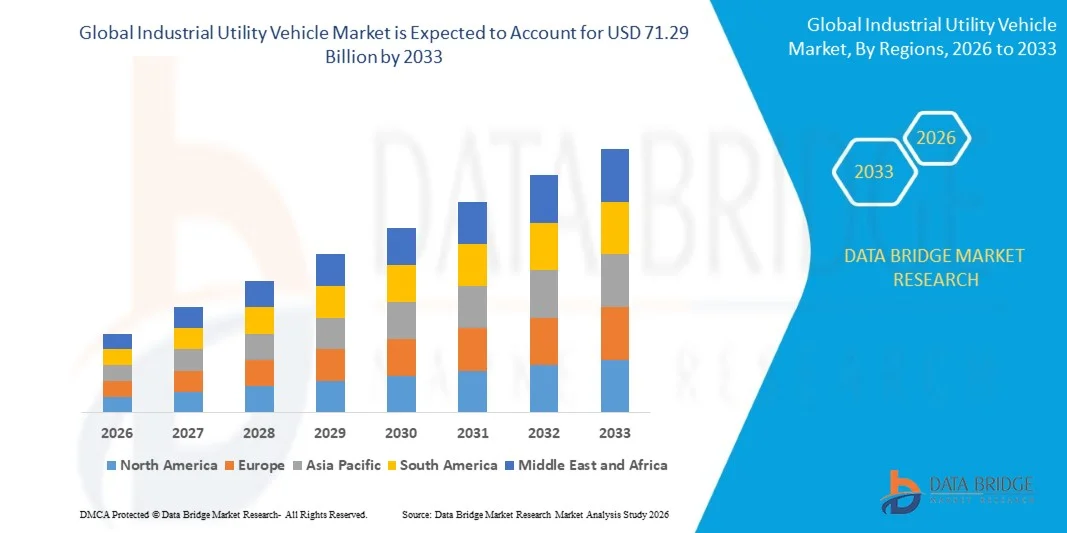
- As per Data Bridge Market Research Analysis the, the global Industrial Utility Vehicle Market was valued at approximately USD 45.67 billion in 2025 and is projected to reach USD 71.29 billion by 2033, growing at a CAGR of 4.55% from 2026 to 2033.
- The market is witnessing growth driven by the increasing demand for efficient material handling, transportation, and mobility solutions across manufacturing, warehousing, logistics, construction, mining, agriculture, and other industrial applications. The growing need to improve operational efficiency, reduce material-handling time, and support the movement of goods, equipment, and personnel across large industrial facilities is further supporting market expansion.
- Increasing adoption of electric and hybrid utility vehicles, industrial automation, smart fleet technologies, and connected vehicle systems is creating further growth opportunities. Manufacturers are also focusing on developing utility vehicles with improved payload capacity, energy efficiency, durability, maneuverability, and automated or connected capabilities to support demanding industrial and commercial environments.
Market Size & Forecast
- Market Value (2025): USD 45.67 billion
- Expected Market Value (2033): USD 71.29 Million
- Forecast CAGR (2026–2033): 4.55%
- Leading Region in 2025: North America
- Fastest Growing Region: Asia-Pacific
What are the Major Takeaways of the Industrial Utility Vehicle market?
- North America represented a leading regional market for the global industrial utility vehicle market, with a 32.4% market share in 2025, supported by established manufacturing, logistics, warehousing, and industrial infrastructure. Increasing adoption of electric utility vehicles, automated material-handling solutions, telematics, and fleet-management technologies is further supporting regional market development.
- Asia-Pacific is expected to witness significant growth in the global Industrial Utility Vehicle Market during the forecast period of 7.65% in 2026 to 2033, driven by rapid industrialization, expanding manufacturing and warehousing activities, infrastructure development, and increasing demand for efficient material-handling solutions. The region's growing adoption of electric and automated utility vehicles is further contributing to market expansion.
- Electric Utility Vehicles represent a key vehicle type segment of the global industrial utility vehicle market, accounting for a 36.7% market share in 2025. increasing emphasis on reducing emissions, improving energy efficiency, lowering operating costs, and complying with environmental regulations is supporting the adoption of electric utility vehicles across manufacturing, warehousing, logistics, construction, and other industrial applications.
- Material Handling represents a key application category of the global Industrial Utility Vehicle Market with market share of 43.24% in 2025, supported by increasing demand for efficient movement of goods, equipment, and personnel across manufacturing facilities, warehouses, logistics centers, ports, and distribution centers. The expansion of e-commerce, warehousing infrastructure, and industrial automation is further supporting demand for utility vehicles used in material-handling operations.
- Warehousing and Manufacturing represent major end-user areas of the global Industrial Utility Vehicle Market with market share of 32.12% in 2025, supported by the need to improve internal transportation, operational efficiency, workplace safety, and material-flow management. Increasing adoption of automated guided vehicles, connected fleet-management systems, and electric utility vehicles is further supporting market development across industrial facilities.
- Battery-Operated is expected to witness significant growth in the global Industrial Utility Vehicle Market during the forecast period of 3.65% in 2026 to 2033. Growth is supported by the expansion of manufacturing, warehousing, logistics, construction, and infrastructure activities, alongside increasing adoption of electric vehicles, automation, telematics, and smart fleet-management technologies.
Report Scope Industrial Utility Vehicle Market Segmentation
|
Attributes |
Industrial Utility Vehicle Key Market Insights |
|
Segments Covered |
|
|
Countries Covered |
North America
Europe
Asia-Pacific
Middle East and Africa
South America
|
|
Key Market Players |
|
|
Market Opportunities |
|
|
Value Added Data Infosets |
In addition to the market insights such as market value, growth rate, market segments, geographical coverage, market players, and market scenario, the market report curated by the Data Bridge Market Research team includes in-depth expert analysis, import/export analysis, pricing analysis, production consumption analysis, and pestle analysis. |
What is the Key Trend in the Industrial Utility Vehicle market?
- Industrial utility vehicle manufacturers are increasingly focusing on electrification and low-emission powertrains to reduce operating costs, emissions, and noise across warehouses, manufacturing facilities, logistics yards, ports, airports, and other industrial environments. Electric utility vehicles are gaining traction particularly in indoor and short-distance applications, where zero-emission operation and lower maintenance requirements provide operational benefits.
- The integration of autonomous navigation, AI, LiDAR, GPS, sensor fusion, and connected fleet-management technologies is emerging as another important trend. Manufacturers are developing utility vehicles that can operate on predefined routes, detect obstacles, optimize movement, and communicate with centralized fleet-management platforms.
- For instance, on December 1, 2025, Omega Seiki Mobility launched the Swayamgati Cargo autonomous electric three-wheeler, designed for industrial parks, manufacturing facilities, airports, warehouses, and other controlled environments. The vehicle combines an electric drivetrain with LiDAR, GPS, multi-sensor navigation, AI-based obstacle detection, geofenced routing, and remote fleet management, and provides a claimed range of up to 120 km. This development demonstrates the growing integration of electrification and autonomous technologies into industrial utility vehicles.
- The convergence of electrification, automation, AI, and connected fleet technologies is transforming industrial utility vehicles from conventional transportation equipment into intelligent mobility solutions. These technologies are enabling real-time vehicle monitoring, route optimization, obstacle detection, remote fleet management, and more efficient movement of goods and personnel, particularly across warehouses, manufacturing sites, airports, industrial campuses, and logistics facilities.
What are the Key Drivers of the Industrial Utility Vehicle market?
- Manufacturers and industrial operators are increasingly shifting toward electric industrial utility vehicles to reduce emissions, operating costs, and noise while improving suitability for indoor manufacturing, warehousing, logistics, and material-handling applications. Battery technology improvements and the availability of lithium-ion systems are further supporting electrification.
- The development of connected and automated industrial utility vehicles is gaining traction as manufacturers integrate telematics, GPS, IoT sensors, fleet-management platforms, and autonomous-driving capabilities. These technologies enable real-time vehicle tracking, utilization monitoring, predictive maintenance, and optimized fleet operations. The increasing adoption of automation across manufacturing, warehousing, and logistics is therefore transforming industrial utility vehicles from conventional transportation equipment into connected assets within smart industrial environments.
- For instance, in May 2025, Raymond West highlighted the growing deployment of electric utility vehicles such as stock chasers and burden carriers in warehouse operations. These vehicles are being used for order picking, line feeding, and movement of materials in areas where conventional forklifts may be less efficient. The company also highlighted the integration of electric utility vehicles with existing fleet-management and charging infrastructure, demonstrating the industry's shift toward connected and electrified industrial mobility.
- The integration of electrification, automation, and real-time fleet intelligence is further expanding the functionality of industrial utility vehicles, enabling operators to monitor vehicle utilization, maintenance requirements, battery status, and operational performance while improving productivity and reducing downtime across manufacturing, warehousing, logistics, construction, and other industrial environments.
Which Factors are Challenging the Growth of the Industrial Utility Vehicle market?
- The transition toward electric and connected industrial utility vehicles requires substantial upfront investment in vehicles, charging infrastructure, battery systems, telematics, and fleet-management platforms. Battery charging availability and site-specific infrastructure requirements can make electrification more challenging for industrial operators, particularly where vehicles operate continuously or across large facilities. Recent industry analysis highlights charging infrastructure, battery management, and fleet-planning requirements as important considerations in the transition toward electric utility vehicles.
- Complexity of Autonomous and Connected Vehicle Integration: Industrial utility vehicle manufacturers are increasingly integrating autonomous navigation, LiDAR, GPS, multi-sensor systems, AI-based obstacle detection, geofencing, and remote fleet management. While these technologies can improve productivity and safety, their integration increases system complexity, software requirements, maintenance needs, and deployment costs.
- The increasing deployment of autonomous utility vehicles in manufacturing plants, warehouses, airports, and distribution centers requires reliable navigation, collision avoidance, communication systems, and safe interaction with workers and conventional vehicles.
- Industrial utility vehicle manufacturers are increasingly shifting from conventional internal-combustion platforms toward battery-electric solutions because of emission-reduction targets, lower operating costs, and environmental regulations. Current market research indicates that lithium-ion batteries, smart charging, battery-health monitoring, and energy-management systems are becoming increasingly important for professional utility-vehicle fleets.
- For insatcne, In 2025, Oxa and Bradshaw EV announced autonomous technology integration for industrial vehicles, while Omega Seiki Mobility introduced an autonomous electric cargo vehicle incorporating LiDAR, GPS, AI-based obstacle recognition, geofencing, and remote fleet management.
- Telematics, geofencing, remote diagnostics, battery-health monitoring, and usage analytics are increasingly being incorporated into electric utility vehicles to monitor vehicle performance, optimize charging, reduce downtime, and improve fleet utilization. Industry analysis identifies these connected capabilities as an important shift in purchasing criteria for fleet operators.
How is the Industrial Utility Vehicle Market Segmented?
The market is segmented on the basis of Drive Type, Level of Autonomy, and Application.
- By Drive Type
On the basis of drive type, the Industrial Utility Vehicle Market is segmented into ICE, Battery-Operated, and Gas-Powered. The Battery-Operated segment represents a key segment of the market with share of 34.24% in 2025, supported by increasing demand for low-emission and energy-efficient utility vehicles across manufacturing, warehousing, freight and logistics, and other industrial operations. The growing focus on reducing operating costs, improving vehicle efficiency, and meeting environmental requirements is further supporting the adoption of battery-operated industrial utility vehicles.
The Battery-Operated segment is expected to witness strong growth during the forecast period of 5.24% in 2026 to 2033, supported by increasing electrification of industrial vehicle fleets, advancements in battery technology, development of charging infrastructure, and growing adoption of electric vehicles for indoor and short-distance industrial transportation applications.
- By Level of Autonomy
On the basis of level of autonomy, the Industrial Utility Vehicle Market is segmented into Non/Semi-Autonomous and Autonomous. The Non/Semi-Autonomous segment represents a key segment of the market with sahre of 34.13% in 2025, supported by the widespread use of utility vehicles requiring operator assistance for material transportation, personnel movement, and other industrial activities. The gradual integration of automated navigation, collision detection, sensors, and fleet-management technologies is supporting the transition toward higher levels of vehicle autonomy.
The Autonomous segment is expected to witness strong growth during the forecast period with CAGR of 6.12% in 2026 to 2033, supported by increasing adoption of automation across manufacturing facilities, warehouses, distribution centers, and logistics operations. Integration of artificial intelligence, LiDAR, GPS, cameras, obstacle detection, and real-time fleet-management technologies is further supporting the deployment of autonomous industrial utility vehicles.
- By Application
On the basis of application, the Industrial Utility Vehicle Market is segmented into Manufacturing, Warehousing, Freight and Logistics, and Others. The Manufacturing segment represents a key segment of the market with share of 76.23% in 2025, supported by increasing demand for efficient transportation of raw materials, components, finished goods, and personnel within manufacturing facilities. The expansion of automated production environments and the growing focus on improving internal material movement are further supporting market growth.
The Warehousing segment is expected to witness strong growth during the forecast period with CAGR of 5.245 in 2026 to 2033, supported by the expansion of e-commerce, distribution centers, automated warehouses, and smart logistics infrastructure. Increasing adoption of automated and electric utility vehicles for material movement, order fulfillment, inventory handling, and intra-facility transportation is further contributing to segment expansion.
Which Region Holds the Largest Share of the Industrial Utility Vehicle market?
- North America dominated the global Industrial Utility Vehicle Market in 2025 with a market share of approximately 36.8%, supported by established industrial infrastructure, strong demand from manufacturing and logistics operations, and increasing adoption of electric and technologically advanced utility vehicles. The presence of established manufacturers and growing investments in industrial automation, material handling, and fleet modernization are further supporting regional market development.
- Asia-Pacific is expected to witness significant growth in the Global Industrial Utility Vehicle Market during the forecast period, supported by rapid industrialization, expanding manufacturing activities, growth of warehousing and logistics infrastructure, and increasing adoption of automated and electric industrial vehicles. China, India, Japan, and South Korea are contributing to regional demand through expanding manufacturing capacity, warehouse automation, and investments in smart industrial infrastructure.
U.S. Industrial Utility Vehicle Market Insight
The U.S. Industrial Utility Vehicle Market is witnessing steady growth, supported by expanding manufacturing, warehousing, freight, logistics, and industrial infrastructure. Increasing demand for efficient material movement and internal transportation is encouraging the adoption of industrial utility vehicles across factories, distribution centers, and large-scale facilities. The transition toward battery-operated vehicles is gaining momentum due to the focus on operational efficiency, lower emissions, and reduced maintenance requirements. In addition, growing integration of automation, telematics, GPS, fleet-management systems, and autonomous driving technologies is enhancing vehicle utilization, safety, and productivity across industrial applications.
Europe Industrial Utility Vehicle Market Insight
The Europe Industrial Utility Vehicle Market is witnessing steady growth, supported by increasing automation across manufacturing, warehousing, freight, and logistics operations. The adoption of electric and battery-operated utility vehicles is expanding as industries focus on improving energy efficiency, reducing emissions, and lowering operating costs. Growing investments in smart factories, automated warehouses, and connected fleet management systems are further supporting market development. Countries such as Germany, France, the U.K., Italy, and Spain are contributing to regional demand through industrial modernization, advanced material-handling infrastructure, and the increasing integration of autonomous and digitally connected utility vehicles.
U.K. Industrial Utility Vehicle Market Insight
The U.K. Industrial Utility Vehicle Market is being supported by increasing automation across manufacturing, warehousing, freight, and logistics operations. Growing adoption of electric and battery-operated utility vehicles is being encouraged by emission-reduction initiatives, energy-efficiency requirements, and the transition toward sustainable industrial mobility. The expansion of automated warehouses and distribution facilities is further increasing demand for connected and autonomous utility vehicles capable of supporting internal material movement. Advancements in telematics, fleet management, sensor technologies, and autonomous navigation are also enhancing vehicle efficiency, safety, and operational visibility across industrial facilities.
Germany Industrial Utility Vehicle Market Insight
Germany’s Industrial Utility Vehicle Market is supported by the country’s strong manufacturing base, advanced logistics infrastructure, and increasing adoption of automation across industrial facilities. Rising demand for efficient material movement within manufacturing plants, warehouses, and distribution centers is encouraging the deployment of electric, connected, and autonomous utility vehicles. The expansion of smart factories and Industry 4.0 initiatives is further creating opportunities for vehicles equipped with telematics, fleet-management systems, sensors, and automated navigation technologies. Growing emphasis on energy efficiency, operational productivity, and reduced emissions is also supporting the transition toward battery-operated industrial utility vehicles.
Asia-Pacific Industrial Utility Vehicle Market Insight
Asia-Pacific Industrial Utility Vehicle Market is experiencing strong growth, driven by expanding manufacturing activities, rapid industrialization, and increasing investments in warehousing and logistics infrastructure. Countries such as China, Japan, India, and South Korea are witnessing greater adoption of utility vehicles for material transportation, internal logistics, freight movement, and facility operations. The growing integration of electric powertrains, automation, telematics, and autonomous technologies is further supporting market development. Rising demand for efficient, connected, and low-emission industrial transportation solutions across manufacturing plants, warehouses, distribution centers, and logistics facilities is expected to strengthen regional market expansion.
Japan Industrial Utility Vehicle Market Insight
The Japan Industrial Utility Vehicle Market is supported by the country’s advanced manufacturing ecosystem, high automation adoption, and growing emphasis on efficient internal material transportation. Demand is being driven by the expansion of automated warehouses, smart factories, logistics facilities, and industrial distribution centers, where utility vehicles are increasingly used for material movement and operational support. The adoption of electric and autonomous utility vehicles is also gaining momentum due to sustainability initiatives, labor constraints, and the need to improve workplace productivity. Integration of sensors, telematics, fleet management, and autonomous navigation technologies is further strengthening market opportunities.
China Industrial Utility Vehicle Market Insight
China’s Industrial Utility Vehicle Market is supported by rapid industrialization, expanding manufacturing capacity, and the growing development of automated warehouses and logistics facilities. Increasing adoption of electric and battery-operated utility vehicles is being driven by efforts to improve energy efficiency, reduce operating emissions, and lower fleet operating costs. Demand is further supported by automation across manufacturing plants, distribution centers, and material-handling operations, where autonomous and semi-autonomous vehicles are increasingly being integrated. Investments in smart factories, connected fleet technologies, and advanced industrial infrastructure are expected to further strengthen market development across China.
Which are the Top Companies in Industrial Utility Vehicle Market?
The Industrial Utility Vehicle Market industry is primarily led by well-established companies, including:
- Polaris Inc. (US)
- Textron Inc (US)
- Deere & Company. (US)
- The Toro Company. (US)
- Ingersoll-Rand plc (Ireland)
- Yamaha Motor Co., Ltd. (Japan)
- KUBOTA Corporation. (Japan)
- American Landmaster (US)
- Columbia Vehicle Group Inc. (US)
- AGT Electric Cars (Canada)
- Bintelli Electric Vehicles. (US)
- Suzhou Eagle Electric Vehicle Manufacturing Co., Ltd (China)
- SpeedwaysElectric (India)
- Marshell Green Power (China)
- Garia A/S (Denmark)
What are Latest Developments in Industrial Utility Vehicle Market?
- In May 2025, Oxa and Bradshaw EV announced a collaboration to integrate autonomous driving technology into industrial electric vehicles, including tow tractors and utility vehicles. The collaboration targets applications across ports, airports, manufacturing sites, distribution centers, and other industrial environments.
- In June 2025, Cyngn announced a collaboration with NVIDIA to use the NVIDIA Isaac robotics platform to accelerate autonomous industrial vehicle development. Cyngn is integrating its DriveMod technology with Isaac to support autonomous vehicles operating in warehouses and manufacturing environments.
- In October 2025, Jungheinrich launched its AntOn by Jungheinrich brand, offering lithium-ion-powered entry-level material-handling vehicles, including forklifts and pallet trucks. The product portfolio was developed through a partnership between Jungheinrich and EP Equipment.
- In March 2026, Oxa secured USD 103 million in funding from investors including NVIDIA’s venture arm and the UK's National Wealth Fund. The funding is intended to accelerate commercial autonomous-driving software and physical AI technologies for industrial applications such as ports, airports, and factories.
- In January 2026, Oxa continued expanding its autonomous industrial mobility solutions, including systems for towing and transporting goods in ports, airports, and factories. The company reported plans for international deployments and broader integration of autonomous technology into industrial vehicles.
- In may 2025,Jungheinrich strengthened its digital ecosystem for electric industrial vehicles and automated guided vehicles, focusing on fleet management, predictive maintenance, and warehouse automation. These developments reflect increasing integration of connected technologies with industrial vehicle fleets.

- Interactive Data Analysis Dashboard
- Company Analysis Dashboard for high growth potential opportunities
- Research Analyst Access for customization & queries
- Competitor Analysis with Interactive dashboard
- Latest News, Updates & Trend analysis
- Harness the Power of Benchmark Analysis for Comprehensive Competitor Tracking
Data collection and base year analysis are done using data collection modules with large sample sizes. The stage includes obtaining market information or related data through various sources and strategies. It includes examining and planning all the data acquired from the past in advance. It likewise envelops the examination of information inconsistencies seen across different information sources. The market data is analysed and estimated using market statistical and coherent models. Also, market share analysis and key trend analysis are the major success factors in the market report. To know more, please request an analyst call or drop down your inquiry.
The key research methodology used by DBMR research team is data triangulation which involves data mining, analysis of the impact of data variables on the market and primary (industry expert) validation. Data models include Vendor Positioning Grid, Market Time Line Analysis, Market Overview and Guide, Company Positioning Grid, Patent Analysis, Pricing Analysis, Company Market Share Analysis, Standards of Measurement, Global versus Regional and Vendor Share Analysis. To know more about the research methodology, drop in an inquiry to speak to our industry experts.
Data Bridge Market Research is a leader in advanced formative research. We take pride in servicing our existing and new customers with data and analysis that match and suits their goal. The report can be customized to include price trend analysis of target brands understanding the market for additional countries (ask for the list of countries), clinical trial results data, literature review, refurbished market and product base analysis. Market analysis of target competitors can be analyzed from technology-based analysis to market portfolio strategies. We can add as many competitors that you require data about in the format and data style you are looking for. Our team of analysts can also provide you data in crude raw excel files pivot tables (Fact book) or can assist you in creating presentations from the data sets available in the report.













