


Infant Incubator Market Overview
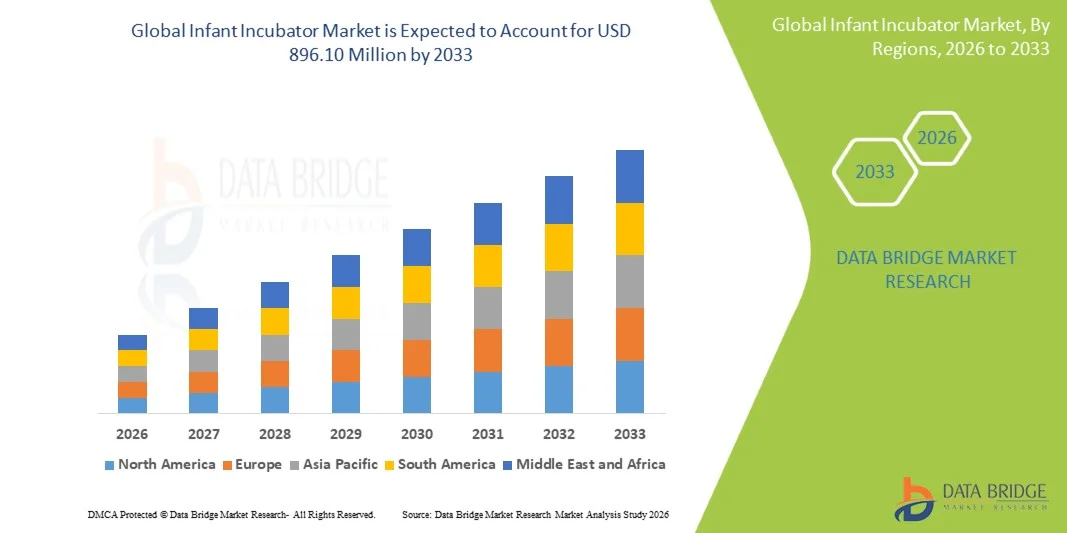
The Infant Incubator Market was valued at USD 525.46 million in 2025 and is projected to reach USD 896.10 million by 2033, growing at a CAGR of 6.90% from 2026 to 2033. The market is experiencing steady growth driven by the rising prevalence of preterm births, increasing neonatal care requirements, and continuous advancements in neonatal intensive care unit (NICU) equipment across healthcare facilities worldwide.
The growing focus on reducing neonatal mortality rates, coupled with expanding investments in maternal and child healthcare infrastructure, is encouraging hospitals and specialty clinics to adopt technologically advanced infant incubators. Modern incubators equipped with precise temperature regulation, humidity control, infection prevention features, and integrated monitoring systems are increasingly replacing conventional neonatal care solutions in many regions, providing safer and more controlled environments for premature and low-birth-weight infants.
Key Market Trends & Insights
- North America dominated the Infant Incubator Market with the largest revenue share of 35.12% in 2025, supported by advanced neonatal care infrastructure, high healthcare spending, and widespread adoption of technologically advanced NICU equipment.
- The Neonatal Intensive Care Unit Incubator segment led the market with a 62.84% share in 2025, driven by its extensive use in hospitals and specialized neonatal care facilities for the treatment of premature and critically ill infants.
- Asia-Pacific is expected to be the fastest-growing region at a CAGR of 7.4% from 2026 to 2033, fueled by rising birth rates, expanding healthcare infrastructure, and increasing investments in neonatal care across China, India, and Southeast Asia.
- Transport Infant Incubator are the fastest-growing product type, projected to register a CAGR of 7.4%, reflecting the surge in need for safe neonatal transportation between healthcare facilities.
- The Conventional Infant Incubators segment dominated the technology category with a 68.27% revenue share in 2025, led by their widespread availability, affordability, and established use across hospitals and maternity centers.
- Low Birth Weight accounted for 46.19% of the market, preferred by the increasing number of infants born with insufficient body weight requiring specialized thermal and environmental support.
- The Neonatal Hypothermia segment is the fastest-growing application category, with a CAGR of 7.2%, driven by the growing awareness of the risks associated with temperature instability among newborns.
Market Size & Forecast
- Global Market Value (2025): USD 525.46 Million
- Expected Market Value (2033): USD 896.10 Million
- Forecast CAGR (2026–2033): 6.90%
- Leading Region in 2025: North America
- Fastest Growing Region: Asia Pacific
Report Scope and Infant Incubator Market Segmentation
|
Attributes |
Infant Incubator Key Market Insights |
|
Segments Covered |
|
|
Countries Covered |
North America · U.S. · Canada · Mexico Europe · Germany · France · U.K. · Netherlands · Switzerland · Belgium · Russia · Italy · Spain · Turkey · Rest of Europe Asia-Pacific · China · Japan · India · South Korea · Singapore · Malaysia · Australia · Thailand · Indonesia · Philippines · Rest of Asia-Pacific Middle East and Africa · Saudi Arabia · U.A.E. · South Africa · Egypt · Israel · Rest of Middle East and Africa South America · Brazil · Argentina · Rest of South America |
|
Key Market Players |
· Drägerwerk AG & Co. KGaA (Germany) · GE HealthCare (U.S.) · ATOM MEDICAL CORPORATION (Japan) · Fanem Ltda. (Brazil) · MEDIPREMA (France) · GINEVRI s.r.l. (Italy) · MEDICOR Elektronika Zrt. (Hungary) · Shvabe (Russia) · Ningbo David Medical Device Co., Ltd. (China) · Olidef cz Indústria e Comércio de Aparelhos Hospitalares Ltda. (Brazil) · BISTOS Co., Ltd. (South Korea) · JW Medical Corporation (South Korea) · V-Care Medical Systems Pvt. Ltd. (India) · Ertunç Özcan A.Ş. (Türkiye) · Phoenix Medical Systems Pvt. Ltd. (India) · NOVOS Medical Systems (India) · Dison Instrument And Meter Co., Ltd. (China) · Beijing Julongsanyou Technology Co., Ltd. (China) · Cobams SAS (France) · Weyer GmbH (Germany) |
|
Market Opportunities |
· Expansion of neonatal care infrastructure in emerging economies · Growing adoption of smart incubators with integrated monitoring, remote diagnostics, and connectivity features · Increasing need for safe neonatal transport services |
|
Value Added Data Infosets |
In addition to the insights on market scenarios such as market value, growth rate, segmentation, geographical coverage, and major players, the market reports curated by the Data Bridge Market Research also include in-depth expert analysis, patient epidemiology, pipeline analysis, pricing analysis, and regulatory framework. |
Infant Incubator Market Trends
Trend: Growing Adoption of Smart and Connected Neonatal Care Systems
Healthcare providers are increasingly adopting smart infant incubators to improve neonatal monitoring, enhance clinical decision-making, and optimize outcomes for premature and critically ill newborns. The integration of wireless connectivity, real-time physiological monitoring, and automated environmental controls enables precise management of neonatal conditions. Hospitals and neonatal intensive care units are similarly leveraging connected incubators to streamline workflows through standardized, data-driven care protocols, while digital health technologies create integrated environments that closely support real-world neonatal care requirements.
For instance, in February 2024, Dräger continued expanding advanced neonatal care solutions featuring integrated monitoring and thermoregulation technologies, supporting the growing trend toward connected neonatal care environments.
Infant Incubator Market Dynamics
Key Market Driver: Rising Incidence of Preterm Births and Neonatal Complications
The increasing incidence of preterm births and neonatal complications has created substantial demand for advanced infant incubators that can provide thermal regulation, humidity control, and continuous physiological monitoring for vulnerable newborns. Hospitals, maternity centers, and neonatal intensive care units are deploying incubators as a core component of neonatal care infrastructure, improving survival rates, supporting early interventions, and enhancing overall treatment outcomes. The growing focus on reducing infant mortality and strengthening neonatal healthcare services continues to accelerate adoption across both developed and emerging healthcare systems.
For instance, in January 2025, GE HealthCare highlighted ongoing investments in neonatal care technologies designed to improve outcomes for premature and low-birth-weight infants, reflecting rising demand for advanced incubator systems.
Key Restraint/Challenge: High Acquisition and Maintenance Cost of Advanced Incubators
A significant restraint in the Infant Incubator Market is the high upfront investment required for advanced neonatal care systems. Modern incubators integrate sophisticated monitoring technologies, automated environmental controls, infection prevention features, and digital connectivity capabilities, demanding substantial expenditure for procurement, installation, and ongoing maintenance. The total cost of ownership extends to staff training, equipment servicing, periodic upgrades, and regulatory compliance requirements, making adoption difficult for smaller hospitals, rural healthcare facilities, and resource-constrained healthcare providers.
For instance, the deployment of technologically advanced neonatal intensive care equipment across developing healthcare systems often requires significant capital allocation, highlighting affordability challenges associated with widespread adoption of premium incubator solutions.
Key Market Opportunity: Expansion of Neonatal Care Infrastructure in Emerging Economies
The expansion of neonatal healthcare infrastructure in emerging economies presents a significant market opportunity. Increasing government healthcare investments can support new neonatal intensive care units, improve access to specialized newborn treatment, and strengthen maternal and child health programs. The development of cost-effective incubator technologies and portable neonatal care solutions is further improving accessibility across underserved regions, opening growth opportunities throughout Asia-Pacific, Latin America, and the Middle East. For instance, in March 2024, UNICEF continued supporting newborn healthcare initiatives in developing regions, encouraging investments in neonatal equipment and infrastructure that contribute to greater adoption of infant incubator systems.
Infant Incubator Market Scope
The infant incubator market is segmented on the basis of product, technology, application, and end user.
- By Product
On the basis of product, the Infant Incubator Market is segmented into transport infant incubator and neonatal intensive care unit (NICU) incubator. The Neonatal Intensive Care Unit Incubator segment dominated the market with a 62.84% share in 2025, owing to its extensive use in hospitals and specialized neonatal care facilities for the treatment of premature and critically ill infants. These incubators provide precise temperature regulation, humidity control, and continuous monitoring capabilities essential for neonatal survival. Increasing admissions to NICUs due to preterm births and neonatal complications are supporting demand. Healthcare providers prefer NICU incubators because of their advanced safety features and integration with monitoring systems. Growing investments in neonatal healthcare infrastructure are further strengthening segment growth. Their critical role in improving neonatal outcomes continues to maintain their market leadership.
The Transport Infant Incubator segment is projected to register the fastest growth at a CAGR of 7.4% from 2026 to 2033, driven by the increasing need for safe neonatal transportation between healthcare facilities. These incubators provide controlled environments during emergency transfers and long-distance transportation of newborns. Rising development of neonatal transport networks is significantly supporting adoption. Healthcare systems are increasingly focusing on reducing risks associated with infant transfers. Technological advancements such as lightweight designs, battery-powered operation, and integrated monitoring systems are improving efficiency. Growing demand for emergency neonatal care services is expected to accelerate segment expansion globally.
- By Technology
On the basis of technology, the Infant Incubator Market is segmented into conventional infant incubators and smart infant incubators. The Conventional Infant Incubators segment dominated the market with a 68.27% share in 2025, driven by their widespread availability, affordability, and established use across hospitals and maternity centers. These systems provide reliable thermal support and basic environmental control for newborn care. Many healthcare facilities, particularly in developing regions, continue to rely on conventional models due to budget constraints. Their simple operational requirements and lower maintenance costs contribute to strong adoption. The segment benefits from a large installed base across public and private healthcare institutions. Consistent demand for essential neonatal care equipment continues to support its leading position.
The Smart Infant Incubators segment is expected to witness the fastest growth at a CAGR of 7.8% from 2026 to 2033, driven by increasing adoption of connected healthcare technologies and advanced neonatal monitoring systems. These incubators offer features such as real-time data tracking, remote monitoring, automated environmental adjustments, and integrated alarm systems. Hospitals are increasingly investing in smart technologies to improve patient outcomes and operational efficiency. Advances in IoT-enabled healthcare devices are enhancing functionality and clinical decision-making. Growing emphasis on personalized neonatal care is further supporting adoption. Rising healthcare digitization initiatives worldwide are expected to accelerate segment growth significantly.
- By Application
On the basis of application, the Infant Incubator Market is segmented into neonatal hypothermia, low birth weight, genetic defects, and others. The Low Birth Weight segment accounted for the largest market share of 46.19% in 2025, owing to the increasing number of infants born with insufficient body weight requiring specialized thermal and environmental support. Infant incubators play a crucial role in stabilizing body temperature and reducing complications in these newborns. Rising awareness regarding neonatal health management is supporting greater utilization of incubator systems. Hospitals prioritize incubator-assisted care to improve survival and developmental outcomes. Increasing maternal health complications and premature deliveries are further driving demand. The segment remains a major contributor to overall market revenue.
The Neonatal Hypothermia segment is projected to grow at the fastest rate with a CAGR of 7.2% from 2026 to 2033, driven by growing awareness of the risks associated with temperature instability among newborns. Infant incubators provide controlled thermal environments that are essential for preventing and managing hypothermia. Healthcare organizations are increasingly implementing protocols focused on neonatal temperature regulation. Expanding neonatal care services in emerging economies are creating additional growth opportunities. Technological advancements in thermoregulation systems are improving treatment effectiveness. Increasing efforts to reduce neonatal mortality rates are expected to support strong segment growth.
- By End User
On the basis of end user, the Infant Incubator Market is segmented into pediatric hospitals, birthing centres, neonatal intensive care units, and others. The Neonatal Intensive Care Units (NICUs) segment dominated the market with a 54.73% share in 2025, driven by the high concentration of premature, low-birth-weight, and critically ill infants requiring advanced supportive care. NICUs utilize infant incubators extensively to provide controlled environments and continuous monitoring. Increasing preterm birth rates and neonatal complications are contributing to higher NICU admissions globally. Governments and healthcare providers are investing significantly in expanding NICU capacities. Advanced neonatal care protocols are further supporting incubator adoption in these settings. The segment continues to benefit from strong clinical demand and healthcare infrastructure development.
The Birthing Centres segment is anticipated to register the fastest growth at a CAGR of 7.1% from 2026 to 2033, driven by increasing preference for specialized maternal and newborn care services. Many birthing centres are expanding their neonatal care capabilities to manage complications immediately after delivery. Rising healthcare investments and growing awareness of newborn health are encouraging equipment upgrades. The availability of compact and technologically advanced incubators is improving accessibility in these facilities. Increasing focus on early intervention and neonatal stabilization is supporting adoption. Expansion of private maternity care services across emerging economies is expected to further accelerate segment growth.
Infant Incubator Market Regional Analysis
North America dominated the Infant Incubator Market with the largest revenue share of 35.12% in 2025, supported by advanced neonatal care infrastructure, high healthcare spending, and widespread adoption of technologically advanced NICU equipment. The region also benefits from high adoption of technologically advanced incubators, increasing neonatal intensive care unit capacities, and growing use of incubator systems across hospitals, pediatric centers, and specialized neonatal care facilities. Increasing focus on reducing infant mortality rates and improving outcomes for premature and low-birth-weight infants continues to strengthen North America’s leadership position in the global market.
U.S. Infant Incubator Market Insight
The U.S. infant incubator market is witnessing strong growth due to rising investments in neonatal healthcare programs, maternal care initiatives, and advanced newborn monitoring technologies. The country’s well-established healthcare infrastructure, along with increasing adoption of smart, connected, and digitally integrated incubator systems, is driving demand across hospitals, NICUs, and pediatric care facilities. In addition, growing emphasis on reducing neonatal mortality and improving outcomes for premature infants is accelerating incubator adoption across healthcare providers and specialized neonatal centers.
Europe Infant Incubator Market Insight
The Europe infant incubator market remains a major contributor to global revenue, driven by strong government support, technological innovation, and high demand for advanced neonatal care solutions. The widespread use of modern incubators in hospitals, maternity centers, and neonatal intensive care units is supporting market expansion across the region. Increasing investments in neonatal healthcare technologies, coupled with stringent healthcare standards and a highly skilled medical workforce, continue to enhance the adoption of infant incubators throughout Europe.
U.K. Infant Incubator Market Insight
The U.K. infant incubator market is experiencing steady growth, supported by rising adoption of advanced neonatal care technologies in hospitals, maternity facilities, and pediatric healthcare centers. Increasing investments in modern incubator infrastructure and growing demand for effective, safe newborn care solutions are contributing to market growth. Furthermore, integration of smart monitoring systems, digital connectivity, and automated environmental controls is improving neonatal care efficiency, positioning the U.K. as a key innovation hub in the infant incubator industry.
Germany Infant Incubator Market Insight
The Germany infant incubator market is expanding steadily due to the country’s strong healthcare system, advanced medical research capabilities, and increasing adoption of next-generation neonatal care technologies. Healthcare providers, neonatal centers, and research institutions are increasingly utilizing incubators for newborn stabilization, intensive monitoring, and specialized treatment applications. Continuous advancements in patient monitoring, smart healthcare integration, and thermoregulation technologies, along with strong government focus on maternal and infant health, are further driving market growth in Germany.
Asia-Pacific Infant Incubator Market Insight
The Asia-Pacific infant incubator market is expected to witness rapid growth, driven by increasing birth rates, expanding healthcare infrastructure, and rising investments in neonatal care facilities across countries such as China, India, and Japan. Growing awareness regarding newborn health, rising adoption of advanced incubator technologies, and increasing demand for accessible and cost-effective neonatal care solutions are supporting regional market expansion. In addition, the growing establishment of NICUs and maternal healthcare centers is accelerating incubator adoption across public and private healthcare sectors.
Japan Infant Incubator Market Insight
The Japan infant incubator market is witnessing consistent growth due to rising investments in advanced neonatal healthcare technologies, medical innovation, and infant care initiatives. Hospitals, neonatal centers, and research institutions are increasingly adopting technologically advanced incubators for newborn monitoring, temperature regulation, and intensive care purposes. Moreover, increasing integration of smart healthcare technologies and the country’s focus on high-quality neonatal care services are further contributing to market growth.
China Infant Incubator Market Insight
The China infant incubator market is growing rapidly, driven by increasing healthcare modernization, expanding neonatal care infrastructure, and rising government focus on maternal and infant health services. Growing adoption of smart and connected incubator systems across hospitals, maternity centers, and pediatric facilities is significantly boosting market demand. In addition, rising investments in healthcare infrastructure, increasing awareness regarding neonatal health management, and rapid technological advancements are positioning China as one of the fastest-growing markets for infant incubators globally.
Infant Incubator Market Share
The infant incubator industry is primarily led by well-established companies, including:
- Drägerwerk AG & Co. KGaA (Germany)
- GE HealthCare (U.S.)
- ATOM MEDICAL CORPORATION (Japan)
- Fanem Ltda. (Brazil)
- MEDIPREMA (France)
- GINEVRI s.r.l. (Italy)
- MEDICOR Elektronika Zrt. (Hungary)
- Shvabe (Russia)
- Ningbo David Medical Device Co., Ltd. (China)
- Olidef cz Indústria e Comércio de Aparelhos Hospitalares Ltda. (Brazil)
- BISTOS Co., Ltd. (South Korea)
- JW Medical Corporation (South Korea)
- V-Care Medical Systems Pvt. Ltd. (India)
- Ertunç Özcan A.Ş. (Türkiye)
- Phoenix Medical Systems Pvt. Ltd. (India)
- NOVOS Medical Systems (India)
- Dison Instrument And Meter Co., Ltd. (China)
- Beijing Julongsanyou Technology Co., Ltd. (China)
- Cobams SAS (France)
- Weyer GmbH (Germany)
Latest Developments in Infant Incubator Market
- In January 2026, mOm Incubators Limited announced that its mOm Essential Incubator received U.S. FDA 510(k) clearance. The portable neonatal incubator is designed to provide thermoregulation for premature infants while allowing mothers and babies to remain together, reducing the need for NICU separation. The device is intended for use across hospitals, including facilities without on-site NICUs, improving access to neonatal care and supporting family-centered treatment models. This development highlights the growing demand for portable and flexible neonatal care solutions
- In October 2024, Millennium Babycares Pvt. Ltd. secured approximately USD 14.5 million in funding to expand its neonatal equipment manufacturing capabilities and strengthen its export presence. The investment is expected to support the development and commercialization of advanced infant incubator technologies featuring enhanced monitoring and automation capabilities. The expansion reflects increasing private-sector investment in neonatal care infrastructure and innovation
- In January 2023, University Hospital Southampton NHS Foundation Trust and the Children’s Air Ambulance introduced England’s first helicopter neonatal incubator for transporting critically ill newborns. The incubator was specifically designed to enable rapid and safe neonatal transfers between hospitals and specialist care centers. The initiative improved access to emergency neonatal transport services and demonstrated the growing importance of transport incubators in critical care environments
- In May 2022, mOm Incubators announced that its mOm Essential Incubator achieved CE Mark certification, enabling commercialization across European markets. The lightweight neonatal incubator was developed to provide accessible and cost-effective thermal care for newborns while reducing the need for short-term admissions to special care units. The certification marked a significant regulatory milestone for expanding neonatal incubator adoption across healthcare systems
- In November 2021, mOm Incubators reported the first clinical use of its innovative neonatal incubator in a UK hospital. The lightweight and foldable incubator was used to support a premature infant at St Peter’s Hospital, demonstrating its effectiveness in both developed and resource-constrained healthcare settings. The milestone validated the technology’s real-world clinical application and highlighted efforts to improve access to neonatal thermal care worldwide

- Interactive Data Analysis Dashboard
- Company Analysis Dashboard for high growth potential opportunities
- Research Analyst Access for customization & queries
- Competitor Analysis with Interactive dashboard
- Latest News, Updates & Trend analysis
- Harness the Power of Benchmark Analysis for Comprehensive Competitor Tracking
Data collection and base year analysis are done using data collection modules with large sample sizes. The stage includes obtaining market information or related data through various sources and strategies. It includes examining and planning all the data acquired from the past in advance. It likewise envelops the examination of information inconsistencies seen across different information sources. The market data is analysed and estimated using market statistical and coherent models. Also, market share analysis and key trend analysis are the major success factors in the market report. To know more, please request an analyst call or drop down your inquiry.
The key research methodology used by DBMR research team is data triangulation which involves data mining, analysis of the impact of data variables on the market and primary (industry expert) validation. Data models include Vendor Positioning Grid, Market Time Line Analysis, Market Overview and Guide, Company Positioning Grid, Patent Analysis, Pricing Analysis, Company Market Share Analysis, Standards of Measurement, Global versus Regional and Vendor Share Analysis. To know more about the research methodology, drop in an inquiry to speak to our industry experts.
Data Bridge Market Research is a leader in advanced formative research. We take pride in servicing our existing and new customers with data and analysis that match and suits their goal. The report can be customized to include price trend analysis of target brands understanding the market for additional countries (ask for the list of countries), clinical trial results data, literature review, refurbished market and product base analysis. Market analysis of target competitors can be analyzed from technology-based analysis to market portfolio strategies. We can add as many competitors that you require data about in the format and data style you are looking for. Our team of analysts can also provide you data in crude raw excel files pivot tables (Fact book) or can assist you in creating presentations from the data sets available in the report.













