


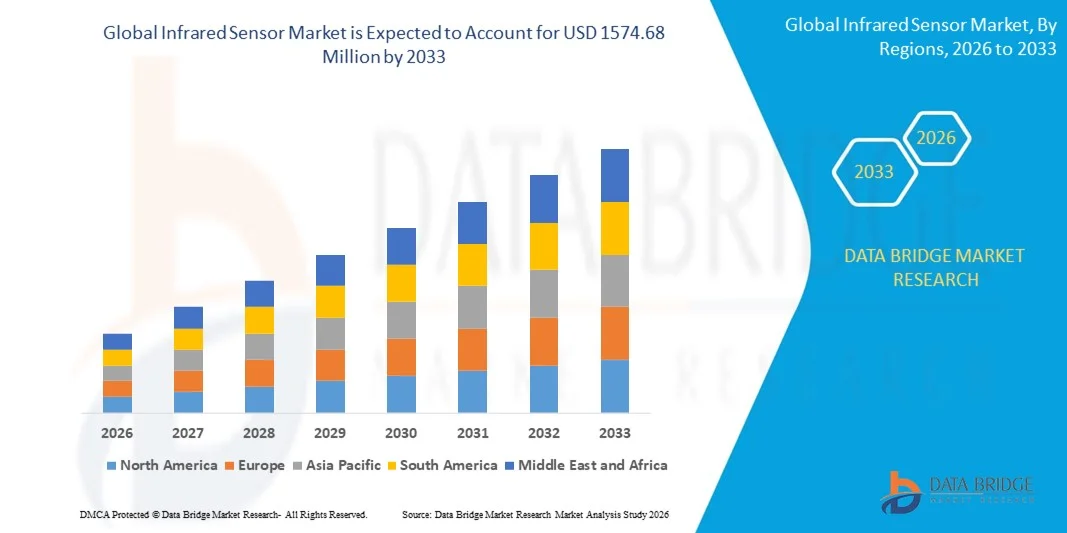
What is the Global Infrared Sensor Market Size and Growth Rate?
- The global infrared sensor market size was valued at USD 745.37 million in 2025 and is expected to reach USD 1574.68 million by 2033, at a CAGR of9.80% during the forecast period
- Increased penetration of infrared detectors in gas analysis, fire detection, and non-contact temperature measurement applications is a crucial factor accelerating the market growth, also growing need for automation equipment for building automation, rising adoption of 5G technology, rising investments in the research and development for integrating infrared cameras in automobiles, increasing investment in the security market and the growing trend of video surveillance and increasing investments in autonomous cars, are the major factors among others boosting the infrared sensor market
What are the Major Takeaways of Infrared Sensor Market?
- Increasing demand for infrared detectors from emerging countries and rising application areas of infrared spectroscopy technique will further create new opportunities for infrared sensor market in the forecast period mentioned above
- However, increasing stringent import and export regulations for infrared cameras is the vital factor among others restraining the market growth, while rising decrease in data accuracy with increasing distance between detector and object and rising availability of substitute technologies will further challenge the infrared sensor market
- Asia-Pacific dominated the infrared sensor market with the largest revenue share of 43.1% in 2025, driven by rapid urbanization, strong industrial growth, and extensive adoption of smart building solutions across China, Japan, India, and South Korea
- North America is projected to witness the fastest growth rate of 10.8% during 2026–2033, supported by advanced IT infrastructure, high adoption of IoT-enabled building systems, and presence of leading analytics solution providers across the U.S. and Canada
- The LWIR segment dominated the market with a revenue share of 42.3% in 2025, driven by its ability to detect thermal signatures in low-visibility environments, high sensitivity to temperature differences, and widespread use in building energy monitoring, security, and industrial process applications
Report Scope and Infrared Sensor Market Segmentation
|
Attributes |
Infrared Sensor Key Market Insights |
|
Segments Covered |
|
|
Countries Covered |
North America
Europe
Asia-Pacific
Middle East and Africa
South America
|
|
Key Market Players |
|
|
Market Opportunities |
|
|
Value Added Data Infosets |
In addition to the insights on market scenarios such as market value, growth rate, segmentation, geographical coverage, and major players, the market reports curated by the Data Bridge Market Research also include in-depth expert analysis, pricing analysis, brand share analysis, consumer survey, demography analysis, supply chain analysis, value chain analysis, raw material/consumables overview, vendor selection criteria, PESTLE Analysis, Porter Analysis, and regulatory framework. |
What is the Key Trend in the Infrared Sensor Market?
Rising Adoption of AI-Enabled Predictive Analytics for Smart Building Operations
- The infrared sensor market is witnessing a key trend of integrating AI, IoT, and cloud-based analytics to enhance real-time monitoring, energy optimization, and operational efficiency in buildings. These solutions allow facility managers to track and adjust systems proactively, improving sustainability and occupant comfort
- For instance, Honeywell International and Johnson Controls have introduced AI-powered Infrared Sensor platforms that combine predictive maintenance, energy monitoring, and fault detection to optimize HVAC, lighting, and energy usage across commercial and industrial facilities
- The increasing deployment of connected infrastructure and smart building initiatives is driving demand for real-time data analytics and predictive monitoring solutions that reduce energy waste and operational costs
- Facility managers are leveraging AI-enabled dashboards and sensor networks to dynamically control building systems, ensuring efficiency and comfort simultaneously
- Rising sustainability mandates, energy efficiency goals, and regulatory compliance are motivating adoption of scalable cloud-based analytics solutions
- As the emphasis on smart buildings and energy optimization grows globally, AI-integrated Infrared Sensor solutions will remain a defining trend driving future market evolution
What are the Key Drivers of Infrared Sensor Market?
- Increasing energy efficiency regulations, carbon reduction goals, and sustainability initiatives are major drivers of the Infrared Sensor market, prompting organizations to adopt intelligent monitoring and building optimization solutions
- For instance, in 2025, Schneider Electric deployed AI-driven predictive analytics and energy management systems across corporate campuses to optimize energy consumption and reduce operational costs
- Rising adoption of smart buildings, IoT-enabled infrastructure, and renewable energy integration is fueling widespread demand for Infrared Sensor platforms
- Technological advancements in cloud computing, edge analytics, and machine learning are enabling precise, actionable insights for building performance and predictive maintenance
- Growing focus on cost savings, improved occupant comfort, and proactive system maintenance motivates facility managers to invest in advanced analytics and sensor solutions
- As adoption expands across commercial, industrial, and government facilities, the Infrared Sensor market is projected to grow steadily, driven by innovation and regulatory compliance initiatives
Which Factor is Challenging the Growth of the Infrared Sensor Market?
- High implementation costs, system integration complexity, and limited legacy IT infrastructure in older buildings pose significant challenges for Infrared Sensor adoption
- For instance, during 2024–2025, several mid-sized enterprises delayed deploying analytics solutions due to expensive retrofitting, software licensing, and setup costs
- Data privacy and cybersecurity concerns restrict large-scale cloud-based deployment in certain regions, limiting market penetration
- Competition from traditional building management systems and local solution providers creates price pressure and slows adoption in cost-sensitive markets
- The need for skilled personnel to configure, operate, and maintain AI-driven analytics platforms adds operational challenges
- To overcome these hurdles, market players are focusing on modular deployment models, SaaS solutions, and strategic partnerships to reduce costs, enhance accessibility, and ensure secure, efficient analytics implementation
How is the Infrared Sensor Market Segmented?
The market is segmented on the basis of spectrum range, working mechanism, type, detection, and end-user.
- By Spectrum Range
On the basis of spectrum range, the infrared sensor market is segmented into Short-Wave IR (SWIR), Mid-Wave IR (MWIR), and Long-Wave IR (LWIR). The LWIR segment dominated the market with a revenue share of 42.3% in 2025, driven by its ability to detect thermal signatures in low-visibility environments, high sensitivity to temperature differences, and widespread use in building energy monitoring, security, and industrial process applications. LWIR sensors are integral to predictive maintenance, thermal imaging, and energy optimization solutions across commercial and industrial sectors.
The SWIR segment is projected to grow at the fastest CAGR from 2026 to 2033, fueled by increasing adoption in high-precision imaging, remote sensing, and industrial quality inspection applications. The growing demand for advanced detection in aerospace, automotive, and smart infrastructure systems continue to drive SWIR deployment globally.
- By Working Mechanism
Based on working mechanism, the infrared sensor market is segmented into Active and Passive sensors. The Passive segment dominated the market with a 58.7% revenue share in 2025, attributed to its simplicity, low power consumption, and ability to detect natural thermal radiation without external illumination. Passive sensors are widely deployed for building energy monitoring, security management, and operations management due to their cost-effectiveness and reliability.
The Active segment is expected to grow at the fastest CAGR during 2026–2033, driven by applications requiring precise thermal detection, range measurement, and high-resolution imaging in industrial, healthcare, and defense sectors. Increasing demand for real-time monitoring, predictive analytics, and integration with IoT-enabled systems is further accelerating Active sensor adoption globally.
- By Type
On the basis of type, the infrared sensor market is segmented into Thermal Infrared Sensors and Quantum Infrared Sensors. The Thermal Infrared Sensors segment dominated the market with a 62.1% revenue share in 2025, due to their wide applicability in energy monitoring, security, and predictive maintenance in commercial and industrial buildings. These sensors offer reliable thermal imaging, real-time monitoring, and easy integration with AI-driven analytics platforms.
The Quantum Infrared Sensors segment is anticipated to grow at the fastest CAGR during 2026–2033, fueled by rising adoption in high-performance industrial applications, aerospace, defense, and scientific research that require ultra-sensitive detection and advanced spectral capabilities. Continuous innovation in quantum detection technology is expected to drive market expansion.
- By Detection
Based on detection type, the infrared sensor market is segmented into Uncooled and Cooled Infrared Sensors. The Uncooled segment dominated the market with a 66.5% revenue share in 2025, driven by their lower cost, ease of integration, and suitability for energy management, building monitoring, and security applications in commercial and residential environments.
The Cooled Infrared Sensors segment is projected to grow at the fastest CAGR from 2026 to 2033, supported by high sensitivity and precision in aerospace, defense, industrial quality control, and critical infrastructure applications. Advanced cooling technologies and miniaturization are expanding opportunities in high-end, performance-driven deployments.
- By End-User
On the basis of end-user, the infrared sensor market is segmented into Healthcare, Aerospace and Defense, Automotive, Commercial, Manufacturing, Oil and Gas, and Others. The Commercial segment dominated the market with a revenue share of 39.4% in 2025, due to large-scale deployment for energy management, security, and building operations monitoring in offices, hospitals, retail spaces, and educational institutions.
The Manufacturing segment is anticipated to witness the fastest CAGR during 2026–2033, driven by the adoption of Industry 4.0, smart factory initiatives, predictive maintenance, and process optimization solutions. Increasing automation, real-time monitoring, and energy efficiency initiatives are accelerating Infrared Sensor adoption in industrial production facilities globally.
Which Region Holds the Largest Share of the Infrared Sensor Market?
- Asia-Pacific dominated the infrared sensor market with the largest revenue share of 43.1% in 2025, driven by rapid urbanization, strong industrial growth, and extensive adoption of smart building solutions across China, Japan, India, and South Korea. Rising demand for energy optimization, predictive maintenance, and building management systems in commercial and industrial facilities has accelerated market penetration
- Enterprises in the region are investing heavily in AI-powered, cloud-managed, and on-premise analytics platforms to enhance operational efficiency, reduce energy costs, and comply with sustainability regulations. The proliferation of smart buildings, IoT integration, and green infrastructure initiatives further strengthens regional dominance
- Supportive government policies promoting energy efficiency, renewable energy integration, and digital infrastructure modernization continue to position Asia-Pacific as the global leader in the infrared sensor market
China Infrared Sensor Market Insight
China represents the largest contributor to the Asia-Pacific infrared sensor market, supported by rapid urban development, industrial expansion, and growing commercial and residential infrastructure. Adoption of AI-based energy management, fault detection, and predictive maintenance platforms is accelerating. Government incentives for smart cities, energy-efficient buildings, and sustainability programs, along with partnerships between domestic and global solution providers, are reinforcing China’s leadership in both cloud and on-premise Infrared Sensor deployments.
India Infrared Sensor Market Insight
India is emerging as a key contributor to the Asia-Pacific infrared sensor market, fueled by increasing construction of commercial, industrial, and residential infrastructure. Government initiatives such as the “Smart Cities Mission” and renewable energy policies are fostering adoption of predictive analytics, cloud-based energy management, and IoT-enabled facility monitoring. Continuous investments in AI-driven sensors, digital monitoring solutions, and smart building infrastructure are driving India’s strong presence within the regional market.
North America Infrared Sensor Market Insight
North America is projected to witness the fastest growth rate of 10.8% during 2026–2033, supported by advanced IT infrastructure, high adoption of IoT-enabled building systems, and presence of leading analytics solution providers across the U.S. and Canada. Rising demand for cloud-managed analytics, predictive maintenance, and integrated building performance optimization is accelerating market expansion. Increasing investments in sustainability, smart buildings, and green certifications further drive regional growth.
U.S. Infrared Sensor Market Insight
The U.S. represents the largest contributor to the North American infrared sensor market, supported by technological innovation, strong IT infrastructure, and adoption of AI-powered energy management and security platforms. Enterprises are leveraging predictive analytics, smart dashboards, and cloud-based solutions to optimize energy, enhance occupant comfort, and ensure regulatory compliance. Large-scale commercial, institutional, and industrial facilities continue to drive demand for advanced Infrared Sensor solutions.
Canada Infrared Sensor Market Insight
Canada contributes steadily to the North American infrared sensor market, supported by adoption of smart building solutions, energy management systems, and AI-driven predictive maintenance platforms. Government policies promoting energy efficiency, sustainability initiatives, and green building certifications are encouraging adoption across commercial, public, and industrial facilities. Collaborative programs between solution providers, research institutions, and policymakers are enhancing innovation in energy optimization and facility monitoring platforms.
Europe Infrared Sensor Market Insight
Europe holds a significant share in the global infrared sensor market, driven by the presence of strong IT infrastructure, advanced manufacturing, and strict energy efficiency regulations in countries such as Germany, U.K., France, and the Netherlands. Enterprises are adopting AI-based monitoring, predictive maintenance, and energy management solutions to improve operational efficiency and comply with EU sustainability standards. Growing smart city projects and IoT-enabled building initiatives continue to boost regional adoption.
Germany Infrared Sensor Market Insight
Germany leads the European infrared sensor market, supported by robust industrial infrastructure, high technology adoption, and strict energy efficiency mandates. Enterprises are investing in cloud-based analytics, predictive maintenance, and smart facility monitoring to optimize energy consumption across commercial, industrial, and public buildings. Advanced R&D, collaboration with solution providers, and government incentives strengthen Germany’s market leadership.
U.K. Infrared Sensor Market Insight
The U.K. market is steadily expanding, driven by cloud-based and AI-powered analytics adoption for commercial, public, and government facilities. Focus on energy efficiency, sustainability compliance, and smart infrastructure modernization is accelerating growth. IoT integration, predictive maintenance solutions, and advanced sensor deployment are enhancing operational performance and reinforcing long-term market expansion within the region.
Which are the Top Companies in Infrared Sensor Market?
The infrared sensor industry is primarily led by well-established companies, including:
- Murata Manufacturing Co., Ltd (Japan)
- Honeywell International Inc (U.S.)
- Lynred (France)
- Teledyne Technologies Incorporated (U.S.)
- Raytheon Technologies Corporation (U.S.)
- Texas Instruments Incorporated (U.S.)
- Hamamatsu Photonics K.K. and its affiliates (Japan)
- OMRON Corporation (Japan)
- Excelitas Technologies Corp (U.S.)
- Nippon Avionics Co., Ltd (Japan)
- NICERA ALL (Japan)
- Zhejiang Dali Technology Co., Ltd (China)
- WUHAN-GUI (China)
- Excelitas Technologies Corp. (U.S.)
- General Dynamics Corporation (U.S.)
- L3Harris Technologies, Inc (U.S.)
- Fluke Corporation (U.S.)
- Leonardo DRS (U.S.)
- Bosch Security Systems, LLC (U.S.)
- Axis Communications AB (Sweden)
What are the Recent Developments in Global Infrared Sensor Market?
- In January 2025, Hamamatsu Photonics launched a mid-infrared detector module compliant with RoHS standards, featuring an integrated preamplifier. This compact and user-friendly module operates at room temperature, providing enhanced performance for diverse applications, reinforcing the company’s innovation in infrared sensing technology
- In January 2025, Lynred introduced the Eyesential SW, an affordable shortwave infrared (SWIR) sensor designed for machine vision applications. The sensor delivers high-resolution imaging and fast frame rates, improving industrial automation efficiency, highlighting growing adoption of cost-effective SWIR solutions
- In April 2024, InfrecTec GmbH announced the completion of its newly constructed project extension and initiated modernization of its existing facilities. The expanded functional area supports the development and production of advanced thermography cameras and infrared sensors, strengthening the company’s manufacturing and innovation capabilities
- In October 2023, Omron Automation launched its SWIR camera series, leveraging cutting-edge Short-Wave IR technology to address common challenges in production processes. The series enhances operational efficiency and precision in industrial monitoring, reflecting Omron’s focus on applied infrared innovations
- In July 2023, STMicroelectronics developed a human motion sensor aimed at upgrading security systems, home automation, and IoT devices utilizing PIR sensing. The sensor improves device responsiveness and accuracy, reinforcing the company’s position in advanced infrared sensing solutions

- Interactive Data Analysis Dashboard
- Company Analysis Dashboard for high growth potential opportunities
- Research Analyst Access for customization & queries
- Competitor Analysis with Interactive dashboard
- Latest News, Updates & Trend analysis
- Harness the Power of Benchmark Analysis for Comprehensive Competitor Tracking
Global Infrared Sensor Market, Supply Chain Analysis and Ecosystem Framework
To support market growth and help clients navigate the impact of geopolitical shifts, DBMR has integrated in-depth supply chain analysis into its Global Infrared Sensor Market research reports. This addition empowers clients to respond effectively to global changes affecting their industries. The supply chain analysis section includes detailed insights such as Global Infrared Sensor Market consumption and production by country, price trend analysis, the impact of tariffs and geopolitical developments, and import and export trends by country and HSN code. It also highlights major suppliers with data on production capacity and company profiles, as well as key importers and exporters. In addition to research, DBMR offers specialized supply chain consulting services backed by over a decade of experience, providing solutions like supplier discovery, supplier risk assessment, price trend analysis, impact evaluation of inflation and trade route changes, and comprehensive market trend analysis.
Data collection and base year analysis are done using data collection modules with large sample sizes. The stage includes obtaining market information or related data through various sources and strategies. It includes examining and planning all the data acquired from the past in advance. It likewise envelops the examination of information inconsistencies seen across different information sources. The market data is analysed and estimated using market statistical and coherent models. Also, market share analysis and key trend analysis are the major success factors in the market report. To know more, please request an analyst call or drop down your inquiry.
The key research methodology used by DBMR research team is data triangulation which involves data mining, analysis of the impact of data variables on the market and primary (industry expert) validation. Data models include Vendor Positioning Grid, Market Time Line Analysis, Market Overview and Guide, Company Positioning Grid, Patent Analysis, Pricing Analysis, Company Market Share Analysis, Standards of Measurement, Global versus Regional and Vendor Share Analysis. To know more about the research methodology, drop in an inquiry to speak to our industry experts.
Data Bridge Market Research is a leader in advanced formative research. We take pride in servicing our existing and new customers with data and analysis that match and suits their goal. The report can be customized to include price trend analysis of target brands understanding the market for additional countries (ask for the list of countries), clinical trial results data, literature review, refurbished market and product base analysis. Market analysis of target competitors can be analyzed from technology-based analysis to market portfolio strategies. We can add as many competitors that you require data about in the format and data style you are looking for. Our team of analysts can also provide you data in crude raw excel files pivot tables (Fact book) or can assist you in creating presentations from the data sets available in the report.













