


Infrared Temperature Detector Market Overview
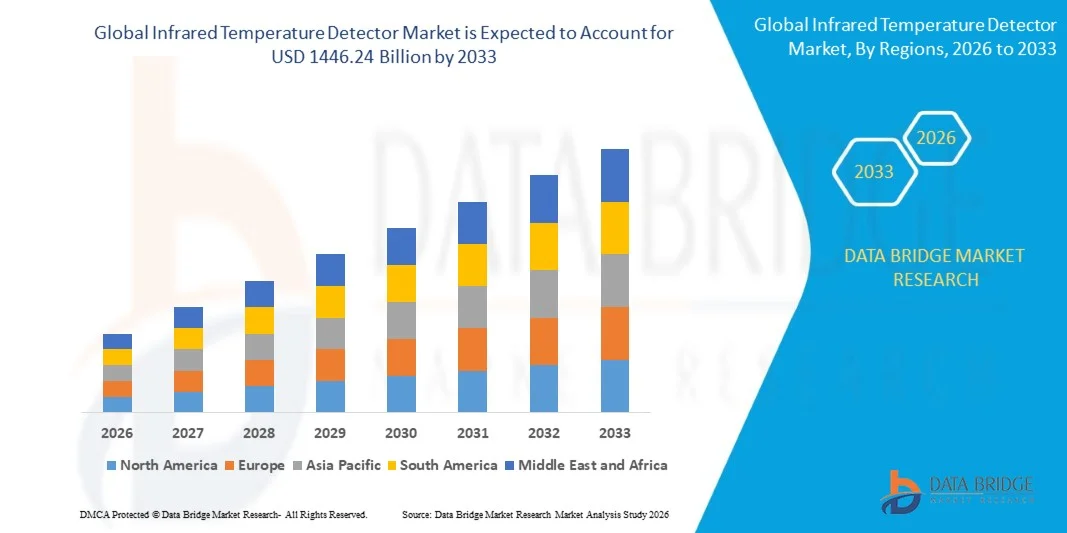
As per Data Bridge Market Research Analysis the infrared temperature detector market was valued at USD 660.14 billion in 2025 and is projected to reach USD 1446.24 billion by 2033, growing at a CAGR of 10.3% from 2026 to 2033. The market is experiencing consistent growth driven by rising demand for accurate, non-contact temperature measurement solutions, rapid advancements in infrared detector hardware and software technologies, and expanding applications across industrial, defense, healthcare, and consumer electronics verticals. The increasing need for real-time thermal monitoring across manufacturing plants, process industries, and public safety environments, combined with growing adoption of uncooled infrared detector technologies, is accelerating market expansion globally.
The growing incidence of industrial accidents and workplace safety mandates globally, combined with stricter government regulations on process monitoring and quality control, is compelling industrial operators, healthcare institutions, and defense organizations to adopt advanced infrared temperature detection technologies. Uncooled infrared detectors — including thermopile, pyroelectric, and microbolometer types — are progressively replacing traditional contact-based temperature measurement instruments in many markets, offering cost-effective, non-invasive, and highly accurate thermal detection solutions for both industrial and non-industrial applications.
Market Size & Forecast
- Global Market Value (2025): USD 660.14 Billion
- Expected Market Value (2033): USD 1446.24 Billion
- Forecast CAGR (2026–2033): 10.3%
- Leading Region in 2025: North America
- Fastest Growing Region: Asia-Pacific
Key Market Trends & Insights
- North America dominated the Global Infrared Temperature Detector Market with the largest revenue share of 40% in 2025, supported by advanced defense and aerospace procurement programs, strong industrial IoT adoption, widespread deployment of infrared detectors in non-contact temperature measurement applications, and the presence of leading infrared technology manufacturers across the U.S. and Canada.
- Asia-Pacific is expected to be the fastest-growing region, projected to register the highest CAGR of over 11.5% (outpacing the global average) during the forecast period of 2022 to 2029. This is fuelled by rapid industrialization, rising investments in smart manufacturing and process automation, growing adoption of infrared temperature detectors in China, India, Japan, and South Korea, and expanding government focus on industrial safety and quality standards.
- The microbolometer segment led the type category with the dominant revenue share in 2024, driven by its cost-effectiveness, high sensitivity, ability to operate at room temperature without cooling requirements, and widespread adoption across industrial thermal imaging, non-contact temperature measurement, and smart building applications.
- Mercury cadmium telluride (MCT) detectors are among the fastest-growing type segments, projected to register a strong CAGR through the forecast period, reflecting surging demand for high-sensitivity, cooled infrared detectors in defense, aerospace, and advanced scientific instrumentation applications requiring superior thermal resolution and long-range detection capability.
- The uncooled infrared detector segment dominated the technology category in 2024, preferred across industrial, non-industrial, and commercial applications for its significantly lower cost, compact form factor, lower power consumption, and ease of integration compared to cooled infrared detector systems. The global infrared temperature detector market was valued at USD 446.00 million in 2021 and is projected to grow to USD 977.10 million by 2029, reflecting sustained demand for uncooled detector technologies.
- The long-wave infrared (LWIR) wavelength segment dominated the Wavelength category in 2025, driven by its superior thermal imaging performance at ambient temperatures, making it the preferred wavelength band for non-contact temperature measurement, industrial process monitoring, and security and surveillance applications across both industrial and non-industrial verticals.
- The non-contact temperature measurement application segment dominated the application category in 2024, accounting for the largest revenue share, driven by widespread adoption across manufacturing, food processing, pharmaceutical production, and healthcare sectors where accurate, real-time, and non-invasive thermal monitoring is critical for process quality control and safety compliance. The global market is projected to grow at a global CAGR of 10.30%, with non-contact temperature measurement remaining the primary application driver.
- The industrial segment dominated the vertical category in 2022, supported by large-scale deployment of infrared temperature detectors across manufacturing, oil and gas, chemicals, power generation, and automotive industries for predictive maintenance, process temperature monitoring, and equipment condition assessment. The industrial segment benefits from increasing adoption of Industry 4.0 frameworks and smart factory automation, which are driving integration of infrared thermal sensors into connected industrial IoT ecosystems.
Report Scope and Infrared Temperature Detector Market Segmentation
|
Attributes |
Infrared Temperature Detector Key Market Insights |
|
Segments Covered |
|
|
Countries Covered |
North America
Europe
Asia-Pacific
Middle East and Africa
South America
|
|
Key Market Players |
|
|
Market Opportunities |
|
|
Value Added Data Infosets |
In addition to the insights on market scenarios such as market value, growth rate, segmentation, geographical coverage, and major players, the market reports curated by the Data Bridge Market Research also include in-depth expert analysis, geographically represented company-wise production and capacity, network layouts of distributors and partners, detailed and updated price trend analysis and deficit analysis of supply chain and demand. |
Infrared Temperature Detector Market Trends
Trend: Growing Integration of Infrared Temperature Detection in Industrial IoT and Smart Manufacturing Ecosystems
Industrial operators and process manufacturers are increasingly embedding infrared temperature detectors into connected Industry 4.0 and Industrial IoT (IIoT) frameworks to enable real-time, continuous thermal monitoring of equipment, production lines, and critical infrastructure. The integration of microbolometer and thermopile-based sensors with cloud-connected data platforms and AI-driven predictive maintenance systems is enabling facilities to detect thermal anomalies, prevent equipment failures, and optimize energy consumption at unprecedented levels of accuracy and efficiency. The thermopile and microbolometer infrared detector market was valued at USD 3.8 billion in 2025 and is projected to reach USD 7.4 billion by 2034 at a CAGR of 8.3%, reflecting the scale of industrial adoption driving this trend. The growing deployment of uncooled infrared detectors — which accounted for 83.71% of the market in 2025 — across smart factory environments is further reinforcing the integration of infrared temperature detection into automated industrial monitoring ecosystems.
Infrared Temperature Detector Market Dynamics
Key Market Driver: Rising Demand for Non-Contact Temperature Measurement Across Industrial and Healthcare Verticals
The accelerating adoption of non-contact infrared temperature measurement technologies across industrial process control, predictive maintenance, healthcare diagnostics, and public safety applications is the primary driver of the Global Infrared Temperature Detector Market. Industrial operators are deploying infrared detectors to monitor equipment temperatures in real time without process interruption, while healthcare institutions are leveraging thermopile and pyroelectric-based sensors for patient temperature screening and diagnostics. The global infrared detector market is projected to grow from USD 0.65 billion in 2025 to USD 1.02 billion by 2030 at a CAGR of 9.6%, with non-contact temperature measurement remaining the dominant application driver. Furthermore, the global infrared detectors market was valued at USD 598 billion in 2024 and is expected to surpass USD 1,447 billion by 2034 at a CAGR of 10.3%, underscoring the sustained demand momentum across industrial and non-industrial verticals.
Key Restraint/Challenge: High Cost of Cooled Infrared Detector Systems and Cryogenic Cooling Infrastructure
A significant restraint in the Global Infrared Temperature Detector Market is the high procurement, installation, and operational cost associated with cooled infrared detector systems — including Mercury Cadmium Telluride (MCT) and Indium Gallium Arsenide (InGaAs) quantum detectors — which require complex cryogenic cooling infrastructure to achieve their high-sensitivity performance characteristics. The total cost of ownership for cooled infrared detector systems extends to cryogenic cooling units, periodic maintenance, and specialized technical support, making adoption difficult for cost-sensitive industrial operators, smaller research institutions, and emerging-market organizations. This cost barrier has historically limited the penetration of high-performance cooled infrared detectors beyond well-funded defense, aerospace, and advanced scientific research applications, constraining broader market expansion into price-sensitive industrial and commercial segments. The infrared detector market was valued at USD 538 million in 2023 and is expected to reach USD 1180.80 million by 2032 at a CAGR of 10.3%, with cost sensitivity remaining a persistent adoption challenge across emerging markets.
Key Market Opportunity: Expanding Deployment of Uncooled Infrared Detectors in Emerging Industrial and Consumer Applications
The rapid advancement and cost reduction of uncooled infrared detector technologies — particularly microbolometer and thermopile-based sensors — presents a significant market opportunity for infrared temperature detector manufacturers serving industrial, consumer electronics, automotive, and smart building markets. Uncooled detectors, which accounted for 83.71% of the infrared detector market in 2025, are increasingly being integrated into automotive night-vision systems, building energy management platforms, wearable health monitoring devices, and industrial IoT sensor networks, dramatically expanding the addressable market beyond traditional defense and scientific applications.
Infrared Temperature Detector Market Scope
The infrared temperature detector market is segmented on the basis of type, technology, wavelength, application, and vertical.
- By Type
On the basis of type, the global infrared temperature detector market is segmented into mercury cadmium telluride (MCT), indium gallium arsenide (INGAAS), pyroelectric, thermopile, microbolometer, thermal detector, photo detector, and others.
The Microbolometer segment dominated the Type category with a 64.27% revenue share in 2025, driven by its proven capability to deliver high-sensitivity thermal imaging and temperature detection without requiring cryogenic cooling infrastructure, making it the most cost-effective and widely deployable infrared detector type across industrial process monitoring, non-contact temperature measurement, smart building management, and public safety applications. Microbolometer-based detectors benefit from continuous advancements in vanadium oxide (VOx) and amorphous silicon (a-Si) thin-film technologies, which are progressively improving detector sensitivity, reducing pixel pitch, and lowering manufacturing costs, further reinforcing the segment's dominant market position. The thermopile and microbolometer infrared detector market was valued at USD 3.8 billion in 2025 and is projected to reach USD 7.4 billion by 2034 at a CAGR of 8.3%, reflecting the scale of adoption driving microbolometer segment growth.
The mercury cadmium telluride (MCT) segment is the fastest-growing type, projected to register the highest CAGR through the forecast period, driven by surging demand for high-sensitivity, long-range infrared detection in defense surveillance, missile guidance, aerospace imaging, and advanced scientific instrumentation applications. MCT detectors deliver superior quantum efficiency, broad spectral response across mid-wave and long-wave infrared bands, and exceptional signal-to-noise performance, making them the preferred detector type for mission-critical defense and aerospace programs. Increasing defense procurement budgets across North America, Europe, and Asia-Pacific are primary growth catalysts for the MCT segment.
- By Technology
On the basis of technology, the global infrared temperature detector market is segmented into cooled infrared detector (includes quantum detectors) and uncooled infrared detector.
The uncooled infrared detector segment dominated the Technology category with an 83.71% market share in 2025, preferred across industrial, commercial, healthcare, and consumer electronics applications for its significantly lower cost, compact and lightweight form factor, lower power consumption, ambient temperature operation, and ease of integration into portable and IoT-connected devices compared to cooled infrared detector systems. The dominance of uncooled detectors is further reinforced by continuous improvements in microbolometer and thermopile sensor performance, which are progressively narrowing the sensitivity gap with cooled detector systems for many commercial and industrial temperature measurement applications.
The cooled infrared detector (quantum detectors) segment, while representing a smaller revenue share, commands significantly higher average selling prices and remains the preferred technology for high-performance defense, aerospace, and scientific research applications requiring ultra-high sensitivity, superior thermal resolution, and long-range detection capability. Cooled quantum detectors — including MCT and InGaAs types — operate at cryogenic temperatures to minimize thermal noise and achieve detection performance levels unattainable by uncooled technologies, making them indispensable for military surveillance, missile seeker systems, and advanced spectroscopy applications.
- By Wavelength
The long-wave infrared (LWIR) segment dominated the wavelength category in 2025, driven by its superior capability to detect thermal radiation emitted by objects at ambient and elevated temperatures across the 8–14 µm spectral band, making it the preferred wavelength range for non-contact temperature measurement, industrial thermal imaging, building energy auditing, and security and surveillance applications. LWIR detectors are compatible with the dominant uncooled microbolometer technology platform, enabling cost-effective, room-temperature operation across a broad range of industrial and commercial temperature measurement use cases. The widespread deployment of LWIR-based infrared cameras and sensors across manufacturing, power generation, and smart building management applications is reinforcing the segment's leading market position.
The mid-wave infrared (MWIR) segment is the fastest-growing wavelength category, projected to register the highest CAGR through the forecast period, driven by surging demand for high-performance cooled infrared detectors in defense targeting systems, airborne surveillance platforms, and industrial high-temperature process monitoring applications. MWIR detectors operating in the 3–5 µm spectral band deliver superior contrast and sensitivity for detecting high-temperature industrial processes and fast-moving thermal targets, making them increasingly preferred for advanced defense, aerospace, and industrial inspection applications.
- By Application
The non-contact temperature measurement segment dominated the application category in 2025, accounting for the largest revenue share, driven by widespread and accelerating adoption across manufacturing, food and beverage processing, pharmaceutical production, healthcare diagnostics, power generation, and public safety applications where accurate, real-time, non-invasive thermal monitoring is critical for process quality control, equipment safety, and regulatory compliance. Non-contact infrared temperature measurement eliminates the risks of contamination, process interruption, and measurement inaccuracy associated with contact-based methods, making it the strongly preferred temperature measurement approach across high-temperature industrial environments and hygiene-sensitive applications. The global infrared detector market is projected to grow from USD 0.65 billion in 2025 to USD 1.02 billion by 2030 at a CAGR of 9.6%, with non-contact temperature measurement remaining the primary application driver throughout the forecast period.
The contact-based temperature measurement segment remains a significant contributor to the market, particularly in precision laboratory, calibration, and low-cost industrial applications where direct physical contact with the measurement target is feasible and acceptable. However, the segment is experiencing slower growth relative to non-contact measurement, as industrial operators increasingly transition to infrared-based non-contact solutions to improve measurement efficiency, reduce maintenance requirements, and enable integration with automated process control and IIoT monitoring platforms.
- By Vertical
The industrial vertical dominated the market in 2025, supported by large-scale deployment of infrared temperature detectors across manufacturing, oil and gas, chemicals, power generation, automotive, and metals and mining industries for predictive maintenance, process temperature monitoring, equipment condition assessment, and quality control applications. The accelerating adoption of Industry 4.0 and IIoT frameworks is driving integration of infrared thermal sensors into connected industrial monitoring ecosystems, enabling real-time, continuous temperature surveillance across complex production environments. The global infrared detectors market was valued at USD 683.8 million in 2024 and is expected to surpass USD 1,641.9 million by 2034 at a CAGR of 1-.3%, with the industrial vertical accounting for the dominant share of this growth driven by expanding predictive maintenance and process automation investments.
The non-industrial vertical is the fastest-growing segment, projected to register the highest CAGR through the forecast period, driven by rapidly expanding adoption of infrared temperature detectors across healthcare diagnostics, smart building energy management, consumer electronics, automotive night-vision systems, and public safety applications. The post-pandemic acceleration of non-contact temperature screening in healthcare and public spaces, combined with growing integration of infrared sensors into smart home devices, wearable health monitors, and automotive driver assistance systems, is creating significant new growth vectors for infrared temperature detector manufacturers beyond traditional industrial markets.
Infrared Temperature Detector Market Regional Analysis
North America dominated the Infrared Temperature Detector Market and accounted for the largest revenue share of 40% in 2025, supported by advanced defense and aerospace procurement infrastructure, strong investments in infrared detector technologies, and the presence of established technology manufacturers including Teledyne FLIR, Honeywell International, Excelitas Technologies, and Raytheon Technologies. The region also benefits from stringent industrial safety and process monitoring regulations, high adoption of uncooled microbolometer and cooled quantum detector platforms, and growing deployment of infrared temperature detectors across industrial predictive maintenance, healthcare diagnostics, and autonomous vehicle development applications. Increasing focus on next-generation defense surveillance systems, smart manufacturing, and non-contact temperature measurement solutions continues to strengthen North America's leadership position in the global market.
Europe Infrared Temperature Detector Market Insight
The Europe Infrared Temperature Detector Market is experiencing steady growth, supported by rising adoption of infrared thermal detection technologies across industrial process monitoring, smart building energy management, automotive safety testing, and defense surveillance applications. Increasing investments in advanced infrared sensor infrastructure, growing demand for non-contact temperature measurement solutions across pharmaceutical manufacturing and food processing industries, and strong focus on industrial safety compliance and energy efficiency are contributing to market growth. Furthermore, the integration of LWIR microbolometer sensors, AI-powered thermal analytics, and IIoT-connected monitoring platforms is improving detector performance and operational efficiency, positioning Europe — home to leading manufacturers including LYNRED (Sofradir), InfraTec GmbH, and Xenics NV — as a key innovation hub in the global Infrared Temperature Detector industry. The global infrared detector market was valued at USD 0.65 billion in 2025 and is projected to reach USD 1.02 billion by 2030 at a CAGR of 9.6%, with Europe maintaining a significant revenue contribution.
Germany Infrared Temperature Detector Market Insight
The Germany Infrared Temperature Detector Market is expanding steadily due to the country's strong industrial manufacturing base, advanced engineering research capabilities, and increasing adoption of next-generation infrared thermal detection technologies across smart factory, automotive, and energy management applications. Industrial companies, automotive OEMs, and research institutes are increasingly deploying microbolometer and thermopile-based infrared detectors for predictive maintenance, process temperature monitoring, and non-contact quality control activities. Continuous advancements in uncooled infrared detector technologies, AI-driven thermal analytics integration, and IIoT connectivity, along with strong government focus on industrial digitalization and energy efficiency under the industry 4.0 framework, are further driving market growth in Germany.
U.S. Infrared Temperature Detector Market Insight
The U.S. Infrared Temperature Detector Market is witnessing strong growth due to rising investments in advanced defense surveillance programs, industrial predictive maintenance platforms, and non-contact temperature measurement technologies across healthcare, manufacturing, and public safety applications. The country's mature defense and aerospace ecosystem, along with increasing adoption of high-performance cooled MCT and InGaAs quantum detectors for military targeting systems and uncooled microbolometer sensors for commercial industrial applications, is driving demand across defense, industrial, and research verticals. In addition, growing emphasis on smart manufacturing adoption, IIoT-connected thermal monitoring infrastructure, and autonomous vehicle night-vision system integration is accelerating infrared temperature detector adoption across industrial operators, automotive OEMs, and government defense agencies. The global infrared detector market is projected to grow from USD 666.39 million in 2024 to USD 1,007.29 million by 2032, with the U.S. accounting for the largest national revenue share throughout the forecast period.
Asia-Pacific Infrared Temperature Detector Market Insight
The Asia-Pacific Infrared Temperature Detector Market is expected to witness rapid growth, driven by increasing industrialization, expanding smart manufacturing investments, and rising deployment of infrared temperature detectors across process industries, automotive production, healthcare, and public safety applications across countries such as China, India, Japan, and South Korea. Growing awareness regarding industrial safety compliance, rising adoption of uncooled microbolometer and thermopile-based infrared detection technologies, and increasing demand for scalable and cost-effective non-contact temperature measurement solutions are supporting regional market expansion. Additionally, the growing presence of electronics and semiconductor manufacturing facilities, expanding defense modernization programs, and large-scale government investments in smart city and smart infrastructure initiatives are accelerating infrared temperature detector adoption across both industrial and non-industrial sectors.
Japan Infrared temperature detector Market Insight
The Japan Infrared Temperature Detector Market is witnessing consistent growth due to rising investments in advanced industrial thermal monitoring technologies, automotive innovation, and smart manufacturing initiatives under the Society 5.0 framework. Industrial manufacturers, automotive OEMs including Toyota and Honda, and research institutes are increasingly adopting high-performance microbolometer and thermopile-based infrared detectors for equipment predictive maintenance, vehicle thermal management testing, and non-contact process temperature measurement. Moreover, increasing integration of infrared sensors into IIoT-connected smart factory platforms, combined with Japan's strong focus on precision manufacturing, energy efficiency, and advanced robotics, is further contributing to market growth. Leading domestic manufacturers including Hamamatsu Photonics, Murata Manufacturing, and Panasonic Corporation are reinforcing Japan's position as a key technology contributor in the global infrared temperature detector market.
China Infrared temperature detector Market Insight
The China Infrared Temperature Detector Market is growing rapidly, driven by increasing industrialization, expanding smart manufacturing infrastructure, and rising government focus on industrial safety compliance, energy efficiency, and public health monitoring. Growing adoption of AI-enabled and IIoT-connected microbolometer and thermopile-based infrared detection platforms across industrial process monitoring, automotive manufacturing, defense surveillance, and healthcare temperature screening applications is significantly boosting market demand. In addition, rising investments in semiconductor and electronics manufacturing, accelerating deployment of infrared sensors in smart city surveillance and public safety infrastructure, and rapid technological advancements in domestic infrared detector manufacturing capabilities are positioning China as one of the fastest-growing markets for Infrared Temperature Detectors globally.
Infrared Temperature Detector Market Share
The infrared temperature detector industry is primarily led by well-established companies, including:
- Teledyne FLIR LLC (U.S.)
- Honeywell International Inc. (U.S.)
- Hamamatsu Photonics K.K. (Japan)
- Excelitas Technologies Corp. (U.S.)
- Texas Instruments Incorporated (U.S.)
- RTX Corporation (U.S.)
- Leonardo DRS, Inc. (U.S.)
- LYNRED (France)
- Murata Manufacturing Co., Ltd. (Japan)
- Panasonic Corporation (Japan)
- Teledyne Technologies Incorporated (U.S.)
- InfraTec GmbH (Germany)
- Xenics nv (Belgium)
- Sensors Unlimited, Inc. (U.S.)
- VIGO Photonics S.A. (Poland)
- Heimann Sensor GmbH (Germany)
- Melexis N.V. (Belgium)
- TE Connectivity plc (Switzerland)
- Nippon Ceramic Co., Ltd. (Japan)
- Fluke Corporation (U.S.)
Latest Developments in Infrared Temperature Detector Market
- In February 2026, LYNRED unveiled YOCTO1024, a new ultra-compact 8µm pixel pitch uncooled microbolometer. Delivering XGA format in an unprecedentedly small footprint, this new infrared detector sets a new benchmark for uncooled thermal imaging across defense, surveillance, and non-industrial applications. This development reinforces LYNRED's position as a leading European manufacturer in the uncooled infrared detector segment.
- In December 2025, Teledyne Technologies Incorporated (the parent company of Teledyne FLIR) was awarded major contracts by the U.S. Space Development Agency (SDA) for the Tranche 3 Tracking Layer missile warning and tracking satellites. Teledyne was selected to supply advanced space-based cooled infrared detectors to three of the four prime contractors. This development highlights the surging demand for high-performance infrared detectors in advanced aerospace and defense verticals.
- In March 2026, Honeywell International Inc. launched a new 4-Series Non-Dispersive Infrared (NDIR) Hydrocarbon Gas Sensor. Utilizing advanced optical infrared technology, this sensor is designed to detect flammable gases and monitor thermal environments in harsh industrial settings like mining, oil and gas, and petrochemicals. The infrared integration allows the sensor to consume significantly less power than traditional sensors, expanding its utility in portable industrial safety and predictive monitoring applications.
- In July 2024, Hamamatsu Photonics K.K. expanded its near-infrared portfolio with the rollout of an ultra-high-speed InGaAs PIN photodiode. Operating at a low reverse voltage, this InGaAs detector is engineered for exceptional signal-to-noise ratios and maximizes light capture in a small photosensitive area. The development targets the rapidly growing demand for high-speed optical data transmission and precision non-contact infrared sensing across industrial and scientific verticals.
- In May 2026, Dataintelo published an updated industry report on the Thermopile and Microbolometer Infrared Detector Market, revealing that the global market for these specific detector types was valued at approximately USD 3.8 billion in 2025. The segment is projected to reach USD 7.4 billion by 2034 at a CAGR of 8.3%. This rapid growth is heavily driven by the smart home and building automation sectors, which are increasingly integrating microbolometer and thermopile arrays for intelligent non-contact temperature control and occupancy monitoring.

- Interactive Data Analysis Dashboard
- Company Analysis Dashboard for high growth potential opportunities
- Research Analyst Access for customization & queries
- Competitor Analysis with Interactive dashboard
- Latest News, Updates & Trend analysis
- Harness the Power of Benchmark Analysis for Comprehensive Competitor Tracking
Global Infrared Temperature Detector Market, Supply Chain Analysis and Ecosystem Framework
To support market growth and help clients navigate the impact of geopolitical shifts, DBMR has integrated in-depth supply chain analysis into its Global Infrared Temperature Detector Market research reports. This addition empowers clients to respond effectively to global changes affecting their industries. The supply chain analysis section includes detailed insights such as Global Infrared Temperature Detector Market consumption and production by country, price trend analysis, the impact of tariffs and geopolitical developments, and import and export trends by country and HSN code. It also highlights major suppliers with data on production capacity and company profiles, as well as key importers and exporters. In addition to research, DBMR offers specialized supply chain consulting services backed by over a decade of experience, providing solutions like supplier discovery, supplier risk assessment, price trend analysis, impact evaluation of inflation and trade route changes, and comprehensive market trend analysis.
Data collection and base year analysis are done using data collection modules with large sample sizes. The stage includes obtaining market information or related data through various sources and strategies. It includes examining and planning all the data acquired from the past in advance. It likewise envelops the examination of information inconsistencies seen across different information sources. The market data is analysed and estimated using market statistical and coherent models. Also, market share analysis and key trend analysis are the major success factors in the market report. To know more, please request an analyst call or drop down your inquiry.
The key research methodology used by DBMR research team is data triangulation which involves data mining, analysis of the impact of data variables on the market and primary (industry expert) validation. Data models include Vendor Positioning Grid, Market Time Line Analysis, Market Overview and Guide, Company Positioning Grid, Patent Analysis, Pricing Analysis, Company Market Share Analysis, Standards of Measurement, Global versus Regional and Vendor Share Analysis. To know more about the research methodology, drop in an inquiry to speak to our industry experts.
Data Bridge Market Research is a leader in advanced formative research. We take pride in servicing our existing and new customers with data and analysis that match and suits their goal. The report can be customized to include price trend analysis of target brands understanding the market for additional countries (ask for the list of countries), clinical trial results data, literature review, refurbished market and product base analysis. Market analysis of target competitors can be analyzed from technology-based analysis to market portfolio strategies. We can add as many competitors that you require data about in the format and data style you are looking for. Our team of analysts can also provide you data in crude raw excel files pivot tables (Fact book) or can assist you in creating presentations from the data sets available in the report.













