


What is the Inline Camera Inspection Market Size and Growth Rate?
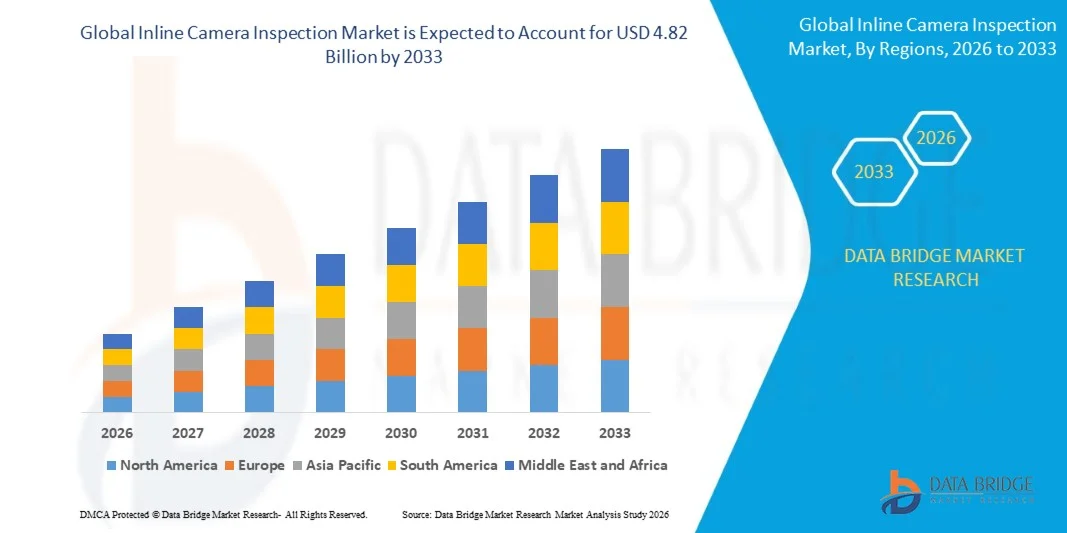
- As per Data Bridge Market Research analysis the inline camera inspection market was valued at USD 2.55 billion in 2025 and is projected to reach USD 4.82 billion by 2033, growing at a CAGR of 8.30% from 2026 to 2033.
- The market is experiencing robust growth driven by the increasing adoption of Industry 4.0 and smart manufacturing initiatives worldwide. A significant driver is the rising demand for AI-powered automated quality inspection systems to replace traditional labour-intensive manual inspection methods.
- Government initiatives promoting factory digitization, such as Germany's Industries 4.0 program and the U.S. CHIPS for America Act, are further accelerating the deployment of machine vision systems for real-time inspection and quality assurance.
Market Size & Forecast
- Market Value (2025): USD 2.55 Billion
- Expected Market Value (2033): USD 4.82 Billion
- Forecast CAGR (2026–2033): 8.30%
- Leading Region in 2025: North America
- Fastest Growing Region: Asia-Pacific
What are the Major Takeaways of the Inline Camera Inspection Market?
- North America dominated the inline camera inspection market and accounted for the largest revenue share of 30.3% in 2025, supported by the widespread adoption of industrial automation, advanced machine vision technologies, and strong investments in smart manufacturing across key industries such as food & beverage, pharmaceuticals, automotive, and electronics.
- Asia-Pacific inline camera inspection market is expected to register the fastest growth rate from 2026 to 2033, supported by rapid industrialization, expanding manufacturing capacity, and increasing investments in factory automation across China, Japan, South Korea, and India.
- The PC-based camera inspection systems segment dominated the market in 2025, owing to their superior processing capabilities, flexibility, and ability to support complex multi-camera inspection applications. These systems are widely deployed across automotive, electronics, pharmaceutical, and food manufacturing facilities where high-speed production lines require advanced image processing, AI-based defect detection, and real-time quality control. Their scalability and compatibility with industrial automation platforms continue to support segment dominance.
- The embedded vision inspection systems segment is projected to register the fastest growth from 2026 to 2033, driven by increasing adoption of compact AI-enabled vision systems, edge computing, and Industry 4.0 technologies. Their low power consumption, reduced hardware footprint, and ability to perform real-time inspection at the production line are accelerating deployment across smart manufacturing facilities.
- The 2D inspection systems segment accounted for the largest market share in 2025, supported by their widespread use for surface inspection, barcode reading, label verification, dimensional measurement, and defect detection across high-volume manufacturing operations. Their lower implementation cost, high inspection speed, and ease of integration with existing production lines make them the preferred choice across multiple industries.
- The 3D inspection systems segment is expected to witness the fastest growth during the forecast period from 2026 to 2033, driven by increasing demand for high-precision dimensional analysis, complex component inspection, and robotic automation. Advances in laser profiling, structured light imaging, and AI-powered machine vision are significantly improving inspection accuracy across automotive, semiconductor, and electronics manufacturing applications.
Report Scope and Inline Camera Inspection Market Segmentation
|
Attributes |
Inline Camera Inspection Key Market Insights |
|
Segments Covered |
|
|
Countries Covered |
North America
Europe
Asia-Pacific
Middle East and Africa
South America
|
|
Key Market Players |
|
|
Market Opportunities |
|
|
Value Added Data Infosets |
In addition to the insights on market scenarios such as market value, growth rate, segmentation, geographical coverage, and major players, the market reports curated by the Data Bridge Market Research also include in-depth expert analysis, geographically represented company-wise production and capacity, network layouts of distributors and partners, detailed and updated price trend analysis and deficit analysis of supply chain and demand. |
What is the Key Trend in the Inline Camera Inspection Market?
- The increasing adoption of AI-powered machine vision and deep learning-based inline inspection systems is transforming quality control across high-speed manufacturing industries by enabling real-time defect detection, reducing false rejects, and improving production efficiency.
- For instance, KEYENCE Corporation launched the IM-X1000 Image Dimension Measurement System and the LJ-X8000 Series 2D/3D Laser Profiler, enabling automated inline dimensional inspection, defect detection, and high-speed quality verification for automotive, electronics, semiconductor, and precision manufacturing applications.
- AI-enabled vision systems process high-resolution images in real time, allowing manufacturers to detect complex defects, improve traceability, and maintain consistent product quality without interrupting production.
- Electronics, food & beverage, pharmaceutical, and semiconductor manufacturers are increasingly deploying AI-enabled inline vision systems to automate inspection, improve production yield, and reduce manual quality checks.
- As manufacturers continue investing in Industry 4.0, factory automation, and AI-driven quality assurance, the deployment of advanced inline camera inspection systems is expected to accelerate, making intelligent machine vision a core component of modern manufacturing.
What are the Key Drivers of the Inline Camera Inspection Market?
- The growing need for automated quality assurance, higher production throughput, and zero-defect manufacturing is significantly increasing demand for inline camera inspection systems capable of performing continuous, real-time inspection on high-speed production lines.
- Manufacturers are increasingly integrating AI-powered machine vision into production processes to improve inspection accuracy, reduce manual intervention, minimize production waste, and strengthen product traceability.
- For instance, Cognex Corporation expanded its AI-powered machine vision portfolio with enhanced edge-learning capabilities in the In-Sight vision system family, enabling manufacturers to automate complex visual inspection tasks across electronics, automotive, and logistics industries.
- As industries continue expanding smart manufacturing and digital factory initiatives, inline camera inspection systems will remain essential for achieving consistent product quality, operational efficiency, and regulatory compliance.
Which Factors are Challenging the Growth of the Inline Camera Inspection Market?
- Advanced inline camera inspection systems require substantial investment due to the integration of high-resolution industrial cameras, AI-enabled software, specialized optics, lighting systems, computing hardware, and production-line integration.
- These high implementation costs limit adoption among small and medium-sized manufacturers, particularly in emerging economies where production automation budgets remain constrained.
- For instance, Cognex Corporation highlighted that manufacturer using separate vision inspection devices incur higher hardware, maintenance, cabling, and engineering costs, emphasizing that system complexity and implementation expenses remain major considerations when deploying inline machine vision solutions.
- In addition to capital expenditure, manufacturers often face challenges related to AI model training, system calibration, integration with factory automation infrastructure, and ongoing maintenance, increasing operational costs.
- The significant upfront investment and implementation complexity continue to slow adoption among cost-sensitive manufacturers, despite the growing demand for automated quality inspection and Industry 4.0 technologies.
How is the Inline Camera Inspection Market Segmented?
The inline camera inspection market is segmented on the basis of system architecture, imaging technology, application and end use industry.
- By System Architecture
On the basis of system architecture, the inline camera inspection market is segmented into smart camera inspection systems, PC-based camera inspection systems, and embedded vision inspection systems. The PC-based camera inspection systems segment dominated the market in 2025, owing to their superior processing capabilities, flexibility, and ability to support complex multi-camera inspection applications. These systems are widely deployed across automotive, electronics, pharmaceutical, and food manufacturing facilities where high-speed production lines require advanced image processing, AI-based defect detection, and real-time quality control. Their scalability and compatibility with industrial automation platforms continue to support segment dominance.
The embedded vision inspection systems segment is projected to register the fastest growth from 2026 to 2033, driven by increasing adoption of compact AI-enabled vision systems, edge computing, and Industry 4.0 technologies. Their low power consumption, reduced hardware footprint, and ability to perform real-time inspection at the production line are accelerating deployment across smart manufacturing facilities.
- By Imaging Technology
On the basis of imaging technology, the inline camera inspection market is segmented into 2D inspection systems and 3D inspection systems. The 2D inspection systems segment accounted for the largest market share in 2025, supported by their widespread use for surface inspection, barcode reading, label verification, dimensional measurement, and defect detection across high-volume manufacturing operations. Their lower implementation cost, high inspection speed, and ease of integration with existing production lines make them the preferred choice across multiple industries.
The 3D inspection systems segment is expected to witness the fastest growth during the forecast period from 2026 to 2033, driven by increasing demand for high-precision dimensional analysis, complex component inspection, and robotic automation. Advances in laser profiling, structured light imaging, and AI-powered machine vision are significantly improving inspection accuracy across automotive, semiconductor, and electronics manufacturing applications.
- By Application
On the basis of application, the inline camera inspection market is segmented into foreign material & contamination detection, visual defect detection, dimensional measurement & verification, identification, verification & traceability, and packaging integrity & seal inspection. The visual defect Detection segment dominated the market with the largest share in 2025 due to its extensive adoption for identifying scratches, dents, cracks, discoloration, missing components, and surface imperfections during high-speed manufacturing processes. Growing emphasis on product quality, regulatory compliance, and zero-defect manufacturing continues to support widespread deployment of automated visual inspection systems.
The identification, verification & traceability segment is anticipated to witness the fastest cagr from 2026 to 2033, driven by increasing implementation of serialization, barcode verification, QR code inspection, and digital product traceability across pharmaceutical, food & beverage, electronics, and medical device industries. Rising regulatory requirements and supply chain transparency initiatives are further accelerating segment growth.
- By End-Use Industry
On the basis of end-use industry, the inline camera inspection market is segmented into food & beverage, pharmaceuticals & biotech, automotive, electronics & semiconductors, medical devices, consumer goods, and personal care. The food & beverage segment dominated the market in 2025 owing to stringent food safety regulations, increasing demand for contamination detection, packaging integrity inspection, label verification, and quality assurance throughout food production processes. Manufacturers are increasingly adopting automated vision inspection systems to improve operational efficiency while ensuring compliance with international food safety standards.
The electronics & semiconductors segment is expected to register the fastest growth from 2026 to 2033, driven by increasing semiconductor manufacturing, miniaturization of electronic components, and rising quality requirements for printed circuit boards (PCBs), microchips, and advanced electronic assemblies. The growing adoption of AI-powered machine vision, high-resolution cameras, and precision metrology technologies is further accelerating the deployment of inline inspection systems across semiconductor fabrication and electronics manufacturing facilities.
Which Region Holds the Largest Share of the Inline Camera Inspection Market?
- North America dominated the inline camera inspection market and accounted for the largest revenue share of 30.3% in 2025, supported by the widespread adoption of industrial automation, advanced machine vision technologies, and strong investments in smart manufacturing across key industries such as food & beverage, pharmaceuticals, automotive, and electronics.
- The region also benefits from stringent product quality and safety regulations, early adoption of AI-enabled vision inspection systems, and the presence of leading machine vision solution providers. Increasing deployment of Industry 4.0 technologies, high-speed production lines, and real-time quality inspection solutions continues to strengthen North America's leadership position in the inline camera inspection market.
U.S. Inline Camera Inspection Market Insight
U.S. inline camera inspection market accounted for the largest revenue share within North America in 2025, driven by widespread implementation of automated quality inspection systems across pharmaceutical manufacturing, semiconductor fabrication, automotive production, and food processing industries. Manufacturers are increasingly integrating AI-enabled vision systems, high-speed industrial cameras, and real-time analytics to minimize production defects and improve operational efficiency. Furthermore, the growing adoption of digital manufacturing technologies and advanced robotics continues to accelerate market growth throughout the country.
Europe Inline Camera Inspection Market Insight
Europe inline camera inspection market is expected to witness significant growth from 2026 to 2033, primarily driven by stringent product quality regulations, increasing industrial automation, and growing adoption of smart manufacturing technologies. Rising investments in pharmaceutical production, automotive manufacturing, electronics assembly, and food safety compliance are encouraging manufacturers to deploy advanced machine vision inspection systems. In addition, Europe's strong emphasis on precision manufacturing and digital transformation continues to support sustained market expansion.
U.K. Inline Camera Inspection Market Insight
U.K. inline camera inspection market is expected to witness significant growth from 2026 to 2033, supported by increasing investments in automated manufacturing, pharmaceutical production, and food processing industries. Growing demand for high-speed defect detection, packaging inspection, and product traceability solutions is driving adoption across production facilities. Furthermore, the country's increasing implementation of Industry 4.0 initiatives and digital quality management systems is expected to further stimulate market growth.
Germany Inline Camera Inspection Market Insight
Germany inline camera inspection market is projected to experience strong growth from 2026 to 2033, fueled by its highly advanced manufacturing sector, strong automotive industry, and leadership in industrial automation technologies. Manufacturers are increasingly deploying AI-powered vision inspection systems to improve precision, reduce production errors, and support predictive quality control. The country's continued investment in smart factories and advanced robotics further strengthens demand for inline camera inspection solutions across automotive, electronics, and industrial manufacturing applications.
Asia-Pacific Inline Camera Inspection Market Insight
Asia-Pacific inline camera inspection market is expected to register the fastest growth rate from 2026 to 2033, supported by rapid industrialization, expanding manufacturing capacity, and increasing investments in factory automation across China, Japan, South Korea, and India. Rising production of electronics, semiconductors, pharmaceuticals, and packaged food products is accelerating demand for automated inspection systems capable of ensuring product quality and regulatory compliance. In addition, growing adoption of AI-based machine vision technologies and government initiatives promoting smart manufacturing continue to drive regional market expansion.
Japan Inline Camera Inspection Market Insight
Japan inline camera inspection market is expected to witness significant growth from 2026 to 2033 due to the country's technological leadership in robotics, precision manufacturing, and industrial automation. Increasing adoption of high-speed vision inspection systems across semiconductor manufacturing, electronics production, and medical device manufacturing is supporting market growth. Moreover, Japan's strong focus on zero-defect manufacturing and continuous technological innovation continues to encourage deployment of advanced inline inspection solutions.
China Inline Camera Inspection Market Insight
China inline camera inspection market accounted for the largest revenue share within Asia-Pacific in 2025, attributed to the country's massive manufacturing base, rapid adoption of industrial automation, and expanding electronics and semiconductor industries. Growing investments in smart factories, increasing production of consumer electronics, automotive components, pharmaceuticals, and packaged food products are driving demand for inline camera inspection systems. Furthermore, strong government support for intelligent manufacturing and the widespread adoption of AI-enabled machine vision technologies continue to reinforce China's leading position in the regional market.
Which are the Top Companies in Inline Camera Inspection Market?
The inline camera inspection industry is primarily led by well-established companies, including:
- Antares Vision S.p.A. (Italy)
- Mettler-Toledo International Inc. (U.S.)
- KEYENCE Corporation (Japan)
- OMRON Corporation (Japan)
- IMAGO Technologies GmbH (Germany)
- OPTEL Group (Canada)
- Baumer Holding AG (Switzerland)
- SEA Vision S.r.l. (Italy)
- SICK AG (Germany)
- Cognex Corporation (U.S.)
- Syntegon Technology GmbH (Germany)
- Teledyne Technologies Incorporated (U.S.)
- Videojet Technologies Inc. (U.S.)
- VITRONIC GmbH (Germany)
- Basler AG (Germany)
What are Latest Developments in Inline Camera Inspection Market?
- In March 2026, KEYENCE Corporation introduced the LJ-X8000 Series 2D/3D Laser Profiler, designed for high-speed inline inspection and precision measurement. The system delivers enhanced defect detection capabilities and supports AI-powered quality inspection across automotive, semiconductor, and electronics manufacturing applications.
- In March 2026, Cognex Corporation released its Annual State of Machine Vision and AI Study, highlighting that AI-enabled machine vision is growing faster than the overall machine vision market. The study found that manufacturers are increasingly investing in AI-integrated inline inspection systems to improve production throughput, inspection accuracy, and overall product quality.
- In February 2026, Teledyne Technologies Incorporated expanded its industrial imaging portfolio by launching two high-performance machine vision solutions for factory automation and precision inspection. The new products are designed for semiconductor, electronics, life sciences, and general industrial manufacturing, strengthening the company's inline inspection capabilities.
- In February 2026, OMRON Corporation announced new smart factory capabilities that integrate robotics, machine vision, and automation controllers with AI-driven inspection technologies. The solution enables high-speed inline quality inspection, improving defect detection accuracy while enhancing manufacturing productivity.
- In January 2026, SICK AG introduced integrated hardware and software solutions featuring intelligent machine vision and sensor technologies to support smart manufacturing. The solutions are designed to enhance inline quality control, product traceability, and production efficiency, helping manufacturers accelerate their transition toward Industry 4.0 and smart factory operations.

- Interactive Data Analysis Dashboard
- Company Analysis Dashboard for high growth potential opportunities
- Research Analyst Access for customization & queries
- Competitor Analysis with Interactive dashboard
- Latest News, Updates & Trend analysis
- Harness the Power of Benchmark Analysis for Comprehensive Competitor Tracking
Global Inline Camera Inspection Market, Supply Chain Analysis and Ecosystem Framework
To support market growth and help clients navigate the impact of geopolitical shifts, DBMR has integrated in-depth supply chain analysis into its Global Inline Camera Inspection Market research reports. This addition empowers clients to respond effectively to global changes affecting their industries. The supply chain analysis section includes detailed insights such as Global Inline Camera Inspection Market consumption and production by country, price trend analysis, the impact of tariffs and geopolitical developments, and import and export trends by country and HSN code. It also highlights major suppliers with data on production capacity and company profiles, as well as key importers and exporters. In addition to research, DBMR offers specialized supply chain consulting services backed by over a decade of experience, providing solutions like supplier discovery, supplier risk assessment, price trend analysis, impact evaluation of inflation and trade route changes, and comprehensive market trend analysis.
Data collection and base year analysis are done using data collection modules with large sample sizes. The stage includes obtaining market information or related data through various sources and strategies. It includes examining and planning all the data acquired from the past in advance. It likewise envelops the examination of information inconsistencies seen across different information sources. The market data is analysed and estimated using market statistical and coherent models. Also, market share analysis and key trend analysis are the major success factors in the market report. To know more, please request an analyst call or drop down your inquiry.
The key research methodology used by DBMR research team is data triangulation which involves data mining, analysis of the impact of data variables on the market and primary (industry expert) validation. Data models include Vendor Positioning Grid, Market Time Line Analysis, Market Overview and Guide, Company Positioning Grid, Patent Analysis, Pricing Analysis, Company Market Share Analysis, Standards of Measurement, Global versus Regional and Vendor Share Analysis. To know more about the research methodology, drop in an inquiry to speak to our industry experts.
Data Bridge Market Research is a leader in advanced formative research. We take pride in servicing our existing and new customers with data and analysis that match and suits their goal. The report can be customized to include price trend analysis of target brands understanding the market for additional countries (ask for the list of countries), clinical trial results data, literature review, refurbished market and product base analysis. Market analysis of target competitors can be analyzed from technology-based analysis to market portfolio strategies. We can add as many competitors that you require data about in the format and data style you are looking for. Our team of analysts can also provide you data in crude raw excel files pivot tables (Fact book) or can assist you in creating presentations from the data sets available in the report.













