


What is the Inline Viscosity Sensors Market Size and Growth Rate?
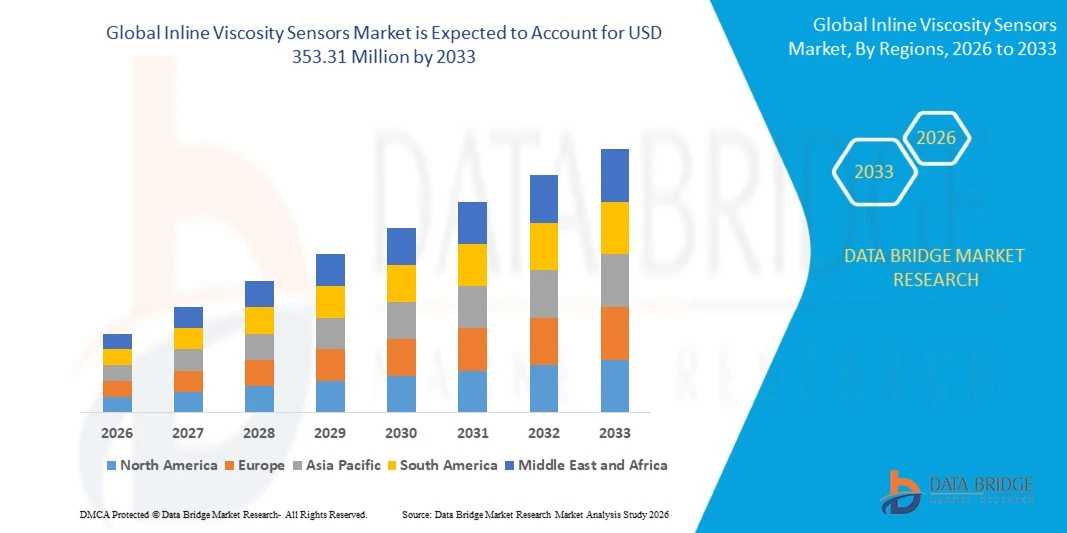
- As per Data Bridge Market Research analysis, the inline viscosity sensors market was valued at USD 210.30 million in 2025 and is projected to reach USD 353.31 million by 2033, growing at a CAGR of 6.70% from 2026 to 2033.
- The market is experiencing consistent growth driven by rising demand for real-time process monitoring, increasing adoption of automated quality control systems, and rapid advancements in smart sensor, industrial automation, and inline measurement technologies.
- The increasing need for accurate viscosity control across oil and gas, chemical manufacturing, food and beverage processing, pharmaceuticals, paints and coatings, and battery production is compelling manufacturers to adopt advanced inline viscosity sensing solutions. Continuous viscosity measurement enables real-time process optimization, early detection of viscosity variations, reduced product waste, and improved consistency, while integration with automated process control systems supports efficient production and enhanced quality management.
Market Size & Forecast
- Global Market Value (2025): USD 210.30 Million
- Expected Market Value (2033): USD 353.31 Million
- Forecast CAGR (2026–2033): 6.70%
- Leading Region in 2025: North America
- Fastest Growing Region: Asia Pacific
What are the Major Takeaways of the Inline Viscosity Sensors Market?
- North America dominated the Inline Viscosity Sensors market with the largest revenue share of 36.8% in 2025, supported by strong industrial automation, established oil and gas and chemical manufacturing sectors, increasing adoption of real-time process monitoring, and growing demand for automated quality control technologies.
- Asia-Pacific is expected to be the fastest-growing region at a CAGR of 8.1% from 2026 to 2033, fueled by rapid industrialization, expanding chemical and pharmaceutical manufacturing, increasing food and beverage production, and rising adoption of smart manufacturing and process automation technologies across China, Japan, India, and South Korea.
- The stand-alone sensors segment led the product type category with a 44.5% share in 2025, driven by their widespread use for direct viscosity measurement, relatively simple installation, and suitability across diverse industrial processing applications.
- Smart sensors are expected to be the fastest-growing product type, registering a CAGR of 8.4%, supported by increasing integration of real-time monitoring, digital connectivity, automated process control, and Industry 4.0 technologies.
- Rotational sensors dominated the technology category with a 32.6% revenue share in 2025, supported by their reliable viscosity measurement capabilities and established use across chemical processing, food and beverage, pharmaceuticals, and other industrial applications.
- The oil & gas segment accounted for the largest application share of 28.7% in 2025, driven by the need for continuous viscosity monitoring of crude oil, lubricants, fuels, and other process fluids to maintain product quality and optimize production efficiency.
- Continuous viscosity measurement is expected to be the fastest-growing operation type, with a CAGR of 7.6% from 2026 to 2033, driven by increasing demand for real-time process optimization, automated quality control, reduced production variability, and early detection of viscosity changes.
Report Scope and Inline Viscosity Sensors Market Segmentation
|
Attributes |
Inline Viscosity Sensors Key Market Insights |
|
Segments Covered |
|
|
Countries Covered |
North America
Europe
Asia-Pacific
Middle East and Africa
South America
|
|
Key Market Players |
|
|
Market Opportunities |
|
|
Value Added Data Infosets |
In addition to the insights on market scenarios such as market value, growth rate, segmentation, geographical coverage, and major players, the market reports curated by the Data Bridge Market Research also include in-depth expert analysis, geographically represented company-wise production and capacity, network layouts of distributors and partners, detailed and updated price trend analysis and deficit analysis of supply chain and demand. |
What is the Key Trend in the Inline Viscosity Sensors Market?
- Inline Viscosity Sensors are increasingly shifting toward smart sensing and real-time process monitoring, enabling manufacturers to continuously measure viscosity, identify process variations, and improve production consistency.
- For instance, in June 2025, Emerson expanded its measurement and analytical technologies to support more connected and automated industrial processes.
- Advanced viscosity sensors enable manufacturers to monitor fluid properties continuously, improving process control, reducing material waste, and supporting consistent product quality across industrial applications.
- Manufacturers are increasingly integrating Inline Viscosity Sensors with automated process control and digital monitoring systems to optimize production and enable faster responses to viscosity changes.
- For instance, in April 2025, Anton Paar highlighted advancements in process viscosity measurement and automated monitoring solutions for industrial applications.
- As industrial automation and real-time quality monitoring continue to expand, adoption of smart and connected Inline Viscosity Sensors is expected to increase across oil and gas, chemical manufacturing, pharmaceuticals, food and beverage processing, and other industries.
What are the Key Drivers of the Inline Viscosity Sensors Market?
- The rising demand for real-time process monitoring and automated quality control is significantly increasing the adoption of Inline Viscosity Sensors across industrial manufacturing applications.
- For instance, in March 2025, Emerson emphasized the growing role of measurement and automation technologies in improving industrial process efficiency and operational control.
- Increasing production of chemicals, pharmaceuticals, food and beverages, and petroleum products is creating greater demand for continuous viscosity measurement to maintain product consistency and process efficiency.
- Manufacturers are increasingly integrating Inline Viscosity Sensors with automated process control systems to detect viscosity variations, reduce production losses, and optimize operating conditions.
- For instance, in May 2025, Endress+Hauser highlighted the use of process measurement technologies for continuous monitoring and optimization across industrial production environments.
- The growing adoption of Industry 4.0 technologies, smart manufacturing, and connected industrial equipment is further supporting demand for intelligent viscosity monitoring solutions.
What Factors are Challenging the Growth of the Inline Viscosity Sensors Market?
- Inline Viscosity Sensors face challenges from high installation and maintenance costs, particularly for advanced systems requiring specialized equipment, integration, and calibration.
- For instance, in February 2025, Anton Paar highlighted the importance of appropriate sensor installation, calibration, and maintenance for achieving reliable viscosity measurements in demanding process environments.
- The need for regular calibration and sensor maintenance can increase operating costs and create technical challenges, particularly in demanding industrial environments.
- Integration with existing process control systems can also be complex, especially for manufacturers operating older production infrastructure and equipment.
- For instance, in July 2025, Emerson highlighted the importance of integrating measurement technologies with existing industrial automation infrastructure to improve process monitoring and control.
- High implementation costs, maintenance requirements, integration complexity, and the need for skilled technical personnel continue to restrict adoption, particularly among small and medium-sized manufacturers.
How is the Inline Viscosity Sensors Market Segmented?
The inline viscosity sensors market is segmented on the basis of product type, technology, application, operation type, and end user.
- By Product Type
On the basis of product type, the inline viscosity sensors market is segmented into stand-alone sensors, integrated sensors, and smart sensors. The stand-alone sensors segment dominated the market with 48.21% share in 2025, owing to their cost-effectiveness, simple integration, and broad applicability across industrial processes. These sensors are widely used in oil & gas, chemical manufacturing, food processing, and other applications where reliable viscosity monitoring is required. Their flexibility in installation and compatibility with existing process systems further support adoption.
The smart sensors segment is projected to register the fastest growth at a CAGR of 6.58% from 2026 to 2033, driven by increasing demand for connected monitoring, real-time process data, automation, and intelligent process control. Smart sensors enable manufacturers to continuously monitor viscosity and integrate measurement data with automated control systems. Growing adoption of industrial automation and Industry 4.0 technologies is further supporting demand.
- By Technology
On the basis of technology, the inline viscosity sensors market is segmented into rotational sensors, vibrational sensors, capillary sensors, ultrasonic sensors, optical sensors, and other technologies. The rotational sensors segment dominated the market with 34.1% share in 2025, supported by their established use for accurate and reliable viscosity measurement across industrial processes. These sensors are widely used in oil & gas, chemical manufacturing, food & beverage processing, pharmaceuticals, and paints & coatings. Their ability to provide continuous measurements under different operating conditions makes them suitable for automated process monitoring and quality control. Increasing demand for real-time viscosity monitoring is further supporting adoption.
The ultrasonic sensors segment is projected to register the fastest growth at a CAGR of 6.9% from 2026 to 2033, driven by increasing demand for non-invasive, continuous, and real-time viscosity measurement. Ultrasonic sensors support automated process monitoring while reducing the need for manual sampling and laboratory testing. Their increasing integration with digital process-control systems and industrial automation platforms is further supporting adoption. Growing demand for efficient process monitoring across chemical manufacturing, pharmaceuticals, food & beverage processing, and other industrial applications is expected to strengthen segment growth.
- By Application
On the basis of application, the inline viscosity sensors market is segmented into oil & gas, chemical manufacturing, food & beverage processing, pharmaceuticals, paints & coatings, battery production, water & wastewater treatment, and other applications. The oil & gas segment dominated the market with 33.84% share in 2025, owing to the increasing need for precise viscosity monitoring across upstream, midstream, and downstream operations. Continuous viscosity measurement helps operators maintain fluid quality, optimize processing conditions, and improve operational efficiency.
The food & beverage processing segment is projected to register the fastest growth at a CAGR of 6.96% from 2026 to 2033, driven by increasing automation, stringent quality-control requirements, and growing demand for consistent product characteristics. Inline viscosity measurement enables manufacturers to monitor products continuously and reduce dependence on manual sampling.
- By Indication
On the basis of indication, the Inline Viscosity Sensors market is segmented into oncology, infectious diseases, cardiovascular diseases, neurological disorders, and other indications. The oncology segment dominated the market with 55.0% share in 2025, supported by the increasing prevalence of cancer and growing adoption of precision oncology. Inline Viscosity Sensors help identify molecular characteristics of tumors and support selection of appropriate targeted treatments. PET and other molecular imaging approaches are increasingly used for tumor characterization and treatment monitoring. Growing availability of targeted cancer therapies is increasing the need for accurate patient stratification. Pharmaceutical companies are also investing heavily in oncology-focused diagnostic development.
The neurological disorders segment is expected to witness the fastest growth at a CAGR of 13.5% from 2026 to 2033, driven by increasing demand for advanced imaging biomarkers and early disease detection. Molecular imaging technologies are increasingly being investigated for neurological conditions such as Alzheimer’s disease and Parkinson’s disease. Improved visualization of disease-related biological changes is supporting more precise diagnosis and monitoring. Growing research into neurodegenerative biomarkers is expanding clinical applications. AI-based image analysis is also improving interpretation of complex neurological imaging data. An aging population and increasing burden of neurological disorders are supporting demand. Expansion of personalized approaches to neurological care is expected to further accelerate segment growth.
- By Operation Type
On the basis of operation type, the inline viscosity sensors market is segmented into continuous viscosity measurement and batch viscosity measurement. The continuous viscosity measurement segment dominated the market with 70.89% share in 2025, driven by its ability to provide real-time feedback for maintaining process stability and product quality. Continuous measurement allows manufacturers to identify viscosity variations quickly and adjust production conditions without interrupting operations.
The batch viscosity measurement segment is projected to register the fastest growth at a CAGR of 6.70% from 2026 to 2033, supported by increasing demand for precise formulation and quality control in batch-based production environments. Batch measurement is particularly relevant where products are manufactured according to specific formulations and require viscosity verification before subsequent processing stages.
- By End User
On the basis of end user, the inline viscosity sensors market is segmented into industrial, commercial, and other end users. The industrial segment dominated the market with 68.5% share in 2025, supported by extensive use of viscosity monitoring across oil & gas, chemical manufacturing, food & beverage processing, pharmaceuticals, paints & coatings, and other industrial applications. Increasing adoption of automated process monitoring, continuous quality control, and real-time viscosity measurement is further supporting demand for inline viscosity sensors.
The commercial segment is projected to register the fastest growth at a CAGR of 6.9% from 2026 to 2033, driven by increasing adoption of compact, connected, and easy-to-integrate viscosity monitoring solutions. Growing demand for automated measurement, improved process consistency, and reduced reliance on manual testing is supporting the use of inline viscosity sensors across commercial applications.
Which Region Holds the Largest Share of the Inline Viscosity Sensors Market?
- North America dominated the inline viscosity sensors market with the largest revenue share of 39.8% in 2025, supported by strong industrial automation, established oil & gas and chemical manufacturing industries, increasing adoption of real-time process monitoring, and growing demand for automated viscosity measurement.
- The region also benefits from advanced manufacturing infrastructure, increasing adoption of smart sensors, strong presence of process instrumentation companies, and growing investments in Industry 4.0 technologies. Rising demand for continuous quality control and digital process optimization continues to strengthen North America’s position in the global market.
U.S. Inline Viscosity Sensors Market Insight
The U.S. inline viscosity sensors market is witnessing strong growth due to increasing adoption of industrial automation, real-time process monitoring, and smart manufacturing technologies. The country’s established oil & gas, chemical, pharmaceutical, food & beverage, and paints and coatings industries are driving demand for continuous viscosity measurement. In addition, growing integration of connected sensors with automated process-control systems is supporting wider adoption across manufacturing facilities.
Asia-Pacific Inline Viscosity Sensors Market Insight
The Asia-Pacific inline viscosity sensors market is expected to witness rapid growth at a CAGR of 8.8% from 2026 to 2033, driven by expanding manufacturing industries, increasing industrial automation, and rising investments in smart production technologies across China, Japan, India, and other countries. Growing chemical, pharmaceutical, food & beverage, battery, and oil & gas production is creating additional demand for continuous viscosity monitoring. Increasing adoption of Industry 4.0 technologies and automated quality-control systems is further supporting market expansion throughout the region.
Japan Inline Viscosity Sensors Market Insight
The Japan inline viscosity sensors market is witnessing consistent growth due to the country’s advanced manufacturing infrastructure, high level of industrial automation, and strong adoption of precision process-control technologies. Chemical, pharmaceutical, food processing, automotive, and electronics-related manufacturing industries are increasingly adopting automated measurement solutions to improve process consistency and production efficiency. Growing integration of smart sensors and digital monitoring systems is further contributing to market development.
China Inline Viscosity Sensors Market Insight
The China inline viscosity sensors market is growing rapidly, driven by expanding chemical manufacturing, oil & gas processing, pharmaceutical production, food & beverage manufacturing, and battery production. Increasing investments in industrial automation and smart manufacturing are boosting demand for real-time viscosity monitoring solutions. In addition, growing adoption of connected process-control systems and Industry 4.0 technologies is strengthening the use of inline viscosity sensors across Chinese manufacturing facilities.
U.K. Inline Viscosity Sensors Market Insight
The U.K. inline viscosity sensors market is experiencing steady growth, supported by increasing adoption of automated process monitoring and digital manufacturing technologies. The country’s chemical, pharmaceutical, food & beverage, oil & gas, and specialty manufacturing industries are creating demand for continuous viscosity measurement and automated quality control. Furthermore, increasing focus on production efficiency, process optimization, and connected industrial equipment is supporting market expansion.
Germany Inline Viscosity Sensors Market Insight
The Germany inline viscosity sensors market is expanding steadily due to the country’s strong manufacturing base, advanced industrial automation, and increasing adoption of Industry 4.0 technologies. Chemical manufacturing, pharmaceuticals, food processing, paints and coatings, and other industrial sectors are increasingly using inline viscosity monitoring to maintain consistent product quality and optimize production processes. Continuous investments in smart manufacturing, digital process control, and industrial automation are further driving market growth.
Which are the Top Companies in Inline Viscosity Sensors Market?
The inline viscosity sensors industry is primarily led by well-established companies, including:
- Anton Paar GmbH (Austria)
- Emerson Electric Co. (U.S.)
- Thermo Fisher Scientific Inc. (U.S.)
- Endress+Hauser Group Services AG (Switzerland)
- Vaisala Oyj (Finland)
- Brookfield Engineering Laboratories, Inc. (U.S.)
- VAF Instruments B.V. (Netherlands)
- Hydramotion Ltd. (U.K.)
- Marimex Industries Pvt. Ltd. (India)
- LORRIC Co., Ltd. (Taiwan)
- Cambridge Viscosity, Inc. (U.S.)
- Sofraser S.A.S. (France)
- Rheonics International AG (Switzerland)
- Integrated Sensing Systems, Inc. (U.S.)
- Micro Motion, Inc. (U.S.)
- KROHNE Messtechnik GmbH (Germany)
- Yokogawa Electric Corporation (Japan)
- AMETEK, Inc. (U.S.)
- PAC L.P. (U.S.)
- TEGAM, Inc. (U.S.)
What are Latest Developments in Inline Viscosity Sensors Market?
- In June 2025, Emerson highlighted advancements in intelligent measurement and automation technologies supporting real-time process monitoring and connected industrial operations. These developments strengthen the integration of smart sensing technologies with automated process-control systems, supporting more efficient viscosity monitoring across industrial applications.
- In April 2025, Anton Paar highlighted its process measurement solutions for monitoring fluid properties in industrial environments. The increasing availability of advanced viscosity measurement technologies supports manufacturers in improving process consistency, quality control, and production efficiency.
- In March 2025, Endress+Hauser highlighted advancements in process instrumentation and digital measurement technologies for continuous industrial monitoring. These developments support the integration of measurement solutions into automated production environments across chemical, pharmaceutical, food and beverage, and other industries.
- In September 2024, Rheonics highlighted the use of inline process viscosity measurement technologies for real-time monitoring and process control. Such developments support manufacturers in reducing dependence on laboratory sampling and responding more quickly to changes in process conditions.
- In November 2024, Vaisala highlighted advancements in industrial measurement and monitoring technologies designed to improve process reliability and operational efficiency. The growing availability of connected measurement solutions is supporting the broader adoption of real-time monitoring and automated quality-control systems.

- Interactive Data Analysis Dashboard
- Company Analysis Dashboard for high growth potential opportunities
- Research Analyst Access for customization & queries
- Competitor Analysis with Interactive dashboard
- Latest News, Updates & Trend analysis
- Harness the Power of Benchmark Analysis for Comprehensive Competitor Tracking
Global Inline Viscosity Sensors Market, Supply Chain Analysis and Ecosystem Framework
To support market growth and help clients navigate the impact of geopolitical shifts, DBMR has integrated in-depth supply chain analysis into its Global Inline Viscosity Sensors Market research reports. This addition empowers clients to respond effectively to global changes affecting their industries. The supply chain analysis section includes detailed insights such as Global Inline Viscosity Sensors Market consumption and production by country, price trend analysis, the impact of tariffs and geopolitical developments, and import and export trends by country and HSN code. It also highlights major suppliers with data on production capacity and company profiles, as well as key importers and exporters. In addition to research, DBMR offers specialized supply chain consulting services backed by over a decade of experience, providing solutions like supplier discovery, supplier risk assessment, price trend analysis, impact evaluation of inflation and trade route changes, and comprehensive market trend analysis.
Data collection and base year analysis are done using data collection modules with large sample sizes. The stage includes obtaining market information or related data through various sources and strategies. It includes examining and planning all the data acquired from the past in advance. It likewise envelops the examination of information inconsistencies seen across different information sources. The market data is analysed and estimated using market statistical and coherent models. Also, market share analysis and key trend analysis are the major success factors in the market report. To know more, please request an analyst call or drop down your inquiry.
The key research methodology used by DBMR research team is data triangulation which involves data mining, analysis of the impact of data variables on the market and primary (industry expert) validation. Data models include Vendor Positioning Grid, Market Time Line Analysis, Market Overview and Guide, Company Positioning Grid, Patent Analysis, Pricing Analysis, Company Market Share Analysis, Standards of Measurement, Global versus Regional and Vendor Share Analysis. To know more about the research methodology, drop in an inquiry to speak to our industry experts.
Data Bridge Market Research is a leader in advanced formative research. We take pride in servicing our existing and new customers with data and analysis that match and suits their goal. The report can be customized to include price trend analysis of target brands understanding the market for additional countries (ask for the list of countries), clinical trial results data, literature review, refurbished market and product base analysis. Market analysis of target competitors can be analyzed from technology-based analysis to market portfolio strategies. We can add as many competitors that you require data about in the format and data style you are looking for. Our team of analysts can also provide you data in crude raw excel files pivot tables (Fact book) or can assist you in creating presentations from the data sets available in the report.













