


What is the Global Inorganic Rheology Market Size and Growth Rate?
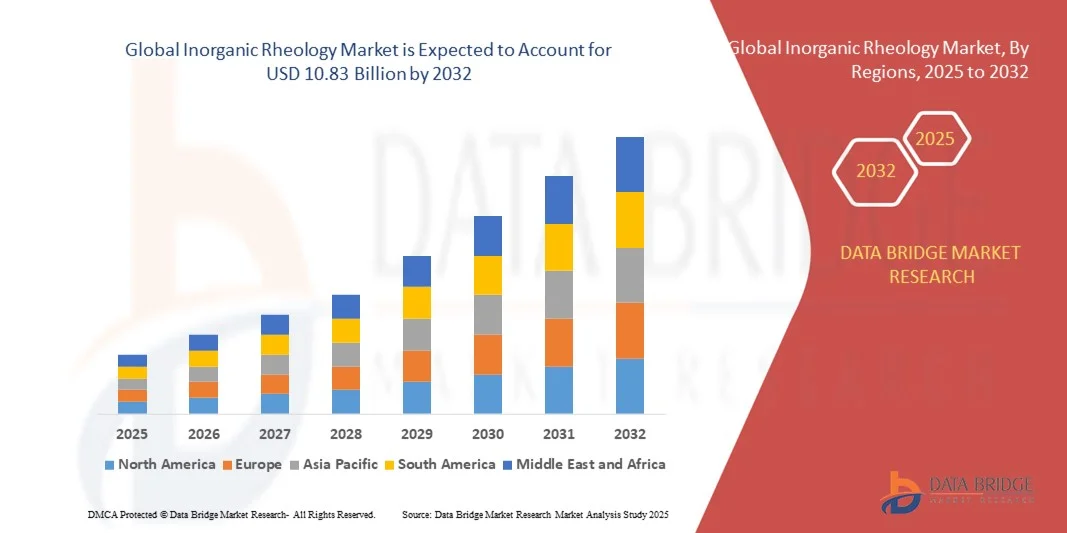
- The global inorganic rheology market size was valued at USD 8.3 billion in 2024 and is expected to reach USD 10.83 billion by 2032, at a CAGR of 3.35% during the forecast period
- Increasing demand for inorganic rheology modifier for electronic and electrical applications is the root cause fuelling up the inorganic rheology modifier market growth rate
- Rising demand and application of inorganic rheology modifier in paints and coatings will further create lucrative and remunerative growth opportunities for the inorganic rheology modifier market
What are the Major Takeaways of Inorganic Rheology Market?
- Rising industrialization and increasing demand for waterborne coating from automotive industry will further induce growth in the demand for inorganic rheology modifier market
- Growth and expansion of buildings and construction industry especially in the developing economies will also act as an important inorganic rheology modifier market growth determinant
- Asia-Pacific dominated the inorganic rheology market with the largest revenue share of 38.54% in 2024, driven by rapid industrialization, increasing demand for paints, coatings, adhesives, and personal care products, and the rising adoption of high-performance, sustainable rheology additives
- North America is poised to grow at the fastest CAGR of 9.47% during the forecast period of 2025–2032, driven by increasing demand for innovative coatings, adhesives, cosmetics, and personal care products
- The Clay segment dominated the market in 2024 with a revenue share of 42.5%, driven by its cost-effectiveness, ease of integration into various formulations, and versatility across paints, coatings, adhesives, and personal care products
Report Scope and Inorganic Rheology Market Segmentation
|
Attributes |
Inorganic Rheology Key Market Insights |
|
Segments Covered |
|
|
Countries Covered |
North America
Europe
Asia-Pacific
Middle East and Africa
South America
|
|
Key Market Players |
|
|
Market Opportunities |
|
|
Value Added Data Infosets |
In addition to the insights on market scenarios such as market value, growth rate, segmentation, geographical coverage, and major players, the market reports curated by the Data Bridge Market Research also include in-depth expert analysis, pricing analysis, brand share analysis, consumer survey, demography analysis, supply chain analysis, value chain analysis, raw material/consumables overview, vendor selection criteria, PESTLE Analysis, Porter Analysis, and regulatory framework. |
What is the Key Trend in the Inorganic Rheology Market?
Shift Towards High-Performance, Sustainable, and Functional Rheology Additives
- A major trend in the global inorganic rheology market is the increasing demand for high-performance and sustainable rheology additives that improve product functionality while meeting environmental regulations
- For instance, advanced synthetic and mineral-based rheology agents are being developed to provide better viscosity control, enhanced suspension, and improved stability in paints, coatings, adhesives, and cosmetics
- Functional innovation, such as temperature and shear-sensitive rheology additives, enables formulators to optimize product flow, spreadability, and storage stability. Some cutting-edge products from companies such as BASF and Evonik allow manufacturers to reduce solvent content while maintaining performance
- The adoption of eco-friendly, bio-based, and low-VOC rheology solutions is gaining traction, allowing formulators to meet regulatory compliance and consumer demand for sustainable products
- Overall, the trend toward advanced, functional, and sustainable inorganic rheology additives is reshaping expectations in industries such as paints & coatings, personal care, and adhesives
What are the Key Drivers of Inorganic Rheology Market?
- The growing demand for high-performance coatings, adhesives, and construction materials is driving the adoption of inorganic rheology additives
- Increasing consumer awareness of product quality and consistency across applications is prompting formulators to invest in advanced rheology solutions
- For instance, in 2024, Wacker Chemie AG launched new inorganic rheology additives with enhanced suspension and stability properties for industrial coatings, which are expected to drive broader adoption
- Regulatory pressure to reduce VOCs and improve eco-friendly formulations is further boosting market growth
- The versatility of inorganic rheology additives, such as improving flow, thixotropy, and anti-settling behavior, along with ease of integration into various formulations, supports rapid adoption across paints, adhesives, construction, and personal care products
Which Factor is Challenging the Growth of the Inorganic Rheology Market?
- The high cost of advanced inorganic rheology additives compared to conventional solutions can limit adoption, particularly in price-sensitive regions
- Performance variability across formulations and the need for technical expertise in formulation optimization can be a barrier for smaller manufacturers
- Availability and sourcing of high-quality raw materials, especially specialty clays or mineral powders, may create supply chain constraints
- While sustainable and bio-based alternatives are emerging, formulators often face trade-offs between cost, performance, and regulatory compliance, which can slow widespread adoption
- Overcoming these challenges through R&D investment, supplier partnerships, and cost-efficient manufacturing, along with training for formulators, will be critical to sustaining growth in the global inorganic rheology market
How is the Inorganic Rheology Market Segmented?
The market is segmented on the basis of type, technology, and application.
- By Type
On the basis of type, the inorganic rheology market is segmented into Clay, Fumed Silica, Specialty Clay, and Others. The Clay segment dominated the market in 2024 with a revenue share of 42.5%, driven by its cost-effectiveness, ease of integration into various formulations, and versatility across paints, coatings, adhesives, and personal care products. Clay-based rheology additives enhance suspension, viscosity control, and thixotropic behavior, making them highly preferred in industrial applications.
Specialty Clay is expected to witness the fastest CAGR of 19.3% from 2025 to 2032, due to increasing demand for high-performance additives in premium paints, coatings, and cosmetics, where performance, stability, and appearance are critical. Manufacturers are investing in functionalized and surface-modified clays to meet the evolving requirements of formulators seeking enhanced performance while maintaining sustainability and regulatory compliance.
- By Technology
On the basis of technology, the inorganic rheology market is segmented into Water-Based and Solvent-Based. The Water-Based segment dominated in 2024 with a 55% market share, driven by the growing preference for eco-friendly, low-VOC formulations in paints, coatings, personal care, and adhesives. Water-based rheology additives offer easy handling, compatibility with modern formulations, and compliance with strict environmental regulations, making them highly attractive for industrial and consumer applications.
The Solvent-Based segment is expected to witness the fastest CAGR of 17.8% from 2025 to 2032, driven by its superior performance in high-end coatings, adhesives, and specialty applications where solvent compatibility and high thermal stability are required. Increasing industrial investments and advancements in hybrid technologies are further supporting the adoption of solvent-based rheology solutions.
- By Application
On the basis of application, the inorganic rheology market is segmented into Paints and Coatings, Cosmetics and Personal Care Products, Adhesives and Sealants, Composites, Household and Industrial Products, Pharmaceutical, Printing Inks, Cable Compounds and Gels, Oil-Well Drilling, Electronics, and Others. The Paints and Coatings segment dominated in 2024 with a revenue share of 48.7%, owing to the critical role of rheology additives in enhancing viscosity, preventing settling, and improving application properties.
The Cosmetics and Personal Care Products segment is expected to witness the fastest CAGR of 18.5% from 2025 to 2032, driven by the rising demand for high-quality, aesthetically appealing, and stable formulations in skincare, haircare, and color cosmetics. The growing trend of sustainable and multifunctional products across industries is further fueling the adoption of inorganic rheology additives.
Which Region Holds the Largest Share of the Inorganic Rheology Market?
- Asia-Pacific dominated the inorganic rheology market with the largest revenue share of 38.54% in 2024, driven by rapid industrialization, increasing demand for paints, coatings, adhesives, and personal care products, and the rising adoption of high-performance, sustainable rheology additives
- Manufacturers in the region benefit from the availability of affordable raw materials, strong domestic production capabilities, and growing investments in R&D for innovative rheology solutions
- This widespread adoption is further supported by increasing urbanization, rising disposable incomes, and the strong growth of end-user industries such as construction, automotive, and electronics, establishing Asia-Pacific as the largest consumer of inorganic rheology products
China Inorganic Rheology Market Insight
The China Inorganic Rheology market captured the largest revenue share in the Asia-Pacific region in 2024, fueled by a booming middle class, rapid urbanization, and increasing demand for industrial coatings, adhesives, and personal care products. Government initiatives promoting industrial modernization and sustainability are supporting the adoption of high-performance inorganic rheology additives in construction, electronics, and cosmetics sectors. The availability of cost-effective, high-quality additives and strong domestic manufacturing is enabling formulators to meet both local and international demand.
Japan Inorganic Rheology Market Insight
The Japan Inorganic Rheology market is expanding steadily due to the country’s high-tech manufacturing culture, emphasis on quality, and increasing urbanization. Japanese manufacturers are integrating inorganic rheology additives into advanced coatings, adhesives, and specialty chemicals, focusing on performance, stability, and sustainability. Rising consumer demand for eco-friendly, high-quality personal care and industrial products is further driving market growth.
Which Region is the Fastest Growing Region in the Inorganic Rheology Market?
North America is poised to grow at the fastest CAGR of 9.47% during the forecast period of 2025–2032, driven by increasing demand for innovative coatings, adhesives, cosmetics, and personal care products. Technological advancements, higher disposable incomes, and growing emphasis on sustainable and high-performance formulations are contributing to rapid adoption. The presence of leading chemical manufacturers and the rising trend of specialty and eco-friendly formulations are expected to accelerate market growth across residential, industrial, and commercial applications.
U.S. Inorganic Rheology Market Insight
The U.S. Inorganic Rheology market is witnessing strong growth due to increasing demand for advanced coatings, adhesives, and personal care formulations. Rising awareness about product performance, environmental compliance, and formulation stability is driving adoption of high-performance inorganic rheology additives. The trend of innovative, sustainable, and multifunctional products across end-use industries further supports market expansion.
Which are the Top Companies in Inorganic Rheology Market?
The inorganic rheology industry is primarily led by well-established companies, including:
- ALTANA AG (Germany)
- BASF SE (Germany)
- Evonik Industries AG (Germany)
- Cabot Corporation (U.S.)
- Wacker Chemie AG (Germany)
- Croda International Plc (U.K.)
- Minerals Technologies Inc. (U.S.)
- MÜNZING Corporation (Germany)
- SAMJI CORP (Japan)
- Superior Materials, Inc. (U.S.)
- Shah Patil & Company (India)
- Quimidroga (Spain)
- Orisil (India)
- OCI COMPANY Ltd. (South Korea)
- Tokuyama Corporation (Japan)
- jaychemmarketing (India)
- Arkema (France)
- Dow (U.S.)
- Clariant AG (Switzerland)
- The Lubrizol Corporation (U.S.)
What are the Recent Developments in Global Inorganic Rheology Market?
- In December 2024, Ohio-based Lubrizol announced multiple innovations, introducing several new solutions across industries, investing in local-for-local innovation, expanding its R&D centers, and enhancing sustainability initiatives, reflecting the company’s commitment to delivering science-driven solutions aligned with market needs and environmental goals
- In April 2024, BASF, headquartered in Germany, launched its ‘Beyond Beauty’ campaign under the Care Chemicals initiative Care 360°, showcasing innovative and sustainable solutions for the personal care industry, promoting transparency in product carbon footprints, and emphasizing the transformative potential of bioactives to meet the rising consumer demand for responsible beauty, highlighting the company’s focus on sustainability and innovation
- In February 2024, Arkema, a French leader in paints and solvents, released two new bio-based waterborne resins under Synaqua, offering up to 97% renewable materials while retaining the strength of alkyd-based coatings, alongside Crayvallac, a 100% recyclable high-performance rheology modifier derived from castor oil and a polyamide base, demonstrating the company’s push toward eco-friendly and high-performance solutions
- In February 2024, AkzoNobel N.V. completed the expansion of its coatings manufacturing facility in Como, Italy, at a cost of USD 22.7 million, adding four new manufacturing lines to produce architectural coatings and automotive primers, enhancing the company’s capacity to serve customers across Eastern Europe, and strengthening its production footprint in the region
- In February 2023, Cargill Incorporated introduced a novel rheology modifier, “Aristoflex Eco T”, enabling cosmetic formulators to create luxurious products without compromising biodegradability, reflecting the company’s dedication to sustainable innovations and eco-conscious formulations

- Interactive Data Analysis Dashboard
- Company Analysis Dashboard for high growth potential opportunities
- Research Analyst Access for customization & queries
- Competitor Analysis with Interactive dashboard
- Latest News, Updates & Trend analysis
- Harness the Power of Benchmark Analysis for Comprehensive Competitor Tracking
Global Inorganic Rheology Modifier Market, Supply Chain Analysis and Ecosystem Framework
To support market growth and help clients navigate the impact of geopolitical shifts, DBMR has integrated in-depth supply chain analysis into its Global Inorganic Rheology Modifier Market research reports. This addition empowers clients to respond effectively to global changes affecting their industries. The supply chain analysis section includes detailed insights such as Global Inorganic Rheology Modifier Market consumption and production by country, price trend analysis, the impact of tariffs and geopolitical developments, and import and export trends by country and HSN code. It also highlights major suppliers with data on production capacity and company profiles, as well as key importers and exporters. In addition to research, DBMR offers specialized supply chain consulting services backed by over a decade of experience, providing solutions like supplier discovery, supplier risk assessment, price trend analysis, impact evaluation of inflation and trade route changes, and comprehensive market trend analysis.
Data collection and base year analysis are done using data collection modules with large sample sizes. The stage includes obtaining market information or related data through various sources and strategies. It includes examining and planning all the data acquired from the past in advance. It likewise envelops the examination of information inconsistencies seen across different information sources. The market data is analysed and estimated using market statistical and coherent models. Also, market share analysis and key trend analysis are the major success factors in the market report. To know more, please request an analyst call or drop down your inquiry.
The key research methodology used by DBMR research team is data triangulation which involves data mining, analysis of the impact of data variables on the market and primary (industry expert) validation. Data models include Vendor Positioning Grid, Market Time Line Analysis, Market Overview and Guide, Company Positioning Grid, Patent Analysis, Pricing Analysis, Company Market Share Analysis, Standards of Measurement, Global versus Regional and Vendor Share Analysis. To know more about the research methodology, drop in an inquiry to speak to our industry experts.
Data Bridge Market Research is a leader in advanced formative research. We take pride in servicing our existing and new customers with data and analysis that match and suits their goal. The report can be customized to include price trend analysis of target brands understanding the market for additional countries (ask for the list of countries), clinical trial results data, literature review, refurbished market and product base analysis. Market analysis of target competitors can be analyzed from technology-based analysis to market portfolio strategies. We can add as many competitors that you require data about in the format and data style you are looking for. Our team of analysts can also provide you data in crude raw excel files pivot tables (Fact book) or can assist you in creating presentations from the data sets available in the report.













