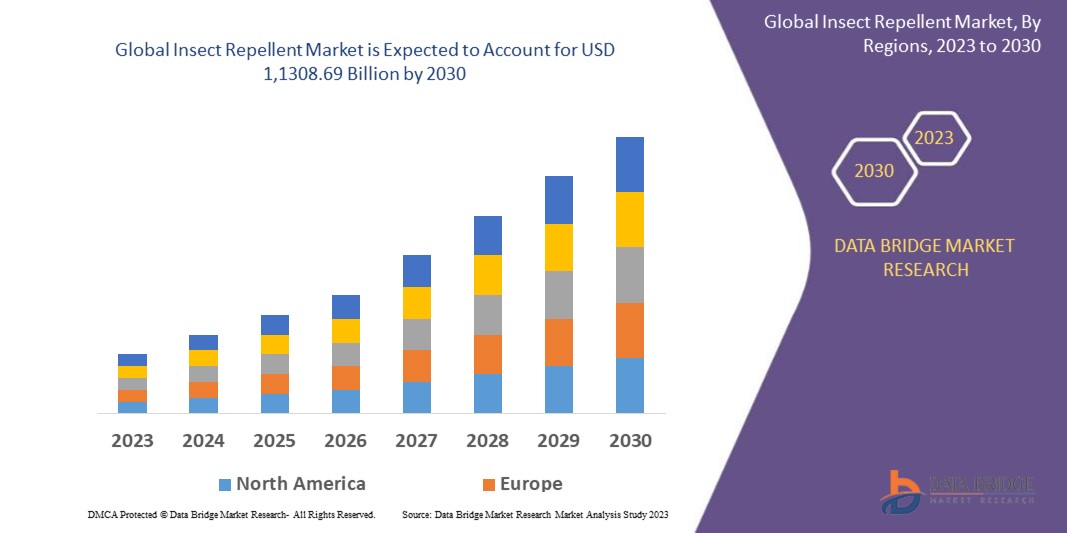
Insect Repellent Market Analysis and Sizes
The insect repellent market is driven by various factors, including increasing awareness about insect-borne diseases, and growing concerns about insect-related allergies. Insect repellents are used to protect individuals from mosquito bites, ticks, flies, and other insects that can transmit diseases such as malaria, dengue, Zika virus, and Lyme disease.
Data Bridge Market Research analyses that the insect repellent market which was USD 7,095.21 million in 2022, would boost up to USD 1,1308.69 billion by 2030, and is expected to undergo a CAGR of 6.00% during the forecast period. This indicates that the market value In addition to the market insights such as market value, growth rate, market segments, geographical coverage, market players, and market scenario, the market report curated by the Data Bridge Market Research team includes in-depth expert analysis, import/export analysis, pricing analysis, production consumption analysis, and consumer behavior.
Insect Repellent Market Scope and Segmentation
|
Report Metric |
Details |
|
Forecast Period |
2023 to 2030 |
|
Base Year |
2022 |
|
Historic Years |
2021 (Customizable to 2015-2020) |
|
Quantitative Units |
Revenue in USD Million, Volumes in Units, Pricing in USD |
|
Segments Covered |
Product Type (Body Worn, Non-Body Worn), Insect Type (Mosquito Repellent, Bugs Repellent, Fly Repellent, Others), Distribution Channel (Online, Offline) |
|
Countries Covered |
U.S., Canada and Mexico in North America, Germany, France, U.K., Netherlands, Switzerland, Belgium, Russia, Italy, Spain, Turkey, Rest of Europe in Europe, China, Japan, India, South Korea, Singapore, Malaysia, Australia, Thailand, Indonesia, Philippines, Rest of Asia-Pacific (APAC) in the Asia-Pacific (APAC), Saudi Arabia, U.A.E, Israel, Egypt, South Africa, Rest of Middle East and Africa (MEA) as a part of Middle East and Africa (MEA), Brazil, Argentina and Rest of South America as part of South America |
|
Market Players Covered |
Spectrum Brands, Inc., (U.S.), S.C. Johnson & Son Inc., (U.S.), Henkel AG & Co. KGaA (Germany), Reckitt Benckiser Group PLC (U.K.), Dabur (India), Godrej Consumer Products Limited (India), Jyothy Laboratories Ltd (India), Johnson & Johnson Private Limited (U.S.), Himalaya Wellness Company (India) |
|
Market Opportunities |
|
Market Definition
Insect repellent refers to a substance or product that is designed to repel or deter insects from landing on or biting humans, animals, or surfaces. The primary purpose of insect repellents is to protect against insect bites, which can transmit diseases and cause irritation or allergic reactions. Insect repellents work by creating a barrier that insects find unpleasant or by masking the human or animal scents that attract insects. They typically contain active ingredients that repel insects, such as DEET (N,N-Diethyl-meta-toluamide), picaridin, IR3535 (Ethyl butylacetylaminopropionate), permethrin, or natural ingredients like citronella, eucalyptus oil, or lemon eucalyptus oil.
Global Insect Repellent Market Dynamics
Drivers
- Rising Awareness of Insect-Borne Diseases
Increasing awareness about the risks associated with insect-borne diseases is a significant driver for the insect repellent market. Diseases such as malaria, dengue fever, Zika virus, West Nile virus, Lyme disease, and chikungunya are transmitted by insects such as mosquitoes and ticks. As people become more aware about these diseases and their potential health consequences, the demand for insect repellents as a preventive measure increases.
- Growing Outdoor Activities
The popularity of outdoor activities such as camping, hiking, gardening, sports, and leisure travel has steadily increased. People engaging in these activities often encounter insects and pests, making the use of insect repellents essential for protection. As outdoor recreational pursuits continue to rise, so does the demand for insect repellent products, thus lifting the market growth from 2023 to 2030.
Opportunities
- Technological Advancements in Repellent Formulations
The insect repellent industry constantly evolves, with ongoing research and development efforts focused on creating more effective, longer-lasting formulations. Innovations such as microencapsulation, nanotechnology, and time-release technologies can potentially improve the efficacy and convenience of insect repellents, providing opportunities for companies that can bring these technologies to market.
- Expansion into Emerging Markets
Emerging markets, particularly in regions with high incidences of insect-borne diseases, present significant growth opportunities for insect repellent manufacturers. Companies can focus on expanding their distribution networks and increasing product availability in these regions to tap into the growing consumer base.
Restraints/Challenges
- Seasonal Demand of the Product
Insect repellents are often associated with outdoor activities and warmer seasons when insects are more prevalent. This seasonal demand can result in fluctuations in sales and revenue for companies operating in this market. They must carefully manage their inventory, production, and marketing strategies to ensure yearly profitability.
- Adverse Environmental Impact Concerns
Some chemical-based insect repellents have been associated with potential environmental and health risks. Consumer awareness and concerns about the environmental impact of certain repellent ingredients, such as DEET, have led to an increased demand for natural and eco-friendly alternatives. Companies must address these concerns and develop sustainable practices to meet consumer expectations.
Global Insect Repellent Market Scope
The insect repellent market is segmented on the basis of product type, insect type and distribution channel. The growth amongst these segments will help you analyses meagre growth segments in the industries and provide the users with a valuable market overview and market insights to help them make strategic decisions for identifying core market applications.
Product Type
- Body Worn
- Oils and Creams
- Stickers and Patches
- Apparels
- Aerosols
- Non-Body Worn
- Coils
- Mats and Sheet
- Liquid Vaporizer
Insect Type
- Mosquito Repellent
- Bugs Repellent
- Fly Repellent
- Others
Distribution Channel
- Online
- Offline
Global Insect Repellent Market Regional Analysis/Insights
The insect repellent market is analyzed and market size insights and trends are provided by country, product type, insect type and distribution channel as referenced above
The countries covered in the insect repellent market report are U.S., Canada and Mexico in North America, Germany, France, U.K., Netherlands, Switzerland, Belgium, Russia, Italy, Spain, Turkey, Rest of Europe in Europe, China, Japan, India, South Korea, Singapore, Malaysia, Australia, Thailand, Indonesia, Philippines, Rest of Asia-Pacific (APAC) in the Asia-Pacific (APAC), Saudi Arabia, U.A.E, Israel, Egypt, South Africa, Rest of Middle East and Africa (MEA) as a part of Middle East and Africa (MEA), Brazil, Argentina and Rest of South America as part of South America.
Asia-Pacific dominates the insect repellent market because of the introduction of new product variations and the high usage of insect repellent tools and kits in the Asia-Pacific region (APAC) is owed by insect-borne diseases and the malaria epidemic.
Middle East and Africa is expected to witness a significant growth rate from 2023 to 2030 due to the rising number of insect repellent manufacturers and the prevailing pathogens and vector-borne sickness.
The country section of the report also provides individual market impacting factors and changes in regulation in the market domestically that impacts the current and future trends of the market. Data points such as down-stream and upstream value chain analysis, technical trends and porter's five forces analysis, case studies are some of the pointers used to forecast the market scenario for individual countries. Also, the presence and availability of global brands and their challenges faced due to large or scarce competition from local and domestic brands, impact of domestic tariffs and trade routes are considered while providing forecast analysis of the country data.
Competitive Landscape and Insect Repellent Market Share Analysis
The insect repellent market competitive landscape provides details by competitor. Details included are company overview, company financials, revenue generated, market potential, investment in research and development, new market initiatives, global presence, production sites and facilities, production capacities, company strengths and weaknesses, product launch, product width and breadth, application dominance. The above data points provided are only related to the companies’ focus related to insect repellent market.
Some of the major players operating in the insect repellent market are:
- Spectrum Brands, Inc., (U.S.)
- S.C. Johnson & Son Inc., (U.S.)
- Henkel AG & Co. KGaA (Germany)
- Reckitt Benckiser Group PLC (U.K.)
- Dabur (India)
- Godrej Consumer Products Limited (India)
- Jyothy Laboratories Ltd (India)
- Johnson & Johnson Private Limited (U.S.)
- Himalaya Wellness Company (India)

- Interactive Data Analysis Dashboard
- Company Analysis Dashboard for high growth potential opportunities
- Research Analyst Access for customization & queries
- Competitor Analysis with Interactive dashboard
- Latest News, Updates & Trend analysis
- Harness the Power of Benchmark Analysis for Comprehensive Competitor Tracking
Table of Content
1 INTRODUCTION
1.1 OBJECTIVES OF THE STUDY
1.2 MARKET DEFINITION
1.3 OVERVIEW OF GLOBAL INSECT REPELLENT MARKET
1.4 CURRENCY AND PRICING
1.5 LIMITATION
1.6 MARKETS COVERED
2 MARKET SEGMENTATION
2.1 KEY TAKEAWAYS
2.2 ARRIVING AT THE GLOBAL INSECT REPELLENT MARKET SIZE
2.3 VENDOR POSITIONING GRID
2.4 MARKETS COVERED
2.5 GEOGRAPHIC SCOPE
2.6 YEARS CONSIDERED FOR THE STUDY
2.7 RESEARCH METHODOLOGY
2.8 TECHNOLOGY LIFE LINE CURVE
2.9 MULTIVARIATE MODELLING
2.1 PRIMARY INTERVIEWS WITH KEY OPINION LEADERS
2.11 DBMR MARKET POSITION GRID
2.12 MARKET APPLICATION COVERAGE GRID
2.13 DBMR MARKET CHALLENGE MATRIX
2.14 IMPORT AND EXPORT DATA
2.15 SECONDARY SOURCES
2.16 GLOBAL INSECT REPELLENT MARKET: RESEARCH SNAPSHOT
2.17 ASSUMPTIONS
3 MARKET OVERVIEW
3.1 DRIVERS
3.2 RESTRAINTS
3.3 OPPORTUNITIES
3.4 CHALLENGES
4 EXECUTIVE SUMMARY
5 PREMIUM INSIGHTS
5.1 CONSUMER BUYING BEHAVIOUR
5.2 FACTORS AFFECTING BUYING DECISION
5.3 PRODUCT ADOPTION SCENARIO
5.4 PORTER’S FIVE FORCES
5.5 REGULATION COVERAGE
5.6 RAW MATERIAL SOURCING ANALYSIS
5.7 IMPORT EXPORT SCENARIO
6 PRODUCTION CAPACITY OUTLOOK
7 PRICE INDEX
8 BRAND OUTLOOK
8.1 BRAND COMPARATIVE ANALYSIS
8.2 PRODUCT VS BRAND OVERVIEW
9 IMPACT OF ECONOMIC SLOWDOWN
9.1 IMPACT ON PRICES
9.2 IMPACT ON SUPPLY CHAIN
9.3 IMPACT ON SHIPMENT
9.4 IMPACT ON DEMAND
9.5 IMPACT ON STRATEGIC DECISIONS
10 SUPPLY CHAIN ANALYSIS
10.1 OVERVIEW
10.2 LOGISTIC COST SCENARIO
10.3 IMPORTANCE OF LOGISTICS SERVICE PROVIDERS
11 GLOBAL INSECT REPELLENT MARKET, BY REPELLENTS TYPE
11.1 OVERVIEW
11.2 BODY WORN REPELLENTS
11.2.1 OILS
11.2.2 CREAMS AND LOTIONS
11.2.3 STOCKERS AND PATCHES
11.2.4 ROLL-ONS
11.2.5 WIPES
11.2.6 APPARELS
11.2.6.1. TROUSERS
11.2.6.2. SHIRTS
11.2.6.3. JACKETS
11.2.6.4. HEAD NETS
11.2.6.5. OTHERS
11.2.7 SPRAYS
11.2.8 OTHERS
11.3 NON-BODY WORN REPELLENTS
11.3.1 COILS
11.3.2 BEDNETS
11.3.3 MATS AND SHEETS
11.3.4 LIQUID VAPORIZER
11.3.5 AEROSOLS
11.3.6 STICKS
11.3.7 CANDLES
11.3.8 TORCHES
11.3.9 OTHERS
12 GLOBAL INSECT REPELLENT MARKET, BY INGREDIENT TYPE
12.1 OVERVIEW
12.2 CITRONELLA OIL
12.3 OIL OF LEMON EUCALYPTUS
12.4 CLOVE
12.5 LEMONGRASS
12.6 BASIL
12.7 NEEM
12.8 LAVENDER
12.9 SOYBEAN OIL
12.1 CATNIP OIL
12.11 GERNANIUM OIL
12.12 CEDARWOOD OIL
12.13 SURFACTANTS
12.14 FATTY ALCOHOL
12.15 DIMETHYL PHTHALATE
12.16 OTHERS
13 GLOBAL INSECT REPELLENT MARKET, BY INSECT TYPE
13.1 OVERVIEW
13.2 MOSQUITO
13.3 BUGS
13.4 FLY
13.5 ANTS
13.6 WASPS
13.7 OTHERS
14 GLOBAL INSECT REPELLENT MARKET, BY PACKAGING TYPE
14.1 OVERVIEW
14.2 TUBES
14.3 CANS
14.4 POUCHES
14.5 BOXES
14.6 BOTTLES
14.7 OTHERS
15 GLOBAL INSECT REPELLENT MARKET, BY PACKAGING MATERIAL TYPE
15.1 OVERVIEW
15.2 PLASTIC
15.2.1 POLYETHYLENE (PE)
15.2.2 POLYETHYLENE TERAPHTHALATE (PET)
15.2.3 POLYVINYL CHLORIDE (PVC)
15.2.4 POLYCARBONATE (PC)
15.2.5 OTHERS
15.3 PAPER
15.4 METAL
15.5 OTHERS
16 GLOBAL INSECT REPELLENT MARKET, BY DISTRIBUTION CHANNEL
16.1 OVERVIEW
16.2 SUPERMARKETS/HYPERMARKETS
16.3 CONVENIENCE STORES
16.4 SPECIALTY STORES
16.5 E-COMMERCE
16.6 OTHERS
17 GLOBAL INSECT REPELLENT MARKET, BY END-USER
17.1 OVERVIEW
17.2 RESIDENTIAL
17.2.1 RESIDENTIAL, BY END-USER
17.2.1.1. MULTIFAMILY BUILDINGS
17.2.1.2. INDEPENDENT HOUSES
17.2.2 RESIDENTIAL, BY TYPE
17.2.2.1. CITRONELLA OIL
17.2.2.2. OIL OF LEMON EUCALYPTUS
17.2.2.3. CLOVE
17.2.2.4. LEMONGRASS
17.2.2.5. BASIL
17.2.2.6. NEEM
17.2.2.7. LAVENDER
17.2.2.8. SOYBEAN OIL
17.2.2.9. CATNIP
17.2.2.10. GERNANIUM OIL
17.2.2.11. CEDARWOOD OIL
17.2.2.12. OTHERS
17.3 COMMERCIAL
17.3.1 COMMERCIAL, BY END-USER
17.3.1.1. COMMERCIAL BUILDINGS
17.3.1.2. SUPERMARKETS/HYPERMARKETS
17.3.1.3. MALLS
17.3.1.4. CORPORATE OFFICES
17.3.1.5. SCHOOLS/UNIVERSITY
17.3.1.6. HOSPITALS
17.3.1.7. BANKS
17.3.1.8. HOTELS AND RESTAURANTS
17.3.1.9. GOVERNMENT BUILDINGS
17.3.1.10. OTHERS
17.3.2 COMMERCIAL, BY TYPE
17.3.2.1. CITRONELLA OIL
17.3.2.2. OIL OF LEMON EUCALYPTUS
17.3.2.3. CLOVE
17.3.2.4. LEMONGRASS
17.3.2.5. BASIL
17.3.2.6. NEEM
17.3.2.7. LAVENDER
17.3.2.8. SOYBEAN OIL
17.3.2.9. CATNIP
17.3.2.10. GERNANIUM OIL
17.3.2.11. CEDARWOOD OIL
17.3.2.12. OTHERS
17.4 RECREATIONAL ACTIVITIES
17.4.1 RECREATIONAL ACTIVITIES, BY END-USER
17.4.1.1. CAMPING
17.4.1.2. TREKKING
17.4.1.3. ADVENTUROUS SPORTS
17.4.1.4. CLIMBING
17.4.1.5. OTHERS
17.4.2 RECREATIONAL ACTIVITIES, BY TYPE
17.4.2.1. CITRONELLA OIL
17.4.2.2. OIL OF LEMON EUCALYPTUS
17.4.2.3. CLOVE
17.4.2.4. LEMONGRASS
17.4.2.5. BASIL
17.4.2.6. NEEM
17.4.2.7. LAVENDER
17.4.2.8. SOYBEAN OIL
17.4.2.9. CATNIP
17.4.2.10. GERNANIUM OIL
17.4.2.11. CEDARWOOD OIL
17.4.2.12. OTHERS
17.5 INDUSTRIAL
17.5.1 INDUSTRIAL, BY TYPE
17.5.1.1. CITRONELLA OIL
17.5.1.2. OIL OF LEMON EUCALYPTUS
17.5.1.3. CLOVE
17.5.1.4. LEMONGRASS
17.5.1.5. BASIL
17.5.1.6. NEEM
17.5.1.7. LAVENDER
17.5.1.8. SOYBEAN OIL
17.5.1.9. CATNIP
17.5.1.10. GERNANIUM OIL
17.5.1.11. CEDARWOOD OIL
17.5.1.12. OTHERS
17.6 OTHERS
18 GLOBAL INSECT REPELLENT MARKET, COMPANY LANDSCAPE
18.1 COMPANY SHARE ANALYSIS: GLOBAL
18.2 COMPANY SHARE ANALYSIS: NORTH AMERICA
18.3 COMPANY SHARE ANALYSIS: EUROPE
18.4 COMPANY SHARE ANALYSIS: ASIA-PACIFIC
18.5 MERGERS & ACQUISITIONS
18.6 NEW PRODUCT DEVELOPMENT & APPROVALS
18.7 EXPANSIONS & PARTNERSHIP
18.8 REGULATORY CHANGES
19 GLOBAL INSECT REPELLENT MARKET, BY GEOGRAPHY (VALUE & VOLUME)
OVERVIEW (ALL SEGMENTATION PROVIDED ABOVE IS REPRESNTED IN THIS CHAPTER BY COUNTRY)
19.1 NORTH AMERICA
19.1.1 U.S.
19.1.2 CANADA
19.1.3 MEXICO
19.2 EUROPE
19.2.1 GERMANY
19.2.2 U.K.
19.2.3 ITALY
19.2.4 FRANCE
19.2.5 SPAIN
19.2.6 SWITZERLAND
19.2.7 NETHERLANDS
19.2.8 BELGIUM
19.2.9 RUSSIA
19.2.10 TURKEY
19.2.11 REST OF EUROPE
19.3 ASIA-PACIFIC
19.3.1 JAPAN
19.3.2 CHINA
19.3.3 SOUTH KOREA
19.3.4 INDIA
19.3.5 AUSTRALIA
19.3.6 SINGAPORE
19.3.7 THAILAND
19.3.8 INDONESIA
19.3.9 MALAYSIA
19.3.10 PHILIPPINES
19.3.11 REST OF ASIA-PACIFIC
19.4 SOUTH AMERICA
19.4.1 BRAZIL
19.4.2 ARGENTINA
19.4.3 REST OF SOUTH AMERICA
19.5 MIDDLE EAST AND AFRICA
19.5.1 SOUTH AFRICA
19.5.2 EGYPT
19.5.3 ISRAEL
19.5.4 UAE
19.5.5 SAUDI ARABIA
19.5.6 KUWAIT
19.5.7 REST OF MIDDLE EAST AND AFRICA
20 GLOBAL INSECT REPELLENT MARKET – COMPANY PROFILE
(NOTE: THE COMPANIES PROFILED IS NOT EXHAUSTIVE LIST AND IS AS PER OUR PREVIOUS CLIENT REQUIREMENT. WE PROFILE MORE THAN 100 COMPANIES IN OUR STUDY AND HENCE THE LIST OF COMPANIES CAN BE MODIFIED OR REPLACED ON REQUEST)
20.1 MERCK KGAA
20.1.1 COMPANY SNAPSHOT
20.1.2 REVENUE ANALYSIS
20.1.3 PRODUCT PORTFOLIO
20.1.4 RECENT UPDATES
20.2 SC JOHNSON PROFESSIONAL USA, INC
20.2.1 COMPANY SNAPSHOT
20.2.2 REVENUE ANALYSIS
20.2.3 PRODUCT PORTFOLIO
20.2.4 RECENT UPDATES
20.3 RECKITT BENCKISER GROUP PLC
20.3.1 COMPANY SNAPSHOT
20.3.2 REVENUE ANALYSIS
20.3.3 PRODUCT PORTFOLIO
20.3.4 RECENT UPDATES
20.4 ADVENTURE READY BRANDS
20.4.1 COMPANY SNAPSHOT
20.4.2 REVENUE ANALYSIS
20.4.3 PRODUCT PORTFOLIO
20.4.4 RECENT UPDATES
20.5 GODREJ CONSUMER PRODUCTS LTD
20.5.1 COMPANY SNAPSHOT
20.5.2 REVENUE ANALYSIS
20.5.3 PRODUCT PORTFOLIO
20.5.4 RECENT UPDATES
20.6 SPECTRUM BRANDS HOLDINGS INC.
20.6.1 COMPANY SNAPSHOT
20.6.2 REVENUE ANALYSIS
20.6.3 PRODUCT PORTFOLIO
20.6.4 RECENT UPDATES
20.7 DABUR INTERNATIONAL
20.7.1 COMPANY SNAPSHOT
20.7.2 REVENUE ANALYSIS
20.7.3 PRODUCT PORTFOLIO
20.7.4 RECENT UPDATES
20.8 BULLFROG
20.8.1 COMPANY SNAPSHOT
20.8.2 REVENUE ANALYSIS
20.8.3 PRODUCT PORTFOLIO
20.8.4 RECENT UPDATES
20.9 ENESIS GROUP
20.9.1 COMPANY SNAPSHOT
20.9.2 REVENUE ANALYSIS
20.9.3 PRODUCT PORTFOLIO
20.9.4 RECENT UPDATES
20.1 MURPHY'S NATURALS
20.10.1 COMPANY SNAPSHOT
20.10.2 REVENUE ANALYSIS
20.10.3 PRODUCT PORTFOLIO
20.10.4 RECENT UPDATES
20.11 QUANTUM HEALTH
20.11.1 COMPANY SNAPSHOT
20.11.2 REVENUE ANALYSIS
20.11.3 PRODUCT PORTFOLIO
20.11.4 RECENT UPDATES
20.12 AUNT FANNIE, INC
20.12.1 COMPANY SNAPSHOT
20.12.2 REVENUE ANALYSIS
20.12.3 PRODUCT PORTFOLIO
20.12.4 RECENT UPDATES
20.13 BABYGANICS
20.13.1 COMPANY SNAPSHOT
20.13.2 REVENUE ANALYSIS
20.13.3 PRODUCT PORTFOLIO
20.13.4 RECENT UPDATES
20.14 QUANTUM, INC
20.14.1 COMPANY SNAPSHOT
20.14.2 REVENUE ANALYSIS
20.14.3 PRODUCT PORTFOLIO
20.14.4 RECENT UPDATES
20.15 3M
20.15.1 COMPANY SNAPSHOT
20.15.2 REVENUE ANALYSIS
20.15.3 PRODUCT PORTFOLIO
20.15.4 RECENT UPDATES
21 QUESTIONNAIRE
22 RELATED REPORTS
23 ABOUT DATA BRIDGE MARKET RESEARCH

Data collection and base year analysis are done using data collection modules with large sample sizes. The stage includes obtaining market information or related data through various sources and strategies. It includes examining and planning all the data acquired from the past in advance. It likewise envelops the examination of information inconsistencies seen across different information sources. The market data is analysed and estimated using market statistical and coherent models. Also, market share analysis and key trend analysis are the major success factors in the market report. To know more, please request an analyst call or drop down your inquiry.
The key research methodology used by DBMR research team is data triangulation which involves data mining, analysis of the impact of data variables on the market and primary (industry expert) validation. Data models include Vendor Positioning Grid, Market Time Line Analysis, Market Overview and Guide, Company Positioning Grid, Patent Analysis, Pricing Analysis, Company Market Share Analysis, Standards of Measurement, Global versus Regional and Vendor Share Analysis. To know more about the research methodology, drop in an inquiry to speak to our industry experts.
Data Bridge Market Research is a leader in advanced formative research. We take pride in servicing our existing and new customers with data and analysis that match and suits their goal. The report can be customized to include price trend analysis of target brands understanding the market for additional countries (ask for the list of countries), clinical trial results data, literature review, refurbished market and product base analysis. Market analysis of target competitors can be analyzed from technology-based analysis to market portfolio strategies. We can add as many competitors that you require data about in the format and data style you are looking for. Our team of analysts can also provide you data in crude raw excel files pivot tables (Fact book) or can assist you in creating presentations from the data sets available in the report.