


Instant Meals Market Size
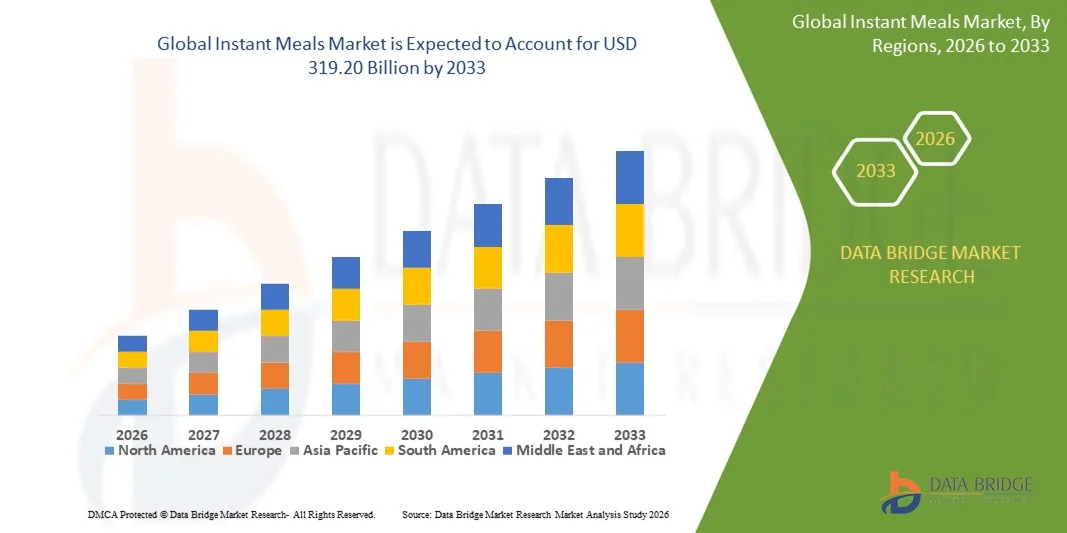
- The global instant meals market size was valued at USD 207.99 billion in 2025 and is expected to reach USD 319.20 billion by 2033, at a CAGR of 5.50% during the forecast period
- The market growth is largely fueled by increasingly busy lifestyles, rising urbanization, and the growing working population, which are driving higher demand for quick, convenient, and time-saving food solutions across both developed and emerging economies
- Furthermore, rising consumer preference for easy-to-prepare, shelf-stable, and ready-to-eat food products is positioning instant meals as a practical everyday dietary choice. These converging factors are accelerating the adoption of instant meals, thereby significantly boosting overall market growth
Instant Meals Market Analysis
- Instant meals, offering minimal preparation time and extended shelf life, have become an essential part of modern diets across households, offices, and institutional settings due to their convenience, consistency, and wide product variety
- The increasing demand for instant meals is primarily driven by changing dietary habits, growth of modern retail and e-commerce channels, and rising acceptance of packaged foods among younger consumers and urban populations
- North America dominated the instant meals market with a share of 41.9% in 2025, due to busy lifestyles, high consumption of ready-to-eat foods, and strong demand for convenience-oriented meal solutions
- Asia-Pacific is expected to be the fastest growing region in the instant meals market during the forecast period due to rapid urbanization, changing dietary habits, and rising disposable incomes
- Instant soups and snacks segment dominated the market with a market share of 40.5% in 2025, due to its widespread consumption across households and offices for quick meal solutions. Consumers often prefer instant soups and snacks for their convenience, ease of preparation, and variety of flavors suited to diverse tastes. The segment also benefits from innovations such as fortified nutrition, ready-to-eat packaging, and compatibility with both home and workplace consumption, enhancing its market presence
Report Scope and Instant Meals Market Segmentation
|
Attributes |
Instant Meals Key Market Insights |
|
Segments Covered |
|
|
Countries Covered |
North America
Europe
Asia-Pacific
Middle East and Africa
South America
|
|
Key Market Players |
|
|
Market Opportunities |
|
|
Value Added Data Infosets |
In addition to the insights on market scenarios such as market value, growth rate, segmentation, geographical coverage, and major players, the market reports curated by the Data Bridge Market Research also include in-depth expert analysis, pricing analysis, brand share analysis, consumer survey, demography analysis, supply chain analysis, value chain analysis, raw material/consumables overview, vendor selection criteria, PESTLE Analysis, Porter Analysis, and regulatory framework. |
Instant Meals Market Trends
Rising Demand for Convenient and Ready-To-Eat Food Solutions
- A prominent trend in the instant meals market is the rising demand for convenient and ready-to-eat food solutions, driven by fast-paced lifestyles, increasing urbanization, and a growing preference for minimal meal preparation across working populations and young consumers. Instant meals are increasingly being positioned as everyday food options rather than occasional substitutes, supporting consistent consumption across households
- For instance, Nestlé continues to expand its instant meals and ready-to-eat portfolio through brands such as Maggi, catering to consumers seeking quick preparation without compromising familiarity and taste. Such product expansions strengthen category penetration and reinforce instant meals as reliable solutions for daily meal requirements
- The trend is further amplified by the growing acceptance of packaged foods in emerging economies, where rising disposable incomes and changing dietary habits are reshaping food consumption patterns. Consumers are increasingly opting for instant meals that align with local flavors while offering speed and ease of use
- Food manufacturers are actively innovating in packaging and shelf-stable formats to improve convenience and storage efficiency. This is encouraging wider adoption among urban households with limited cooking time and space constraints
- The expanding presence of instant meals across supermarkets, convenience stores, and online grocery platforms is improving accessibility and driving impulse purchases. This retail expansion is strengthening market visibility and reinforcing sustained demand for ready-to-eat food solutions
- Overall, the rising emphasis on convenience, combined with evolving consumer lifestyles, is establishing instant meals as a core segment within the global packaged food industry and supporting long-term market growth
Instant Meals Market Dynamics
Driver
Increasing Urbanization and Busy Consumer Lifestyles
- Increasing urbanization and busy consumer lifestyles are key drivers accelerating growth in the instant meals market, as longer working hours and changing family structures reduce the time available for traditional cooking. Urban consumers increasingly prioritize speed and simplicity in meal preparation, directly boosting demand for instant and ready-to-eat products
- For instance, ITC Limited has expanded its ready-to-eat and instant food offerings under its packaged foods portfolio to cater to urban professionals and students seeking quick meal solutions. These offerings align closely with the needs of time-constrained consumers and strengthen market demand across metropolitan areas
- The growing number of single-person households and nuclear families is further driving reliance on instant meals that require minimal preparation and cleanup. This shift is supporting higher consumption frequency and repeat purchases
- Urban expansion is also contributing to the growth of modern retail and online grocery platforms, which play a critical role in distributing instant meals efficiently. Improved availability across these channels is reinforcing consumer adoption
- As urban populations continue to grow globally, the sustained pressure on time and lifestyle convenience is expected to keep this driver influential in shaping instant meals market expansion
Restraint/Challenge
Growing Health Concerns Associated with Processed Foods
- The instant meals market faces challenges due to growing health concerns associated with processed foods, including perceptions around high sodium content, preservatives, and reduced nutritional value. These concerns are influencing consumer purchasing behavior, particularly among health-conscious demographics
- For instance, Unilever has faced increasing pressure to reformulate its instant and packaged food products to address nutritional transparency and healthier ingredient expectations. Such scrutiny highlights the broader challenge faced by instant meal manufacturers in balancing convenience with health considerations
- Rising awareness of lifestyle-related health issues is encouraging some consumers to limit their intake of highly processed foods. This shift is creating resistance among certain consumer segments and impacting overall market acceptance
- Regulatory bodies and public health organizations are increasingly emphasizing nutritional labeling and responsible marketing of processed foods. Compliance with these requirements can increase operational complexity for manufacturers
- Manufacturers must invest in product reformulation, clean-label initiatives, and nutritional improvements to address these concerns, which can elevate costs and extend development timelines. These challenges collectively place pressure on market growth while reshaping product strategies across the instant meals industry
Instant Meals Market Scope
The market is segmented on the basis of product type, packaging type, and distribution channel.
- By Product Type
On the basis of product type, the instant meals market is segmented into instant breakfast/cereals, instant soups and snacks, instant baked goods, instant meat products, and others. The instant soups and snacks segment dominated the market with the largest market revenue share of 40.5% in 2025, driven by its widespread consumption across households and offices for quick meal solutions. Consumers often prefer instant soups and snacks for their convenience, ease of preparation, and variety of flavors suited to diverse tastes. The segment also benefits from innovations such as fortified nutrition, ready-to-eat packaging, and compatibility with both home and workplace consumption, enhancing its market presence.
The instant breakfast/cereals segment is anticipated to witness the fastest growth rate from 2026 to 2033, fueled by rising health-conscious consumption patterns and the demand for convenient, nutrient-rich breakfast options. For instance, companies such as Nestlé have expanded their instant cereal offerings with fortified ingredients and portion-controlled packaging. The segment’s growth is supported by busy urban lifestyles, increasing awareness of balanced nutrition, and the adoption of ready-to-eat breakfasts in schools, offices, and travel scenarios.
- By Packaging Type
On the basis of packaging type, the instant meals market is segmented into canned, frozen or chilled, retort, and others. The retort packaging segment held the largest market revenue share in 2025, driven by its extended shelf life, convenience, and portability for both retail and on-the-go consumption. Consumers often prefer retort-packed meals for their ready-to-eat nature, minimal preparation requirement, and reduced need for refrigeration, making them ideal for urban households and outdoor activities. The segment also benefits from advancements in packaging technology that preserve flavor, nutrition, and texture, further strengthening market adoption.
The frozen or chilled segment is expected to witness the fastest CAGR from 2026 to 2033, fueled by increasing demand for fresh-tasting, preservative-free ready meals. For instance, ConAgra Foods has expanded its frozen meal portfolio to cater to health-conscious and convenience-seeking consumers. The segment growth is driven by rising cold chain infrastructure, greater consumer awareness of fresh meal options, and the popularity of frozen meals in modern retail formats such as supermarkets and online grocery platforms.
- By Distribution Channel
On the basis of distribution channel, the instant meals market is segmented into hypermarket/supermarket, convenience/departmental stores, specialty stores, online stores, and others. The hypermarket/supermarket segment dominated the market in 2025, driven by high product visibility, extensive product range, and ease of bulk purchasing for consumers. Shoppers often prefer hypermarkets and supermarkets for one-stop convenience, promotions, and the availability of both domestic and international instant meal brands. The segment also benefits from organized retail growth and strategic product placement that enhances impulse buying and brand awareness.
The online stores segment is anticipated to witness the fastest growth from 2026 to 2033, fueled by rising e-commerce penetration and increasing preference for home delivery of ready-to-eat meals. For instance, Amazon Fresh and BigBasket have expanded their instant meal categories with multiple brands and subscription-based options. The segment’s growth is supported by digital marketing, convenience of doorstep delivery, and the rising trend of online grocery shopping among urban and tech-savvy consumers.
Instant Meals Market Regional Analysis
- North America dominated the instant meals market with the largest revenue share of 41.9% in 2025, driven by busy lifestyles, high consumption of ready-to-eat foods, and strong demand for convenience-oriented meal solutions
- Consumers in the region place strong emphasis on time-saving food options, consistent taste, and extended shelf life, supporting widespread adoption of instant soups, snacks, and ready meals
- This dominance is further reinforced by high disposable incomes, well-established retail infrastructure, and strong penetration of online grocery platforms, positioning instant meals as a staple across households and working populations
U.S. Instant Meals Market Insight
The U.S. instant meals market captured the largest revenue share within North America in 2025, supported by high reliance on packaged and convenience foods due to fast-paced work culture. Strong demand for instant breakfasts, soups, and frozen meals, combined with extensive availability across supermarkets and online channels, continues to drive market growth. The rising preference for portion-controlled and quick-preparation meals among working professionals and students further strengthens market expansion.
Europe Instant Meals Market Insight
The Europe instant meals market is projected to grow at a steady CAGR during the forecast period, supported by increasing urbanization, rising single-person households, and demand for convenient food solutions. Consumers across the region show growing acceptance of packaged meals that balance convenience with quality. Expansion of private-label instant food products and strong retail penetration are contributing to sustained market growth.
U.K. Instant Meals Market Insight
The U.K. instant meals market is expected to register notable growth, driven by increasing demand for quick meal options among working professionals and students. The popularity of instant soups, ready meals, and chilled products is supported by strong supermarket presence and evolving consumer eating habits. Growth in online grocery shopping further enhances product accessibility across the country.
Germany Instant Meals Market Insight
The Germany instant meals market is anticipated to expand at a considerable CAGR, supported by high demand for convenient yet reliable food products. Germany’s well-developed food processing industry and strong retail networks encourage consistent consumption of instant meals. Rising urban populations and demand for easy-to-prepare foods in working households are key contributors to market growth.
Asia-Pacific Instant Meals Market Insight
The Asia-Pacific instant meals market is poised to grow at the fastest CAGR during the forecast period, driven by rapid urbanization, changing dietary habits, and rising disposable incomes. Increasing adoption of packaged foods among young consumers and expanding modern retail formats are accelerating demand. The region’s large population base and growing working-class segment strongly support market expansion.
Japan Instant Meals Market Insight
The Japan instant meals market is gaining steady momentum, supported by a strong culture of convenience foods and high acceptance of ready-to-eat meals. Demand for instant noodles, soups, and packaged meals remains strong due to long working hours and compact living conditions. Advanced food processing capabilities and efficient distribution networks further sustain market growth.
China Instant Meals Market Insight
The China instant meals market accounted for the largest revenue share in Asia-Pacific in 2025, driven by rapid urbanization, expanding middle-class population, and increasing consumption of packaged foods. Strong domestic manufacturing capacity and wide availability of affordable instant meal products support high market penetration. Growth in e-commerce grocery platforms and changing consumer lifestyles continue to propel market expansion across urban and semi-urban areas.
Instant Meals Market Share
The instant meals industry is primarily led by well-established companies, including:
- Nestlé (Switzerland)
- Unilever (U.K.)
- Conagra Brands (U.S.)
- Nomad Foods (U.K.)
- McCain Foods Limited (Canada)
- BAKKAVOR GROUP PLC (U.K.)
- General Mills Inc. (U.S.)
- Campbell Soup Company (U.S.)
- Hormel Foods Corporation (U.S.)
- Tyson Foods, Inc. (U.S.)
- Fleury Michon (France)
- Birds Eye Limited (U.K.)
- Findus (Sweden)
- ITC Limited (India)
- Greencore Group plc (Ireland)
- Orkla (Norway)
Latest Developments in Global Instant Meals Market
- In March 2025, iD Fresh Food strengthened its presence in the instant meals market by launching instant homestyle sambar, marking its entry into the ₹5,000-crore ready-to-heat segment. This launch expands the company’s breakfast portfolio and reinforces the market shift toward preservative-free, shelf-stable instant meals, while wider availability through e-commerce platforms is improving consumer access and accelerating category penetration
- In June 2024, ShimlaRed expanded its ready-to-eat and dips and sauces portfolio with the launch of new RTE meals and Chinese sauces, addressing growing demand for flavorful yet convenient food options. This development supports market growth by aligning instant meals with evolving urban lifestyles that prioritize taste, variety, and ease of preparation
- In February 2024, ITC broadened its instant meals offerings under its packaged foods portfolio by introducing new ready-to-eat Indian meal variants targeted at working professionals. This expansion enhances competitive intensity in the market and reflects rising consumer preference for trusted brands delivering quick, consistent meal solutions
- In November 2023, Nestlé introduced new instant meal and cup-based formats tailored for urban consumers seeking portability and minimal preparation time. This move supports market expansion by driving innovation in packaging and portion control, strengthening instant meals adoption among younger and on-the-go consumers
- In August 2023, Tata Consumer Products expanded its ready-to-eat meal range through select brands in its food portfolio, focusing on convenience-led Indian recipes. This development contributes to overall market growth by leveraging strong distribution networks and increasing the reach of instant meals across modern retail and online channels

- Interactive Data Analysis Dashboard
- Company Analysis Dashboard for high growth potential opportunities
- Research Analyst Access for customization & queries
- Competitor Analysis with Interactive dashboard
- Latest News, Updates & Trend analysis
- Harness the Power of Benchmark Analysis for Comprehensive Competitor Tracking
Global Instant Meals Market, Supply Chain Analysis and Ecosystem Framework
To support market growth and help clients navigate the impact of geopolitical shifts, DBMR has integrated in-depth supply chain analysis into its Global Instant Meals Market research reports. This addition empowers clients to respond effectively to global changes affecting their industries. The supply chain analysis section includes detailed insights such as Global Instant Meals Market consumption and production by country, price trend analysis, the impact of tariffs and geopolitical developments, and import and export trends by country and HSN code. It also highlights major suppliers with data on production capacity and company profiles, as well as key importers and exporters. In addition to research, DBMR offers specialized supply chain consulting services backed by over a decade of experience, providing solutions like supplier discovery, supplier risk assessment, price trend analysis, impact evaluation of inflation and trade route changes, and comprehensive market trend analysis.
Data collection and base year analysis are done using data collection modules with large sample sizes. The stage includes obtaining market information or related data through various sources and strategies. It includes examining and planning all the data acquired from the past in advance. It likewise envelops the examination of information inconsistencies seen across different information sources. The market data is analysed and estimated using market statistical and coherent models. Also, market share analysis and key trend analysis are the major success factors in the market report. To know more, please request an analyst call or drop down your inquiry.
The key research methodology used by DBMR research team is data triangulation which involves data mining, analysis of the impact of data variables on the market and primary (industry expert) validation. Data models include Vendor Positioning Grid, Market Time Line Analysis, Market Overview and Guide, Company Positioning Grid, Patent Analysis, Pricing Analysis, Company Market Share Analysis, Standards of Measurement, Global versus Regional and Vendor Share Analysis. To know more about the research methodology, drop in an inquiry to speak to our industry experts.
Data Bridge Market Research is a leader in advanced formative research. We take pride in servicing our existing and new customers with data and analysis that match and suits their goal. The report can be customized to include price trend analysis of target brands understanding the market for additional countries (ask for the list of countries), clinical trial results data, literature review, refurbished market and product base analysis. Market analysis of target competitors can be analyzed from technology-based analysis to market portfolio strategies. We can add as many competitors that you require data about in the format and data style you are looking for. Our team of analysts can also provide you data in crude raw excel files pivot tables (Fact book) or can assist you in creating presentations from the data sets available in the report.













