


Insulin Analogues Market Overview
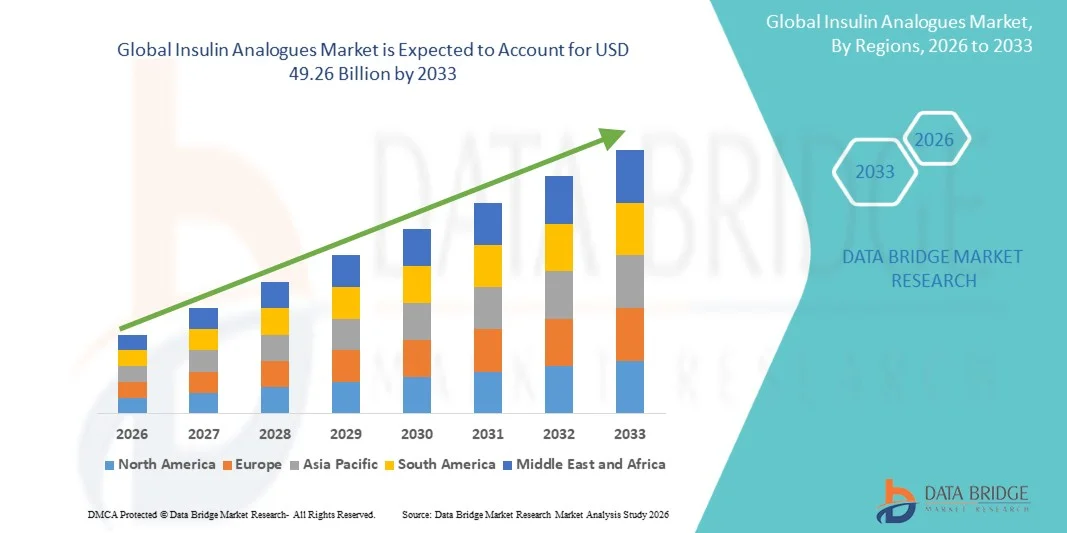
As per Data Bridge Market Research analysis, the insulin analogues market was valued at USD 31.86 billion in 2025 and is projected to reach USD 49.26 billion by 2033, growing at a CAGR of 5.60% from 2026 to 2033. The market is experiencing consistent growth driven by the increasing prevalence of diabetes, rising adoption of advanced insulin formulations, and ongoing innovation in long-acting and rapid-acting insulin therapies.
The growing global burden of Type 1 and Type 2 diabetes, coupled with increasing demand for improved glycemic control and patient-friendly treatment options, is accelerating the adoption of insulin analogues. The commercialization of next-generation analogues, including once-weekly insulin candidates, along with expanding access initiatives, favorable reimbursement policies, and continuous advancements in insulin delivery technologies, is further supporting market growth across both developed and emerging healthcare markets
Market Size & Forecast
- Global Market Value (2025): USD 31.86 Billion
- Expected Market Value (2033): USD 49.26 Billion
- Forecast CAGR (2026–2033): 5.60%
- Leading Region in 2025: North America
- Fastest Growing Region: Asia Pacific
Key Market Trends & Insights
- North America dominated the insulin analogues market with the largest revenue share of 40.5% in 2025, supported by the high prevalence of diabetes, advanced healthcare infrastructure, strong reimbursement coverage, and widespread adoption of advanced insulin therapies
- The long-acting insulin analogues segment led the market with a 50.55% share in 2025, driven by increasing demand for basal insulin therapies that provide prolonged glycemic control with reduced dosing frequency
- Asia-Pacific is expected to be the fastest-growing region during the forecast period with an estimated CAGR of 8.1% from 2026 to 2033, fueled by the rising diabetes burden, increasing healthcare expenditure, improving access to diabetes treatment, and growing adoption of insulin analogue therapies in China and India
- Rapid-acting insulin analogues are the fastest-growing type, projected to register a CAGR of 7.8%, reflecting the surge in demand for effective postprandial glucose management and intensive insulin therapy
- The injection segment dominated the delivery method category with a 80.85% revenue share in 2025, led by its widespread availability, cost-effectiveness, and established usage across diabetes treatment settings
- Diabetes type 2 accounted for 70.75% of the market, preferred by the increasing global prevalence of Type 2 diabetes and the growing number of patients requiring insulin therapy due to inadequate glycemic control
- The diabetes type 1 segment is the fastest-growing application category, with a CAGR of 8.9%, driven by the essential requirement for lifelong insulin therapy among individuals with Type 1 diabetes
Report Scope and Insulin Analogues Market Segmentation
|
Attributes |
Insulin Analogues Key Market Insights |
|
Segments Covered |
|
|
Countries Covered |
North America
Europe
Asia-Pacific
Middle East and Africa
South America
|
|
Key Market Players |
|
|
Market Opportunities |
|
|
Value Added Data Infosets |
In addition to the insights on market scenarios such as market value, growth rate, segmentation, geographical coverage, and major players, the market reports curated by the Data Bridge Market Research also include in-depth expert analysis, patient epidemiology, pipeline analysis, pricing analysis, and regulatory framework. |
Insulin Analogues Market Trends
Trend: Increasing Adoption of Next-Generation Long-Acting and Ultra-Long-Acting Insulin Analogues
The insulin analogues market is witnessing increasing adoption of advanced long-acting and ultra-long-acting formulations due to their ability to provide sustained glycemic control, reduce dosing frequency, and improve treatment adherence compared with conventional insulin therapies. Pharmaceutical companies are focusing on developing innovative basal insulin analogues with extended duration of action and improved pharmacokinetic profiles. The emergence of once-weekly insulin therapies is further transforming diabetes management by reducing injection burden and supporting better patient compliance, while continuous clinical advancements are expanding treatment options for individuals requiring intensive insulin therapy. For instance, in March 2024, Novo Nordisk announced positive results from the Phase 3 ONWARDS clinical trial programme for once-weekly insulin icodec, demonstrating improved glycemic control and supporting its potential as a new-generation basal insulin analogue for adults with diabetes.
The shift toward longer-acting and less frequent insulin analogue therapies is expected to remain a major market trend as manufacturers focus on improving convenience, adherence, and long-term diabetes outcomes.
Insulin Analogues Market Dynamics
Key Market Driver: Rising Diabetes Prevalence and Growing Demand for Advanced Insulin Therapies
The increasing prevalence of diabetes worldwide is creating substantial demand for insulin analogues that offer improved glucose management, predictable action profiles, and enhanced patient convenience. The growing burden of Type 1 and Type 2 diabetes, rising obesity rates, and increasing diagnosis rates are encouraging healthcare providers to adopt modern insulin analogue therapies over traditional insulin formulations. Pharmaceutical companies are expanding insulin analogue production capacity and improving access to advanced diabetes treatments across developed and emerging healthcare markets, supporting sustained market growth. For instance, in November 2021, the International Diabetes Federation (IDF) released the 10th Edition of the IDF Diabetes Atlas, reporting that approximately 537 million adults were living with diabetes globally in 2021, with projections reaching 643 million by 2030 and 783 million by 2045, highlighting the growing demand for effective insulin-based therapies.
The expanding global diabetes population and increasing requirement for effective glucose management solutions will continue to drive demand for insulin analogues across healthcare systems worldwide.
Key Restraint/Challenge: High Cost of Insulin Analogues and Limited Accessibility
A significant restraint in the insulin analogues market is the high cost associated with advanced insulin formulations compared with conventional human insulin products. Manufacturing complexity, intellectual property protection, and limited availability of affordable alternatives contribute to pricing challenges, particularly in low- and middle-income countries. Restricted affordability and uneven healthcare reimbursement coverage continue to limit access to insulin analogue therapies, creating barriers for widespread adoption despite their clinical advantages. Healthcare organizations and governments are increasingly focusing on improving affordability through biosimilar insulin development and access programs. For instance, in April 2024, the World Health Organization (WHO) highlighted ongoing challenges in diabetes care, including barriers related to the availability, affordability, and accessibility of insulin, particularly in low- and middle-income countries where high costs and limited supply continue to restrict access to essential diabetes treatments.
Cost pressures and unequal access remain key challenges for insulin analogue adoption, making affordability initiatives and biosimilar development important factors for future market expansion.
Key Market Opportunity: Expansion of Biosimilar Insulin Analogues and Digital Diabetes Management Integration
The development of biosimilar insulin analogues and integration with digital diabetes management platforms represent significant market opportunities. Biosimilar insulin products can improve affordability and expand patient access, while connected insulin pens, continuous glucose monitoring systems, and digital health platforms enable personalized diabetes management. The combination of insulin analogue innovation with data-driven monitoring technologies is creating opportunities for pharmaceutical companies to improve treatment outcomes, enhance adherence, and expand diabetes care solutions across emerging markets. For instance, in July 2021, Biocon Biologics and Viatris received U.S. FDA approval for Semglee (insulin glargine-yfgn) as the first interchangeable biosimilar insulin product, enabling pharmacy-level substitution and supporting improved access to more affordable insulin analogue therapies for people with diabetes.
Increasing adoption of biosimilar insulin analogues and digital healthcare solutions is expected to create new growth opportunities by improving affordability, accessibility, and personalized diabetes care.
Insulin Analogues Market Scope
The insulin analogues market is segmented on the basis of type, delivery method, application, and end user.
- By Type
On the basis of type, the insulin analogues market is segmented into long-acting insulin analogues, rapid-acting insulin analogues, and premix insulin analogues. The long-acting insulin analogues segment dominated the market with an estimated share of 50.55% in 2025, owing to increasing demand for basal insulin therapies that provide prolonged glycemic control with reduced dosing frequency. These analogues, including insulin glargine, insulin detemir, and insulin degludec, are widely preferred due to their stable pharmacokinetic profiles and lower risk of hypoglycemia compared with conventional insulin products. The rising prevalence of Type 2 diabetes and increasing requirement for continuous glucose management are significantly supporting segment growth. Long-acting analogues are extensively used among patients requiring once-daily insulin administration, improving treatment convenience and adherence. Continuous innovation in ultra-long-acting insulin formulations is further strengthening their market position. Growing adoption of advanced basal insulin therapies across developed and emerging markets is expected to maintain segment dominance during the forecast period.
The rapid-acting insulin analogues segment is projected to register the fastest growth at an estimated CAGR of 7.8% from 2026 to 2033, driven by increasing demand for effective postprandial glucose management and intensive insulin therapy. Rapid-acting analogues such as insulin lispro, insulin aspart, and insulin glulisine provide faster onset of action and improved flexibility around meal timing. Growing adoption among patients requiring tighter glucose control is accelerating their demand across diabetes care settings. These products are widely used in combination with basal insulin therapies to achieve comprehensive glycemic management. Advancements in insulin delivery devices, including smart pens and insulin pumps, are further supporting rapid-acting analogue adoption. Increasing focus on personalized diabetes management and improved treatment outcomes is expected to drive future segment expansion.
- By Delivery Method
On the basis of delivery method, the insulin analogues market is segmented into injection, insulin pump, and inhalation. The injection segment dominated the market with an estimated share of 80.85% in 2025, owing to its widespread availability, cost-effectiveness, and established usage across diabetes treatment settings. Injectable insulin analogue therapies, including prefilled pens, cartridges, and syringes, remain the primary administration method globally due to their proven clinical effectiveness. The segment benefits from extensive physician familiarity and broad patient acceptance across Type 1 and Type 2 diabetes populations. Increasing availability of advanced insulin pens with improved dosing accuracy and convenience is further supporting segment growth. Healthcare providers continue to recommend injectable insulin analogues as a reliable and accessible treatment option. The strong presence of established pharmaceutical manufacturers and widespread distribution networks continues to reinforce the dominance of injection-based delivery.
The insulin pump segment is expected to witness the fastest growth at an estimated CAGR of 10.2% from 2026 to 2033, driven by increasing adoption of advanced diabetes management technologies and demand for automated insulin delivery systems. Insulin pumps provide continuous subcutaneous insulin infusion, enabling improved glucose control and reducing the burden of multiple daily injections. Rising adoption among Type 1 diabetes patients and increasing integration with continuous glucose monitoring (CGM) systems are accelerating segment expansion. Technological advancements such as smart pumps, closed-loop systems, and artificial intelligence-based glucose management are enhancing treatment efficiency. Growing preference for personalized and digital diabetes care solutions is further increasing insulin pump adoption. Expanding healthcare infrastructure and rising awareness regarding advanced insulin delivery technologies are expected to create significant growth opportunities.
- By Application
On the basis of application, the insulin analogues market is segmented into diabetes type 1, diabetes type 2, and gestational diabetes. The diabetes type 2 segment dominated the market with an estimated share of 70.75% in 2025, attributed to the increasing global prevalence of Type 2 diabetes and the growing number of patients requiring insulin therapy due to inadequate glycemic control. Type 2 diabetes represents the majority of diabetes cases worldwide, creating substantial demand for insulin analogues as disease progression often requires injectable treatment. Increasing obesity rates, sedentary lifestyles, and aging populations are contributing to the expansion of the Type 2 diabetes patient pool. Insulin analogues are increasingly preferred due to improved glucose management, reduced hypoglycemia risk, and enhanced patient convenience. Growing diagnosis rates and improved access to diabetes treatment in emerging economies are further supporting segment growth. The increasing adoption of combination therapies involving insulin analogues and other glucose-lowering agents continues to strengthen market demand.
The diabetes type 1 segment is expected to experience the fastest growth at an estimated CAGR of 8.9% from 2026 to 2033, driven by the essential requirement for lifelong insulin therapy among individuals with Type 1 diabetes. Insulin analogues are considered a critical component of Type 1 diabetes management due to their ability to closely mimic physiological insulin patterns. Increasing adoption of rapid-acting and long-acting analogue combinations is improving glycemic control and reducing treatment complications. Rising awareness regarding intensive insulin therapy and continuous glucose monitoring is supporting segment expansion. Technological advancements in insulin pumps and automated insulin delivery systems are further increasing the utilization of insulin analogues among Type 1 diabetes patients. Growing investment in diabetes research and innovative treatment approaches is expected to support continued segment growth.
- By End User
On the basis of end user, the insulin analogues market is segmented into hospitals, homecare, and diabetes clinics. The homecare segment dominated the market with an estimated share of 55.60% in 2025, driven by the increasing adoption of self-administered insulin therapies and the growing preference for convenient diabetes management outside healthcare facilities. Rising availability of insulin pens, prefilled devices, and digital monitoring solutions is enabling patients to manage insulin therapy independently. The expansion of remote healthcare and telemedicine services is further supporting home-based diabetes care. Homecare settings provide improved treatment convenience, reduced hospital visits, and better long-term disease management. Increasing awareness regarding self-injection techniques and patient education programs is strengthening adoption. The growing burden of diabetes worldwide is expected to continue increasing demand for homecare-based insulin analogue administration.
The diabetes clinics segment is projected to register the fastest growth at an estimated CAGR of 8.0% from 2026 to 2033, supported by increasing demand for specialized diabetes management services and personalized treatment approaches. Diabetes clinics provide comprehensive care, including insulin initiation, dose optimization, patient education, and continuous disease monitoring. Rising diabetes prevalence and increasing complexity of diabetes treatment are driving patients toward specialized healthcare facilities. These clinics are increasingly adopting technologies such as continuous glucose monitoring and digital diabetes management platforms. Growing focus on preventive care and early intervention is further supporting segment expansion. Increasing healthcare investments and the development of dedicated diabetes care centers are expected to accelerate growth in this segment.
Insulin Analogues Market Regional Analysis
North America dominated the insulin analogues market with the largest revenue share of 40.5% in 2025, supported by the high prevalence of diabetes, advanced healthcare infrastructure, strong reimbursement coverage, and widespread adoption of advanced insulin therapies. The region also benefits from the presence of leading insulin manufacturers, increasing utilization of long-acting and rapid-acting insulin analogues, and early adoption of advanced diabetes management technologies. Growing integration of continuous glucose monitoring systems, insulin delivery devices, and digital diabetes care platforms is accelerating market development. Increasing focus on personalized diabetes management, improved glycemic control, and expanding access to advanced insulin treatments continues to strengthen North America's leadership position in the global market.
U.S. Insulin Analogues Market Insight
The U.S. insulin analogues market is witnessing strong growth due to the high prevalence of diabetes, increasing adoption of advanced insulin therapies, and expanding use of innovative diabetes management technologies. The country’s mature healthcare infrastructure, strong reimbursement framework, and presence of leading insulin manufacturers are driving demand for long-acting, rapid-acting, and next-generation insulin analogues. In addition, growing adoption of continuous glucose monitoring (CGM), connected insulin delivery systems, and personalized diabetes care solutions is accelerating insulin analogue utilization across hospitals, diabetes clinics, and homecare settings. According to the Centers for Disease Control and Prevention (CDC), approximately 38.4 million people in the U.S. had diabetes in 2021, representing a significant patient base requiring advanced glucose management therapies, including insulin analogues.
Europe Insulin Analogues Market Insight
The Europe insulin analogues market remains a major contributor to global revenue, driven by high diabetes prevalence, established healthcare systems, and strong adoption of advanced diabetes treatment options. The widespread availability of long-acting and rapid-acting insulin analogues, supportive reimbursement policies, and increasing focus on improving diabetes outcomes are supporting market expansion across the region. Increasing investments in biosimilar insulin development, digital diabetes management platforms, and innovative insulin delivery technologies continue to enhance adoption of insulin analogues throughout Europe. The International Diabetes Federation (IDF) reported that approximately 61 million adults were living with diabetes in the European Region in 2021, creating significant demand for effective insulin-based therapies.
U.K. Insulin Analogues Market Insight
The U.K. insulin analogues market is experiencing steady growth, supported by increasing diabetes prevalence, strong National Health Service (NHS) diabetes management programs, and rising adoption of modern insulin therapies. Increasing use of insulin pens, continuous glucose monitoring systems, and personalized treatment approaches is contributing to market growth. Furthermore, government initiatives focused on improving diabetes outcomes, reducing complications, and expanding access to innovative diabetes technologies are strengthening the adoption of insulin analogues across healthcare settings. According to Diabetes UK, approximately 4.4 million people were living with diabetes in the U.K. in 2023, increasing the requirement for effective insulin therapy and diabetes management solutions.
Germany Insulin Analogues Market Insight
The Germany insulin analogues market is expanding steadily due to the country’s advanced healthcare infrastructure, high diabetes burden, and increasing adoption of innovative diabetes therapies. Healthcare providers are increasingly utilizing insulin analogues, including basal and rapid-acting formulations, to achieve improved glycemic control and reduce treatment complications. Continuous advancements in diabetes monitoring technologies, strong pharmaceutical research capabilities, and favorable access to modern therapies are further driving market growth in Germany. According to the International Diabetes Federation, Germany had approximately 8.5 million adults living with diabetes in 2021, representing one of the largest diabetes populations in Europe and supporting demand for insulin analogue therapies.
Asia-Pacific Insulin Analogues Market Insight
The Asia-Pacific insulin analogues market is expected to witness rapid growth, driven by the increasing diabetes population, rising healthcare expenditure, and improving access to advanced diabetes treatments across countries such as China, India, and Japan. Growing awareness regarding insulin therapy, expansion of healthcare infrastructure, and increasing adoption of modern insulin delivery systems are supporting regional market expansion. In addition, rising investments by pharmaceutical companies in emerging markets and increasing availability of biosimilar insulin products are accelerating insulin analogue adoption across commercial and homecare settings. According to the International Diabetes Federation, the Western Pacific Region had approximately 206 million adults living with diabetes in 2021, making it one of the largest diabetes regions globally and creating substantial demand for insulin therapies.
Japan Insulin Analogues Market Insight
The Japan insulin analogues market is witnessing consistent growth due to the country’s aging population, increasing diabetes prevalence, and strong adoption of advanced healthcare technologies. Pharmaceutical companies and healthcare providers are increasingly adopting long-acting insulin analogues, insulin pens, and digital monitoring solutions to improve diabetes management. Moreover, Japan’s focus on reducing diabetes-related complications and enhancing personalized treatment approaches is further contributing to market growth. According to the International Diabetes Federation, Japan had approximately 11 million adults living with diabetes in 2021, supporting continued demand for insulin analogue therapies and diabetes management solutions.
China Insulin Analogues Market Insight
The China insulin analogues market is growing rapidly, driven by the country’s large diabetes population, increasing healthcare spending, and expanding access to advanced diabetes treatments. Growing adoption of long-acting and rapid-acting insulin analogues, increasing use of insulin pens, and government initiatives to improve chronic disease management are significantly boosting market demand. In addition, increasing domestic production of insulin products and growing availability of biosimilar insulin therapies are positioning China as one of the fastest-growing markets for insulin analogues globally. The China National Medical Products Administration (NMPA) approved Novo Nordisk’s insulin icodec injection (Awiqli), a novel long-acting insulin analogue designed for once-weekly administration in adults with Type 2 diabetes. The approval expanded access to next-generation insulin analogue therapies in China and supports the country’s growing demand for advanced diabetes management solutions.
Insulin Analogues Market Share
The insulin analogues industry is primarily led by well-established companies, including:
- Novo Nordisk A/S (Denmark)
- Eli Lilly and Company (U.S.)
- Sanofi (France)
- Viatris Inc. (U.S.)
- Biocon Limited (India)
- Boehringer Ingelheim International GmbH (Germany)
- Ypsomed AG (Switzerland)
- Wockhardt Limited (India)
- Gan & Lee Pharmaceuticals (China)
- United Laboratories International Holdings Limited (Hong Kong)
- Julphar (United Arab Emirates)
- Adocia (France)
- Beta Bionics (U.S.)
- Insulet Corporation (U.S.)
- Tandem Diabetes Care, Inc. (U.S.)
- Medtronic (Ireland)
- DexCom, Inc. (U.S.)
- Senseonics, Incorporated (U.S.)
Latest Developments in Insulin Analogues Market
- In July 2025, the U.S. Food and Drug Administration (FDA) approved Kirsty (insulin aspart-xjhz), the first rapid-acting interchangeable biosimilar insulin product to NovoLog (insulin aspart). Developed as a fast-acting insulin analogue, Kirsty was approved in prefilled pen and vial presentations for improving glycemic control in adults and pediatric patients with diabetes. This approval expanded biosimilar competition in the rapid-acting insulin analogue segment and supported efforts to improve access to advanced insulin therapies
- In February 2025, Novo Nordisk received approval from China’s National Medical Products Administration (NMPA) for Awiqli (insulin icodec), a once-weekly basal insulin analogue developed for adults with diabetes requiring insulin therapy. The approval introduced an innovative long-acting insulin option designed to reduce injection frequency compared with traditional daily basal insulin treatments. The launch strengthens the adoption of next-generation insulin analogues in China and reflects the industry’s focus on improving treatment convenience, adherence, and diabetes management outcomes
- In March 2024, Novo Nordisk announced that its once-weekly basal insulin icodec received a positive recommendation from the European Medicines Agency’s Committee for Medicinal Products for Human Use (CHMP). The recommendation followed results from the Phase 3 ONWARDS clinical programme and supported the potential introduction of a new long-acting insulin analogue designed to improve treatment convenience for adults with diabetes
- In November 2021, Viatris and Biocon Biologics launched interchangeable Semglee (insulin glargine-yfgn) injection and insulin glargine-yfgn injection in the United States following FDA approval as the first interchangeable biosimilar insulin products. The products were introduced as alternatives to Lantus (insulin glargine), a long-acting insulin analogue, and were made available in vial and prefilled pen formats. This launch strengthened the availability of biosimilar insulin analogues and supported broader access to affordable basal insulin therapies for people with diabetes
- In July 2021, the U.S. Food and Drug Administration (FDA) approved Semglee (insulin glargine-yfgn) as the first interchangeable biosimilar insulin product for diabetes treatment. Developed by Viatris and Biocon Biologics, Semglee became interchangeable with Lantus (insulin glargine), enabling pharmacy-level substitution under applicable state laws. This approval expanded access to long-acting insulin analogue therapy and represented a major milestone in biosimilar insulin development

- Interactive Data Analysis Dashboard
- Company Analysis Dashboard for high growth potential opportunities
- Research Analyst Access for customization & queries
- Competitor Analysis with Interactive dashboard
- Latest News, Updates & Trend analysis
- Harness the Power of Benchmark Analysis for Comprehensive Competitor Tracking
Data collection and base year analysis are done using data collection modules with large sample sizes. The stage includes obtaining market information or related data through various sources and strategies. It includes examining and planning all the data acquired from the past in advance. It likewise envelops the examination of information inconsistencies seen across different information sources. The market data is analysed and estimated using market statistical and coherent models. Also, market share analysis and key trend analysis are the major success factors in the market report. To know more, please request an analyst call or drop down your inquiry.
The key research methodology used by DBMR research team is data triangulation which involves data mining, analysis of the impact of data variables on the market and primary (industry expert) validation. Data models include Vendor Positioning Grid, Market Time Line Analysis, Market Overview and Guide, Company Positioning Grid, Patent Analysis, Pricing Analysis, Company Market Share Analysis, Standards of Measurement, Global versus Regional and Vendor Share Analysis. To know more about the research methodology, drop in an inquiry to speak to our industry experts.
Data Bridge Market Research is a leader in advanced formative research. We take pride in servicing our existing and new customers with data and analysis that match and suits their goal. The report can be customized to include price trend analysis of target brands understanding the market for additional countries (ask for the list of countries), clinical trial results data, literature review, refurbished market and product base analysis. Market analysis of target competitors can be analyzed from technology-based analysis to market portfolio strategies. We can add as many competitors that you require data about in the format and data style you are looking for. Our team of analysts can also provide you data in crude raw excel files pivot tables (Fact book) or can assist you in creating presentations from the data sets available in the report.












