


Intelligent Network Market Size
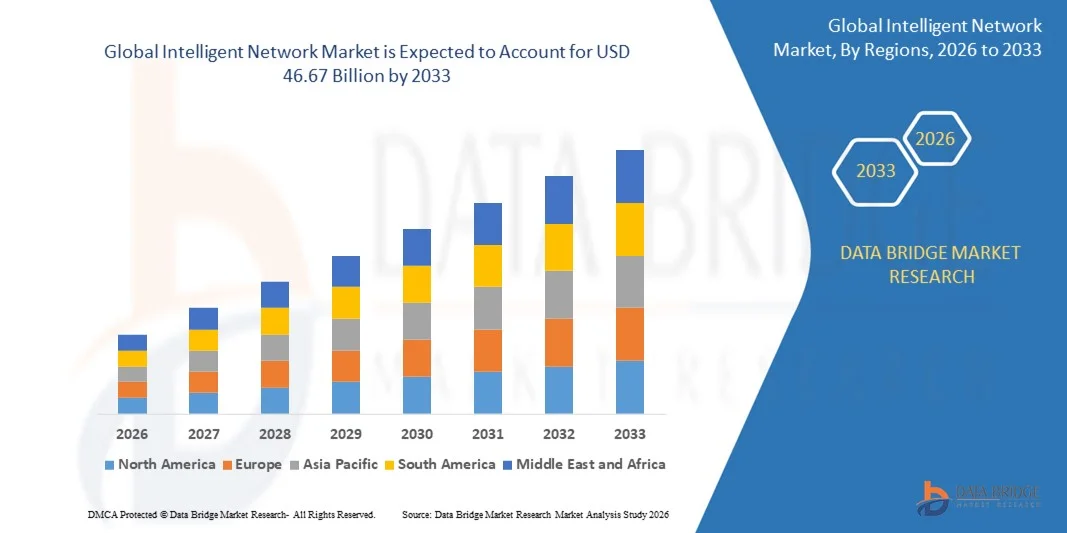
- The global intelligent network market size was valued at USD 6.87 billion in 2025 and is expected to reach USD 46.67 billion by 2033, at a CAGR of 27.05% during the forecast period
- The market growth is largely fuelled by the increasing deployment of 5G networks and the rising demand for advanced network management solutions to improve operational efficiency and service delivery
- The growing adoption of cloud computing, software-defined networking, and network function virtualization is further accelerating the demand for intelligent network solutions across telecom and enterprise sectors
Intelligent Network Market Analysis
- Intelligent network solutions are gaining significant adoption due to their ability to enable automation, improve network reliability, and support dynamic service provisioning across modern telecom environments
- Increasing digital transformation, rapid growth in connected devices, and the expansion of IoT ecosystems are driving the need for intelligent, scalable, and flexible network architectures globally
- North America dominated the intelligent network market with the largest revenue share in 2025, driven by the rapid adoption of advanced networking technologies and the strong presence of major cloud and telecom service providers
- Asia-Pacific region is expected to witness the highest growth rate in the global intelligent network market, driven by increasing smartphone penetration, expansion of 5G networks, and rising investments in smart cities and industrial automation
- The Resource Management segment held the largest market revenue share in 2025 driven by the increasing need for efficient utilization of network infrastructure and optimization of bandwidth and computing resources. Intelligent resource management solutions help network operators automate allocation, reduce operational costs, and improve overall network efficiency, making them essential for telecom and cloud environments
Report Scope and Intelligent Network Market Segmentation
|
Attributes |
Intelligent Network Key Market Insights |
|
Segments Covered |
|
|
Countries Covered |
North America
Europe
Asia-Pacific
Middle East and Africa
South America
|
|
Key Market Players |
|
|
Market Opportunities |
|
|
Value Added Data Infosets |
In addition to the market insights such as market value, growth rate, market segments, geographical coverage, market players, and market scenario, the market report curated by the Data Bridge Market Research team includes in-depth expert analysis, import/export analysis, pricing analysis, production consumption analysis, and pestle analysis. |
Intelligent Network Market Trends
Growing Adoption of 5G and Cloud-Native Network Architecture
- The rapid deployment of 5G networks is significantly transforming the intelligent network market, as telecom operators increasingly adopt cloud-native and software-defined networking technologies to enhance flexibility, scalability, and performance. Intelligent networks enable real-time traffic management, automated provisioning, and efficient resource utilization, helping operators deliver high-speed connectivity and improved service quality. This trend is encouraging telecom providers to modernize legacy infrastructure and accelerate digital transformation initiatives
- Increasing demand for high-speed data services, low latency, and seamless connectivity is driving the adoption of intelligent network solutions across telecom and enterprise sectors. Businesses are integrating intelligent networking capabilities to support applications such as IoT, edge computing, and mission-critical communications. These capabilities help improve operational efficiency, reduce downtime, and ensure consistent service delivery, strengthening the role of intelligent networks in next-generation communication ecosystems
- Automation and artificial intelligence are playing a crucial role in intelligent network evolution, enabling predictive maintenance, fault detection, and automated decision-making. Network operators are leveraging AI-driven analytics to optimize network performance, enhance reliability, and minimize operational costs. This shift is also supporting autonomous network operations, allowing service providers to improve efficiency and customer experience while reducing manual intervention
- For instance, in 2024, Ericsson in Sweden and Nokia in Finland expanded their intelligent network portfolios with cloud-native 5G core and automation solutions for telecom operators. These solutions were introduced to enhance network scalability, enable real-time analytics, and support advanced applications. The launches strengthened their competitive positioning and accelerated intelligent network adoption among global telecom providers
- While adoption is accelerating, sustained growth depends on continuous innovation, integration with emerging technologies, and investment in scalable infrastructure. Vendors are focusing on developing AI-enabled network management platforms, improving interoperability, and enhancing security features to support evolving telecom and enterprise requirements
Intelligent Network Market Dynamics
Driver
Increasing Deployment of 5G and Network Automation
- The expanding rollout of 5G infrastructure is a major driver for the intelligent network market, as telecom operators require advanced network management solutions to handle increased data traffic and complex network environments. Intelligent networks enable automated configuration, efficient traffic routing, and improved service delivery, helping operators meet growing connectivity demands and enhance overall network performance
- Rising adoption of connected devices and digital services is further accelerating market growth. Intelligent networks support seamless connectivity for IoT devices, smart cities, and industrial automation by enabling real-time communication and efficient resource allocation. This capability is essential for ensuring reliable network performance and supporting next-generation digital applications across industries
- Telecom operators and technology providers are actively investing in intelligent network solutions to enhance operational efficiency and reduce costs. These investments include automation platforms, AI-based analytics, and cloud-based network management systems. Such initiatives are helping organizations improve network reliability, enhance scalability, and deliver advanced services to customers
- For instance, in 2023, Cisco Systems in the U.S. and Huawei Technologies in China introduced intelligent network automation and cloud-based management solutions to support telecom operators. These developments enabled faster network deployment, improved service quality, and reduced operational complexity, strengthening their presence in the intelligent network market
- Although increasing deployment of 5G and automation supports growth, long-term expansion will depend on infrastructure investment, technology integration, and workforce readiness. Continuous innovation and strategic partnerships will be essential to support evolving network requirements and maintain competitive advantage
Restraint/Challenge
High Implementation Cost and Integration Complexity
- The high cost associated with intelligent network deployment remains a key challenge, particularly for small and mid-sized telecom operators. Investment in advanced hardware, software platforms, and infrastructure modernization significantly increases initial implementation costs. These financial constraints can limit adoption, especially in developing regions with budget limitations
- Integration with existing legacy systems presents another major challenge, as telecom operators must ensure compatibility and seamless operation across diverse network environments. Complex migration processes, interoperability issues, and potential service disruptions increase implementation risks and operational challenges
- Security and data privacy concerns also affect market growth, as intelligent networks involve extensive data collection, automation, and cloud integration. Network operators must implement advanced security measures to protect sensitive data and prevent cyber threats. These requirements increase operational complexity and demand continuous monitoring and investment
- For instance, in 2024, telecom operators in Southeast Asia working with solutions from Juniper Networks in the U.S. and ZTE Corporation in China reported delays in intelligent network deployment due to integration challenges and high infrastructure costs. These issues impacted implementation timelines and increased overall project expenses, affecting adoption rates
- Addressing these challenges will require cost-effective deployment strategies, improved interoperability, and enhanced security frameworks. Collaboration between telecom operators, technology providers, and governments will be essential to support infrastructure development, reduce costs, and accelerate intelligent network adoption globally
Intelligent Network Market Scope
The intelligent network market is segmented on the basis of application, enterprise size, and end-user.
- By Application
On the basis of application, the intelligent network market is segmented into Information Cognition, Resource Management, Traffic Prediction and Classification, Performance Prediction, and Configuration Extrapolation. The Resource Management segment held the largest market revenue share in 2025 driven by the increasing need for efficient utilization of network infrastructure and optimization of bandwidth and computing resources. Intelligent resource management solutions help network operators automate allocation, reduce operational costs, and improve overall network efficiency, making them essential for telecom and cloud environments.
The Traffic Prediction and Classification segment is expected to witness the fastest growth rate from 2026 to 2033, driven by the rising demand for real-time network monitoring and proactive congestion management. These solutions use artificial intelligence and analytics to predict traffic patterns, enhance service quality, and prevent network disruptions. They are particularly valuable for supporting 5G networks, IoT connectivity, and high-speed data services.
- By Enterprise Size
On the basis of enterprise size, the intelligent network market is segmented into Large Enterprises and SMEs. The Large Enterprises segment accounted for the largest market revenue share in 2025 driven by their extensive network infrastructure and higher investment capacity in advanced networking technologies. Large organizations rely on intelligent network solutions to improve operational efficiency, enhance security, and manage complex network environments across multiple locations.
The SMEs segment is expected to witness the fastest growth rate from 2026 to 2033, driven by increasing digital transformation and growing adoption of cloud-based networking solutions. SMEs are implementing intelligent networks to improve connectivity, reduce downtime, and support business expansion while maintaining cost efficiency and scalability.
- By End-User
On the basis of end-user, the intelligent network market is segmented into Cloud Service Providers, Telecom Service Providers, Managed Network Service Providers, and Others. The Telecom Service Providers segment held the largest market revenue share in 2025 driven by the rapid deployment of 5G networks and the growing need for automated network management. Intelligent network solutions help telecom operators enhance network performance, reduce operational complexity, and deliver improved customer experience.
The Cloud Service Providers segment is expected to witness the fastest growth rate from 2026 to 2033, driven by the increasing adoption of cloud computing and the need for efficient data traffic management. Intelligent networks enable cloud providers to optimize resource utilization, ensure reliable service delivery, and support large-scale digital applications, strengthening their role in modern IT infrastructure.
Intelligent Network Market Regional Analysis
- North America dominated the intelligent network market with the largest revenue share in 2025, driven by the rapid adoption of advanced networking technologies and the strong presence of major cloud and telecom service providers
- Organizations in the region highly prioritize network automation, predictive analytics, and AI-driven optimization to enhance operational efficiency, reduce downtime, and improve service quality across complex network infrastructures
- This widespread adoption is further supported by high investments in digital transformation, early adoption of 5G, and increasing demand for scalable and intelligent network management solutions, establishing intelligent networks as a critical component across enterprise and telecom environments
U.S. Intelligent Network Market Insight
The U.S. intelligent network market captured the largest revenue share in 2025 within North America, fueled by the strong presence of hyperscale data centers and leading technology providers. Enterprises are increasingly adopting intelligent network solutions to improve network visibility, automate operations, and enhance performance management. The growing deployment of AI, cloud computing, and software-defined networking is further accelerating market growth. Moreover, rising investments in 5G infrastructure and edge computing are significantly contributing to the expansion of intelligent network adoption.
Europe Intelligent Network Market Insight
The Europe intelligent network market is expected to witness the fastest growth rate from 2026 to 2033, primarily driven by increasing investments in telecom modernization and digital infrastructure. The rising focus on network automation and efficient traffic management is encouraging adoption across industries. European enterprises are also emphasizing secure and efficient network operations to support digital services. The region is experiencing strong growth across telecom, cloud, and enterprise sectors, with intelligent networks being integrated into next-generation infrastructure.
U.K. Intelligent Network Market Insight
The U.K. intelligent network market is expected to witness the fastest growth rate from 2026 to 2033, driven by increasing deployment of 5G networks and cloud services. Businesses are focusing on intelligent network solutions to enhance connectivity, optimize performance, and support digital applications. In addition, the growing demand for automated network management and real-time analytics is accelerating adoption. The country’s strong technology ecosystem and investments in telecom innovation continue to support market expansion.
Germany Intelligent Network Market Insight
The Germany intelligent network market is expected to witness the fastest growth rate from 2026 to 2033, fueled by strong industrial digitalization and Industry 4.0 initiatives. Organizations are adopting intelligent networks to support connected devices, automation, and real-time data processing. Germany’s advanced telecom infrastructure and focus on technological innovation are promoting adoption across manufacturing and enterprise sectors. The integration of AI-driven network management solutions is also becoming increasingly prominent.
Asia-Pacific Intelligent Network Market Insight
The Asia-Pacific intelligent network market is expected to witness the fastest growth rate from 2026 to 2033, driven by rapid expansion of telecom networks and increasing cloud adoption. Rising digital transformation initiatives and growing internet penetration are encouraging intelligent network deployment. Governments and enterprises across the region are investing heavily in advanced networking technologies. Furthermore, increasing demand for efficient network performance and scalability is supporting market growth.
Japan Intelligent Network Market Insight
The Japan intelligent network market is expected to witness the fastest growth rate from 2026 to 2033 due to strong technological advancement and early adoption of innovative networking solutions. The country is focusing on deploying intelligent networks to support 5G, IoT, and smart infrastructure. Enterprises are increasingly investing in automated network management to enhance efficiency and reliability. Moreover, the growing need for high-performance networks is contributing to market expansion.
China Intelligent Network Market Insight
The China intelligent network market accounted for the largest market revenue share in Asia Pacific in 2025, attributed to rapid telecom expansion and strong government support for digital infrastructure. China is one of the leading adopters of 5G and cloud technologies, driving demand for intelligent network solutions. Enterprises are increasingly deploying advanced networking systems to improve operational efficiency. The country’s large-scale digital ecosystem and growing data traffic are key factors propelling the market.
Intelligent Network Market Share
The Intelligent Network industry is primarily led by well-established companies, including:
- Cisco Systems (U.S.)
- Huawei Technologies Co., Ltd (China)
- Telefonaktiebolaget LM Ericsson (Sweden)
- Tech Mahindra Limited (India)
- Hewlett Packard Enterprise Development LP (U.S.)
- Nokia (Finland)
- Juniper Networks, Inc (U.S.)
- Colt Technology Services Group Limited (U.K.)
- Netcracker (U.S.)
- Loom Systems (Israel)
- Ennetix (Israel)
- Aria Networks (U.K.)
- ExtraHop Networks (U.S.)
- Park Place Technologies (U.S.)
- APCON (U.S.)
- BluVector (U.S.)
- Nitro Solutions (U.S.)
- Netrolix (U.S.)
- Darktrace (U.K.)
- Flowmon Networks a.s (Czech Republic)
- Balbix, Inc (U.S.)
Latest Developments in Global Intelligent Network Market
- In November 2023, Huawei launched the 5.5G Intelligent Core Network Solution, designed to enhance service intelligence, network intelligence, and operational management (O&M) intelligence. This solution enables telecom operators to support a broader range of new business opportunities, improve network automation, and optimize operational efficiency. The innovation aims to drive smarter, more interconnected networks globally, accelerating digital transformation across industries
- In June 2023, Nokia introduced new products for its AirScale baseband portfolio, including Levante and Lodos 5G baseband capacity cards and the high-performance Ponente baseband control card. These innovations boost throughput, energy efficiency, and overall network capacity. They enable operators to handle increasing data traffic and support advanced 5G services, enhancing network performance and customer experience
- In 2022, Huawei expanded its 5G network solutions with upgraded Massive MIMO technology and AI-driven optimization tools. The enhancements improve spectrum efficiency, reduce energy consumption, and enable dynamic network management. This deployment supports enterprise digital transformation and provides operators with scalable solutions to meet growing 5G demand
- In 2022, Nokia deployed advanced 5G Standalone solutions in multiple regions, increasing network reliability, throughput, and coverage. These solutions support emerging applications such as autonomous vehicles, smart factories, and immersive AR/VR experiences. The rollout strengthens operator capabilities and accelerates the adoption of next-generation connectivity services
- In 2021, Huawei rolled out its CloudEngine data center switches with integrated AI capabilities. The switches optimize data processing, enhance network automation, and support large-scale cloud and enterprise deployments. This advancement improves operational efficiency, reduces latency, and facilitates faster deployment of digital services
- In 2021, Nokia introduced its ReefShark chipset series, enhancing 5G radio performance, reducing power consumption, and enabling higher network capacity. The chipsets support ultra-reliable low-latency communications and massive IoT deployments. Operators benefit from lower operational costs and the ability to deliver advanced 5G services more efficiently

- Interactive Data Analysis Dashboard
- Company Analysis Dashboard for high growth potential opportunities
- Research Analyst Access for customization & queries
- Competitor Analysis with Interactive dashboard
- Latest News, Updates & Trend analysis
- Harness the Power of Benchmark Analysis for Comprehensive Competitor Tracking
Data collection and base year analysis are done using data collection modules with large sample sizes. The stage includes obtaining market information or related data through various sources and strategies. It includes examining and planning all the data acquired from the past in advance. It likewise envelops the examination of information inconsistencies seen across different information sources. The market data is analysed and estimated using market statistical and coherent models. Also, market share analysis and key trend analysis are the major success factors in the market report. To know more, please request an analyst call or drop down your inquiry.
The key research methodology used by DBMR research team is data triangulation which involves data mining, analysis of the impact of data variables on the market and primary (industry expert) validation. Data models include Vendor Positioning Grid, Market Time Line Analysis, Market Overview and Guide, Company Positioning Grid, Patent Analysis, Pricing Analysis, Company Market Share Analysis, Standards of Measurement, Global versus Regional and Vendor Share Analysis. To know more about the research methodology, drop in an inquiry to speak to our industry experts.
Data Bridge Market Research is a leader in advanced formative research. We take pride in servicing our existing and new customers with data and analysis that match and suits their goal. The report can be customized to include price trend analysis of target brands understanding the market for additional countries (ask for the list of countries), clinical trial results data, literature review, refurbished market and product base analysis. Market analysis of target competitors can be analyzed from technology-based analysis to market portfolio strategies. We can add as many competitors that you require data about in the format and data style you are looking for. Our team of analysts can also provide you data in crude raw excel files pivot tables (Fact book) or can assist you in creating presentations from the data sets available in the report.













