


Intelligent Occupancy Sensor Market Overview
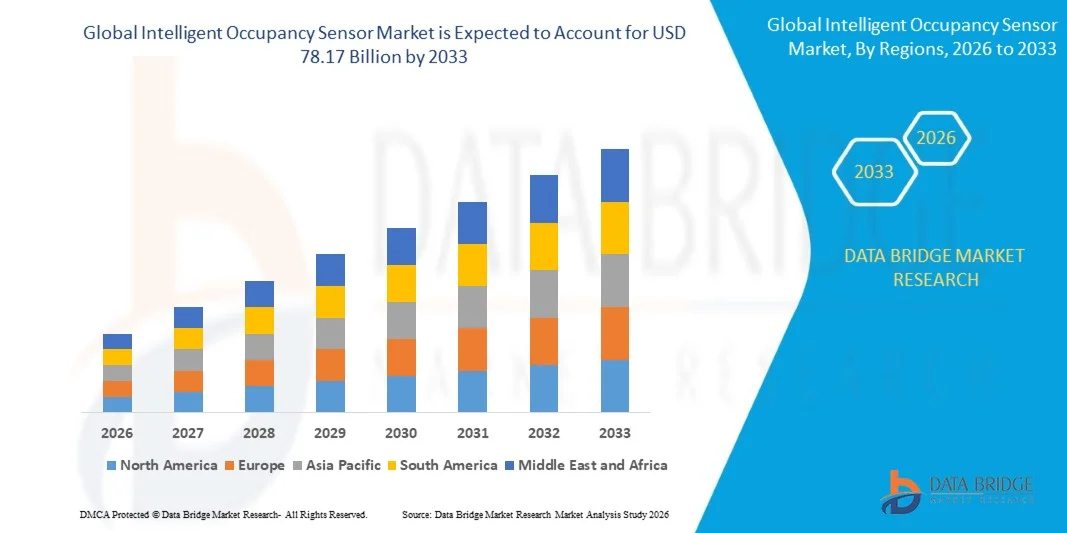
As per Data Bridge Market Research Analysis, the intelligent occupancy sensor market was valued at USD 2.53 billion in 2021 and was projected to reach USD 24.91 billion by 2029, growing at a CAGR of 33.10% from 2022 to 2029. Extending the same published growth rate provides an estimated market value of approximately USD 7.94 billion in 2025 and an indicative value of approximately USD 78.17 billion in 2033. Growth is being supported by smart-building investments, tighter energy-efficiency requirements, automated lighting and HVAC control, workplace-space optimization, and the wider use of connected building-management platforms.
Intelligent occupancy sensors go beyond basic motion detection by combining sensing hardware with connectivity, software, and analytics. Passive infrared sensors remain widely used because they are affordable and reliable, while dual-technology, microwave and millimetre-wave radar, thermal, time-of-flight, and image-processing solutions are expanding where accurate detection of stationary occupants is important. A dedicated intelligent occupancy sensor study also expects 13.2% CAGR from 2025 to 2031, indicating that AI-enabled and connected products may grow faster than the overall occupancy sensor category.
Market Size & Forecast
- Market Value (2025): USD 7.94 Billion
- Expected Market Value (2033): USD 78.17 Billion
- Forecast CAGR (2026-2033): 33.10%
- Leading Region: North America
- Fastest-Growing Region: Asia-Pacific
Key Market Trends & Insights
- North America dominated the intelligent occupancy sensor market with the largest revenue share in 2025, supported by increasing investments in smart buildings, energy-efficiency initiatives, and building automation technologies. Organizations across the region are deploying occupancy sensors to optimize lighting, HVAC, and security systems while reducing operating costs and meeting sustainability objectives.
- Asia-Pacific intelligent occupancy sensor market is expected to witness the fastest growth rate from 2026 to 2033, supported by rapid urbanization, expanding smart city initiatives, and increasing investments in connected infrastructure across China, Japan, India, and Southeast Asia.
- The Passive Infrared (PIR) segment held the largest market revenue share in 2025 due to its cost-effectiveness, low power consumption, and widespread deployment across commercial buildings, offices, retail spaces, and residential applications. PIR sensors are preferred for lighting control and HVAC automation because of their reliability, ease of installation, and compatibility with smart-building platforms.
- The dual technology segment is projected to register the fastest growth at a CAGR from 2026 to 2033, driven by increasing demand for higher detection accuracy through the combination of PIR and ultrasonic or radar technologies. Growing adoption across healthcare facilities, premium office spaces, and intelligent building environments is accelerating segment expansion.
- The wired segment accounted for the largest market revenue share in 2025 driven by its superior reliability, low latency, and widespread use in commercial and industrial building automation systems. Wired solutions remain the preferred option for large-scale deployments requiring uninterrupted connectivity and centralized control.
- The wireless segment is expected to witness the fastest growth at a CAGR from 2026 to 2033, supported by rising adoption of IoT-enabled smart homes, retrofitting projects, and mesh-network technologies such as Zigbee, Matter, and Thread. Increasing demand for flexible and cost-efficient installations is further contributing to market growth.
Report Scope and Intelligent Occupancy Sensor Market Segmentation
|
Attributes |
Intelligent Occupancy Sensor Key Market Insights |
|
Segments Covered |
|
|
Countries Covered |
North America
Europe
Asia-Pacific
South America
Middle East and Africa
|
|
Key Market Players |
|
|
Market Opportunities |
|
|
Value Added Data Infosets |
In addition to the insights on market scenarios such as market value, growth rate, segmentation, geographical coverage, and major players, the market reports curated by the Data Bridge Market Research also include in-depth expert analysis, geographically represented company-wise production and capacity, network layouts of distributors and partners, detailed and updated price trend analysis and deficit analysis of supply chain and demand. |
Intelligent Occupancy Sensor Market Trends
Trend: Shift from Motion Detection to Privacy-Preserving Spatial Intelligence
Growing demand for intelligent, privacy-friendly building technologies is accelerating the adoption of advanced occupancy sensing solutions across residential, commercial, healthcare, and public infrastructure applications. Building owners and enterprises are increasingly moving beyond basic motion detection toward systems capable of identifying occupancy status, space utilization, dwell time, and environmental conditions while preserving occupant privacy. The integration of passive infrared, ultrasonic, mmWave radar, thermal sensing, and edge AI is further improving detection accuracy and reducing false triggers.
The expansion of hybrid work environments, smart homes, connected healthcare, and energy-management programs is creating sustained demand for occupancy platforms that provide real-time presence and utilization insights. For instance, in January 2026, Aqara introduced its Spatial Multi-Sensor FP400 at CES 2026, featuring mmWave radar, AI-enabled multi-person positioning, posture recognition, headcount analytics, and Thread/Zigbee connectivity for smart residential and commercial environments. The launch reflects increasing industry investment in privacy-preserving spatial intelligence technologies.
The growing emphasis on local AI processing, privacy-friendly sensing, and interoperable connectivity standards is expected to reinforce long-term demand for intelligent occupancy solutions, positioning manufacturers to benefit from increasing investments in smart buildings, workplace analytics, and connected infrastructure.
Intelligent Occupancy Sensor Market Dynamics
Key Market Driver: Rising Demand for Energy-Efficient and Responsive Buildings
The global building industry continues to prioritize energy efficiency, sustainability, and occupant comfort, driving adoption of intelligent occupancy sensors across commercial, institutional, and residential environments. Lighting and HVAC systems frequently operate irrespective of actual occupancy, creating unnecessary energy consumption and operating expenses. Intelligent occupancy sensors provide real-time presence information, enabling building systems to dynamically adjust based on occupant activity.
Major building-technology providers continue expanding connected sensing capabilities to meet growing demand. For instance, Johnson Controls' NS8000 Series Network Sensors combine occupancy detection with temperature, humidity, and carbon dioxide monitoring to support advanced HVAC control and building automation applications. The increasing adoption of green-building standards, energy codes, and building-management systems is directly strengthening demand for intelligent occupancy sensing technologies.
As construction and retrofit projects continue emphasizing measurable energy savings and automated building operations, occupancy-based lighting and HVAC management are expected to remain key drivers of long-term market growth.
Key Restraint/Challenge: Integration Cost, Interoperability, Accuracy, and Data Privacy
Intelligent occupancy sensor deployments remain challenged by installation costs, integration complexity, and concerns surrounding privacy and cybersecurity. Large facilities often require substantial investments in sensors, gateways, software platforms, and network infrastructure, while legacy buildings may utilize incompatible lighting, HVAC, and access-control systems.
Manufacturers must also address false triggers, missed detections, wireless connectivity issues, and increasing scrutiny regarding data governance and connected-device security. For instance, the National Institute of Standards and Technology (NIST) IoT cybersecurity baseline highlights requirements including device identification, secure configuration, software updates, data protection, and access control capabilities for connected devices. These considerations continue to increase deployment complexity across enterprise environments.
Despite strong market demand, integration challenges, interoperability limitations, and privacy concerns are expected to remain significant restraints, increasing implementation costs and reinforcing the need for secure, standards-based occupancy sensing solutions throughout the forecast period.
Key Market Opportunity: AI-Enabled Workplace Analytics and Multi-Sensor Building Platforms
Organizations are increasingly seeking occupancy platforms that deliver actionable insights for energy management, workplace optimization, maintenance scheduling, and space planning. Hybrid work models have significantly increased demand for desk utilization, meeting-room analytics, and anonymous occupancy monitoring, while healthcare and senior-living environments require privacy-preserving activity analysis capabilities.
Leading innovators continue expanding multi-sensor offerings to capitalize on these opportunities. For instance, in July 2025, Butlr introduced a wired version of its Heatic AI sensor platform, complementing its wireless portfolio with anonymous body-heat sensing and AI-powered occupancy analytics for workplaces, higher education, healthcare, and senior-living facilities. The development demonstrates how suppliers are broadening deployment options across both retrofit and new-building environments.
As enterprises increasingly adopt data-driven building management strategies, solutions combining occupancy sensing, environmental monitoring, and AI-powered analytics are expected to create substantial long-term opportunities, enabling suppliers to generate recurring software, analytics, and managed-service revenue streams.
Intelligent Occupancy Sensor Market Scope
The intelligent occupancy sensor market is segmented on the basis of technology, connectivity, end user, and application.
- By Technology
On the basis of technology, the intelligent occupancy sensor market is segmented into passive infrared, ultrasonic, dual technology, microwave, image processing, and others. The Passive Infrared (PIR) segment held the largest market revenue share in 2025 due to its cost-effectiveness, low power consumption, and widespread deployment across commercial buildings, offices, retail spaces, and residential applications. PIR sensors are preferred for lighting control and HVAC automation because of their reliability, ease of installation, and compatibility with smart-building platforms.
The dual technology segment is projected to register the fastest growth at a CAGR from 2026 to 2033, driven by increasing demand for higher detection accuracy through the combination of PIR and ultrasonic or radar technologies. Growing adoption across healthcare facilities, premium office spaces, and intelligent building environments is accelerating segment expansion.
- By Connectivity
On the basis of connectivity, the intelligent occupancy sensor market is segmented into wired and wireless. The wired segment accounted for the largest market revenue share in 2025 driven by its superior reliability, low latency, and widespread use in commercial and industrial building automation systems. Wired solutions remain the preferred option for large-scale deployments requiring uninterrupted connectivity and centralized control.
The wireless segment is expected to witness the fastest growth at a CAGR from 2026 to 2033, supported by rising adoption of IoT-enabled smart homes, retrofitting projects, and mesh-network technologies such as Zigbee, Matter, and Thread. Increasing demand for flexible and cost-efficient installations is further contributing to market growth.
- By End User
On the basis of end user, the intelligent occupancy sensor market is segmented into commercial, residential, industrial, and others. The Commercial segment held the largest market revenue share in 2025 driven by strong adoption across office buildings, healthcare facilities, educational institutions, hospitality establishments, and retail environments. Increasing implementation of energy-efficiency regulations and smart-building initiatives continues to support segment dominance.
The residential segment is projected to register the fastest growth at a CAGR during the forecast period of 2026 to 2033, driven by growing investments in smart homes, home automation systems, and connected living technologies across developed and emerging economies.
- By Application
On the basis of application, the intelligent occupancy sensor market is segmented into lighting control, HVAC and energy management, security and surveillance, and others. The Lighting Control segment accounted for the largest market revenue share in 2025 due to increasing deployment in commercial facilities to reduce electricity consumption and comply with energy-efficiency standards. Occupancy-based lighting automation continues to be one of the most mature applications globally.
The HVAC and energy management segment is expected to witness the fastest growth at a CAGR of from 2026 to 2033, supported by rising demand for intelligent climate-control systems and increasing investments in sustainable building infrastructure.
- By Operation
On the basis of operation, the intelligent occupancy sensor market is segmented into indoor operation and outdoor operation. The Indoor Operation segment held the largest market revenue share in 2025 driven by extensive deployment across offices, hospitals, educational facilities, retail stores, and residential buildings. Indoor environments continue to represent the primary application area for intelligent occupancy sensing technologies.
The outdoor operation segment is projected to register the fastest growth during the forecast period, driven by increasing adoption in smart-city projects, parking facilities, public infrastructure, and perimeter-security applications. Rising investments in connected urban infrastructure are supporting segment expansion.
- By Coverage Area
On the basis of coverage area, the intelligent occupancy sensor market is segmented into Less Than 89°, 90–179°, and 180–360°. The 180–360° segment accounted for the largest market revenue share in 2025 due to its ability to provide broad area coverage across open office spaces, conference rooms, warehouses, and commercial facilities. The growing preference for ceiling-mounted occupancy sensors is further strengthening segment demand.
The 90–179° segment is expected to witness the fastest growth from 2026 to 2033, supported by increasing installations in residential buildings, corridors, classrooms, and smaller commercial environments where targeted occupancy detection is preferred.
- By Building Type
On the basis of building type, the intelligent occupancy sensor market is segmented into residential buildings and commercial buildings. The commercial buildings segment held the largest market revenue share in 2025 driven by the increasing adoption of intelligent building management systems, energy-performance mandates, and workplace-optimization initiatives. Commercial facilities continue to represent the largest deployment environment for occupancy-based automation technologies worldwide.
The residential buildings segment is projected to register the fastest growth at a CAGR from 2026 to 2033, driven by increasing penetration of smart-home ecosystems, connected lighting solutions, and consumer demand for convenience, energy savings, and enhanced security across residential properties.
Intelligent Occupancy Sensor Market Regional Analysis
North America Intelligent Occupancy Sensor Market Insight
North America dominated the intelligent occupancy sensor market with the largest revenue share in 2025, supported by increasing investments in smart buildings, energy-efficiency initiatives, and building automation technologies. Organizations across the region are deploying occupancy sensors to optimize lighting, HVAC, and security systems while reducing operating costs and meeting sustainability objectives. Strong adoption across commercial offices, healthcare facilities, educational institutions, and industrial buildings continues to reinforce regional market leadership.
U.S. Intelligent Occupancy Sensor Market Insight
The U.S. intelligent occupancy sensor market captured the largest revenue share in 2025 within North America, driven by growing implementation of intelligent building management systems and stricter energy regulations. Building owners increasingly prioritize occupancy-based automation to improve operational efficiency, occupant comfort, and workplace utilization. Rising adoption of AI-enabled sensors, workplace analytics platforms, and connected IoT ecosystems is further supporting market expansion.
Europe Intelligent Occupancy Sensor Market Insight
The Europe intelligent occupancy sensor market is expected to witness the fastest growth rate from 2026 to 2033, primarily driven by stringent energy-efficiency standards, carbon-reduction initiatives, and increasing deployment of smart infrastructure. Governments and enterprises across the region are investing in intelligent occupancy solutions to support sustainable building operations and comply with green-building certification requirements. The growing adoption of connected lighting and HVAC systems is further accelerating market growth.
U.K. Intelligent Occupancy Sensor Market Insight
The U.K. intelligent occupancy sensor market is expected to witness significant growth during the forecast period, supported by rising demand for hybrid workplace solutions and intelligent building technologies. Organizations are increasingly adopting occupancy analytics to improve space utilization, energy management, and employee experience. The country's focus on net-zero targets and commercial building modernization is expected to continue supporting market demand.
Germany Intelligent Occupancy Sensor Market Insight
The Germany intelligent occupancy sensor market is expected to witness robust growth from 2026 to 2033, fueled by increasing investments in Industry 4.0, smart manufacturing, and energy-efficient buildings. Germany's strong engineering capabilities and emphasis on sustainability are encouraging widespread adoption of intelligent sensing technologies across commercial and industrial environments. The integration of occupancy sensors with advanced building management systems is further contributing to market expansion.
Asia-Pacific Intelligent Occupancy Sensor Market Insight
The Asia-Pacific intelligent occupancy sensor market is expected to witness the fastest growth rate from 2026 to 2033, supported by rapid urbanization, expanding smart city initiatives, and increasing investments in connected infrastructure across China, Japan, India, and Southeast Asia. Growing awareness regarding energy conservation and rising adoption of intelligent building solutions are significantly contributing to regional market growth. In addition, increasing construction activities are creating substantial opportunities for occupancy sensor deployment.
Japan Intelligent Occupancy Sensor Market Insight
The Japan intelligent occupancy sensor market is expected to witness strong growth during the forecast period due to the country's advanced technological ecosystem and increasing demand for intelligent healthcare and assisted-living solutions. The growing adoption of occupancy sensing technologies across smart homes, offices, and healthcare facilities is supporting market expansion. Furthermore, Japan's aging population is expected to increase demand for privacy-preserving occupancy monitoring systems.
China Intelligent Occupancy Sensor Market Insight
The China intelligent occupancy sensor market accounted for the largest market revenue share in Asia-Pacific in 2025, attributed to rapid urbanization, large-scale smart city projects, and substantial investments in commercial and residential infrastructure. China continues to lead the adoption of intelligent building technologies, supported by government digitalization initiatives and a strong domestic manufacturing base. Increasing deployment of occupancy sensors across offices, retail facilities, and public infrastructure is expected to sustain long-term market growth.
Intelligent Occupancy Sensor Market Share
The intelligent occupancy sensor industry is primarily led by well-established companies, including:
- Legrand (France)
- Schneider Electric (France)
- Eaton (Ireland)
- Johnson Controls (Ireland)
- Acuity Brands (U.S.)
- Leviton Manufacturing Co., Inc. (U.S.)
- Lutron Electronics Co., Inc. (U.S.)
- Honeywell International Inc. (U.S.)
- Siemens AG (Germany)
- Signify N.V. (Netherlands)
- Butlr Technologies (U.S.)
Latest Developments in Intelligent Occupancy Sensor Market
- In January 2026, Aqara presented new spatial-intelligence products at CES 2026, including the Spatial Multi-Sensor FP400 and Multi-State Sensor P100. The FP400 uses mmWave radar and AI algorithms for multi-person positioning, posture recognition, headcount, dwell analytics, and fall detection, while Thread and Zigbee support integration with connected smart-space systems.
- In July 2025, Butlr launched a wired version of its Heatic AI sensor to complement its wireless occupancy-sensing portfolio. The privacy-preserving solution uses body-heat sensing and AI to provide anonymous occupancy, movement, utilization, and activity information across workplaces, smart buildings, higher education, senior living, and other environments.
- In August 2024, Possumic launched the RS6240, a 60 GHz 4D mmWave radar system-on-chip designed for low-power, long-range, and interference-resistant sensing. The development supports presence detection, point-cloud sensing, and compact radar-based applications in smart homes, intelligent lighting, healthcare, security, and industrial automation.

- Interactive Data Analysis Dashboard
- Company Analysis Dashboard for high growth potential opportunities
- Research Analyst Access for customization & queries
- Competitor Analysis with Interactive dashboard
- Latest News, Updates & Trend analysis
- Harness the Power of Benchmark Analysis for Comprehensive Competitor Tracking
Global Intelligent Occupancy Sensor Market, Supply Chain Analysis and Ecosystem Framework
To support market growth and help clients navigate the impact of geopolitical shifts, DBMR has integrated in-depth supply chain analysis into its Global Intelligent Occupancy Sensor Market research reports. This addition empowers clients to respond effectively to global changes affecting their industries. The supply chain analysis section includes detailed insights such as Global Intelligent Occupancy Sensor Market consumption and production by country, price trend analysis, the impact of tariffs and geopolitical developments, and import and export trends by country and HSN code. It also highlights major suppliers with data on production capacity and company profiles, as well as key importers and exporters. In addition to research, DBMR offers specialized supply chain consulting services backed by over a decade of experience, providing solutions like supplier discovery, supplier risk assessment, price trend analysis, impact evaluation of inflation and trade route changes, and comprehensive market trend analysis.
Data collection and base year analysis are done using data collection modules with large sample sizes. The stage includes obtaining market information or related data through various sources and strategies. It includes examining and planning all the data acquired from the past in advance. It likewise envelops the examination of information inconsistencies seen across different information sources. The market data is analysed and estimated using market statistical and coherent models. Also, market share analysis and key trend analysis are the major success factors in the market report. To know more, please request an analyst call or drop down your inquiry.
The key research methodology used by DBMR research team is data triangulation which involves data mining, analysis of the impact of data variables on the market and primary (industry expert) validation. Data models include Vendor Positioning Grid, Market Time Line Analysis, Market Overview and Guide, Company Positioning Grid, Patent Analysis, Pricing Analysis, Company Market Share Analysis, Standards of Measurement, Global versus Regional and Vendor Share Analysis. To know more about the research methodology, drop in an inquiry to speak to our industry experts.
Data Bridge Market Research is a leader in advanced formative research. We take pride in servicing our existing and new customers with data and analysis that match and suits their goal. The report can be customized to include price trend analysis of target brands understanding the market for additional countries (ask for the list of countries), clinical trial results data, literature review, refurbished market and product base analysis. Market analysis of target competitors can be analyzed from technology-based analysis to market portfolio strategies. We can add as many competitors that you require data about in the format and data style you are looking for. Our team of analysts can also provide you data in crude raw excel files pivot tables (Fact book) or can assist you in creating presentations from the data sets available in the report.













