What is the Intelligent Well Completion Systems Market Size and Growth Rate?
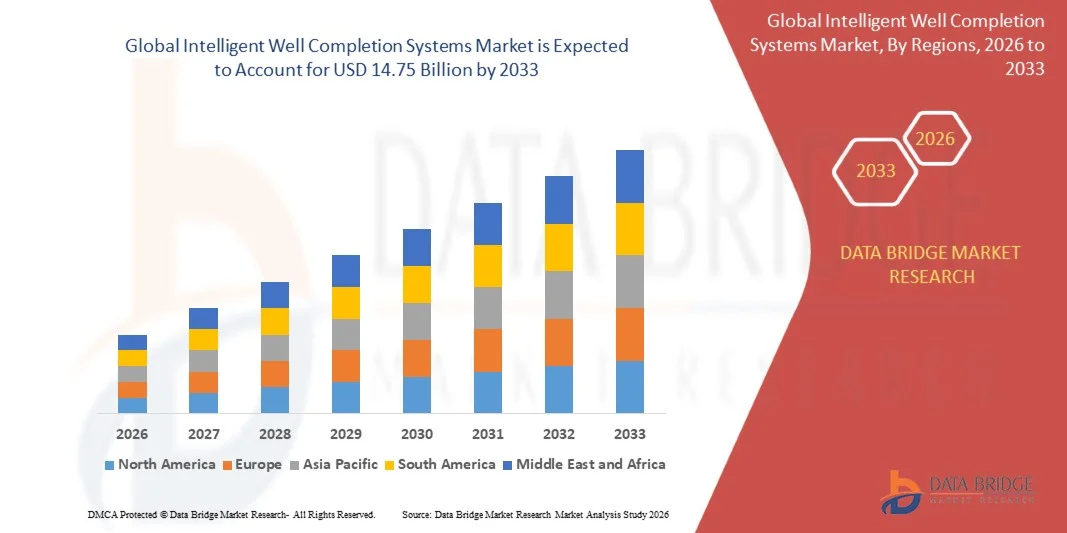
- As per Data Bridge Market Research analysis the intelligent well completion systems market was valued at USD 8.40 billion in 2025 and is projected to reach USD 14.75 billion by 2033, growing at a CAGR of 7.30% from 2026 to 2033.
- The market is experiencing consistent growth driven by the increasing complexity of oil and gas reservoirs, the need for enhanced oil recovery (EOR) techniques, and a growing focus on operational efficiency and cost reduction. Technological advancements, such as the integration of real-time data monitoring, automation, and AI-driven analytics, are enabling operators to make informed decisions and optimize production processes. In addition, rising global energy demand is necessitating more efficient extraction methods, thereby fostering investments in intelligent well completion systems.
- The growing adoption of intelligent completions in offshore drilling, where well intervention is expensive and high-risk, is a significant factor. Furthermore, new developments in technology, such as advancements in self-adaptive inflow control, are making production more viable and providing opportunities for market growth. Despite market volatility, major operators are investing in intelligent systems to maximize asset value, improve recovery rates, and manage complex reservoirs more effectively, which continues to strengthen the market's growth prospects.
Market Size & Forecast
- Market Value (2025): USD 8.40 Billion
- Expected Market Value (2033): USD 14.75 Billion
- Forecast CAGR (2026–2033): 7.30%
- Leading Region in 2025: North America
- Fastest Growing Region: Asia-Pacific
What are the Major Takeaways of the Intelligent Well Completion Systems Market?
- North America dominated the intelligent well completion systems market and accounted for the largest revenue share in 2025, supported by abundant oil production, a high rate of extraction from unconventional sources, and significant technological advancements.
- The Asia-Pacific intelligent well completion systems market is expected to witness fastest growth from 2026 to 2033, supported by increasing offshore exploration, rising energy demand, and expanding upstream investments in countries such as China, India, Malaysia, and Australia
- The downhole sensors segment led the market in 2025, supported by their critical role in continuously monitoring pressure, temperature, and flow conditions to improve reservoir performance and production optimization. Their ability to provide accurate real-time reservoir data has made them an essential component of intelligent completions.
- The real-time data communication segment is expected to witness the fastest growth from 2026 to 2033, driven by increasing demand for remote well surveillance, digital oilfield technologies, and high-speed data transmission that enables predictive maintenance and rapid operational decision-making.
- The oil and gas production segment dominated the market in 2025 due to increasing deployment of intelligent completions to maximize hydrocarbon recovery, improve production efficiency, and minimize costly well interventions. Growing investments in mature field optimization and enhanced recovery projects continue to support segment growth.
- The water injection segment is anticipated to witness the fastest growth from 2026 to 2033, driven by increasing enhanced oil recovery (EOR) activities, reservoir pressure maintenance programs, and rising adoption of intelligent monitoring technologies to optimize injection performance and improve field productivity.
Report Scope and Intelligent Well Completion Systems Market Segmentation
|
Attributes |
Intelligent Well Completion Systems Key Market Insights |
|
Segments Covered |
|
|
Countries Covered |
North America
Europe
Asia-Pacific
Middle East and Africa
South America
|
|
Key Market Players |
|
|
Market Opportunities |
|
|
Value Added Data Infosets |
In addition to the insights on market scenarios such as market value, growth rate, segmentation, geographical coverage, and major players, the market reports curated by the Data Bridge Market Research also include import export analysis, production capacity overview, production consumption analysis, price trend analysis, climate change scenario, supply chain analysis, value chain analysis, raw material/consumables overview, vendor selection criteria, PESTLE Analysis, Porter Analysis, and regulatory framework. |
What is the Key Trend in the Intelligent Well Completion Systems Market?
- Oil and gas operators are increasingly adopting digital and intelligent well completion systems integrated with real-time downhole sensors, fiber-optic monitoring, and remote-control technologies to optimize production, improve reservoir management, and reduce intervention costs.
- For instance, in January 2025, Baker Hughes launched the SureCONNECT FE downhole fiber-optic wet-mate system, enabling continuous fiber-optic monitoring and electric intelligent completion capabilities across the entire wellbore without intervention, improving reservoir performance and reducing maintenance costs.
- Real-time production data and continuous downhole monitoring enable operators to remotely adjust inflow control valves, detect reservoir changes early, and maximize hydrocarbon recovery while minimizing unplanned interventions.
- Offshore operators are increasingly deploying intelligent completions in deepwater and high-pressure/high-temperature (HPHT) wells to enhance production reliability and reduce costly well interventions throughout the field lifecycle.
- As energy companies continue prioritizing digital oilfield technologies, production optimization, and lower operating costs, the adoption of intelligent well completion systems is expected to accelerate, making them an integral part of modern field development strategies.
What are the Key Drivers of the Intelligent Well Completion Systems Market?
- The increasing development of deepwater, ultra-deepwater, and unconventional oil & gas reservoirs is driving demand for intelligent well completion systems that enable continuous reservoir monitoring, remote flow control, and production optimization in complex well environments.
- For instance, in June 2024, Halliburton announced the deployment of the world's first 12-zone SmartWell intelligent completion system in the Middle East, integrating interval control valves and fiber-optic sensing to improve reservoir management and maximize hydrocarbon recovery from multilayer reservoirs.
- National oil companies and international operators are increasingly investing in digital oilfield technologies, including intelligent completions, to improve production efficiency, reduce intervention costs, and extend the productive life of mature assets.
- As operators increasingly prioritize higher recovery rates, lower operating costs, and data-driven reservoir management, intelligent well completion systems are expected to witness strong adoption across both new field developments and mature oil and gas assets.
Which Factors are Challenging the Growth of the Intelligent Well Completion Systems Market?
- Intelligent well completion systems require substantial upfront investment due to the integration of downhole sensors, intelligent flow control valves, fiber-optic communication systems, permanent monitoring equipment, and advanced digital infrastructure.
- The complexity of installation, integration with existing production systems, and specialized maintenance requirements increases project costs, particularly for smaller operators and marginal fields.
- For instance, in April 2024, SLB was awarded three completion contracts by Petrobras for the Búzios Wave II offshore development in Brazil. The project covers up to 35 subsea wells and includes electric interval control valves and electric subsurface safety valves, highlighting the significant engineering complexity, advanced equipment integration, and high capital investment required for intelligent well completion deployments.
- High capital expenditure, technical complexity, and the need for highly skilled personnel continue to limit wider adoption, particularly among small and mid-sized exploration and production companies, slowing deployment despite growing demand for digital oilfield solutions.
How is the Intelligent Well Completion Systems Market Segmented?
The intelligent well completion systems market is segmented on the basis of technology, application, end use, and component.
- By Technology
On the basis of technology, the intelligent well completion systems market is segmented into downhole sensors, flow control devices, and real-time data communication. The downhole sensors segment led the market in 2025, supported by their critical role in continuously monitoring pressure, temperature, and flow conditions to improve reservoir performance and production optimization. Their ability to provide accurate real-time reservoir data has made them an essential component of intelligent completions.
The real-time data communication segment is expected to witness the fastest growth from 2026 to 2033, driven by increasing demand for remote well surveillance, digital oilfield technologies, and high-speed data transmission that enables predictive maintenance and rapid operational decision-making.
- By Application
On the basis of application, the intelligent well completion systems market is segmented into oil and gas production, water injection, and gas injection. The oil and gas production segment dominated the market in 2025 due to increasing deployment of intelligent completions to maximize hydrocarbon recovery, improve production efficiency, and minimize costly well interventions. Growing investments in mature field optimization and enhanced recovery projects continue to support segment growth.
The water injection segment is anticipated to witness the fastest growth from 2026 to 2033, driven by increasing enhanced oil recovery (EOR) activities, reservoir pressure maintenance programs, and rising adoption of intelligent monitoring technologies to optimize injection performance and improve field productivity.
- By End Use
On the basis of end use, the intelligent well completion systems market is segmented into onshore and offshore. The onshore segment accounted for the largest market share in 2025, supported by the high number of producing wells, expanding unconventional oil and gas developments, and increasing investments in digital well management technologies. Lower deployment costs and easier maintenance also contribute to widespread adoption across onshore fields.
The offshore segment is projected to register the fastest growth from 2026 to 2033, driven by increasing deepwater and ultra-deepwater exploration, rising investments in subsea production systems, and growing demand for intelligent completions to reduce intervention costs in challenging offshore environments.
- By Component
On the basis of component, the intelligent well completion systems market is segmented into hardware, software, and service. The hardware segment dominated the market in 2025 owing to extensive deployment of downhole sensors, intelligent valves, packers, and communication systems required for smart well operations. Continuous investments in advanced completion equipment further support the segment's leading position.
The software segment is expected to experience the fastest growth from 2026 to 2033, driven by increasing adoption of AI-enabled analytics, cloud-based reservoir management platforms, digital twins, and real-time production optimization solutions that enhance operational efficiency and decision-making.
Which Region Holds the Largest Share of the Intelligent Well Completion Systems Market?
- North America dominated the intelligent well completion systems market and accounted for the largest revenue share in 2025, supported by abundant oil production, a high rate of extraction from unconventional sources, and significant technological advancements.
- The region also benefits from the presence of key oil and gas producers and technology companies that drive innovation and competition. Increasing investments in the research and development of intelligent well completion techniques to increase profit from wells are expected to aid the market's growth. Furthermore, the Gulf of Mexico region, with one of the highest global densities of offshore rig deployment, is a significant contributor to the market's growth.
U.S. Intelligent Well Completion Systems Market Insight
The U.S. intelligent well completion systems market accounted for the largest revenue share within North America in 2025, driven by strong exploration and production activities across shale basins such as the Permian, Eagle Ford, and Bakken. Increasing investments in unconventional resource development, coupled with growing adoption of intelligent completions for production optimization, remote monitoring, and reduced intervention costs, continue to support market expansion.
Europe Intelligent Well Completion Systems Market Insight
The Europe intelligent well completion systems market is expected to witness steady growth from 2026 to 2033, supported by increasing offshore investments in the North Sea, digitalization of mature oilfields, and growing emphasis on maximizing production efficiency. Rising adoption of automation technologies and advanced reservoir management solutions is encouraging operators to deploy intelligent completion systems across offshore assets.
U.K. Intelligent Well Completion Systems Market Insight
The U.K. intelligent well completion systems market is expected to witness notable growth from 2026 to 2033, driven by continued investments in North Sea offshore developments and enhanced oil recovery projects. Increasing deployment of smart completion technologies to improve production performance, reduce intervention frequency, and optimize aging offshore fields is expected to strengthen market demand.
Germany Intelligent Well Completion Systems Market Insight
The Germany intelligent well completion systems market is expected to witness steady growth from 2026 to 2033, supported by the country's emphasis on digital energy technologies, automation, and offshore engineering expertise. Increasing investments in intelligent monitoring solutions, well integrity management, and advanced reservoir optimization technologies, along with the presence of leading oilfield technology providers, are contributing to market development.
Asia-Pacific Intelligent Well Completion Systems Market Insight
The Asia-Pacific intelligent well completion systems market is expected to witness fastest growth from 2026 to 2033, supported by increasing offshore exploration, rising energy demand, and expanding upstream investments in countries such as China, India, Malaysia, and Australia. The growing focus on production optimization, reservoir monitoring, and digital transformation across the oil and gas sector is driving the adoption of intelligent completion technologies.
China Intelligent Well Completion Systems Market Insight
The China intelligent well completion systems market accounted for the largest market revenue share in Asia-Pacific in 2025, attributed to rising investments in both conventional and unconventional oil and gas production, increasing offshore exploration activities, and rapid adoption of digital oilfield technologies. Government support for enhancing domestic energy production and improving reservoir recovery efficiency continues to drive the deployment of intelligent well completion systems across the country.
Japan Intelligent Well Completion Systems Market Insight
The Japan intelligent well completion systems market is expected to witness steady growth from 2026 to 2033 due to increasing investment in offshore energy technologies, digital monitoring systems, and advanced engineering solutions. Japanese companies continue to invest in automation, sensing technologies, and energy infrastructure that support the deployment of intelligent well completion systems in global upstream oil and gas operations.
Which are the Top Companies in Intelligent Well Completion Systems Market?
The intelligent well completion systems industry is primarily led by well-established companies, including:
- SLB (U.S.)
- Halliburton Company (U.S.)
- Baker Hughes Company (U.S.)
- Weatherford International plc (U.S.)
- NOV Inc. (U.S.)
- TechnipFMC plc (U.K.)
- Expro Group Holdings N.V. (U.S.)
- Vallourec S.A. (France)
- Welltec A/S (Denmark)
- Tendeka B.V. (U.K.)
- Packers Plus Energy Services Inc. (Canada)
- China Oilfield Services Limited (China)

- Interactive Data Analysis Dashboard
- Company Analysis Dashboard for high growth potential opportunities
- Research Analyst Access for customization & queries
- Competitor Analysis with Interactive dashboard
- Latest News, Updates & Trend analysis
- Harness the Power of Benchmark Analysis for Comprehensive Competitor Tracking
Data collection and base year analysis are done using data collection modules with large sample sizes. The stage includes obtaining market information or related data through various sources and strategies. It includes examining and planning all the data acquired from the past in advance. It likewise envelops the examination of information inconsistencies seen across different information sources. The market data is analysed and estimated using market statistical and coherent models. Also, market share analysis and key trend analysis are the major success factors in the market report. To know more, please request an analyst call or drop down your inquiry.
The key research methodology used by DBMR research team is data triangulation which involves data mining, analysis of the impact of data variables on the market and primary (industry expert) validation. Data models include Vendor Positioning Grid, Market Time Line Analysis, Market Overview and Guide, Company Positioning Grid, Patent Analysis, Pricing Analysis, Company Market Share Analysis, Standards of Measurement, Global versus Regional and Vendor Share Analysis. To know more about the research methodology, drop in an inquiry to speak to our industry experts.
Data Bridge Market Research is a leader in advanced formative research. We take pride in servicing our existing and new customers with data and analysis that match and suits their goal. The report can be customized to include price trend analysis of target brands understanding the market for additional countries (ask for the list of countries), clinical trial results data, literature review, refurbished market and product base analysis. Market analysis of target competitors can be analyzed from technology-based analysis to market portfolio strategies. We can add as many competitors that you require data about in the format and data style you are looking for. Our team of analysts can also provide you data in crude raw excel files pivot tables (Fact book) or can assist you in creating presentations from the data sets available in the report.