


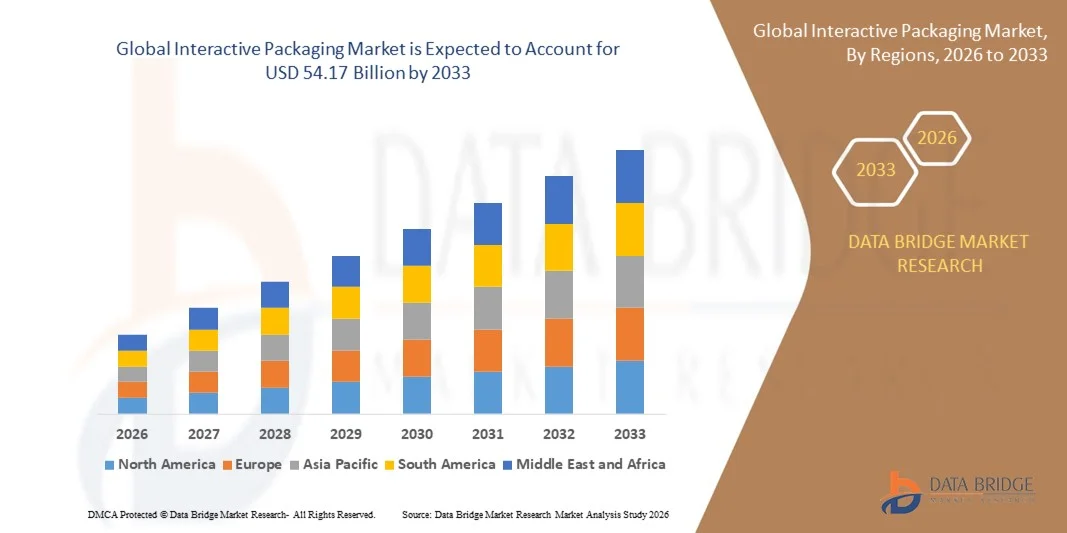
Global Interactive Packaging Market Size
- The global Interactive Packaging Market size was valued at USD 36.67billion in 2025 and is expected to reach USD 54.17 billion by 2033, at a CAGR of 5.00% during the forecast period.
- The market growth is primarily driven by increasing consumer demand for personalized and engaging product experiences, as well as advancements in packaging technologies such as augmented reality (AR), near-field communication (NFC), and QR code integration.
- Additionally, rising emphasis on brand differentiation, marketing innovation, and enhanced customer interaction is encouraging businesses across food & beverage, pharmaceuticals, and consumer goods sectors to adopt interactive packaging solutions. These factors collectively are propelling market expansion and accelerating the adoption of innovative packaging formats globally.
Global Interactive Packaging Market Analysis
- Interactive packaging, incorporating technologies such as QR codes, NFC, AR, and digital displays, is becoming an essential tool for enhancing consumer engagement and brand interaction across food & beverage, pharmaceuticals, and consumer goods sectors due to its ability to provide personalized experiences and real-time information.
- The growing adoption of interactive packaging is primarily driven by increasing consumer demand for immersive and engaging product experiences, rising e-commerce penetration, and the need for brands to differentiate themselves in highly competitive markets.
- North America dominated the Global Interactive Packaging Market with the largest revenue share of 34% in 2025, supported by high smartphone penetration, advanced retail infrastructure, and strong presence of leading packaging technology providers, with the U.S. witnessing significant adoption of AR-enabled and smart label solutions by major consumer brands.
- Asia-Pacific is expected to be the fastest-growing region in the Global Interactive Packaging Market during the forecast period due to rising urbanization, increasing disposable incomes, and growing interest among consumers in interactive and digitally connected product experiences.
- The food & beverages segment dominated the market with the largest revenue share of 38.5% in 2025, driven by high consumer engagement in packaged goods and the widespread adoption of QR codes, AR labels, and NFC-enabled experiences.
Report Scope and Global Interactive Packaging Market Segmentation
|
Attributes |
Interactive Packaging Key Market Insights |
|
Segments Covered |
|
|
Countries Covered |
North America
Europe
Asia-Pacific
Middle East and Africa
South America
|
|
Key Market Players |
|
|
Market Opportunities |
|
|
Value Added Data Infosets |
In addition to the insights on market scenarios such as market value, growth rate, segmentation, geographical coverage, and major players, the market reports curated by the Data Bridge Market Research also include import export analysis, production capacity overview, production consumption analysis, price trend analysis, climate change scenario, supply chain analysis, value chain analysis, raw material/consumables overview, vendor selection criteria, PESTLE Analysis, Porter Analysis, and regulatory framework. |
Global Interactive Packaging Market Trends
Enhanced Engagement Through AR and Smart Packaging Technologies
- A significant and accelerating trend in the global Interactive Packaging Market is the increasing integration of augmented reality (AR), QR codes, and NFC technologies with consumer products, enabling brands to deliver immersive and interactive experiences that go beyond traditional packaging.
- For instance, Coca-Cola’s AR-enabled labels allow consumers to scan bottles with smartphones to unlock games, promotions, and virtual experiences, while L’Oréal’s smart packaging uses QR codes to provide personalized product information and tutorials.
- AI and AR integration in interactive packaging enables features such as personalized recommendations, real-time feedback, and dynamic content based on user interaction. Some smart labels can track consumer engagement and adapt marketing messages accordingly, creating a more targeted and engaging experience.
- The seamless integration of interactive packaging with mobile apps and digital platforms facilitates centralized engagement, allowing users to access loyalty programs, product tutorials, and brand campaigns from a single interface. This enhances brand-consumer interaction and strengthens customer loyalty.
- This trend toward more intelligent, immersive, and connected packaging is fundamentally reshaping consumer expectations for product experiences. Consequently, companies such as Avery Dennison and Amcor are developing AR-enabled and smart label solutions that provide interactive content, personalized messaging, and gamified experiences.
- The demand for interactive packaging that leverages AR, NFC, and AI-driven personalization is growing rapidly across both FMCG and luxury goods sectors, as brands increasingly prioritize engagement, customer experience, and digital innovation.
Global Interactive Packaging Market Dynamics
Driver
Growing Need Driven by Consumer Engagement and Brand Differentiation
- The increasing demand for unique and engaging product experiences, coupled with brands’ efforts to differentiate themselves in competitive markets, is a significant driver for the heightened adoption of interactive packaging.
- For instance, in 2025, Coca-Cola expanded its AR-enabled labels campaign, allowing consumers to access games, promotions, and virtual experiences through mobile apps. Such initiatives by leading companies are expected to drive growth in the interactive packaging industry during the forecast period.
- As consumers increasingly value personalized and immersive interactions with products, interactive packaging offers features such as dynamic content, gamified experiences, and real-time feedback, providing a compelling upgrade over traditional packaging.
- Furthermore, the growing popularity of e-commerce and digital marketing channels is making interactive packaging an integral tool for consumer engagement, enabling seamless integration with mobile apps, loyalty programs, and social media campaigns.
- The ability to provide real-time product information, personalized recommendations, and interactive experiences enhances brand loyalty and encourages repeat purchases, propelling adoption across food & beverage, pharmaceutical, and luxury goods sectors. The trend toward eco-friendly, smart, and digitally connected packaging solutions further supports market growth.
Restraint/Challenge
Concerns Regarding Cost, Technology Adoption, and Consumer Awareness
- High initial costs of interactive packaging solutions, particularly AR-enabled labels and smart NFC tags, pose a challenge to broader market penetration. Small and medium-sized brands may find the investment prohibitive compared to traditional packaging options.
- For instance, brands seeking to implement advanced digital or AR-based packaging campaigns often face significant setup and maintenance costs, slowing adoption in price-sensitive markets.
- Additionally, limited consumer awareness and familiarity with interactive packaging technologies can restrict engagement. If end-users do not actively scan QR codes or engage with AR experiences, the marketing impact may be reduced, making ROI a concern for brands.
- Ensuring compatibility with smartphones, apps, and digital platforms is also critical, as poorly executed or inaccessible interactive features can diminish the perceived value.
- Overcoming these challenges through cost-effective solutions, consumer education campaigns, and user-friendly designs will be vital for sustaining market growth. Companies such as Avery Dennison and Amcor are developing scalable, affordable, and intuitive interactive packaging solutions to expand adoption and demonstrate clear consumer benefits.
Global Interactive Packaging Market Scope
Interactive packaging market is segmented on the basis of end-use industries, packages and package.
- By End-Use Industries
On the basis of end-use industries, the Global Interactive Packaging Market is segmented into cosmetics, food & beverages, electronics, telecommunication, pharmaceuticals, nutraceuticals, and healthcare. The food & beverages segment dominated the market with the largest revenue share of 38.5% in 2025, driven by high consumer engagement in packaged goods and the widespread adoption of QR codes, AR labels, and NFC-enabled experiences. Brands in this sector leverage interactive packaging to provide product information, loyalty rewards, and immersive experiences, creating strong brand recall.
The cosmetics segment is expected to witness the fastest CAGR of 19.8% from 2026 to 2033, fueled by increasing demand for personalized consumer experiences and digital try-on solutions. Premium cosmetic brands are integrating AR and NFC-enabled packaging to enhance product storytelling, educate consumers, and foster loyalty, making interactive packaging a vital tool in high-margin, competitive markets.
- By Packages
On the basis of packages, the Global Interactive Packaging Market is segmented into folding boxes, labels, cases, posters & brochures, POS materials, calendars, and others. The labels segment dominated the market with the largest revenue share of 41.2% in 2025, driven by its low cost, ease of integration with smartphones, and versatility across multiple product categories. Labels serve as an accessible medium for implementing QR codes, NFC tags, and AR experiences, providing instant engagement and tracking capabilities for brands.
The folding boxes segment is expected to witness the fastest CAGR of 18.5% from 2026 to 2033, supported by growing demand in premium food, cosmetics, and consumer electronics packaging. Folding boxes not only offer structural protection but also provide a larger surface area for interactive features, enabling immersive storytelling, gamification, and digital connectivity, which significantly enhances consumer engagement and purchasing decisions.
- By Package
On the basis of package type, the Global Interactive Packaging Market is segmented into sound, smell, visual, and touch. The visual segment dominated the market with the largest revenue share of 44.7% in 2025, driven by the popularity of AR experiences, high-resolution printed graphics, and video-enabled labels that attract consumer attention and enhance brand recall. Visual interactive packaging enables storytelling, gamified campaigns, and product demonstrations, making it highly appealing across FMCG, electronics, and luxury sectors.
The touch segment is expected to witness the fastest CAGR of 20.2% from 2026 to 2033, fueled by increasing consumer preference for tactile engagement and premium unboxing experiences. Textured surfaces, embossed patterns, and augmented tactile elements are being incorporated to create memorable multi-sensory experiences, particularly in cosmetics, food & beverage, and luxury goods industries, driving higher adoption of touch-enabled interactive packaging solutions globally.
Global Interactive Packaging Market Regional Analysis
- North America dominated the Global Interactive Packaging Market with the largest revenue share of 34% in 2025, driven by increasing consumer demand for personalized and engaging product experiences, as well as strong adoption of digital and smart packaging technologies.
- Consumers in the region increasingly value interactive features such as AR-enabled labels, QR codes, NFC tags, and smart packaging that provide real-time product information, loyalty rewards, and immersive brand engagement.
- This widespread adoption is further supported by high disposable incomes, advanced retail infrastructure, strong smartphone penetration, and a tech-savvy population. The presence of leading packaging technology providers and early adoption by major consumer brands have also contributed to North America being the largest market, establishing interactive packaging as a key tool for enhancing customer experience and driving brand differentiation across FMCG, cosmetics, pharmaceuticals, and luxury goods sectors.
U.S. Interactive Packaging Market Insight
The U.S. interactive packaging market captured the largest revenue share of 81% in 2025 within North America, fueled by rapid adoption of AR, NFC, and QR-enabled packaging across food & beverages, cosmetics, and consumer electronics sectors. Consumers increasingly seek personalized, immersive product experiences that combine convenience, entertainment, and information. The growing trend of e-commerce, combined with strong demand for loyalty programs and digital engagement, further propels the interactive packaging industry. Moreover, the integration of packaging with mobile applications and social media campaigns is significantly enhancing brand-consumer interaction and contributing to market expansion.
Europe Interactive Packaging Market Insight
The Europe interactive packaging market is projected to expand at a substantial CAGR throughout the forecast period, primarily driven by rising consumer preference for premium, engaging product experiences and strict regulations on product labeling and traceability. Urbanization and increasing digital literacy are fostering adoption across food & beverages, pharmaceuticals, and cosmetics. European consumers are drawn to interactive packaging for its ability to provide detailed product information, brand storytelling, and gamified experiences, while companies leverage these solutions to enhance loyalty and differentiate their products in competitive markets.
U.K. Interactive Packaging Market Insight
The U.K. interactive packaging market is anticipated to grow at a noteworthy CAGR during the forecast period, driven by the rising popularity of smart and personalized packaging among consumers. Increasing consumer awareness of product transparency, sustainability, and interactive marketing campaigns encourages brands to adopt QR codes, AR labels, and NFC-enabled packaging. The country’s robust retail infrastructure and high e-commerce penetration further stimulate market growth, allowing brands to integrate digital experiences seamlessly into packaging to enhance engagement and boost repeat purchases.
Germany Interactive Packaging Market Insight
The Germany interactive packaging market is expected to expand at a considerable CAGR during the forecast period, fueled by growing demand for innovative and sustainable packaging solutions in food, cosmetics, and pharmaceutical sectors. German consumers’ strong preference for eco-friendly and tech-enabled products encourages the adoption of AR, NFC, and smart labels. Additionally, the integration of interactive packaging with mobile applications and loyalty programs is becoming increasingly prevalent, with companies emphasizing transparency, traceability, and consumer engagement, aligning with local expectations for innovation and sustainability.
Asia-Pacific Interactive Packaging Market Insight
The Asia-Pacific interactive packaging market is poised to grow at the fastest CAGR of 24% during the forecast period of 2026 to 2033, driven by rising urbanization, increasing disposable incomes, and digitalization across countries such as China, Japan, and India. The growing popularity of e-commerce and smartphone penetration is facilitating the adoption of QR codes, NFC, and AR-enabled packaging. Furthermore, APAC’s role as a manufacturing hub for packaging solutions is expanding accessibility and affordability, allowing interactive packaging to reach a wider consumer base and supporting growth across food & beverages, cosmetics, and pharmaceuticals sectors.
Japan Interactive Packaging Market Insight
The Japan interactive packaging market is gaining momentum due to high digital literacy, technologically advanced retail environments, and a strong consumer preference for personalized experiences. Adoption is driven by AR-enabled labels, QR codes, and NFC tags that provide convenience, product information, and immersive engagement. Integration with mobile applications and loyalty programs enhances interaction, while innovative packaging campaigns in cosmetics and food sectors are creating high consumer engagement. Additionally, the aging population is boosting demand for easy-to-understand, interactive product information to simplify purchasing decisions.
China Interactive Packaging Market Insight
The China interactive packaging market accounted for the largest market revenue share in Asia-Pacific in 2025, attributed to the growing middle class, rapid urbanization, and high smartphone penetration. Consumers increasingly prefer packaging that offers product information, brand engagement, and digital experiences via QR codes, NFC, and AR. The push for smart retail environments, combined with affordable interactive packaging solutions from domestic manufacturers, is fueling growth. Additionally, e-commerce expansion and the adoption of digital marketing strategies by brands are further driving the integration of interactive packaging into mainstream consumer products.
Global Interactive Packaging Market Share
The Interactive Packaging industry is primarily led by well-established companies, including:
• Amcor Limited (Australia)
• Avery Dennison Corporation (U.S.)
• Sealed Air Corporation (U.S.)
• Berry Global, Inc. (U.S.)
• WestRock Company (U.S.)
• Smurfit Kappa Group (Ireland)
• Mondi Group (Austria)
• Huhtamaki Oyj (Finland)
• Graphic Packaging International (U.S.)
• Stora Enso Oyj (Finland)
• Tetra Pak International (Sweden)
• UPM-Kymmene Corporation (Finland)
• DS Smith Plc (U.K.)
• Crown Holdings, Inc. (U.S.)
• Sonoco Products Company (U.S.)
• RPC Group (U.K.)
• Amcor Flexibles (Australia)
• Constantia Flexibles (Austria)
• Huhtamaki Flexible Packaging (Finland)
• SIG Combibloc Group (Switzerland)
What are the Recent Developments in Global Interactive Packaging Market?
- In April 2024, Amcor Limited, a global leader in packaging solutions, launched a strategic initiative in South Africa aimed at promoting AR-enabled and smart packaging technologies for the food and beverage sector. This initiative highlights the company’s commitment to delivering innovative, consumer-engaging packaging solutions tailored to local market needs. By leveraging its global expertise and advanced interactive packaging offerings, Amcor is strengthening brand-consumer interaction and reinforcing its position in the rapidly growing global Interactive Packaging Market.
- In March 2024, Avery Dennison Corporation, a leading provider of labeling and packaging solutions, introduced a next-generation NFC-enabled label for cosmetics and personal care products. The solution allows consumers to access personalized product information, tutorials, and loyalty rewards directly via smartphones. This advancement underscores Avery Dennison’s focus on enhancing consumer engagement and providing brands with tools to differentiate their products through digital interactivity.
- In March 2024, WestRock Company successfully deployed an interactive packaging solution for a major urban retail campaign in Bengaluru, India, combining QR codes, AR, and NFC technologies to improve customer engagement. The initiative demonstrates WestRock’s dedication to leveraging smart packaging to create immersive retail experiences, contributing to higher brand loyalty and sales performance in emerging markets.
- In February 2024, Smurfit Kappa Group, a leading provider of sustainable packaging solutions, announced a strategic collaboration with several FMCG brands to implement AR-enabled folding boxes and smart labels across multiple product lines. This collaboration aims to enhance consumer interaction, provide real-time product information, and streamline marketing campaigns, highlighting Smurfit Kappa’s commitment to driving innovation and digital transformation in packaging.
- In January 2024, Berry Global, Inc. unveiled its new interactive packaging portfolio at the Packaging Innovations Expo 2024, featuring QR codes, NFC tags, and AR-enabled surfaces for food, beverage, and personal care products. The solutions allow brands to engage consumers with immersive experiences while providing traceability and sustainability insights. Berry Global’s offerings demonstrate the company’s focus on integrating advanced digital technologies into packaging to enhance consumer experience, engagement, and brand loyalty.

- Interactive Data Analysis Dashboard
- Company Analysis Dashboard for high growth potential opportunities
- Research Analyst Access for customization & queries
- Competitor Analysis with Interactive dashboard
- Latest News, Updates & Trend analysis
- Harness the Power of Benchmark Analysis for Comprehensive Competitor Tracking
Global Interactive Packaging Market, Supply Chain Analysis and Ecosystem Framework
To support market growth and help clients navigate the impact of geopolitical shifts, DBMR has integrated in-depth supply chain analysis into its Global Interactive Packaging Market research reports. This addition empowers clients to respond effectively to global changes affecting their industries. The supply chain analysis section includes detailed insights such as Global Interactive Packaging Market consumption and production by country, price trend analysis, the impact of tariffs and geopolitical developments, and import and export trends by country and HSN code. It also highlights major suppliers with data on production capacity and company profiles, as well as key importers and exporters. In addition to research, DBMR offers specialized supply chain consulting services backed by over a decade of experience, providing solutions like supplier discovery, supplier risk assessment, price trend analysis, impact evaluation of inflation and trade route changes, and comprehensive market trend analysis.
Data collection and base year analysis are done using data collection modules with large sample sizes. The stage includes obtaining market information or related data through various sources and strategies. It includes examining and planning all the data acquired from the past in advance. It likewise envelops the examination of information inconsistencies seen across different information sources. The market data is analysed and estimated using market statistical and coherent models. Also, market share analysis and key trend analysis are the major success factors in the market report. To know more, please request an analyst call or drop down your inquiry.
The key research methodology used by DBMR research team is data triangulation which involves data mining, analysis of the impact of data variables on the market and primary (industry expert) validation. Data models include Vendor Positioning Grid, Market Time Line Analysis, Market Overview and Guide, Company Positioning Grid, Patent Analysis, Pricing Analysis, Company Market Share Analysis, Standards of Measurement, Global versus Regional and Vendor Share Analysis. To know more about the research methodology, drop in an inquiry to speak to our industry experts.
Data Bridge Market Research is a leader in advanced formative research. We take pride in servicing our existing and new customers with data and analysis that match and suits their goal. The report can be customized to include price trend analysis of target brands understanding the market for additional countries (ask for the list of countries), clinical trial results data, literature review, refurbished market and product base analysis. Market analysis of target competitors can be analyzed from technology-based analysis to market portfolio strategies. We can add as many competitors that you require data about in the format and data style you are looking for. Our team of analysts can also provide you data in crude raw excel files pivot tables (Fact book) or can assist you in creating presentations from the data sets available in the report.













