


What is the Interface IC Market Size and Growth Rate?
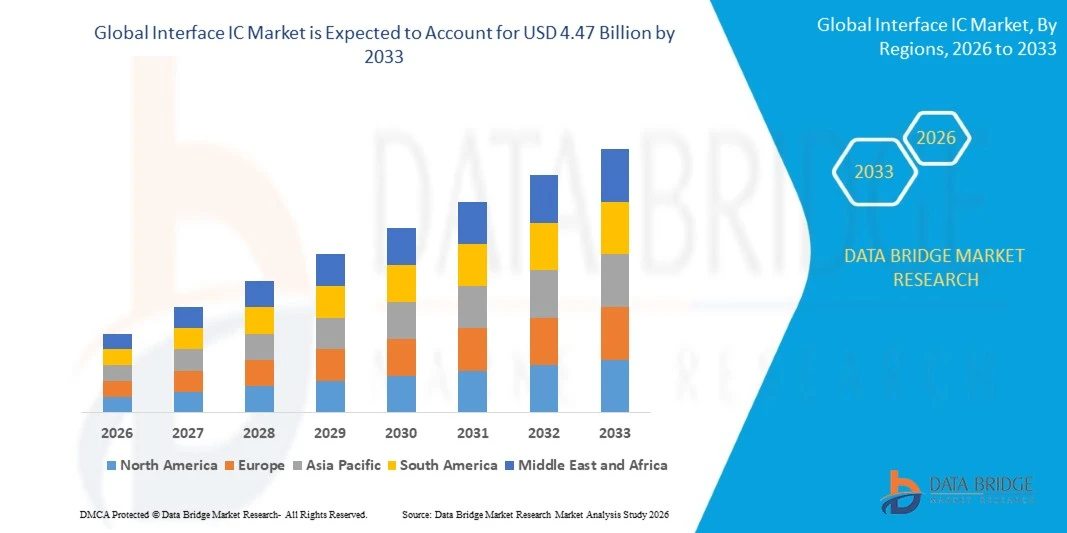
- As per Data Bridge Market Research analysis, the interface IC market was valued at USD 3.21 billion in 2025 and is projected to reach USD 4.47 billion by 2033, growing at a CAGR of 4.30% from 2026 to 2033.
- The market is growing at a steady pace, reflecting its position as a mature but essential semiconductor category, supported by continuous evolution of connectivity standards such as USB Type-C, PCIe, and DisplayPort, rising electronic content per device across consumer, automotive, and industrial applications, and growing demand for higher-speed, higher-integration interface solutions in computing and data center infrastructure.
- Interface ICs are semiconductor devices that enable reliable communication and data exchange between electronic components and subsystems, supporting protocols including USB, I2C, SPI, I3C, UART, HDMI, DisplayPort, PCIe, and Ethernet. Functions within this category span signal conditioning devices such as retimers and redrivers, voltage level shifters, switches and multiplexers, electrostatic discharge and port protection devices, and power delivery controllers. Interface ICs are essential, if largely invisible, components across smartphones, laptops, automotive infotainment and in-vehicle networks, industrial automation equipment, and data center servers, and the category’s growth closely tracks the pace at which new connectivity standards are adopted across these end markets.
Market Size & Forecast
- Global Market Value (2025): USD 3.21 Billion
- Expected Market Value (2033): USD 4.47 Billion
- Forecast CAGR (2026–2033): 4.30%
- Leading Region in 2025: North America
- Fastest Growing Region: Asia-Pacific
What are the Major Takeaways of the Interface IC Market?
- North America dominated the global interface IC market with the largest revenue share of 34.72% in 2025, supported by the concentration of leading interface IC designers and headquarters in the region, strong demand from the computing and data center industry, and continued expansion of domestic digital infrastructure.
- Asia-Pacific is expected to be the fastest-growing region at a CAGR of 6.1% from 2026 to 2033, driven by the region’s position as the world’s largest electronics manufacturing base, rising domestic semiconductor self-sufficiency initiatives, and growing production of smartphones, laptops, and automotive electronics across China, Taiwan, South Korea, and India.
- The USB interface IC segment led the interface standard category with a 39.46% share in 2025, owing to the near-universal inclusion of USB connectivity across consumer electronics, computing peripherals, and automotive infotainment systems, and rising adoption of USB Type-C and USB Power Delivery standards across smartphones, laptops, and IoT devices.
- PCIe interface ICs are the fastest-growing interface standard segment, projected to register a CAGR of 6.8%, reflecting rapid adoption of PCIe 5.0 and 6.0 retimers and switches in AI servers and data center infrastructure as interconnect bandwidth requirements accelerate.
- The digital interface ICs segment dominated the type category with a 42.18% revenue share in 2025, reflecting broad use across smartphones, computers, automotive electronics, industrial electronics, data centers, and telecommunications equipment. The switches & multiplexers segment led the product/technology category with a 31.74% share in 2025.
- Consumer electronics represented the leading end-use segment with a 36.84% share in 2025, while automotive is the fastest-growing end-use category at a CAGR of 6.4%, driven by rising electronic content, in-vehicle networking, and infotainment connectivity in software-defined vehicles.
- Retimers & redrivers are the fastest-growing product/technology segment at a CAGR of 6.9%, driven by the growing need to maintain signal integrity at increasing USB, DisplayPort, and PCIe data rates over longer board traces and cable lengths.
Report Scope and Interface IC Market Segmentation
|
Attributes |
Interface IC Key Market Insights |
|
Segments Covered |
|
|
Countries Covered |
North America
Europe
Asia-Pacific
Middle East and Africa
South America
|
|
Key Market Players |
|
|
Market Opportunities |
|
|
Value Added Data Infosets |
In addition to the insights on market scenarios such as market value, growth rate, segmentation, geographical coverage, and major players, the market reports curated by the Data Bridge Market Research also include in-depth expert analysis, geographically represented company-wise production and capacity, network layouts of distributors and partners, detailed and updated price trend analysis and deficit analysis of supply chain and demand. |
What is the Key Trend in the Interface IC Market?
- Interface IC suppliers are increasingly consolidating functionality that previously required multiple separate chips into single devices capable of handling several protocols simultaneously, such as combined USB Type-C power delivery, DisplayPort Alt Mode, and protection functions, reducing board space and simplifying system design for customers.
- This consolidation trend is especially visible in USB Type-C products, where suppliers are combining power delivery control, signal conditioning, and protection circuitry that were once discrete components.
- For instance, in April 2026, Infineon Technologies introduced the EZ-PD CCG7S, a single-port USB Type-C Power Delivery solution that integrates a buck-boost controller with the option of integrated MOSFETs, consolidating power regulation and USB-C PD control into a single device.
- Suppliers are also extending signal-conditioning and protocol-bridging ICs to support higher data rates and automotive-grade reliability requirements as in-vehicle connectivity standards converge with consumer USB and DisplayPort protocols.
- For instance, in October 2025, Diodes Incorporated introduced the automotive-compliant PI2DPT1021Q, a 10Gbps bit-level retimer supporting both DisplayPort 1.4 and USB 3.2 standards for USB Type-C applications such as infotainment, digital clusters, rear-seat entertainment, and smart cockpits, featuring an integrated USB/DP crossbar switch and sub-1-nanosecond latency.
- As suppliers continue to integrate multiple protocols and functions into single interface IC packages, and as automotive-grade signal-conditioning devices extend high-speed consumer connectivity standards into vehicles, multi-protocol integration is expected to remain the defining trend in the interface IC market through the forecast period.
What are the Key Drivers of the Interface IC Market?
- The continued evolution and proliferation of connectivity standards, including USB Type-C, USB Power Delivery, PCIe, and DisplayPort, across virtually every category of electronic device sustains steady replacement and upgrade demand for interface ICs as manufacturers adopt each new generation of standard.
- Rising electronic content in automotive applications is a particularly strong driver, as modern vehicles increasingly rely on high-speed USB and DisplayPort connectivity for infotainment, digital clusters, and rear-seat entertainment systems, each of which requires automotive-qualified interface ICs capable of meeting stringent reliability and temperature requirements.
- For instance, in September 2025, Nexperia introduced the NEX531x-Q100 dual-port USB Type-C Power Delivery controller, supporting USB D+/D- based fast charging protocols for automotive USB charging applications, reflecting continued supplier investment in automotive-grade interface solutions.
- Data center and computing infrastructure is driving demand for the highest-performance segment of the interface IC market, as AI servers and high-bandwidth computing systems require increasingly sophisticated signal-conditioning devices to maintain data integrity at rising interconnect speeds.
- For instance, in October 2024, Texas Instruments introduced new automotive interface ICs supporting high-speed in-vehicle communications to address increasing data bandwidth requirements for advanced driver assistance systems (ADAS) and infotainment applications.
- With connectivity standards continuing to evolve, automotive electronic content rising, and data center infrastructure demanding ever-higher interconnect performance, demand for interface ICs is expected to remain resilient throughout the forecast period despite the category’s overall maturity.
What Factors are Challenging the Growth of the Interface IC Market?
- The interface IC market is a structurally mature semiconductor category in which growth in underlying device volumes remains moderate, since the proliferation of connected devices that drove rapid historical expansion has slowed in established markets such as smartphones and personal computers.
- This maturity means that revenue growth increasingly depends on rising complexity and value per device, such as the shift from simple analog interface components to higher-value, multi-protocol mixed-signal devices, rather than on expanding unit volumes.
- For instance, in October 2024, Texas Instruments expanded its interface portfolio with new automotive communication ICs while emphasizing that innovation and higher integration are becoming the primary drivers of revenue growth as mature semiconductor markets experience slower unit growth.
- Intense price competition among a large number of suppliers, ranging from major diversified semiconductor companies to specialized interface IC designers, continues to pressure average selling prices, particularly in high-volume, commoditized product categories such as basic level shifters and simple USB protection devices.
- The combination of moderate underlying device volume growth, a mature competitive landscape with established players competing primarily on integration and price, and the need for continuous, costly product development to keep pace with each new generation of connectivity standard continues to constrain the overall growth rate of the interface IC market relative to faster-growing semiconductor categories such as AI accelerators.
How is the Interface IC Market Segmented?
The interface IC market is segmented on the basis of interface standard, type, product/technology, technology node, end-use and sales channel.
- By Interface Standard
On the basis of interface standard, the global interface IC market is segmented into USB, I2C/SPI/I3C, HDMI & DisplayPort, PCIe, Ethernet & LVDS, and UART/RS-232/RS-485. The USB segment dominated the market with a 39.46% share in 2025, owing to the near-universal inclusion of USB connectivity across consumer electronics, computing peripherals, and automotive infotainment systems, and strong demand for high-speed, energy-efficient interface ICs supporting USB Type-C and Power Delivery standards.
The PCIe segment is projected to register the fastest growth at a CAGR of 6.8% from 2026 to 2033, driven by rapid adoption of PCIe 5.0 and 6.0 retimers, redrivers, and switches in AI servers and data center infrastructure, where rising interconnect bandwidth requirements are accelerating replacement and upgrade cycles.
- By Type
On the basis of type, the global interface IC market is segmented into analog interface ICs, digital interface ICs, and mixed-signal interface ICs. The digital interface ICs segment dominated the market with a share of 42.18% in 2025, reflecting broad application across smartphones, computers, automotive electronics, industrial electronics, data centers, and telecommunications equipment, where digital protocols form the backbone of inter-component communication.
The mixed-signal interface ICs segment is expected to witness the fastest CAGR of 5.6% from 2026 to 2033, driven by rising integration of analog power and protection functions together with digital protocol handling within single devices, as suppliers consolidate previously separate components to reduce board space and system cost.
- By Product/Technology
On the basis of product/technology, the global interface IC market is segmented into retimers & redrivers, level shifters & translators, switches & multiplexers, port protection & ESD devices, and power delivery controllers. The switches & multiplexers segment dominated the market with a share of 31.74% in 2025, reflecting their widespread use in routing high-speed USB, DisplayPort, and PCIe signals between multiple ports and devices.
The retimers & redrivers segment is expected to witness the fastest CAGR of 6.9% from 2026 to 2033, driven by the growing need to maintain signal integrity at increasing USB, DisplayPort, and PCIe data rates over longer board traces and cable lengths, particularly in automotive and data center applications.
- By Technology Node
On the basis of technology node, the global interface IC market is segmented into above 90nm, 28–90nm, and below 28nm. The 28–90nm segment dominated the market with a share of 48.62% in 2025, reflecting its established position as the process node of choice for most mainstream interface IC designs, balancing performance, power efficiency, and manufacturing cost.
The below 28nm segment is expected to witness the fastest CAGR of 6.2% from 2026 to 2033, driven by rising demand for the highest-performance retimers and SerDes devices used in data center and AI server interconnects, where advanced process nodes enable higher signal integrity at multi-gigabit data rates.
- By End-Use
On the basis of end-use, the global interface IC market is segmented into consumer electronics, automotive, industrial & instrumentation, computing & data centers, and telecommunications. The consumer electronics segment dominated the market with a share of 36.84% in 2025, as modern devices including smartphones, laptops, gaming consoles, audio devices, and smart home electronics require efficient, high-speed interface ICs supporting protocols such as USB, HDMI, and Ethernet for reliable data transfer.
The automotive segment is expected to witness the fastest CAGR of 6.4% from 2026 to 2033, driven by rising electronic content per vehicle, expanding in-vehicle networking, and growing adoption of high-speed USB and DisplayPort connectivity for infotainment, digital clusters, and rear-seat entertainment in software-defined vehicles.
- By Sales Channel
On the basis of sales channel, the global interface IC market is segmented into direct/OEM sales, distributors & authorized resellers, and online/e-commerce. The distributors & authorized resellers segment dominated the market with a share of 54.37% in 2025, reflecting the continued importance of established electronic component distribution networks in reaching the broad base of small and mid-sized design customers that interface IC suppliers serve.
The online/e-commerce segment is expected to witness the fastest CAGR of 5.8% from 2026 to 2033, driven by growing designer and engineer preference for direct online ordering of interface IC samples and small-volume production quantities through component distributor platforms.
Which Region Holds the Largest Share of the Interface IC Market?
- North America dominated the interface IC market and accounted for the largest revenue share of 34.72% in 2025, supported by the concentration of leading interface IC designers and headquarters in the region, strong demand from the domestic computing and data center industry, and continued expansion of digital infrastructure across the United States.
- The region also benefits from deep relationships between interface IC suppliers and major computing, networking, and automotive OEMs, supporting rapid adoption of new connectivity standards. Continued investment in AI server and data center infrastructure is expected to reinforce North America’s leadership through the forecast period.
U.S. Interface IC Market Insight
The U.S. interface IC market holds the leading position within North America, underpinned by the concentration of major interface IC suppliers, including Texas Instruments, Analog Devices, and Diodes Incorporated, headquartered in the country, and by strong domestic demand from the computing, data center, and automotive electronics industries. U.S. suppliers continue to lead in launching new USB Type-C, PCIe, and DisplayPort interface devices, supported by close collaboration with major computing and automotive OEMs on next-generation connectivity requirements.
Canada Interface IC Market Insight
Canada's interface IC market is growing steadily, supported by the country's expanding semiconductor design ecosystem, increasing ICT investments, and rising demand for high-speed connectivity across automotive, industrial automation, telecommunications, and data center applications. Adoption of USB Type-C, PCIe, Ethernet, and DisplayPort standards is driving demand for advanced mixed-signal and high-speed interface ICs. Canada's strengths in semiconductor R&D, photonics, and specialized chip design further support innovation, while increasing digital infrastructure investments and AI-enabled computing create long-term opportunities for interface IC suppliers.
Asia-Pacific Interface IC Market Insight
The Asia-Pacific interface IC market is expected to witness the fastest growth globally, driven by the region’s position as the world’s largest electronics manufacturing base, rising domestic semiconductor self-sufficiency initiatives, and growing production of smartphones, laptops, and automotive electronics across China, Taiwan, South Korea, and India. Government-driven initiatives supporting advanced electronics manufacturing continue to provide strong momentum for regional interface IC demand.
China Interface IC Market Insight
The China interface IC market is expanding rapidly, supported by the country’s position as the world’s largest electronics assembly base and sustained government investment in domestic semiconductor design and manufacturing capability. Chinese electronics manufacturers continue to integrate the latest USB Type-C, HDMI, and PCIe interface standards into smartphones, laptops, and consumer electronics, while domestic interface IC designers are expanding their product ranges to reduce reliance on imported components.
India Interface IC Market Insight
India's interface IC market is witnessing strong growth, driven by expanding electronics manufacturing, rapid adoption of smartphones, automotive electronics, industrial automation, and increasing deployment of 5G, IoT, and AI-enabled devices. Government initiatives such as the India Semiconductor Mission and the Design Linked Incentive (DLI) Scheme are strengthening the domestic semiconductor design ecosystem, encouraging the development and adoption of advanced interface ICs for high-speed connectivity standards including USB Type-C, PCIe, Ethernet, and MIPI. Rising investments in semiconductor design, data centers, and electric vehicles are expected to further accelerate demand for high-performance interface IC solutions across the country.
Which are the Top Companies in Interface IC Market?
The interface IC industry is primarily led by well-established companies, including:
- Texas Instruments Incorporated (U.S.)
- Analog Devices, Inc. (U.S.)
- Infineon Technologies AG (Germany)
- NXP Semiconductors N.V. (Netherlands)
- STMicroelectronics N.V. (Switzerland)
- Renesas Electronics Corporation (Japan)
- Microchip Technology Inc. (U.S.)
- onsemi (U.S.)
- Diodes Incorporated (U.S.)
- Semtech Corporation (U.S.)
- Marvell Technology, Inc. (U.S.)
- MaxLinear, Inc. (U.S.)
- Credo Technology Group Holding Ltd (U.S.)
- Realtek Semiconductor Corp. (Taiwan)
- Cirrus Logic, Inc. (U.S.)
- Monolithic Power Systems, Inc. (U.S.)
- Nexperia B.V. (Netherlands)
- Melexis N.V. (Belgium)
- Allegro MicroSystems, Inc. (U.S.)
- Himax Technologies, Inc. (Taiwan)
- Broadcom Inc. (U.S.)
- Intel Corporation (U.S.)
- Qualcomm Incorporated (U.S.)
- Toshiba Electronic Devices & Storage Corporation (Japan)
- Pericom Semiconductor Corporation (Diodes Incorporated) (U.S.)
What are Latest Developments in Interface IC Market?
- In April 2026, Infineon Technologies introduced the EZ-PD CCG7S, a single-port USB Type-C Power Delivery solution that integrates a buck-boost controller with the option of integrated MOSFETs, consolidating power regulation and USB-C PD control into a single device for consumer and computing applications.
- In April 2026, Texas Instruments introduced the SN74CBTLV3257-Q1 automotive 4-bit 1-of-2 high-speed analog switch and the SN74CBTLV3126-Q1 automotive quadruple FET bus switch, both featuring partial-power-down modes and automotive-qualified reliability for in-vehicle switching applications.
- In January 2026, Diodes Incorporated launched the AP53782, a highly integrated USB Type-C PD3.1 dual-role-power controller with an I2C interface, designed for flexible system control across consumer and computing USB-C applications.
- In September 2025, Nexperia introduced the NEX531x-Q100, a dual-port USB Type-C Power Delivery controller supporting USB D+/D- based fast charging protocols for automotive USB charging applications.
- In August 2025, Texas Instruments launched the TPD4S201 and automotive-qualified TPD4S201-Q1, single-chip USB Type-C port protector ICs providing IEC ESD and 28V short-to-VBUS overvoltage protection.
- In October 2025, Diodes Incorporated continued expanding its automotive retimer portfolio with the PI2DPT1021Q, a 10Gbps bit-level retimer supporting DisplayPort 1.4 and USB 3.2 for automotive infotainment and digital cockpit applications.

- Interactive Data Analysis Dashboard
- Company Analysis Dashboard for high growth potential opportunities
- Research Analyst Access for customization & queries
- Competitor Analysis with Interactive dashboard
- Latest News, Updates & Trend analysis
- Harness the Power of Benchmark Analysis for Comprehensive Competitor Tracking
Global Interface Ic Market, Supply Chain Analysis and Ecosystem Framework
To support market growth and help clients navigate the impact of geopolitical shifts, DBMR has integrated in-depth supply chain analysis into its Global Interface Ic Market research reports. This addition empowers clients to respond effectively to global changes affecting their industries. The supply chain analysis section includes detailed insights such as Global Interface Ic Market consumption and production by country, price trend analysis, the impact of tariffs and geopolitical developments, and import and export trends by country and HSN code. It also highlights major suppliers with data on production capacity and company profiles, as well as key importers and exporters. In addition to research, DBMR offers specialized supply chain consulting services backed by over a decade of experience, providing solutions like supplier discovery, supplier risk assessment, price trend analysis, impact evaluation of inflation and trade route changes, and comprehensive market trend analysis.
Data collection and base year analysis are done using data collection modules with large sample sizes. The stage includes obtaining market information or related data through various sources and strategies. It includes examining and planning all the data acquired from the past in advance. It likewise envelops the examination of information inconsistencies seen across different information sources. The market data is analysed and estimated using market statistical and coherent models. Also, market share analysis and key trend analysis are the major success factors in the market report. To know more, please request an analyst call or drop down your inquiry.
The key research methodology used by DBMR research team is data triangulation which involves data mining, analysis of the impact of data variables on the market and primary (industry expert) validation. Data models include Vendor Positioning Grid, Market Time Line Analysis, Market Overview and Guide, Company Positioning Grid, Patent Analysis, Pricing Analysis, Company Market Share Analysis, Standards of Measurement, Global versus Regional and Vendor Share Analysis. To know more about the research methodology, drop in an inquiry to speak to our industry experts.
Data Bridge Market Research is a leader in advanced formative research. We take pride in servicing our existing and new customers with data and analysis that match and suits their goal. The report can be customized to include price trend analysis of target brands understanding the market for additional countries (ask for the list of countries), clinical trial results data, literature review, refurbished market and product base analysis. Market analysis of target competitors can be analyzed from technology-based analysis to market portfolio strategies. We can add as many competitors that you require data about in the format and data style you are looking for. Our team of analysts can also provide you data in crude raw excel files pivot tables (Fact book) or can assist you in creating presentations from the data sets available in the report.













