


What is the Internet of Things (IoT) Based Cars Market Size and Overview?
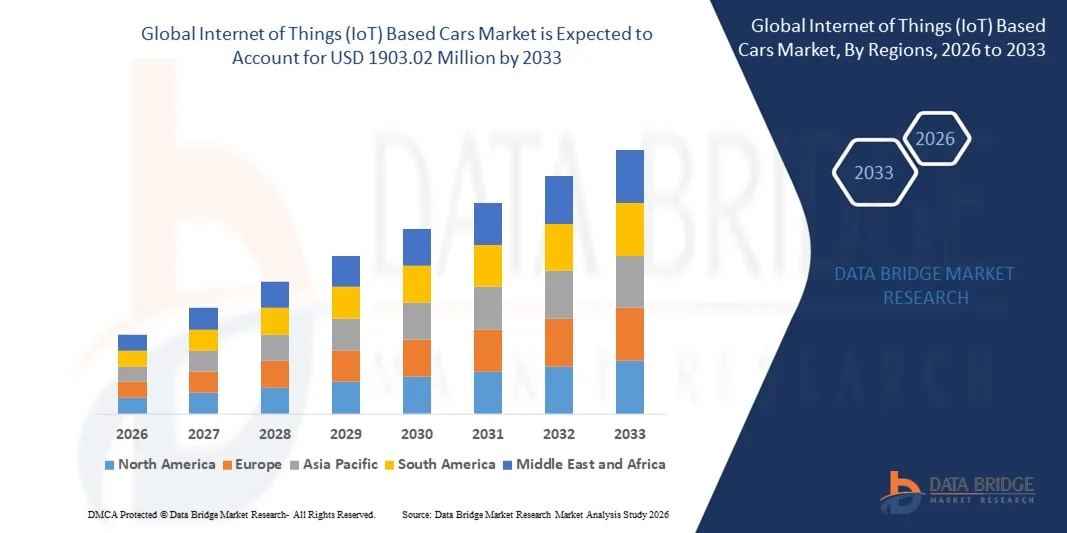
- As per Data Bridge Market Research Analysis the global Internet of Things (IoT) based cars market size was valued at USD 564.70 million in 2025 and is expected to reach USD 1903.02 million by 2033, at a CAGR of 16.40% during the forecast period
- The market growth is largely fueled by the increasing adoption of connected vehicle technologies and continuous advancements in automotive IoT infrastructure, enabling real-time vehicle communication, remote diagnostics, and enhanced driver assistance capabilities across modern vehicles
- Furthermore, rising consumer demand for advanced infotainment systems, improved vehicle safety, and seamless digital connectivity between vehicles, smartphones, and cloud platforms is positioning IoT-enabled vehicles as an essential component of modern smart mobility ecosystems. These converging factors are accelerating the adoption of connected vehicle platforms, thereby significantly boosting the growth of the Internet of Things (IoT) based cars market
Market Size & Forecast
- Global Market Value (2025): 564.70 million USD
- Expected Market Value (2033): 1903.02 million USD
- Forecast CAGR (2026–2033): 16.40%
What are the Major Takeaways of Internet of Things (IoT) Based Cars Market?
- Internet of Things (IoT) based cars, which enable continuous communication between vehicles, drivers, and surrounding infrastructure through embedded sensors, connectivity modules, and cloud platforms, are becoming critical elements of modern intelligent transportation systems due to their ability to enhance vehicle safety, operational efficiency, and user experience
- The increasing demand for IoT-enabled vehicles is primarily driven by the rapid expansion of connected mobility solutions, rising integration of advanced telematics and navigation technologies, and the growing deployment of vehicle-to-vehicle and vehicle-to-infrastructure communication systems that support safer and more efficient transportation networks
- North America dominated the Internet of Things (IoT) based cars market in 2025, due to strong adoption of connected vehicle technologies and advanced automotive digital infrastructure across the region
- Asia-Pacific is expected to be the fastest growing region in the Internet of Things (IoT) based cars market during the forecast period due to rapid urbanization, increasing vehicle ownership, and growing adoption of connected technologies across emerging economies
- Hardware segment dominated the market with a market share of 47.3% in 2025, due to the extensive deployment of sensors, control units, communication modules, and embedded devices that enable connected vehicle functionality. Automakers increasingly integrate IoT hardware components to support real-time data collection, vehicle diagnostics, and safety monitoring. The expansion of advanced driver assistance systems and connected infotainment platforms further increases demand for robust hardware infrastructure in vehicles
Report Scope and Internet of Things (IoT) Based Cars Market Segmentation
|
Attributes |
Internet of Things (IoT) Based Cars Key Market Insights |
|
Segments Covered |
|
|
Countries Covered |
North America
Europe
Asia-Pacific
Middle East and Africa
South America
|
|
Key Market Players |
|
|
Market Opportunities |
|
|
Value Added Data Infosets |
In addition to the market insights such as market value, growth rate, market segments, geographical coverage, market players, and market scenario, the market report curated by the Data Bridge Market Research team includes in-depth expert analysis, import/export analysis, pricing analysis, production consumption analysis, and pestle analysis. |
What is the Key Trend in the Internet of Things (IoT) Based Cars Market?
Growing 5G and V2X Integration in Connected Cars
- A major trend in the Internet of Things (IoT) based cars market is the increasing integration of 5G connectivity and vehicle-to-everything (V2X) communication technologies that enable real-time data exchange between vehicles, infrastructure, and digital platforms. These technologies are transforming connected vehicles into intelligent mobility systems capable of improving traffic efficiency, road safety, and driver experience
- For instance, Qualcomm has introduced advanced automotive 5G and C-V2X connectivity platforms that enable high-speed communication between vehicles and surrounding infrastructure. These solutions support real-time navigation updates, traffic information sharing, and advanced safety features in connected vehicles
- Automotive manufacturers are increasingly integrating V2X technologies into vehicles to support advanced driver assistance systems and cooperative driving capabilities. This technology allows vehicles to exchange data regarding speed, traffic conditions, and road hazards, improving situational awareness and reducing accident risks
- The expansion of connected infrastructure and intelligent transportation systems is encouraging governments and automotive companies to invest in IoT-enabled mobility platforms. These initiatives are enabling vehicles to communicate with smart traffic signals, road sensors, and cloud platforms to improve transportation efficiency
- Telecommunication companies are also supporting this trend through deployment of high-speed mobile networks that enable continuous vehicle connectivity. The integration of advanced communication technologies is strengthening the foundation for connected mobility services and next-generation automotive ecosystems
- The rising adoption of connected vehicles supported by 5G networks and V2X communication technologies is reinforcing the transition toward intelligent transportation systems. This trend is positioning IoT-enabled vehicles as key components of future mobility infrastructures and smart city ecosystems
Internet of Things (IoT) Based Cars Market Dynamics
Driver
Rising Adoption of Connected Vehicle Technologies
- The increasing demand for connected vehicle technologies is significantly driving the growth of the Internet of Things (IoT) based cars market as automakers focus on integrating advanced connectivity solutions that enhance safety, navigation, and in-vehicle digital services. These technologies enable vehicles to collect and transmit real-time data that supports predictive maintenance, remote diagnostics, and improved driver assistance systems
- For instance, Ford Motor Company has expanded its connected vehicle services through the FordPass platform, which allows drivers to remotely monitor vehicle health, locate vehicles, and access digital mobility services through smartphone applications. Such solutions highlight the growing importance of IoT connectivity in modern vehicles
- The integration of telematics and cloud platforms is enabling automotive companies to offer real-time vehicle data analytics and connected mobility services. These capabilities support efficient fleet management, improved route planning, and enhanced driver safety across commercial and passenger vehicles
- Consumers are increasingly demanding vehicles equipped with advanced infotainment systems, remote connectivity features, and integrated navigation platforms. This shift toward digitally connected vehicles is encouraging manufacturers to expand IoT integration across new automotive models
- The rapid expansion of connected mobility ecosystems and growing integration of digital technologies in vehicles continues to strengthen this driver. Increasing reliance on IoT connectivity in modern vehicles is supporting the development of intelligent transportation systems and accelerating market growth
Restraint/Challenge
Increasing Cybersecurity Risks in Connected Vehicles
- The Internet of Things (IoT) based cars market faces significant challenges related to cybersecurity vulnerabilities as connected vehicles rely heavily on digital communication networks and cloud platforms for data transmission. These interconnected systems increase the potential risk of cyberattacks targeting vehicle control systems, communication networks, and sensitive user data
- For instance, the National Highway Traffic Safety Administration has emphasized the importance of cybersecurity frameworks for connected vehicles following multiple demonstrations of remote vehicle hacking that highlighted potential security risks in automotive communication systems
- Connected vehicles generate and transmit large volumes of data including location information, driver behavior patterns, and vehicle performance metrics. Protecting this sensitive data from unauthorized access requires robust encryption, secure software architecture, and continuous monitoring systems
- The increasing integration of wireless communication technologies such as Wi-Fi, Bluetooth, and cellular connectivity further expands the potential attack surface for cyber threats. This creates challenges for automotive manufacturers that must maintain strong cybersecurity defenses while enabling seamless connectivity
- The rising concerns regarding data privacy and vehicle security continue to influence consumer trust and regulatory frameworks in the connected vehicle ecosystem. Addressing these cybersecurity challenges remains critical for sustaining the long-term growth of the IoT-based cars market
How is the Internet of Things (IoT) Based Cars Market Segmented?
The market is segmented on the basis of offering, connectivity form factor, communication type, and application.
- By Offering
On the basis of offering, the Internet of Things (IoT) Based Cars market is segmented into hardware, software, and services. The hardware segment dominated the market with the largest market revenue share of 47.3% in 2025, driven by the extensive deployment of sensors, control units, communication modules, and embedded devices that enable connected vehicle functionality. Automakers increasingly integrate IoT hardware components to support real-time data collection, vehicle diagnostics, and safety monitoring. The expansion of advanced driver assistance systems and connected infotainment platforms further increases demand for robust hardware infrastructure in vehicles. Hardware also forms the foundation for seamless connectivity between vehicles and external digital ecosystems. As connected vehicle technologies expand, the demand for reliable and high-performance hardware components continues to strengthen across passenger and commercial vehicles.
The software segment is anticipated to witness the fastest growth rate from 2026 to 2033, fueled by increasing demand for intelligent data processing, predictive analytics, and cloud-based vehicle management platforms. Automotive manufacturers are focusing on advanced software solutions to enable real-time vehicle monitoring, over-the-air updates, and enhanced cybersecurity capabilities. IoT vehicle software also supports features such as remote diagnostics, fleet management optimization, and personalized driving experiences. Growing adoption of artificial intelligence and machine learning in automotive platforms further strengthens the importance of software in connected vehicles. As vehicles evolve into software-defined platforms, the demand for advanced IoT software ecosystems is expected to rise significantly.
- By Connectivity Form Factor
On the basis of connectivity form factor, the Internet of Things (IoT) Based Cars market is segmented into embedded, tethered, and integrated. The embedded segment dominated the market with the largest market revenue share in 2025, driven by its ability to provide built-in connectivity directly through factory-installed modules and SIM-based communication systems. Embedded connectivity enables continuous communication between vehicles, cloud platforms, and service providers without requiring external devices. Automotive manufacturers increasingly prefer embedded solutions for enhanced reliability, real-time telematics, and advanced safety services. These systems support critical functions such as emergency assistance, remote diagnostics, and predictive maintenance. The growing integration of advanced connected car services across new vehicle models further supports the dominance of embedded connectivity solutions.
The integrated segment is expected to witness the fastest CAGR from 2026 to 2033, driven by the growing convergence of smartphones, infotainment systems, and vehicle communication platforms. Integrated connectivity enables seamless synchronization between personal devices and vehicle systems, enhancing user experience and convenience. Consumers increasingly demand smart vehicle ecosystems that support navigation, voice assistants, and personalized digital services. The rising adoption of connected infotainment platforms and cloud-based automotive applications further accelerates demand for integrated connectivity architectures. As vehicles become more digitally interconnected with consumer devices and smart environments, integrated connectivity solutions are expected to grow rapidly.
- By Communication Type
On the basis of communication type, the Internet of Things (IoT) Based Cars market is segmented into in-vehicle communication, vehicle-to-vehicle communication, and vehicle-to-infrastructure communication. The in-vehicle communication segment dominated the market with the largest market revenue share in 2025, driven by the increasing integration of electronic control units, sensors, and communication networks within modern vehicles. In-vehicle communication systems enable efficient data exchange between different vehicle components, supporting functions such as engine control, safety systems, and infotainment operations. The rapid adoption of advanced driver assistance systems and vehicle automation technologies further increases the importance of internal communication networks. Automotive manufacturers continue to expand electronic architecture to support connected and intelligent vehicle capabilities. As vehicle electronics become more sophisticated, in-vehicle communication remains essential for efficient system coordination and performance.
The vehicle-to-vehicle communication segment is projected to witness the fastest growth rate from 2026 to 2033, driven by the rising focus on road safety and collaborative traffic management technologies. Vehicle-to-vehicle communication allows connected cars to exchange real-time data regarding speed, position, and road conditions. This communication capability supports collision avoidance systems and improves situational awareness for drivers and autonomous systems. Governments and automotive companies are investing in connected mobility initiatives to reduce accidents and improve transportation efficiency. As intelligent transportation systems continue to expand globally, the adoption of vehicle-to-vehicle communication technologies is expected to accelerate significantly.
- By Application
On the basis of application, the Internet of Things (IoT) Based Cars market is segmented into infotainment, navigation, and telematics. The infotainment segment dominated the market with the largest market revenue share in 2025, driven by growing consumer demand for advanced digital entertainment and connectivity features inside vehicles. Modern infotainment systems integrate streaming services, smartphone connectivity, voice assistants, and personalized content platforms. Automotive manufacturers are increasingly focusing on enhancing in-car user experiences through large touch displays, connected applications, and multimedia capabilities. The growing popularity of connected entertainment services and real-time content access further drives the adoption of IoT-enabled infotainment systems. As vehicles increasingly function as digital lifestyle spaces, infotainment applications continue to lead market demand.
The telematics segment is expected to witness the fastest CAGR from 2026 to 2033, fueled by increasing adoption of fleet management solutions, vehicle tracking systems, and remote diagnostics technologies. Telematics platforms enable real-time monitoring of vehicle performance, driver behavior, and operational efficiency. Businesses and transportation companies rely on telematics to optimize routes, reduce fuel consumption, and improve asset utilization. Insurance companies are also adopting telematics-based usage models to assess driver risk and offer personalized policies. As connected vehicle ecosystems expand across commercial fleets and smart mobility services, telematics applications are projected to experience rapid growth.
Which Region Holds the Largest Share of the Internet of Things (IoT) Based Cars Market?
- North America dominated the Internet of Things (IoT) based cars market with the largest revenue share in 2025, driven by strong adoption of connected vehicle technologies and advanced automotive digital infrastructure across the region
- Consumers and automotive manufacturers in the region highly value real-time connectivity, intelligent infotainment systems, and advanced telematics solutions that enhance driving safety, vehicle monitoring, and user experience
- This widespread adoption is further supported by high technology investments, a strong presence of leading automotive and technology companies, and the increasing integration of cloud platforms and 5G connectivity, establishing IoT-enabled vehicles as a key component of the region’s smart mobility ecosystem
U.S. Internet of Things (IoT) Based Cars Market Insight
The U.S. Internet of Things (IoT) Based Cars market captured the largest revenue share in 2025 within North America, fueled by the rapid adoption of connected vehicles and increasing integration of digital mobility technologies. Automakers and technology companies in the country are heavily investing in telematics, advanced driver assistance systems, and cloud-connected automotive platforms. The growing demand for enhanced in-vehicle infotainment and real-time navigation services is also accelerating market growth. Moreover, the expansion of autonomous driving research and increasing deployment of 5G-enabled vehicle communication technologies are significantly strengthening the connected car ecosystem in the country.
Europe Internet of Things (IoT) Based Cars Market Insight
The Europe Internet of Things (IoT) Based Cars market is projected to expand at a substantial CAGR throughout the forecast period, primarily driven by strict vehicle safety regulations and increasing focus on intelligent transportation systems. European automakers are increasingly integrating IoT technologies to enhance vehicle connectivity, predictive maintenance, and fleet management capabilities. The rising demand for smart mobility solutions and connected infrastructure is accelerating IoT integration in vehicles. In addition, the region’s focus on sustainable transportation and digital innovation is encouraging the adoption of connected car platforms across passenger and commercial vehicles.
U.K. Internet of Things (IoT) Based Cars Market Insight
The U.K. Internet of Things (IoT) Based Cars market is anticipated to grow at a noteworthy CAGR during the forecast period, driven by increasing demand for connected mobility services and smart transportation solutions. Consumers are increasingly seeking vehicles equipped with advanced navigation, infotainment, and telematics capabilities. The country’s strong digital infrastructure and rising investments in smart mobility research are supporting the growth of IoT-enabled vehicles. Furthermore, the expansion of electric vehicles combined with connected vehicle technologies is expected to further stimulate market growth.
Germany Internet of Things (IoT) Based Cars Market Insight
The Germany Internet of Things (IoT) Based Cars market is expected to expand at a considerable CAGR during the forecast period, fueled by the presence of major automotive manufacturers and continuous technological innovation in connected vehicle systems. Germany’s automotive industry is actively integrating IoT technologies to enhance vehicle intelligence, safety, and operational efficiency. The country’s strong focus on autonomous driving development and advanced automotive electronics is further accelerating IoT adoption. In addition, the integration of connected vehicle platforms with smart transportation infrastructure is supporting the growth of IoT-based automotive solutions in the country.
Asia-Pacific Internet of Things (IoT) Based Cars Market Insight
The Asia-Pacific Internet of Things (IoT) Based Cars market is poised to grow at the fastest CAGR during the forecast period of 2026 to 2033, driven by rapid urbanization, increasing vehicle ownership, and growing adoption of connected technologies across emerging economies. Governments across the region are promoting smart mobility and digital transportation initiatives to improve traffic management and road safety. Rising consumer demand for advanced infotainment systems and connected navigation services is also contributing to market growth. In addition, the region’s strong automotive manufacturing ecosystem is accelerating the production and adoption of IoT-enabled vehicles.
Japan Internet of Things (IoT) Based Cars Market Insight
The Japan Internet of Things (IoT) Based Cars market is gaining momentum due to the country’s strong technological capabilities and focus on intelligent mobility solutions. Japanese automakers are actively integrating IoT technologies to enable advanced driver assistance systems, vehicle diagnostics, and smart infotainment services. The country’s emphasis on innovation and connected infrastructure is encouraging the adoption of IoT-enabled automotive platforms. Furthermore, the integration of vehicles with smart city ecosystems and transportation networks is expected to support continued market growth.
China Internet of Things (IoT) Based Cars Market Insight
The China Internet of Things (IoT) Based Cars market accounted for the largest market revenue share in Asia Pacific in 2025, attributed to the country’s large automotive production capacity and rapid adoption of connected vehicle technologies. China is investing heavily in smart mobility infrastructure, including vehicle-to-everything communication networks and intelligent transportation systems. The growing demand for advanced infotainment, navigation, and telematics services is also increasing IoT integration in vehicles. In addition, the presence of strong domestic automotive manufacturers and technology companies is further driving the expansion of the connected car market in China.
Which are the Top Companies in Internet of Things (IoT) Based Cars Market ?
The Internet of Things (IoT) based cars industry is primarily led by well-established companies, including:
- Texas Instruments Incorporated (U.S.)
- General Motors (U.S.)
- Ford Motor Company (U.S.)
- Apple Inc. (U.S.)
- Cisco Systems Inc. (U.S.)
- Intel Corporation (U.S.)
- IBM (U.S.)
- Google LLC (U.S.)
- Microsoft Corporation (U.S.)
- Vodafone Group Plc (U.K.)
- TomTom International BV (Netherlands)
- Thales Group (France)
- AT&T Intellectual Property (U.S.)
- Robert Bosch GmbH (Germany)
- Audi AG (Germany)
What are Latest Developments in Global Internet of Things (IoT) Based Cars Market?
- In February 2026, Hyundai Motor Group partnered with Vodafone to expand connected car services across several Middle Eastern markets. Through Vodafone’s Global SIM technology, the collaboration enables seamless cross-border connectivity and regulatory-compliant IoT communication for vehicles. This development strengthens the deployment of connected mobility solutions such as remote diagnostics, vehicle monitoring, and digital vehicle services. The partnership is expected to accelerate the adoption of IoT-enabled automotive platforms and enhance the global expansion of connected vehicle ecosystems
- In February 2025, Tuya Smart partnered with Chery Automobile to develop integrated smart car and smart home connectivity solutions. The collaboration focuses on linking connected vehicles with home automation systems through IoT platforms and advanced smart cockpit technologies. This initiative enhances the interoperability between vehicles and digital living environments, expanding the role of IoT ecosystems in mobility. The development supports the evolution of connected vehicles as integrated components of broader smart lifestyle platforms
- In October 2024, Kia India collaborated with Airtel Business to strengthen its connected vehicle platform through enhanced IoT connectivity infrastructure. The partnership enables advanced features such as remote vehicle monitoring, navigation assistance, over-the-air diagnostics, and voice-enabled vehicle controls. This development significantly improves the connectivity capabilities of modern vehicles and enhances the overall digital driving experience. The collaboration is expected to accelerate the adoption of IoT-enabled automotive technologies in emerging automotive markets
- In February 2024, Cisco Systems partnered with TELUS to introduce a 5G-enabled connected vehicle platform designed to support large-scale IoT automotive connectivity. The platform enables automakers to manage vehicle communication networks, subscription-based digital services, and SIM lifecycle management through a unified system. This development significantly enhances high-speed vehicle connectivity and supports advanced telematics and data-driven automotive services. The initiative is expected to strengthen the growth of 5G-connected vehicles and expand IoT infrastructure within the automotive sector
- In January 2024, Microsoft partnered with LG Electronics to integrate cloud-based gaming and digital entertainment services into connected vehicle platforms. The collaboration enables in-vehicle access to cloud gaming through advanced infotainment systems powered by connected cloud infrastructure. This development highlights the growing integration of digital content platforms with IoT-enabled automotive technologies. The partnership further expands the role of connected vehicles as digital entertainment and service hubs within the broader IoT mobility ecosystem

- Interactive Data Analysis Dashboard
- Company Analysis Dashboard for high growth potential opportunities
- Research Analyst Access for customization & queries
- Competitor Analysis with Interactive dashboard
- Latest News, Updates & Trend analysis
- Harness the Power of Benchmark Analysis for Comprehensive Competitor Tracking
Data collection and base year analysis are done using data collection modules with large sample sizes. The stage includes obtaining market information or related data through various sources and strategies. It includes examining and planning all the data acquired from the past in advance. It likewise envelops the examination of information inconsistencies seen across different information sources. The market data is analysed and estimated using market statistical and coherent models. Also, market share analysis and key trend analysis are the major success factors in the market report. To know more, please request an analyst call or drop down your inquiry.
The key research methodology used by DBMR research team is data triangulation which involves data mining, analysis of the impact of data variables on the market and primary (industry expert) validation. Data models include Vendor Positioning Grid, Market Time Line Analysis, Market Overview and Guide, Company Positioning Grid, Patent Analysis, Pricing Analysis, Company Market Share Analysis, Standards of Measurement, Global versus Regional and Vendor Share Analysis. To know more about the research methodology, drop in an inquiry to speak to our industry experts.
Data Bridge Market Research is a leader in advanced formative research. We take pride in servicing our existing and new customers with data and analysis that match and suits their goal. The report can be customized to include price trend analysis of target brands understanding the market for additional countries (ask for the list of countries), clinical trial results data, literature review, refurbished market and product base analysis. Market analysis of target competitors can be analyzed from technology-based analysis to market portfolio strategies. We can add as many competitors that you require data about in the format and data style you are looking for. Our team of analysts can also provide you data in crude raw excel files pivot tables (Fact book) or can assist you in creating presentations from the data sets available in the report.













