


Interoperable Healthcare Solutions Market Size
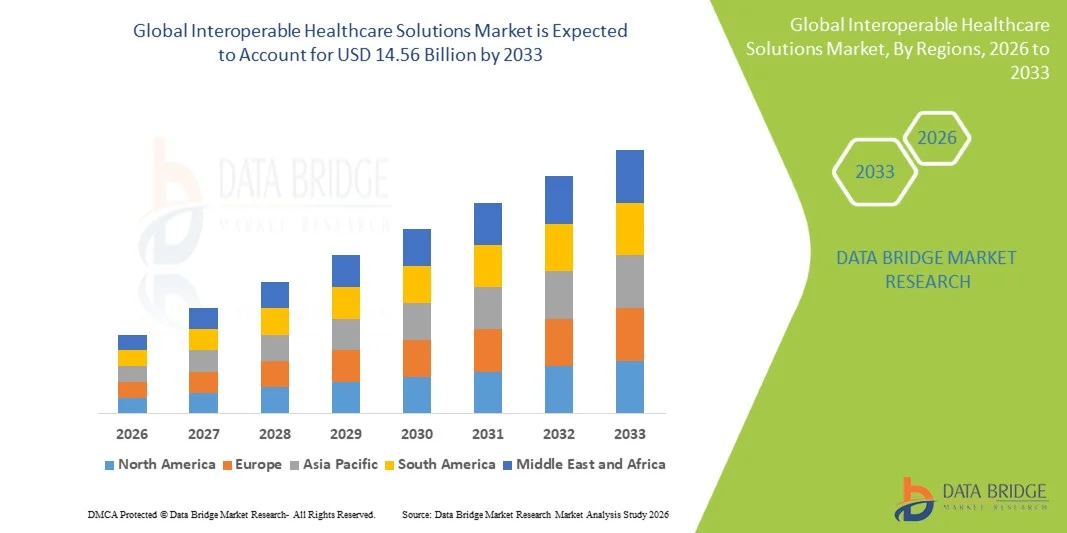
- The global Interoperable Healthcare Solutions market size was valued at USD 5.28 billion in 2025 and is expected to reach USD 14.56 billion by 2033, at a CAGR of 13.52% during the forecast period
- The market growth is largely fueled by increasing digital transformation across healthcare systems, rising adoption of electronic health records (EHRs), and growing demand for seamless data exchange among hospitals, clinics, laboratories, and payers, leading to improved operational efficiency and coordinated patient care
- Furthermore, rising demand for secure, integrated, and patient-centric healthcare information systems is establishing Interoperable Healthcare Solutions as a critical foundation of modern healthcare delivery. These converging factors are accelerating the uptake of Interoperable Healthcare Solutions, thereby significantly boosting the industry's growth
Interoperable Healthcare Solutions Market Analysis
- Interoperable healthcare solutions, including health information exchange platforms, EHR integration systems, cloud-based data interoperability tools, API-enabled healthcare software, and patient data management platforms, are increasingly vital components of modern healthcare ecosystems due to their ability to streamline workflows, enhance care coordination, and improve patient outcomes
- The escalating demand for Interoperable Healthcare Solutions is primarily fueled by rising adoption of digital health records, increasing need for real-time clinical data sharing, growing regulatory focus on standardized healthcare data exchange, and expanding investments in connected healthcare infrastructure
- North America dominated the interoperable healthcare solutions market with the largest revenue share of 43.5% in 2025, characterized by advanced healthcare IT infrastructure, high adoption of electronic health records, strong regulatory support for interoperability standards, and the presence of leading healthcare technology companies, with the U.S. witnessing significant deployment of integrated care and data exchange platforms across hospitals and provider networks
- Asia-Pacific is expected to be the fastest-growing region in the interoperable healthcare solutions market during the forecast period, projected to register a CAGR of 13.1%, due to rapid healthcare digitalization, increasing government healthcare IT initiatives, rising healthcare expenditure, and growing demand for efficient patient data management systems
- The on-premises segment dominated the market with a revenue share of 57.6% in 2025, driven by strong preference among large hospitals and government institutions for in-house data control and security
Report Scope and Interoperable Healthcare Solutions Market Segmentation
|
Attributes |
Interoperable Healthcare Solutions Key Market Insights |
|
Segments Covered |
|
|
Countries Covered |
North America
Europe
Asia-Pacific
Middle East and Africa
South America
|
|
Key Market Players |
|
|
Market Opportunities |
|
|
Value Added Data Infosets |
In addition to the insights on market scenarios such as market value, growth rate, segmentation, geographical coverage, and major players, the market reports curated by the Data Bridge Market Research also include in-depth expert analysis, patient epidemiology, pipeline analysis, pricing analysis, and regulatory framework. |
Interoperable Healthcare Solutions Market Trends
“Rising Adoption of Connected Data Exchange and Unified Care Platforms”
- A significant and accelerating trend in the global Interoperable Healthcare Solutions market is the growing demand for seamless healthcare data exchange across hospitals, clinics, laboratories, pharmacies, insurers, and digital health platforms. This trend is being driven by the need to improve care coordination, reduce administrative inefficiencies, and enable real-time access to accurate patient information across multiple care settings
- Cloud-based interoperability platforms, health information exchanges (HIEs), and API-driven integration tools are increasingly being adopted to connect fragmented healthcare systems and legacy databases
- For instance, Oracle Health and Epic Systems have expanded interoperable electronic health record ecosystems that enable providers to securely share patient records across hospitals and physician networks
- The increasing use of standardized data frameworks such as HL7, FHIR, and secure digital APIs is improving compatibility between different healthcare software systems. These standards are enabling faster implementation of connected care models and reducing barriers caused by incompatible IT infrastructures
- Interoperable solutions are also playing a vital role in remote care delivery, telehealth integration, and patient engagement platforms. Through unified systems, clinicians can access laboratory data, imaging records, prescriptions, and remote monitoring information through a single interface, improving decision-making speed and treatment continuity
- This movement toward connected and data-driven healthcare ecosystems is fundamentally reshaping provider expectations regarding operational efficiency and patient-centric care delivery. As a result, technology vendors are increasingly launching scalable and modular interoperability solutions for both large hospitals and smaller outpatient networks
- Demand for interoperable healthcare solutions is rising rapidly across public health systems, private hospitals, insurers, and life sciences organizations as stakeholders prioritize efficiency, compliance, and coordinated care outcomes
Interoperable Healthcare Solutions Market Dynamics
Driver
“Growing Need for Coordinated Care, Digital Transformation, and Data Accessibility”
- The increasing need to eliminate healthcare data silos and improve coordination between providers is a major driver for the global Interoperable Healthcare Solutions market. Healthcare organizations are prioritizing systems that allow secure and timely information exchange to improve treatment quality and reduce duplication of services
- Governments and healthcare institutions are actively investing in digital health infrastructure and national data exchange initiatives to modernize care delivery
- For instance, National Health Service in the UK and multiple U.S. health systems have accelerated interoperability investments to improve connected patient record access and streamline cross-provider collaboration
- Rising adoption of electronic health records (EHRs), telemedicine, and remote patient monitoring is further driving demand for interoperability tools, as these platforms require seamless integration to function efficiently across multiple touchpoints
- Increasing pressure to reduce hospital readmissions and improve clinical outcomes is encouraging providers to adopt interoperable systems that provide complete patient histories, medication records, and diagnostic data in real time
- Healthcare payers are also supporting market growth by promoting value-based care models that depend on accurate, shared data for claims management, care coordination, and performance measurement
- In addition, growing patient expectations for digital access to personal health records, appointments, and prescriptions are encouraging providers to invest in connected healthcare ecosystems
Restraint/Challenge
“Cybersecurity Risks, Integration Complexity, and High Deployment Costs”
- Concerns regarding cybersecurity vulnerabilities and patient data privacy remain a major challenge for broader market adoption. As interoperable platforms exchange sensitive health information across networks, they may become targets for ransomware, unauthorized access, and data breaches
- Many healthcare providers remain cautious after high-profile cyber incidents affecting hospital IT systems and patient databases
- For instance, ransomware attacks on healthcare institutions in the U.S. and Europe have highlighted the operational and financial risks associated with connected digital infrastructure
- Integration with outdated legacy systems is another major obstacle, as many hospitals continue to use old software architectures that are not easily compatible with modern interoperability standards or cloud platforms
- The relatively high cost of implementation can also restrain adoption, particularly among smaller hospitals and clinics with limited IT budgets. Expenses often include software licensing, data migration, cybersecurity upgrades, staff training, and ongoing maintenance
- Lack of uniform global standards and varying regulatory frameworks across countries can slow multi-region deployments, especially for multinational healthcare providers and technology vendor
- Resistance to organizational change and workflow disruption may further delay implementation, as clinicians and administrators often require time and training to transition from siloed systems to integrated digital environments
- Overcoming these restraints through stronger cybersecurity frameworks, simplified integration models, workforce training, and cost-effective deployment strategies will be essential for sustained market expansion
Interoperable Healthcare Solutions Market Scope
The market is segmented on the basis of type, interoperability level, end-user, and deployment.
• By Type
On the basis of type, the Interoperable Healthcare Solutions market is segmented into software solutions, standalone software, integrated software, and services. The software solutions segment dominated the largest market revenue share of 46.8% in 2025, driven by the rising need for seamless data exchange, workflow automation, and centralized healthcare information management across hospitals and payer networks. Healthcare organizations are increasingly investing in advanced software platforms to reduce administrative burdens, improve patient outcomes, and comply with regulatory interoperability mandates. Software solutions also support electronic health records (EHR), telehealth integration, analytics, and revenue cycle management, making them critical for modern healthcare ecosystems. Their scalability and compatibility with multiple systems further strengthen adoption across developed and emerging markets. Vendors are continuously launching AI-enabled and cloud-compatible software platforms, adding to segment growth. Large healthcare systems prefer enterprise-wide software due to efficiency gains and long-term cost savings. Increasing digital transformation initiatives and smart hospital development also support demand. As a result, software solutions remain the leading segment globally.
The services segment is anticipated to witness the fastest growth rate of 18.9% CAGR from 2026 to 2033, fueled by growing demand for consulting, implementation, training, and maintenance services. Healthcare providers often require third-party expertise to integrate legacy systems with new interoperable platforms. Managed services are becoming essential for cybersecurity monitoring, compliance management, and system optimization. Rising adoption of outsourced IT services among small and medium facilities further boosts growth. Increasing complexity of multi-vendor healthcare environments is also accelerating demand for specialized support services.
• By Interoperability Level
On the basis of interoperability level, the Interoperable Healthcare Solutions market is segmented into foundational interoperability, structural interoperability, and semantic interoperability. The foundational interoperability segment held the largest market revenue share of 41.5% in 2025, driven by its widespread use as the first stage of healthcare data exchange. It enables one system to securely send and receive information from another, making it essential for hospitals transitioning from paper-based or siloed digital records. Many healthcare providers prioritize foundational interoperability because it offers lower implementation complexity and faster deployment compared with higher-level models. Government digitization initiatives and basic EHR connectivity projects are further supporting segment demand. It is commonly adopted in diagnostic centers, clinics, and regional hospital networks. Cost-effectiveness and broad compatibility with existing systems also strengthen adoption. Developing economies especially favor foundational solutions due to budget constraints. As healthcare digitization expands globally, this segment continues to dominate revenue share.
The semantic interoperability segment is expected to witness the fastest CAGR of 20.4% from 2026 to 2033, driven by the need for advanced data interpretation and intelligent clinical decision-making. Semantic systems allow exchanged data to be understood consistently across platforms using standardized terminology. Growing adoption of AI, predictive analytics, and population health management tools is accelerating demand. Precision medicine and cross-border healthcare data exchange are also creating strong future opportunities.
• By End-User
On the basis of end-user, the Interoperable Healthcare Solutions market is segmented into healthcare providers, healthcare payers, and pharmacies. The healthcare providers segment accounted for the largest market revenue share of 52.3% in 2025, driven by strong adoption across hospitals, clinics, and integrated care centers. Providers rely heavily on interoperable systems for patient record sharing, laboratory connectivity, imaging access, and coordinated care delivery. Increasing patient volumes and demand for efficient workflows are pushing providers toward connected healthcare ecosystems. Hospitals also use interoperable solutions to reduce duplicate testing, lower errors, and improve treatment decisions. Expansion of smart hospitals and telemedicine networks further supports this segment. Large provider groups are investing heavily in integrated EHR and clinical data platforms. Regulatory requirements for patient data access and exchange are also encouraging implementation. As providers remain the central hub of healthcare data generation, this segment continues to lead the market.
The pharmacies segment is anticipated to register the fastest CAGR of 19.1% from 2026 to 2033, fueled by rising e-prescription adoption and medication management integration. Retail and hospital pharmacies increasingly require real-time connectivity with providers and insurers. Growth in digital prescriptions, medication adherence platforms, and online pharmacy ecosystems is further accelerating demand. Expanding pharmaceutical care services and chronic disease management programs also support rapid growth.
• By Deployment
On the basis of deployment, the Interoperable Healthcare Solutions market is segmented into cloud-based and on-premises. The on-premises segment dominated the market with a revenue share of 57.6% in 2025, driven by strong preference among large hospitals and government institutions for in-house data control and security. Many healthcare organizations continue using on-premises systems to meet strict privacy requirements and internal IT governance policies. These deployments offer direct infrastructure management, customization flexibility, and integration with legacy hospital systems. Institutions with large patient databases often prefer on-site architecture for performance reliability and compliance reasons. Existing investments in internal data centers also sustain adoption. High usage among public hospitals and academic medical centers contributes significantly to revenue share. Organizations handling sensitive imaging and genomic data often choose on-premises models. Therefore, this segment remained dominant in 2025.
The cloud-based segment is projected to witness the fastest CAGR of 22.1% from 2026 to 2033, driven by lower upfront costs, scalability, and faster deployment timelines. Healthcare providers increasingly prefer cloud platforms for remote access, disaster recovery, and multi-site connectivity. Growth of telehealth, AI analytics, and subscription-based SaaS models is further accelerating adoption. Small and mid-sized healthcare organizations are especially shifting toward cloud infrastructure for cost efficiency and flexibility.
Interoperable Healthcare Solutions Market Regional Analysis
- North America dominated the interoperable healthcare solutions market with the largest revenue share of approximately 43.5% in 2025, characterized by advanced healthcare IT infrastructure, high adoption of electronic health records, strong regulatory support for interoperability standards, and the presence of leading healthcare technology companies
- Healthcare providers in the region highly value seamless data exchange, integrated clinical workflows, real-time patient information access, and secure connectivity between hospitals, laboratories, payers, and outpatient care systems
- This widespread adoption is further supported by substantial healthcare spending, strong digital transformation strategies, and the growing need to improve care coordination and operational efficiency, establishing interoperable healthcare solutions as a critical component of modern healthcare systems
U.S. Interoperable Healthcare Solutions Market Insight
The U.S. interoperable healthcare solutions market captured the largest revenue share in 2025 within North America, fueled by the extensive deployment of electronic health records, rapid adoption of cloud-based healthcare platforms, and strong federal initiatives promoting healthcare data interoperability. Healthcare organizations are increasingly prioritizing unified patient records, efficient care coordination, and secure information sharing across provider networks. Moreover, the presence of leading healthcare technology vendors and increasing investments in AI-enabled analytics and connected care platforms are significantly contributing to the market's expansion.
Europe Interoperable Healthcare Solutions Market Insight
The Europe interoperable healthcare solutions market is projected to expand at a substantial CAGR throughout the forecast period, primarily driven by rising digital health transformation initiatives, increasing cross-border healthcare collaboration, and growing demand for standardized patient data exchange systems. The region’s focus on healthcare efficiency, patient-centric care, and regulatory compliance is fostering the adoption of interoperable healthcare technologies. Significant growth is being witnessed across hospitals, specialty clinics, and national health systems, with integrated healthcare platforms being incorporated into both existing and newly modernized care infrastructures.
U.K. Interoperable Healthcare Solutions Market Insight
The U.K. interoperable healthcare solutions market is anticipated to grow at a noteworthy CAGR during the forecast period, driven by NHS digitization programs, increasing demand for coordinated care delivery, and rising investments in connected health ecosystems. Healthcare institutions are emphasizing streamlined patient records management, telehealth integration, and enhanced clinical communication systems. The country’s mature healthcare IT environment and growing adoption of advanced analytics platforms are expected to continue stimulating market growth.
Germany Interoperable Healthcare Solutions Market Insight
The Germany interoperable healthcare solutions market is expected to expand at a considerable CAGR during the forecast period, fueled by increasing awareness of digital healthcare modernization, rising demand for secure patient data sharing, and strong investments in smart hospital infrastructure. Germany’s well-developed healthcare ecosystem, combined with its emphasis on innovation, privacy, and efficiency, promotes the adoption of interoperable healthcare systems across hospitals and specialist centers. The integration of connected healthcare platforms with diagnostic, billing, and patient management systems is also becoming increasingly prevalent.
Asia-Pacific Interoperable Healthcare Solutions Market Insight
The Asia-Pacific interoperable healthcare solutions market is poised to grow at the fastest CAGR of approximately 13.1% during the forecast period, driven by rapid healthcare digitalization, increasing government healthcare IT initiatives, rising healthcare expenditure, and growing demand for efficient patient data management systems. Expanding hospital networks, rising adoption of cloud healthcare solutions, and increasing investments in smart healthcare infrastructure are accelerating market growth across emerging economies.
Japan Interoperable Healthcare Solutions Market Insight
The Japan interoperable healthcare solutions market is gaining momentum due to the country’s advanced healthcare infrastructure, aging population, and increasing need for connected care delivery systems. The Japanese market places significant emphasis on healthcare efficiency, and the adoption of interoperable solutions is driven by increasing deployment of digital records, hospital automation systems, and telemedicine platforms. Integration with diagnostic systems and long-term elderly care services is further fueling growth.
China Interoperable Healthcare Solutions Market Insight
The China interoperable healthcare solutions market accounted for the largest market revenue share in Asia Pacific in 2025, attributed to rapid hospital digitization, strong government healthcare modernization initiatives, and increasing adoption of connected health platforms. China stands as one of the fastest developing healthcare IT markets, and interoperable healthcare solutions are becoming increasingly popular across public hospitals, private healthcare groups, and regional care networks. The push toward smart hospitals, AI-enabled healthcare ecosystems, and scalable cloud infrastructure is propelling the market in China.
Interoperable Healthcare Solutions Market Share
The Interoperable Healthcare Solutions industry is primarily led by well-established companies, including:
- Oracle Corporation (U.S.)
- Microsoft Corporation (U.S.)
- IBM Corporation (U.S.)
- Epic Systems Corporation (U.S.)
- InterSystems Corporation (U.S.)
- Allscripts Healthcare, LLC (U.S.)
- NextGen Healthcare, Inc. (U.S.)
- Philips Healthcare (Netherlands)
- GE HealthCare Technologies Inc. (U.S.)
- Siemens Healthineers AG (Germany)
- Change Healthcare (U.S.)
- Cognizant Technology Solutions Corporation (U.S.)
- Tata Consultancy Services Limited (India)
- Infosys Limited (India)
- Wipro Limited (India)
- Accenture plc (Ireland)
- Fujitsu Limited (Japan)
- NXGN Management, LLC (U.S.)
Latest Developments in Global Interoperable Healthcare Solutions Market
- In January 2021, the U.S. Department of Health and Human Services (HHS) implemented the 21st Century Cures Act interoperability and information blocking rules, requiring healthcare providers and health IT developers to improve patient access to electronic health data through standardized APIs. This milestone significantly accelerated demand for interoperable healthcare solutions worldwide
- In July 2021, healthcare organizations increased adoption of HL7 FHIR-based integration platforms to enable seamless exchange of electronic health records (EHRs), laboratory data, and imaging information across multiple care settings. This development marked a major transition from legacy data exchange systems toward modern interoperable frameworks
- In March 2022, Oracle Corporation completed its acquisition of Cerner Corporation, creating Oracle Health and strengthening its position in interoperable healthcare data systems. The acquisition aimed to modernize EHR connectivity, cloud infrastructure, and data-sharing capabilities across hospitals and healthcare networks
- In October 2022, healthcare providers increasingly adopted cloud-based interoperability platforms to integrate patient records, billing systems, imaging archives, and telehealth applications. The shift supported scalable data exchange while reducing dependence on costly on-premise infrastructure
- In May 2023, leading health IT vendors expanded investments in open API ecosystems that enabled third-party apps, payer systems, and provider platforms to securely exchange real-time patient data. This development improved care coordination, patient engagement, and workflow automation across healthcare systems
- In November 2023, healthcare interoperability solution providers introduced enhanced cybersecurity and identity management tools to protect sensitive patient information during cross-platform data exchange. These upgrades addressed growing concerns around privacy, ransomware risks, and regulatory compliance
- In June 2024, a consortium of major EHR vendors and technology companies announced the launch of a national patient credentialing service, allowing patients to use a single secure digital identity to access health records across multiple provider networks. This initiative represented a major step toward patient-centered interoperability
- In December 2024, regulatory enforcement intensified against healthcare organizations and vendors found guilty of information blocking, prompting faster adoption of compliant interoperable systems and transparent data-sharing practices. This strengthened market demand for modern interoperability solutions

- Interactive Data Analysis Dashboard
- Company Analysis Dashboard for high growth potential opportunities
- Research Analyst Access for customization & queries
- Competitor Analysis with Interactive dashboard
- Latest News, Updates & Trend analysis
- Harness the Power of Benchmark Analysis for Comprehensive Competitor Tracking
Data collection and base year analysis are done using data collection modules with large sample sizes. The stage includes obtaining market information or related data through various sources and strategies. It includes examining and planning all the data acquired from the past in advance. It likewise envelops the examination of information inconsistencies seen across different information sources. The market data is analysed and estimated using market statistical and coherent models. Also, market share analysis and key trend analysis are the major success factors in the market report. To know more, please request an analyst call or drop down your inquiry.
The key research methodology used by DBMR research team is data triangulation which involves data mining, analysis of the impact of data variables on the market and primary (industry expert) validation. Data models include Vendor Positioning Grid, Market Time Line Analysis, Market Overview and Guide, Company Positioning Grid, Patent Analysis, Pricing Analysis, Company Market Share Analysis, Standards of Measurement, Global versus Regional and Vendor Share Analysis. To know more about the research methodology, drop in an inquiry to speak to our industry experts.
Data Bridge Market Research is a leader in advanced formative research. We take pride in servicing our existing and new customers with data and analysis that match and suits their goal. The report can be customized to include price trend analysis of target brands understanding the market for additional countries (ask for the list of countries), clinical trial results data, literature review, refurbished market and product base analysis. Market analysis of target competitors can be analyzed from technology-based analysis to market portfolio strategies. We can add as many competitors that you require data about in the format and data style you are looking for. Our team of analysts can also provide you data in crude raw excel files pivot tables (Fact book) or can assist you in creating presentations from the data sets available in the report.













