


Intestine Cancer Therapeutics Market Size
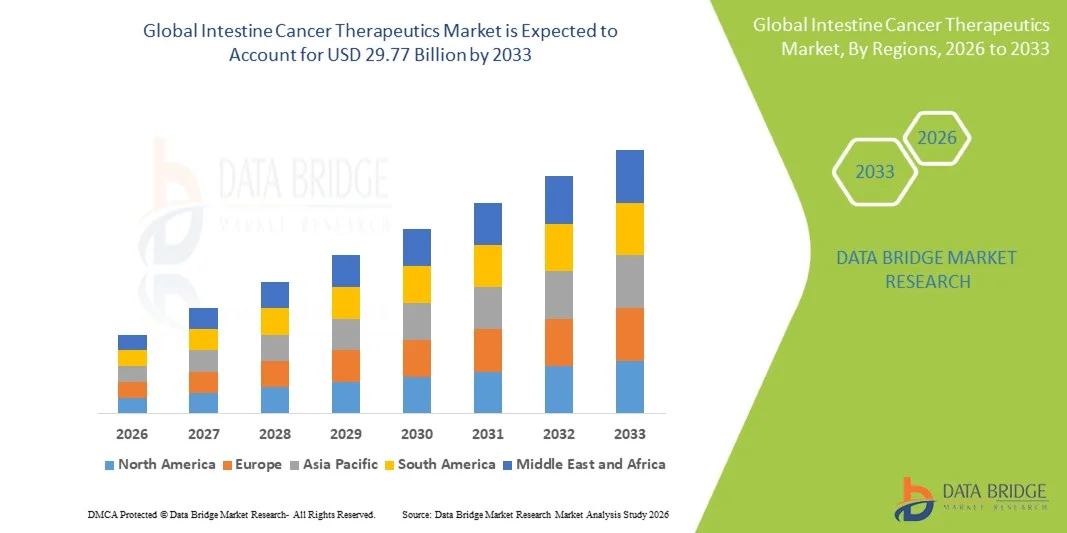
- The global Intestine Cancer Therapeutics market size was valued at USD 15.97 billion in 2025and is expected to reach USD 29.77 billion by 2033, at a CAGR of 8.10% during the forecast period
- The market growth is largely fueled by the growing adoption and technological progress within targeted oncology therapy and immunotherapy platforms, leading to increased precision medicine applications in both early-stage and advanced intestine cancer treatment settings
- Furthermore, rising demand for effective, well-tolerated, and molecularly targeted treatment solutions for colorectal, small intestinal, and anal cancers is establishing novel therapeutics as the modern standard of oncological care. These converging factors are accelerating the uptake of Intestine Cancer Therapeutics solutions, thereby significantly boosting the industry's growth
Intestine Cancer Therapeutics Market Analysis
- Intestine cancer therapeutics, offering cytotoxic, targeted, and immunomodulatory treatment options for malignancies of the large and small intestine, are increasingly vital components of modern oncology care pathways in both hospital and outpatient infusion settings due to their improved efficacy, enhanced tolerability profiles, and seamless integration with companion diagnostic frameworks
- The escalating demand for intestine cancer therapeutics is primarily fueled by the rising global incidence of colorectal cancer, the expanding molecular understanding of intestine cancer biology, and a growing preference for evidence-based precision oncology approaches
- North America dominated the intestine cancer therapeutics market with the largest revenue share of 41.20% in 2025, characterized by early adoption of precision oncology technologies, high healthcare expenditure, and a strong presence of key pharmaceutical industry players, with the U.S. experiencing substantial growth particularly in immunotherapy and anti-VEGF therapeutic segments
- Asia-Pacific is expected to be the fastest growing region in the intestine cancer therapeutics market during the forecast period due to increasing incidence rates of colorectal cancer, growing healthcare infrastructure investments, and rising awareness of early detection and treatment in countries such as China, Japan, and India
- The Parenteral segment held the largest market revenue share of 57.2% in 2025, driven by its rapid drug absorption, high bioavailability, and strong use in hospital-based cancer treatment settings
Report Scope and Intestine Cancer Therapeutics Market Segmentation
|
Attributes |
Intestine Cancer Therapeutics Key Market Insights |
|
Segments Covered |
|
|
Countries Covered |
North America · U.S. · Canada · Mexico Europe · Germany · France · U.K. · Netherlands · Switzerland · Belgium · Russia · Italy · Spain · Turkey · Rest of Europe Asia-Pacific · China · Japan · India · South Korea · Singapore · Malaysia · Australia · Thailand · Indonesia · Philippines · Rest of Asia-Pacific Middle East and Africa · Saudi Arabia · U.A.E. · South Africa · Egypt · Israel · Rest of Middle East and Africa South America · Brazil · Argentina · Rest of South America |
|
Key Market Players |
· Roche (Switzerland) · Merck & Co. (U.S.) · Bristol Myers Squibb (U.S.) · Pfizer (U.S.) · Eli Lilly and Company (U.S.) · Bayer AG (Germany) · Amgen (U.S.) · Sanofi (France) · Novartis (Switzerland) · Takeda Pharmaceutical (Japan) · Taiho Pharmaceutical (Japan) · Regeneron Pharmaceuticals (U.S.) · AstraZeneca (U.K.) · Johnson & Johnson (U.S.) · AbbVie (U.S.) · Teva Pharmaceutical Industries (Israel) · Ipsen (France) · Daiichi Sankyo (Japan) · Genentech (U.S.) |
|
Market Opportunities |
· Rising adoption of immunotherapy and targeted therapy · Expanding demand in emerging economies |
|
Value Added Data Infosets |
In addition to the insights on market scenarios such as market value, growth rate, segmentation, geographical coverage, and major players, the market reports curated by the Data Bridge Market Research also include in-depth expert analysis, patient epidemiology, pipeline analysis, pricing analysis, and regulatory framework. |
Intestine Cancer Therapeutics Market Trends
“Precision Oncology Driving Next-Generation Biomarker-Guided Treatment Selection”
- A significant and accelerating trend in the global Intestine Cancer Therapeutics market is the deepening integration of comprehensive genomic profiling (CGP) and liquid biopsy technologies into routine clinical decision-making for intestine cancer management. This fusion of diagnostic and therapeutic approaches is significantly enhancing treatment selection precision and expanding the proportion of patients eligible for molecularly targeted therapy
- For Instance, leading oncology diagnostic companies such as Foundation Medicine and Guardant Health have developed comprehensive liquid biopsy platforms that enable real-time monitoring of circulating tumor DNA (ctDNA) in colorectal cancer patients, facilitating earlier detection of acquired treatment resistance and enabling timely therapeutic adjustment
- Biomarker-guided treatment selection in intestine cancer therapeutics enables features such as MSI-H/dMMR testing to identify patients eligible for pembrolizumab therapy, KRAS/NRAS wild-type identification to stratify patients for anti-EGFR therapy, and HER2 amplification testing to guide trastuzumab-based combination regimens. These precision approaches have demonstrated response rate improvements of up to 38% compared to unselected chemotherapy
- The seamless integration of CGP results with oncology information systems (OIS) and tumor board decision-support platforms facilitates centralized multidisciplinary cancer care management. Through a single integrated pathway, oncologists can manage patient genomic profiles, treatment histories, and clinical trial eligibility criteria, creating a unified precision oncology experience
- This trend towards more precise, data-driven, and biomarker-guided treatment strategies is fundamentally reshaping clinical practice standards for intestine cancer management. Consequently, companies such as Amgen are advancing targeted therapies including sotorasib (KRAS G12C inhibitor) with companion diagnostics specifically designed to identify the subset of colorectal cancer patients most likely to derive clinical benefit
- The demand for intestine cancer therapeutics that offer seamless biomarker integration and precision medicine frameworks is growing rapidly across both academic medical centers and community oncology settings, as oncologists increasingly prioritize treatment individualization and comprehensive genomic-guided decision-making
Intestine Cancer Therapeutics Market Dynamics
Driver
“Growing Need Due to Rising Colorectal Cancer Incidence and Expanding Treatment Landscape”
- The increasing global incidence of colorectal cancer, particularly among younger adults under 50 who are experiencing early-onset disease at rates growing by approximately 2.4% annually in several high-income countries, coupled with the rapidly expanding therapeutic armamentarium driven by clinical trial results, is a significant driver for the heightened demand for intestine cancer therapeutics
- For Instance, in April 2025, Bristol-Myers Squibb announced updated long-term survival data from the CheckMate-8HW trial demonstrating superior overall survival for nivolumab plus ipilimumab combination immunotherapy versus chemotherapy in MSI-H/dMMR metastatic colorectal cancer, reinforcing the pivotal role of immunotherapy in molecularly selected intestine cancer patient populations. Such strategies by key companies are expected to drive the Intestine Cancer Therapeutics industry growth in the forecast period
- As oncologists and patients become increasingly aware of the survival benefits conferred by evidence-based molecular therapy selection and comprehensive multidisciplinary cancer care, intestine cancer therapeutics offer advanced clinical efficacy, durable response rates, and manageable safety profiles, providing a compelling improvement over conventional cytotoxic-only treatment approaches
- Furthermore, the growing availability of clinical trial access, expanded compassionate use programs, and real-world evidence platforms is accelerating the adoption of novel intestine cancer therapeutics across both academic medical centers and community oncology practices
- The convenience of subcutaneous administration formats for some targeted agents, extended dosing intervals, and the ability to manage treatment through integrated patient support programs are key factors propelling the adoption of advanced intestine cancer therapeutics across both inpatient and outpatient treatment settings
Restraint/Challenge
“High Treatment Costs and Drug Resistance Development”
- Concerns surrounding the high acquisition costs of novel targeted therapies and immunotherapy agents for intestine cancer, combined with the inevitable development of acquired drug resistance through various molecular escape mechanisms, pose a significant challenge to sustained market penetration and long-term treatment effectiveness
- For Instance, the annual treatment cost for advanced colorectal cancer patients receiving combination immunotherapy plus anti-VEGF regimens can exceed USD 250,000 in the United States, creating significant access barriers for patients in both uninsured domestic populations and healthcare systems in lower-income countries with limited oncology drug budgets
- Addressing these cost and resistance challenges through expanded biosimilar availability, value-based contracting frameworks, and the development of resistance-overcoming next-generation combination strategies is crucial for ensuring equitable access to effective intestine cancer therapeutics globally
- Companies such as Roche emphasize their patient assistance programs and health technology assessment submissions in their market access strategies to improve reimbursement coverage and patient affordability
- In addition, the complexity of acquired resistance mechanisms in intestine cancer, including KRAS amplification, EMT-driven resistance, and bypass pathway activation, requires ongoing investment in translational research and adaptive clinical trial designs to develop effective sequencing and combination strategies that can overcome resistance and maintain therapeutic efficacy
- Overcoming these challenges through innovative pricing and access models, strategic combination therapy development, and the advancement of next-generation molecular therapies will be vital for sustained market growth
Intestine Cancer Therapeutics Market Scope
The market is segmented on the basis of treatment type, route of administration, end-users, and distribution channel.
- By Treatment Type
On the basis of type, the Intestine Cancer Therapeutics market is segmented into Immunotherapy, Chemotherapy, and Others. The Immunotherapy segment dominated the largest market revenue share of 46.8% in 2025, driven by its high treatment efficacy, improved survival outcomes, and strong adoption of targeted cancer therapies. Increasing use of immune checkpoint inhibitors and monoclonal antibodies is significantly supporting segment growth. Rising prevalence of intestinal cancers globally is further boosting demand. Continuous advancements in oncology drug development are enhancing treatment precision. Growing preference for personalized medicine is strengthening adoption. Pharmaceutical companies are heavily investing in immunotherapy pipelines. Regulatory approvals for novel immunotherapy drugs are accelerating market penetration. Combination therapy approaches are further improving clinical outcomes. Higher patient response rates compared to traditional therapies are driving preference. Overall, immunotherapy remains the most advanced and widely adopted treatment approach.
The Chemotherapy segment is expected to witness the fastest growth rate of 9.8% from 2026 to 2033, driven by its continued importance as a first-line and combination cancer treatment option. Chemotherapy remains widely accessible and cost-effective across both developed and emerging regions. Increasing use in combination with immunotherapy and targeted therapy is improving effectiveness. Rising cancer burden worldwide is supporting demand growth. Expansion of oncology infrastructure is improving treatment availability. Development of improved formulations with fewer side effects is boosting adoption. Strong use in adjuvant and neoadjuvant settings is further supporting growth. Availability of generic chemotherapy drugs enhances affordability. Government reimbursement programs are increasing accessibility. Overall, chemotherapy continues to play a critical role in cancer treatment protocols.
- By Route of Administration
On the basis of route of administration, the Intestine Cancer Therapeutics market is segmented into Oral and Parenteral. The Parenteral segment held the largest market revenue share of 57.2% in 2025, driven by its rapid drug absorption, high bioavailability, and strong use in hospital-based cancer treatment settings. Intravenous therapies remain the standard for advanced intestinal cancer cases. Increasing adoption of biologics and monoclonal antibodies is strengthening this segment. Hospitals prefer parenteral administration for precise dosing control. Strong use in chemotherapy and immunotherapy regimens supports dominance. Continuous monitoring in clinical settings ensures safety and effectiveness. Rising hospital admissions for cancer care further boost demand. Advanced infusion technologies are improving treatment delivery. Higher clinical reliability compared to oral drugs supports preference. Overall, parenteral administration remains the dominant route in oncology treatment.
The Oral segment is expected to witness the fastest CAGR of 10.6% from 2026 to 2033, driven by increasing demand for convenient, non-invasive treatment options. Oral therapies enable at-home administration, reducing hospital dependency. Advancements in oral chemotherapy formulations are improving effectiveness. Rising adoption in maintenance therapy is supporting growth. Expanding elderly population is increasing demand for oral drugs. Improved patient compliance is a key growth driver. Growth in outpatient care models is accelerating adoption. Cost-effectiveness compared to injectable treatments supports usage. Increasing availability of targeted oral drugs is boosting expansion. Overall, oral administration is emerging as a fast-growing segment.
- By End-Users
On the basis of end-users, the Intestine Cancer Therapeutics market is segmented into Hospitals, Homecare, Specialty Centres, and Others. The Hospitals segment dominated the largest market revenue share of 52.4% in 2025, driven by advanced oncology infrastructure, skilled healthcare professionals, and availability of comprehensive cancer treatment facilities. Hospitals serve as the primary treatment centers for diagnosis and therapy administration. High patient inflow for chemotherapy and immunotherapy supports dominance. Availability of infusion centers strengthens usage. Strong reimbursement coverage enhances hospital preference. Integrated diagnostic and treatment systems improve outcomes. Rising cancer prevalence globally supports demand. Multidisciplinary oncology care teams enhance efficiency. Continuous technological advancements in hospitals further strengthen adoption. Overall, hospitals remain the core treatment hub for intestine cancer therapeutics.
The Homecare segment is expected to witness the fastest CAGR of 12.3% from 2026 to 2033, driven by increasing preference for patient-friendly and cost-effective treatment settings. Rising adoption of oral therapies is enabling home-based cancer care. Growing elderly population is supporting demand. Advancements in remote patient monitoring improve safety. Increasing healthcare cost pressures are shifting care toward home settings. Expansion of trained homecare professionals is supporting growth. Government initiatives promoting home treatment are accelerating adoption. Improved patient comfort enhances compliance. Digital healthcare integration is further driving expansion. Overall, homecare is rapidly emerging as a high-growth segment.
- By Distribution Channel
On the basis of distribution channel, the Intestine Cancer Therapeutics market is segmented into Hospital Pharmacy, Online Pharmacy, and Retail Pharmacy. The Hospital Pharmacy segment held the largest market revenue share of 49.6% in 2025, driven by direct integration with oncology treatment workflows and immediate availability of critical cancer drugs. Hospital pharmacies ensure controlled and supervised drug dispensing. Strong procurement systems support bulk oncology drug supply. High dependency on hospital-based treatments strengthens dominance. Presence of oncology specialists improves medication management. Rising inpatient cancer treatments further support demand. Regulatory compliance ensures safe drug handling. Hospital pharmacies play a key role in chemotherapy distribution. Strong hospital infrastructure supports consistent usage. Overall, hospital pharmacies remain the leading distribution channel.
The Online Pharmacy segment is expected to witness the fastest CAGR of 14.7% from 2026 to 2033, driven by increasing digital healthcare adoption and rising demand for convenient medicine access. Growing internet penetration is supporting online pharmacy expansion. Home delivery of medicines enhances patient convenience. Increasing telemedicine adoption is driving prescriptions online. Cost transparency and competitive pricing attract users. Expansion of regulatory support for e-pharmacies is boosting growth. Rising preference for home-based treatment supports demand. Improved logistics systems ensure safe delivery. Subscription-based medicine models are gaining popularity. Overall, online pharmacies are rapidly transforming pharmaceutical distribution.
Intestine Cancer Therapeutics Market Regional Analysis
- North America dominated the intestine cancer therapeutics market with the largest revenue share of approximately 41.20% in 2025, driven by early adoption of precision oncology technologies, high healthcare expenditure, advanced diagnostic capabilities, and the strong presence of leading pharmaceutical and biotechnology companies. The region also benefits from well-established cancer care infrastructure and widespread access to innovative treatment modalities, supporting rapid uptake of next-generation therapies
- Patients and healthcare providers in the region increasingly prioritize targeted treatment approaches such as immunotherapy and anti-VEGF therapies, along with combination regimens that improve survival outcomes in colorectal and intestinal cancers. Strong clinical research activity and favorable reimbursement frameworks further enhance the adoption of advanced therapeutic solutions
- This widespread adoption is further supported by robust healthcare infrastructure, high awareness of cancer screening programs, and increasing integration of personalized medicine approaches, establishing the region as a key hub for innovative Intestine Cancer Therapeutics
U.S. Intestine Cancer Therapeutics Market Insight
The U.S. intestine cancer therapeutics market captured the largest revenue share in 2025 within North America, driven by rapid advancements in oncology drug development and strong uptake of precision medicine approaches. Patients are increasingly benefiting from improved access to immunotherapies, targeted biologics, and anti-VEGF therapies that are reshaping treatment standards for intestinal and colorectal cancers. The growing emphasis on biomarker-based patient stratification, combined with expanding clinical trial activity across leading cancer research centers, is further accelerating innovation in treatment protocols. Moreover, strong collaboration between pharmaceutical companies, research institutes, and healthcare providers is significantly contributing to the development and commercialization of next-generation oncology therapies.
Europe Intestine Cancer Therapeutics Market Insight
The Europe intestine cancer therapeutics market is projected to expand at a substantial CAGR throughout the forecast period, primarily driven by increasing colorectal cancer incidence, strong government healthcare initiatives, and expanding access to advanced oncology treatments. The region benefits from structured cancer screening programs and growing adoption of precision oncology frameworks across major healthcare systems. European countries are also witnessing rising utilization of targeted therapies, immuno-oncology drugs, and combination treatment strategies aimed at improving patient survival rates. In addition, supportive regulatory pathways and increasing participation in multinational clinical trials are further strengthening market growth across hospital and specialty oncology centers.
U.K. Intestine Cancer Therapeutics Market Insight
The U.K. intestine cancer therapeutics market is anticipated to grow at a noteworthy CAGR during the forecast period, supported by strong national cancer screening programs and increasing focus on early diagnosis. Rising incidence of colorectal cancers and improved access to advanced treatment options are key factors driving market expansion. The country’s robust healthcare infrastructure, combined with active adoption of innovative biologics and immunotherapies, is enhancing treatment outcomes. Furthermore, the integration of personalized medicine approaches and growing participation in oncology research studies are expected to continue supporting market growth.
Germany Intestine Cancer Therapeutics Market Insight
The Germany intestine cancer therapeutics market is expected to expand at a considerable CAGR during the forecast period, driven by a strong healthcare system, high awareness of cancer prevention, and increasing use of advanced oncology therapeutics. The country’s emphasis on clinical research and innovation supports the adoption of targeted cancer therapies. Germany also demonstrates strong uptake of immunotherapy-based treatment regimens and biologics, particularly in hospital-based oncology care. In addition, structured reimbursement systems and rising investment in cancer research infrastructure are contributing to steady market development.
Asia-Pacific Intestine Cancer Therapeutics Market Insight
The Asia-Pacific intestine cancer therapeutics market is poised to grow at the fastest CAGR during the forecast period, driven by increasing incidence rates of colorectal cancer, expanding healthcare infrastructure, and rising awareness of early diagnosis and treatment options. Growing healthcare investments across emerging economies are further improving access to advanced oncology therapies. In addition, expanding government initiatives focused on cancer control programs, along with increasing availability of modern treatment facilities, are supporting rapid market growth across the region. Rising demand for affordable and effective therapeutic solutions is also accelerating adoption across diverse healthcare settings.
Japan Intestine Cancer Therapeutics Market Insight
The Japan intestine cancer therapeutics market is gaining momentum due to its advanced healthcare system, strong focus on early cancer detection, and high adoption of innovative treatment approaches. The country’s aging population is contributing significantly to increased demand for effective colorectal cancer therapies. Japan continues to see growing use of targeted therapies, immunotherapies, and precision oncology approaches in clinical practice. Strong integration of research-driven treatment protocols and advanced diagnostic technologies is further supporting market expansion across specialized oncology centers.
China Intestine Cancer Therapeutics Market Insight
The China intestine cancer therapeutics market accounted for the largest market revenue share in Asia Pacific in 2025, attributed to a rapidly growing patient population, increasing healthcare expenditure, and strong improvements in oncology care infrastructure. Rising awareness of colorectal cancer screening and early treatment is further supporting market growth. China is also witnessing expanding adoption of targeted therapies and immuno-oncology treatments, supported by growing domestic pharmaceutical innovation and increasing clinical research activity. The development of advanced hospital networks and improved access to modern cancer therapies continue to strengthen the country’s position in the regional market.
Intestine Cancer Therapeutics Market Share
The Intestine Cancer Therapeutics industry is primarily led by well-established companies, including:
- Roche (Switzerland)
- Merck & Co. (U.S.)
- Bristol Myers Squibb (U.S.)
- Pfizer (U.S.)
- Eli Lilly and Company (U.S.)
- Bayer AG (Germany)
- Amgen (U.S.)
- Sanofi (France)
- Novartis (Switzerland)
- Takeda Pharmaceutical (Japan)
- Taiho Pharmaceutical (Japan)
- Regeneron Pharmaceuticals (U.S.)
- AstraZeneca (U.K.)
- Johnson & Johnson (U.S.)
- AbbVie (U.S.)
- Teva Pharmaceutical Industries (Israel)
- Ipsen (France)
- Daiichi Sankyo (Japan)
- Genentech (U.S.)
Latest Developments in Global Intestine Cancer Therapeutics Market
- In March 2025, Merck & Co. announced expanded FDA approval of pembrolizumab (Keytruda) as first-line treatment for MSI-H/dMMR unresectable or metastatic colorectal cancer in combination with FOLFOX chemotherapy, representing a significant regulatory milestone that substantially broadens the eligible patient population for frontline immunotherapy in colorectal cancer
- In February 2025, Roche announced the pivotal Phase III initiation of its novel anti-CEA/CD3 bispecific antibody RG6123 in combination with atezolizumab for the treatment of previously treated metastatic colorectal cancer, marking an important pipeline advancement in T-cell engaging immunotherapy for gastrointestinal malignancies
- In December 2024, Amgen presented updated long-term efficacy data from the CodeBreaK 300 trial at the ESMO Congress, confirming durable clinical benefit for sotorasib plus panitumumab in KRAS G12C-mutant metastatic colorectal cancer, supporting broader adoption of this novel targeted combination in a genomically defined patient subgroup
- In October 2024, AstraZeneca initiated a pivotal trial investigating olaparib (PARP inhibitor) in combination with FOLFIRI for BRCA-mutated metastatic colorectal cancer, expanding the potential therapeutic utility of PARP inhibition beyond ovarian and breast cancer into the intestine cancer therapeutic landscape
- In July 2024, Bayer announced the successful out-licensing agreement for its novel KRASG12C inhibitor LY3537982 to Eli Lilly, with intestine cancer as a primary targeted indication, reflecting growing pharmaceutical industry investment in KRAS-targeted therapy development for colorectal cancer

- Interactive Data Analysis Dashboard
- Company Analysis Dashboard for high growth potential opportunities
- Research Analyst Access for customization & queries
- Competitor Analysis with Interactive dashboard
- Latest News, Updates & Trend analysis
- Harness the Power of Benchmark Analysis for Comprehensive Competitor Tracking
Data collection and base year analysis are done using data collection modules with large sample sizes. The stage includes obtaining market information or related data through various sources and strategies. It includes examining and planning all the data acquired from the past in advance. It likewise envelops the examination of information inconsistencies seen across different information sources. The market data is analysed and estimated using market statistical and coherent models. Also, market share analysis and key trend analysis are the major success factors in the market report. To know more, please request an analyst call or drop down your inquiry.
The key research methodology used by DBMR research team is data triangulation which involves data mining, analysis of the impact of data variables on the market and primary (industry expert) validation. Data models include Vendor Positioning Grid, Market Time Line Analysis, Market Overview and Guide, Company Positioning Grid, Patent Analysis, Pricing Analysis, Company Market Share Analysis, Standards of Measurement, Global versus Regional and Vendor Share Analysis. To know more about the research methodology, drop in an inquiry to speak to our industry experts.
Data Bridge Market Research is a leader in advanced formative research. We take pride in servicing our existing and new customers with data and analysis that match and suits their goal. The report can be customized to include price trend analysis of target brands understanding the market for additional countries (ask for the list of countries), clinical trial results data, literature review, refurbished market and product base analysis. Market analysis of target competitors can be analyzed from technology-based analysis to market portfolio strategies. We can add as many competitors that you require data about in the format and data style you are looking for. Our team of analysts can also provide you data in crude raw excel files pivot tables (Fact book) or can assist you in creating presentations from the data sets available in the report.












