


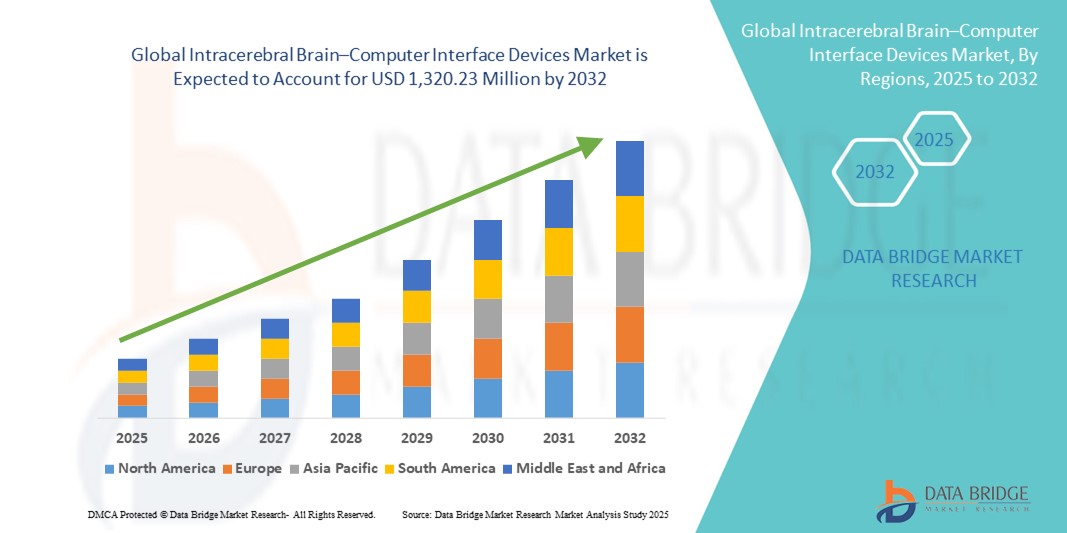
Intracerebral Brain–Computer Interface Devices Market Size
- The global intracerebral brain–computer interface devices market size was valued at USD 297.00 million in 2024 and is expected to reach USD 1,320.23 million by 2032, at a CAGR of 20.50% during the forecast period
- The market growth is largely fueled by advancements in neural engineering, miniaturized implantable electronics, and AI-driven signal decoding, enabling more precise, high-bandwidth communication between the brain and external devices for medical and assistive applications
- Furthermore, rising demand for effective solutions to restore motor function, enable communication for locked-in patients, and deliver closed-loop neuromodulation therapies is positioning intracerebral BCIs as a transformative technology in neurorehabilitation and neurological disorder management. These converging factors are accelerating the uptake of intracerebral BCI devices, thereby significantly boosting the industry's growth
Intracerebral Brain–Computer Interface Devices Market Analysis
- Intracerebral BCIs, which use implantable electrodes to record and/or stimulate neural activity within the brain, are becoming critical tools in advanced neuroprosthetics, communication systems for locked-in patients, and closed-loop neuromodulation therapies due to their high signal fidelity and ability to directly interface with neural circuits
- The accelerating demand for intracerebral BCIs is primarily fueled by breakthroughs in neural signal decoding, biocompatible electrode materials, and wireless implantable systems, alongside increasing prevalence of neurological disorders and spinal cord injuries requiring innovative assistive and therapeutic solutions
- North America dominated the intracerebral brain–computer interface devices market with the largest revenue share of 40.3% in 2024, supported by strong research funding, early adoption in clinical trials, and a concentration of pioneering neurotechnology companies, with the U.S. leading in both academic and commercial deployments
- Asia-Pacific is expected to be the fastest-growing region in the intracerebral brain–computer interface devices market during the forecast period, propelled by rising investment in neuroscience research, expanding healthcare infrastructure, and government-backed innovation initiatives
- The motor restoration segment dominated the intracerebral brain–computer interface devices market with an estimated share of 51.5% in 2024, owing to its significant clinical potential in enabling movement control for paralyzed patients and the growing number of successful proof-of-concept trials demonstrating functional recovery through brain-controlled prosthetics
Report Scope and Intracerebral Brain–Computer Interface Devices Market Segmentation
|
Attributes |
Intracerebral Brain–Computer Interface Devices Key Market Insights |
|
Segments Covered |
|
|
Countries Covered |
North America
Europe
Asia-Pacific
Middle East and Africa
South America
|
|
Key Market Players |
|
|
Market Opportunities |
|
|
Value Added Data Infosets |
In addition to the insights on market scenarios such as market value, growth rate, segmentation, geographical coverage, and major players, the market reports curated by the Data Bridge Market Research also include in-depth expert analysis, pricing analysis, brand share analysis, consumer survey, demography analysis, supply chain analysis, value chain analysis, raw material/consumables overview, vendor selection criteria, PESTLE Analysis, Porter Analysis, and regulatory framework. |
Intracerebral Brain–Computer Interface Devices Market Trends
Advancements in AI-Driven Neural Decoding and Wireless Implantable Systems
- A significant and accelerating trend in the global intracerebral BCI devices market is the integration of artificial intelligence (AI) with next-generation implantable electrode arrays and wireless data transmission modules, enabling more accurate and real-time decoding of neural signals for a wide range of medical and assistive applications
- For instance, companies such as Neuralink and Synchron are developing high-channel-count intracortical implants capable of streaming neural data wirelessly to AI-powered processors, allowing paralyzed patients to control digital devices or prosthetic limbs with greater precision and speed. Similarly, Blackrock Neurotech’s recent trials have demonstrated AI-enhanced decoding for faster typing speeds in communication BCIs for locked-in patients
- AI integration allows for adaptive algorithms that learn individual neural activity patterns over time, improving signal-to-noise ratio and device responsiveness. For instance, adaptive decoding systems can adjust to electrode signal drift or changes in brain physiology, ensuring consistent performance without frequent recalibration
- Wireless implant technologies are reducing patient dependency on transcutaneous connectors, lowering infection risks, and enabling greater freedom of movement— ritical for both home use and rehabilitation settings
- The combination of AI-driven decoding, advanced biocompatible electrode materials, and wireless implants is creating more intuitive, reliable, and patient-friendly intracerebral BCI systems, reshaping expectations for neuroprosthetics, communication tools, and closed-loop therapeutic devices
- Demand for AI-integrated and wireless intracerebral BCI solutions is rapidly growing across clinical neuroscience, rehabilitation, and assistive technology sectors, as patients, clinicians, and researchers seek higher usability and improved long-term outcomes
Intracerebral Brain–Computer Interface Devices Market Dynamics
Driver
Rising Prevalence of Neurological Disorders and Expanding Clinical Applications
- The growing incidence of conditions such as spinal cord injuries, ALS, stroke, and advanced Parkinson’s disease, coupled with the need for innovative communication and mobility restoration solutions, is a key driver of the intracerebral BCI devices market
- For instance, in 2024, several FDA-approved early feasibility studies for intracortical BCIs demonstrated successful restoration of digital communication capabilities in locked-in patients, spurring further clinical adoption
- As healthcare systems prioritize advanced neurorehabilitation technologies, intracerebral BCIs offer high-resolution brain signal access for restoring lost motor function, enabling speech synthesis, and supporting closed-loop neuromodulation for movement and mood disorders
- In addition, the rapid pace of R&D in neural engineering, biocompatible implant materials, and machine learning-driven signal processing is broadening potential clinical applications, from prosthetic limb control to epilepsy monitoring
- The availability of wireless, minimally invasive implantation techniques and the increasing involvement of major medtech companies are further accelerating market penetration in both developed and emerging economies
Restraint/Challenge
Surgical Risks, Long-Term Implant Viability, and Regulatory Hurdles
- The invasive nature of intracerebral BCIs poses inherent surgical risks, such as infection, tissue damage, and immune response to implants, which can deter both patients and clinicians from adoption
- Long-term device performance remains a challenge, as electrode degradation, encapsulation by glial tissue, and signal instability can affect usability over time
- Regulatory approval pathways for implantable neurotechnology are lengthy and complex, with extensive safety and efficacy data requirements that can delay commercialization and increase development costs
- For instance, several high-profile intracortical BCI trials have experienced extended timelines due to the need for additional safety data before moving to larger patient cohorts
- Cost is another barrier, as current systems require expensive neurosurgical implantation, post-operative care, and specialized technical support, limiting accessibility in lower-income regions
- Overcoming these challenges will require continued advances in minimally invasive delivery methods, long-lasting electrode materials, standardized regulatory frameworks, and scalable manufacturing to reduce costs while ensuring patient safety
Intracerebral Brain–Computer Interface Devices Market Scope
The market is segmented on the basis of product type, application, technology type, and end user.
- By Product Type
On the basis of product type, the global intracerebral brain–computer interface devices market is segmented into intracortical microelectrode arrays, flexible polymer thread electrodes, depth electrodes, implantable signal-processing modules, and external processing units & software. The intracortical microelectrode arrays segment dominated the market with the largest revenue share in 2024, driven by their high signal fidelity, well-established clinical trial use, and suitability for capturing fine-grained motor and sensory signals. Their proven role in pioneering neuroprosthetic applications, such as brain-controlled robotic limbs, has reinforced demand among research institutions and specialized clinics.
The flexible polymer thread electrodes segment is anticipated to witness the fastest growth rate from 2025 to 2032, fueled by advancements in minimally invasive implantation techniques and improved biocompatibility. These electrodes reduce tissue response and signal degradation over time, making them an attractive choice for long-term therapeutic BCIs. Their potential for higher channel counts and adaptability to cortical curvature is also accelerating research interest.
- By Application
On the basis of application, the global intracerebral brain–computer interface devices market is segmented into motor restoration, communication, neurorehabilitation, clinical monitoring, and closed-loop therapeutic stimulation. The motor restoration segment held the largest market revenue share of 51.5% in 2024, supported by a growing number of successful clinical demonstrations where BCIs restored partial mobility or control of assistive devices in paralyzed patients. This segment benefits from strong funding from both public health agencies and private investors aiming to advance neuroprosthetic integration into daily life.
The closed-loop therapeutic stimulation segment is expected to grow at the fastest CAGR during the forecast period, as healthcare providers and researchers increasingly recognize its potential in treating neurological and psychiatric disorders. By combining real-time neural decoding with targeted stimulation, these systems offer more personalized and adaptive therapy compared to conventional neuromodulation approaches.
- By Technology Type
On the basis of technology type, the global intracerebral brain–computer interface devices market is segmented into penetrating silicon microelectrodes, flexible polymer electrodes, stent-based endovascular electrodes, and on-implant wireless telemetry systems. The penetrating silicon microelectrodes segment led the market in 2024, attributed to their established track record in capturing high-resolution neuronal data and their integration in most FDA-approved early feasibility trials. Despite being invasive, their precision and durability in short-to-mid-term studies have maintained their clinical preference.
The on-implant wireless telemetry systems segment is projected to record the fastest growth rate from 2025 to 2032, driven by the push to eliminate percutaneous connectors, lower infection risks, and improve patient comfort. This shift is aligned with broader industry goals of developing fully implantable, long-lasting, and patient-friendly BCI platforms.
- By End User
On the basis of end user, the global intracerebral brain–computer interface devices market is segmented into hospitals & neurosurgery centers, rehabilitation centers, academic & research institutes, neurotech companies & startups, and government research labs. The hospitals & neurosurgery centers segment dominated the market in 2024, reflecting their role as primary sites for surgical implantation, post-operative monitoring, and integration of BCIs into therapeutic regimens. Strong partnerships between hospitals and neurotech companies have further solidified their position.
The academic & research institutes segment is expected to expand at the fastest CAGR during the forecast period, fueled by increased grant funding, cross-disciplinary collaborations, and the growing involvement of universities in translational neuroscience research. These institutions are central to the development, validation, and early testing of novel intracerebral BCI design
Intracerebral Brain–Computer Interface Devices Market Regional Analysis
- North America dominated the global intracerebral brain–computer interface devices market with the largest revenue share of 40.3% in 2024, supported by strong research funding, early adoption in clinical trials, and a concentration of pioneering neurotechnology companies, with the U.S. leading in both academic and commercial deployments
- The region’s dominance is reinforced by high adoption in advanced neurosurgical centers, strong collaborations between universities and tech companies, and the availability of skilled neurosurgeons and neuroscientists specializing in BCI applications
- Growing demand for solutions targeting paralysis, neurodegenerative disorders, and rehabilitation therapy, combined with the integration of AI-based neural decoding algorithms, is positioning North America as the key hub for intracerebral BCI innovation and deployment
U.S. Intracerebral Brain–Computer Interface Devices Market Insight
The U.S. intracerebral brain–computer interface (BCI) devices market captured the largest revenue share of 84% in 2024 within North America, fueled by rapid advancements in neural implant technology and strong government and private-sector funding. Increasing clinical trials targeting paralysis, epilepsy, and neurodegenerative disorders are accelerating adoption. The presence of major BCI innovators, such as Neuralink and Synchron, combined with a robust regulatory and academic ecosystem, is propelling growth. Furthermore, the integration of AI-driven neural decoding systems and wireless brain implants is enhancing device precision and patient outcomes.
Europe Intracerebral Brain–Computer Interface Devices Market Insight
The Europe intracerebral brain–computer interface (BCI) devices market is projected to grow at a substantial CAGR throughout the forecast period, driven by rising neurological disorder prevalence and strong collaborations between research institutions and medtech companies. Stringent EU medical device regulations are promoting the development of safer, more reliable implants. Increasing adoption in rehabilitation centers, hospitals, and research labs, alongside supportive government funding for neurotechnology, is fueling demand. Both residential assistive applications and advanced clinical trials are contributing to the region’s expansion.
U.K. Intracerebral Brain–Computer Interface Devices Market Insight
The U.K. intracerebral brain–computer interface (BCI) devices market is anticipated to grow at a noteworthy CAGR during the forecast period, driven by government-backed neuroscience initiatives and investments in precision medicine. Heightened awareness of neurorehabilitation solutions for stroke and injury patients is fostering adoption. The country’s strong academic research base and partnerships with global neurotech companies are enabling rapid commercialization. In addition, the U.K.’s focus on ethical AI integration in healthcare is expected to shape the evolution of BCI systems.
Germany Intracerebral Brain–Computer Interface Devices Market Insight
The Germany intracerebral brain–computer interface (BCI) devices market is expected to expand at a considerable CAGR, supported by the country’s advanced medical technology infrastructure and leadership in engineering innovation. High investment in brain–machine interface R&D, along with integration into neurosurgical practices, is boosting market penetration. German consumers and institutions place strong emphasis on privacy, data security, and device reliability, which is influencing the development of clinically safe, precision-focused BCI solutions.
Asia-Pacific Intracerebral Brain–Computer Interface Devices Market Insight
The Asia-Pacific intracerebral brain–computer interface (BCI) devices market is poised to grow at the fastest CAGR of 25% during the forecast period of 2025 to 2032, driven by large patient populations with neurological conditions and increasing investments in healthcare innovation across China, Japan, and India. Government programs promoting digital healthcare, coupled with emerging domestic neurotech startups, are expanding accessibility. The region’s growing expertise in electronics manufacturing is lowering device costs, enabling broader adoption in both clinical and assistive living applications.
Japan Intracerebral Brain–Computer Interface Devices Market Insight
The Japan intracerebral brain–computer interface (BCI) devices market is gaining momentum due to its deep-rooted high-tech culture, advanced neurosurgical capabilities, and strong demand for assistive living technologies. Increasing elderly population demographics are driving interest in BCIs for mobility and communication support. Collaborations between academic institutions, robotics companies, and healthcare providers are fostering innovation, with a focus on miniaturized, low-power, and highly precise neural implants.
India Intracerebral Brain–Computer Interface Devices Market Insight
The India intracerebral brain–computer interface (BCI) devices market accounted for the largest market revenue share in Asia Pacific in 2024, supported by the country’s expanding medical device sector and rising investments in neurological research. High rates of spinal cord injuries and stroke-related disabilities are increasing demand for advanced rehabilitation solutions. Government-led digital health initiatives and a growing pool of skilled biomedical engineers are creating fertile ground for both domestic manufacturing and international BCI partnerships.
Intracerebral Brain–Computer Interface Devices Market Share
The intracerebral brain–computer interface devices industry is primarily led by well-established companies, including:
- Neuralink Corporation (U.S.)
- Synchron Inc. (U.S.)
- Blackrock Neurotech (U.S.)
- CorTec GmbH (Germany)
- NeuroPace, Inc. (U.S.)
- Brain Products GmbH (Germany)
- g.tec medical engineering GmbH (Austria)
- Emotiv Inc. (U.S.)
- NeuroSky, Inc. (U.S.)
- Paradromics Inc. (U.S.)
- MindMaze SA (Switzerland)
- Kernel (U.S.)
- OpenBCI (U.S.)
- InteraXon Inc. (Canada)
- Compumedics Limited (Australia)
- Bitbrain Technologies S.L. (Spain)
- Neurable, Inc. (U.S.)
- NextMind (France)
- Cognixion (Canada)
- InBrain Neuroelectronics S.L. (Spain)
What are the Recent Developments in Global Intracerebral Brain–Computer Interface Devices Market?
- In July 2025, Wired’s “Uncanny Valley” podcast featured an in-depth look at Synchron’s minimally invasive Stentrode BCI system. One patient, implanted via the jugular vein, is now using the device to interact with Amazon Alexa, control an Apple Vision Pro, play games, write emails, and more demonstrating practical, everyday usability of intracerebral BCIs
- July 2025, CorTec announced the first human implantation of its Brain Interchange closed-loop BCI system, developed in Germany. The procedure was performed under an FDA-approved clinical trial at Harborview Medical Center (Seattle) in a stroke patient. This milestone marks a significant step toward using implantable BCIs to enhance upper-limb motor recovery post-stroke
- In May 2025, Paradromics received media coverage for successfully completing the first human test of its Connexus brain implant, verifying its ability to record electrical brain signals and marking a critical milestone toward clinical trials
- In April 2025, Precision Neuroscience received FDA 510(k) clearance for its Layer 7 Cortical Interface, a high-resolution, thin-film electrode array for recording and stimulating brain activity for up to 30 days. This milestone marked the first full regulatory approval for a next-generation wireless BCI device
- In April 2025, it was also reported that the Layer 7 Cortical Interface is recognized as the first wireless BCI device to receive FDA clearance, enabling its use for longer-duration brain mapping and boosting neural decoding capabilities through extended data collection
- In April 2021, researchers in the BrainGate clinical trial achieved the first human use of a wireless, high-bandwidth intracortical BCI. The implant transmitted neural signals at single-neuron resolution with fidelity matching wired systems, enabling participants with paralysis to point, click, and type via a small wireless transmitter worn on the head

- Interactive Data Analysis Dashboard
- Company Analysis Dashboard for high growth potential opportunities
- Research Analyst Access for customization & queries
- Competitor Analysis with Interactive dashboard
- Latest News, Updates & Trend analysis
- Harness the Power of Benchmark Analysis for Comprehensive Competitor Tracking
Data collection and base year analysis are done using data collection modules with large sample sizes. The stage includes obtaining market information or related data through various sources and strategies. It includes examining and planning all the data acquired from the past in advance. It likewise envelops the examination of information inconsistencies seen across different information sources. The market data is analysed and estimated using market statistical and coherent models. Also, market share analysis and key trend analysis are the major success factors in the market report. To know more, please request an analyst call or drop down your inquiry.
The key research methodology used by DBMR research team is data triangulation which involves data mining, analysis of the impact of data variables on the market and primary (industry expert) validation. Data models include Vendor Positioning Grid, Market Time Line Analysis, Market Overview and Guide, Company Positioning Grid, Patent Analysis, Pricing Analysis, Company Market Share Analysis, Standards of Measurement, Global versus Regional and Vendor Share Analysis. To know more about the research methodology, drop in an inquiry to speak to our industry experts.
Data Bridge Market Research is a leader in advanced formative research. We take pride in servicing our existing and new customers with data and analysis that match and suits their goal. The report can be customized to include price trend analysis of target brands understanding the market for additional countries (ask for the list of countries), clinical trial results data, literature review, refurbished market and product base analysis. Market analysis of target competitors can be analyzed from technology-based analysis to market portfolio strategies. We can add as many competitors that you require data about in the format and data style you are looking for. Our team of analysts can also provide you data in crude raw excel files pivot tables (Fact book) or can assist you in creating presentations from the data sets available in the report.













