


What is the Intracranial Hemorrhage Diagnosis and Treatment Market Size and Growth Rate?
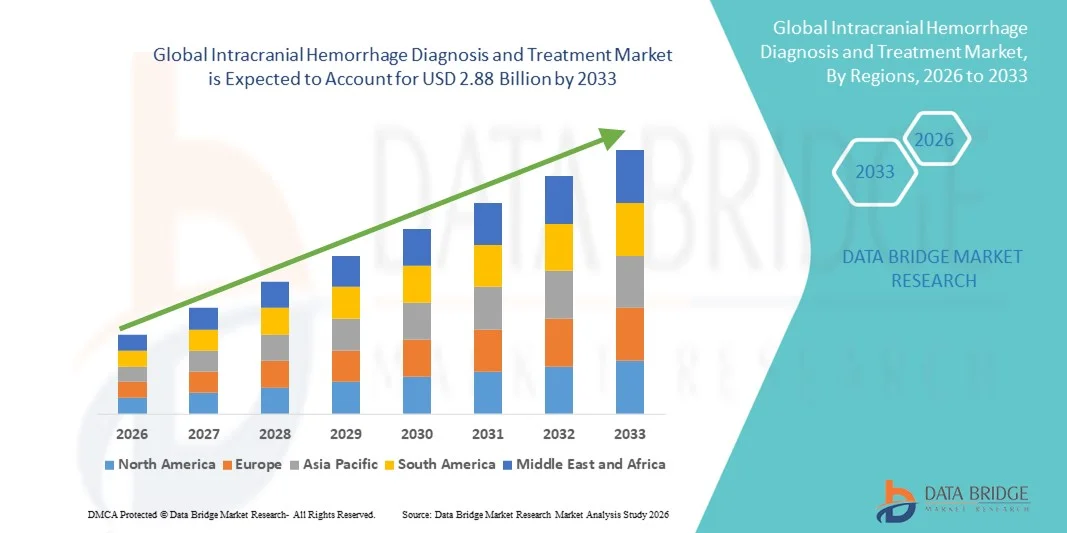
- As per Data Bridge Market Research Analysis the global intracranial hemorrhage diagnosis and treatment market size was valued at USD 1.89 billion in 2025 and is expected to reach USD 2.88 billion by 2033, at a CAGR of 5.45% during the forecast period
- The market growth is largely fueled by the rising incidence of intracranial hemorrhage caused by factors such as traumatic brain injuries, hypertension, stroke, and an aging population, along with increasing awareness of the importance of early and accurate diagnosis in emergency and critical care settings
- Furthermore, growing demand for advanced neuroimaging technologies, rapid diagnostic tools, and effective medical and surgical treatment options—combined with continuous advancements in diagnostic imaging, minimally invasive neurosurgical techniques, and neurocritical care—is accelerating the uptake of intracranial hemorrhage diagnosis and treatment solutions, thereby significantly boosting the overall growth of the market
Market Size & Forecast
- Global Market Value (2025): USD 1.89 billion
- Expected Market Value (2033): USD 2.88 billion
- Forecast CAGR (2026–2033): 5.45%
What are the Major Takeaways of Intracranial Hemorrhage Diagnosis and Treatment Market?
- Intracranial hemorrhage diagnosis and treatment solutions, including advanced neuroimaging systems, pharmacological therapies, and surgical interventions, are increasingly critical in emergency and neurocritical care settings due to the high morbidity and mortality associated with hemorrhagic brain injuries
- The escalating demand for intracranial hemorrhage diagnosis and treatment is primarily driven by the rising incidence of traumatic brain injuries, stroke, hypertension-related complications, and an aging population, along with growing awareness of the importance of rapid diagnosis and timely clinical intervention
- North America dominated the intracranial hemorrhage diagnosis and treatment market with the largest revenue share of 41.9% in 2025, supported by advanced healthcare infrastructure, widespread availability of CT and MRI imaging systems, strong presence of leading medical device and pharmaceutical companies, and high adoption of advanced neurosurgical and neurocritical care solutions, particularly in the U.S.
- Asia-Pacific is expected to be the fastest-growing region in the intracranial hemorrhage diagnosis and treatment market during the forecast period, driven by increasing incidence of stroke and head trauma, expanding healthcare infrastructure, rising healthcare expenditure, and improving access to advanced diagnostic and treatment technologies in countries such as China and India
- The CT Scan segment dominated the largest market revenue share of 48.6% in 2025, driven by its rapid imaging capability and critical role in emergency diagnosis of intracranial hemorrhage
Report Scope and Intracranial Hemorrhage Diagnosis and Treatment Market Segmentation
|
Attributes |
Intracranial Hemorrhage Diagnosis and Treatment Key Market Insights |
|
Segments Covered |
|
|
Countries Covered |
North America
Europe
Asia-Pacific
Middle East and Africa
South America
|
|
Key Market Players |
|
|
Market Opportunities |
|
|
Value Added Data Infosets |
In addition to the insights on market scenarios such as market value, growth rate, segmentation, geographical coverage, and major players, the market reports curated by the Data Bridge Market Research also include in-depth expert analysis, patient epidemiology, pipeline analysis, pricing analysis, and regulatory framework. |
What is the Key Trend in the Intracranial Hemorrhage Diagnosis and Treatment Market?
Advancements in Early Diagnosis and Improved Clinical Management of Intracranial Hemorrhage
- A significant and accelerating trend in the global intracranial hemorrhage diagnosis and treatment market is the increasing emphasis on early and accurate diagnosis combined with rapid, targeted treatment approaches to reduce mortality and long-term neurological damage. Healthcare providers are prioritizing faster diagnostic workflows and evidence-based treatment protocols to improve patient outcomes
- For instance, advancements in neuroimaging technologies such as high-resolution computed tomography (CT) scans and magnetic resonance imaging (MRI) are enabling clinicians to detect intracranial hemorrhages more quickly and accurately, even in emergency settings. Early diagnosis is critical for determining the appropriate therapeutic intervention and preventing disease progression
- Innovations in treatment options, including minimally invasive surgical techniques, improved clot evacuation devices, and advanced neurocritical care management, are enhancing survival rates and reducing complications associated with intracranial bleeding
- In addition, growing adoption of standardized clinical guidelines and stroke care pathways is supporting consistent and timely treatment across hospitals and trauma centers. These integrated care approaches improve coordination between emergency departments, neurosurgeons, and intensive care units
- The increasing focus on post-treatment monitoring and rehabilitation is also contributing to better long-term outcomes for patients recovering from intracranial hemorrhage
- This trend toward faster diagnosis, improved treatment precision, and comprehensive patient management is reshaping clinical practices worldwide
- As a result, healthcare systems and medical device manufacturers are investing in advanced diagnostic tools and therapeutic solutions to address the critical needs associated with intracranial hemorrhage care
Intracranial Hemorrhage Diagnosis and Treatment Market Dynamics
Driver
Rising Incidence of Stroke, Traumatic Brain Injuries, and Aging Population
- The increasing global incidence of stroke, traumatic brain injuries (TBIs), and age-related cerebrovascular disorders is a key driver fueling the growth of the Intracranial Hemorrhage Diagnosis and Treatment market
- Factors such as hypertension, anticoagulant use, and head trauma significantly increase the risk of intracranial bleeding
- For instance, in 2025, several countries reported expanded investments in stroke and trauma care infrastructure, including the establishment of specialized neurocritical care units, to manage the growing burden of intracranial hemorrhage cases. Such initiatives are expected to drive market growth during the forecast period
- The rapidly aging global population is particularly vulnerable to intracranial hemorrhage due to weakened blood vessels and higher prevalence of chronic conditions, increasing demand for diagnostic imaging and long-term treatment solutions
- Improved awareness among healthcare professionals and the public regarding early symptoms of stroke and brain injury is further accelerating timely diagnosis and treatment adoption
- In addition, expanding access to emergency medical services and improvements in hospital infrastructure are supporting increased utilization of intracranial hemorrhage diagnostic and treatment technologies
Restraint/Challenge
High Treatment Costs and Limited Access to Specialized Care
- High costs associated with advanced diagnostic imaging, neurosurgical procedures, and intensive care management present a significant challenge to the widespread adoption of intracranial hemorrhage treatment solutions, particularly in low- and middle-income regions
- For instance, access to specialized neurosurgical expertise, advanced imaging equipment, and neuro-intensive care units remains limited in rural and underdeveloped areas, delaying diagnosis and treatment
- In addition, the complexity of intracranial hemorrhage management requires highly trained medical professionals, which can strain healthcare systems with workforce shortages
- Variability in treatment outcomes, risk of complications, and long recovery periods can also increase the overall economic burden on patients and healthcare providers
- Addressing these challenges through improved healthcare infrastructure, expanded training programs, cost-effective diagnostic tools, and broader access to specialized care will be essential for sustaining long-term growth in the intracranial hemorrhage diagnosis and treatment market
How is the Intracranial Hemorrhage Diagnosis and Treatment Market Segmented?
The market is segmented on the basis of diagnosis type, diagnosis and treatment.
- By Type
On the basis of type, the Intracranial Hemorrhage Diagnosis and Treatment market is segmented into Intracerebral Hemorrhage, Subarachnoid Bleeding, Epidural Hematoma, and Subdural Blood Hematoma. The Intracerebral Hemorrhage segment dominated the largest market revenue share of 45.7% in 2025, driven by its high prevalence among stroke patients and the need for rapid clinical intervention. Intracerebral hemorrhage often leads to severe neurological deficits and requires urgent medical or surgical treatment. Broad awareness of early detection and established treatment protocols in hospitals and trauma centers supports adoption. Advancements in imaging technology, such as CT and MRI, enhance accurate diagnosis and improve patient outcomes. Rising incidence of hypertension and cerebral small-vessel disease globally further boosts demand. Continuous government investments in stroke care infrastructure and supportive reimbursement policies reinforce market leadership.
The Subarachnoid Bleeding segment is expected to witness the fastest CAGR of 8.7% from 2026 to 2033, owing to increasing detection rates and improved management of aneurysmal ruptures. Advances in endovascular coiling, microsurgical clipping, and intensive care monitoring are driving adoption. Increasing public awareness campaigns for aneurysm screening and early intervention contribute to growth. Expansion of neurosurgical and critical care facilities in emerging markets supports market penetration. Rising research in genetic risk factors and preventive strategies further accelerates adoption.
- By Diagnosis and Treatment
On the basis of diagnosis and treatment type, the market is segmented into Diagnosis, Treatment, and Surgery. The Diagnosis segment accounted for the largest market revenue share of 47.3% in 2025, driven by the critical need for early detection of intracranial hemorrhage using imaging modalities such as CT scans, MRI, and cerebral angiography. Rapid diagnosis is crucial for differentiating hemorrhagic from ischemic strokes and initiating timely intervention. Broad availability of imaging facilities, favorable reimbursement policies, and continuous technological improvements, including multi-slice CT and high-field MRI, reinforce market leadership.
The Treatment segment is projected to register the fastest CAGR of 9.1% from 2026 to 2033, fueled by advancements in pharmacological therapies, neuroprotective drugs, and intensive care protocols. Early medical stabilization and guideline-based drug therapies increase adoption. Growing clinical trials, improved hospital protocols, and access to advanced therapies in emerging markets further drive growth.
Which Region Holds the Largest Share of the Intracranial Hemorrhage Diagnosis and Treatment Market?
- North America dominated the intracranial hemorrhage diagnosis and treatment market with the largest revenue share of 41.9% in 2025, supported by advanced healthcare infrastructure and widespread availability of diagnostic imaging technologies such as CT and MRI systems
- The strong presence of leading medical device and pharmaceutical companies, particularly in the U.S., along with high adoption of advanced neurosurgical and neurocritical care solutions, is significantly driving market growth
- In addition, increasing incidence of stroke and traumatic brain injuries, coupled with rapid diagnosis and early intervention practices, continues to support sustained demand across the region.
U.S. Intracranial Hemorrhage Diagnosis and Treatment Market Insight
The U.S. intracranial hemorrhage diagnosis and treatment market accounted for the largest revenue share within North America in 2025, driven by high healthcare spending, well-established emergency care systems, and extensive access to advanced neuroimaging and surgical technologies. Increasing adoption of minimally invasive neurosurgical procedures, strong focus on early detection, and availability of specialized neurocritical care units are contributing to market expansion. Furthermore, ongoing clinical research, technological innovation, and favorable reimbursement policies are strengthening the U.S. market.
Europe Intracranial Hemorrhage Diagnosis and Treatment Market Insight
The Europe intracranial hemorrhage diagnosis and treatment market is projected to expand at a substantial CAGR throughout the forecast period, driven by an aging population, rising prevalence of cerebrovascular disorders, and improved access to advanced diagnostic technologies. Strong public healthcare systems, increasing investments in stroke care infrastructure, and growing awareness of early diagnosis and timely treatment are supporting market growth across the region. Additionally, advancements in imaging technologies and neurosurgical devices are further enhancing patient outcomes in Europe.
U.K. Intracranial Hemorrhage Diagnosis and Treatment Market Insight
The U.K. intracranial hemorrhage diagnosis and treatment market is anticipated to grow at a noteworthy CAGR during the forecast period, supported by the National Health Service’s (NHS) emphasis on rapid stroke diagnosis and standardized treatment pathways. Increasing adoption of advanced imaging systems, improved emergency response frameworks, and rising awareness of intracranial hemorrhage management are driving market growth. National initiatives aimed at reducing stroke-related mortality are expected to further sustain market expansion.
Germany Intracranial Hemorrhage Diagnosis and Treatment Market Insight
The Germany intracranial hemorrhage diagnosis and treatment market is expected to expand at a considerable CAGR during the forecast period, fueled by a robust healthcare infrastructure, high availability of advanced neurodiagnostic equipment, and strong focus on evidence-based clinical care. Germany’s extensive network of hospitals and specialized neurology centers, combined with high healthcare expenditure and continuous innovation in neurosurgical technologies, is promoting widespread adoption of advanced diagnosis and treatment solutions.
Asia-Pacific Intracranial Hemorrhage Diagnosis and Treatment Market Insight
The Asia-Pacific intracranial hemorrhage diagnosis and treatment market is expected to grow at the fastest CAGR during the forecast period, driven by increasing incidence of stroke and head trauma, expanding healthcare infrastructure, and rising healthcare expenditure. Improving access to advanced diagnostic and treatment technologies, along with growing awareness of early intervention, is accelerating market growth in countries such as China and India. Government initiatives to strengthen emergency care services and neurology departments are further supporting market expansion across the region.
Japan Intracranial Hemorrhage Diagnosis and Treatment Market Insight
The Japan intracranial hemorrhage diagnosis and treatment market is witnessing steady growth due to the country’s aging population and high prevalence of cerebrovascular diseases. Strong emphasis on early diagnosis, advanced imaging capabilities, and availability of specialized neurosurgical care is driving market expansion. Japan’s technologically advanced healthcare system and continuous innovation in neurodiagnostics continue to support effective management of intracranial hemorrhage cases.
China Intracranial Hemorrhage Diagnosis and Treatment Market Insight
The China intracranial hemorrhage diagnosis and treatment market accounted for a significant revenue share in Asia-Pacific in 2025, driven by rising incidence of stroke, rapid urbanization, and improving healthcare access. Expansion of hospital infrastructure, increasing availability of CT and MRI systems, and government-led healthcare reforms aimed at improving emergency and neurological care are key factors propelling market growth. Additionally, increasing awareness of early diagnosis and treatment is expected to further boost demand in China.
Which are the Top Companies in Intracranial Hemorrhage Diagnosis and Treatment Market? (Companies)
The Intracranial Hemorrhage Diagnosis and Treatment industry is primarily led by well-established companies, including:
• Medtronic plc (Ireland)
• Johnson & Johnson (U.S.)
• Stryker Corporation (U.S.)
• B. Braun SE(Germany)
• Boston Scientific Corporation (U.S.)
• Abbott (U.S.)
• Siemens Healthineers AG (Germany)
• GE Healthcare (U.S.)
• Koninklijke Philips N.V. (Netherlands)
• Canon Medical Systems Corporation (Japan)
• Terumo Corporation (Japan)
• Baxter International Inc. (U.S.)
• Integra LifeSciences Holdings Corporation (U.S.)
• Penumbra, Inc. (U.S.)
• Natus Medical Incorporated (U.S.)
• Nihon Kohden Corporation (Japan)
• Brainlab AG (Germany)
• Edwards Lifesciences Corporation (U.S.)
• Teleflex Incorporated (U.S.)
What are Latest Developments in Intracranial Hemorrhage Diagnosis and Treatment Market?
- In May 2024, the U.S. Food and Drug Administration (FDA) granted 510(k) clearance for Heuron ICH, an artificial intelligence (AI)-enabled software designed to detect and triage intracranial hemorrhages on non-contrast CT scans, offering 86 % sensitivity and 88 % specificity to facilitate rapid diagnosis in emergency settings. This clearance marked an important regulatory milestone by bringing advanced AI-assisted imaging analysis into clinical use for critical brain bleed detection, helping radiologists identify subtle hemorrhages swiftly and potentially improving early intervention outcomes
- In February 2024, the FDA cleared Viz ICH Plus, an AI-powered algorithm developed by Viz.ai that automates detection, labeling, and volume quantification of intracerebral hemorrhages on CT imaging, providing clinicians with quantified assessments that support faster and more informed treatment decisions. This regulatory approval reflects growing integration of machine learning into neuroimaging workflows to improve diagnostic precision in life-threatening hemorrhages
- In June 2024, Penumbra Inc. introduced its advanced neuro access devices, BMX81 and BMX96, to the European market, featuring laser-cut stainless steel hypotube technology for better trackability and stability, aimed at improving both hemorrhagic and ischemic stroke interventions in catheter-based procedures. These device launches represent meaningful advances in the interventional treatment toolset for acute brain bleed management and stroke care

- Interactive Data Analysis Dashboard
- Company Analysis Dashboard for high growth potential opportunities
- Research Analyst Access for customization & queries
- Competitor Analysis with Interactive dashboard
- Latest News, Updates & Trend analysis
- Harness the Power of Benchmark Analysis for Comprehensive Competitor Tracking
Data collection and base year analysis are done using data collection modules with large sample sizes. The stage includes obtaining market information or related data through various sources and strategies. It includes examining and planning all the data acquired from the past in advance. It likewise envelops the examination of information inconsistencies seen across different information sources. The market data is analysed and estimated using market statistical and coherent models. Also, market share analysis and key trend analysis are the major success factors in the market report. To know more, please request an analyst call or drop down your inquiry.
The key research methodology used by DBMR research team is data triangulation which involves data mining, analysis of the impact of data variables on the market and primary (industry expert) validation. Data models include Vendor Positioning Grid, Market Time Line Analysis, Market Overview and Guide, Company Positioning Grid, Patent Analysis, Pricing Analysis, Company Market Share Analysis, Standards of Measurement, Global versus Regional and Vendor Share Analysis. To know more about the research methodology, drop in an inquiry to speak to our industry experts.
Data Bridge Market Research is a leader in advanced formative research. We take pride in servicing our existing and new customers with data and analysis that match and suits their goal. The report can be customized to include price trend analysis of target brands understanding the market for additional countries (ask for the list of countries), clinical trial results data, literature review, refurbished market and product base analysis. Market analysis of target competitors can be analyzed from technology-based analysis to market portfolio strategies. We can add as many competitors that you require data about in the format and data style you are looking for. Our team of analysts can also provide you data in crude raw excel files pivot tables (Fact book) or can assist you in creating presentations from the data sets available in the report.













