


Intraoperative Radiation Therapy Market Size
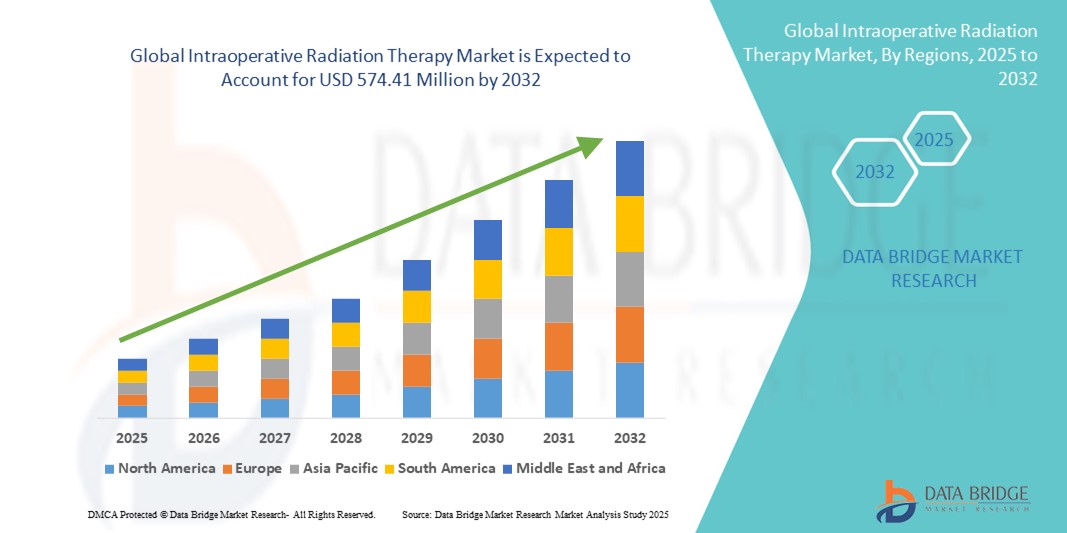
- The global intraoperative radiation therapy market size was valued at USD 326.91 million in 2024 and is expected to reach USD 574.41 million by 2032, at a CAGR of 7.30% during the forecast period
- The market growth is largely fueled by the rising prevalence of cancer, growing adoption of single-dose radiation therapy for breast-conserving surgeries, and continuous technological advancements in mobile and miniaturized IORT systems
- Furthermore, increasing demand for shorter treatment pathways, supportive reimbursement frameworks, and growing clinical evidence supporting the efficacy of IORT are positioning it as a preferred radiation therapy modality, thereby significantly boosting the industry’s growth
Intraoperative Radiation Therapy Market Analysis
- Intraoperative radiation therapy (IORT), delivering targeted radiation directly to tumors during surgery, is increasingly recognized as a vital oncology treatment modality due to its ability to shorten treatment cycles, minimize radiation exposure, and preserve healthy tissues
- The rising demand for IORT is primarily fueled by the global cancer burden, greater adoption of breast-conserving surgeries, and technological advancements in mobile IORT systems that allow seamless integration into operating rooms
- North America dominated the intraoperative radiation therapy market with the largest revenue share of 43% in 2024, supported by advanced healthcare infrastructure, favorable reimbursement policies, and strong clinical adoption in the U.S., especially in breast and gastrointestinal cancers
- Asia-Pacific is projected to be the fastest growing region in the intraoperative radiation therapy market, owing to rising cancer incidence, improving access to radiation oncology services, and increasing government and private investments in healthcare infrastructure
- Electron segment dominated the intraoperative radiation therapy market with the largest market share of 58.8% in 2024, driven by its precision, favorable clinical outcomes, and widespread adoption in treating breast, colorectal, and gynecological cancers
Report Scope and Intraoperative Radiation Therapy Market Segmentation
|
Attributes |
Intraoperative Radiation Therapy Key Market Insights |
|
Segments Covered |
|
|
Countries Covered |
North America
Europe
Asia-Pacific
Middle East and Africa
South America
|
|
Key Market Players |
|
|
Market Opportunities |
|
|
Value Added Data Infosets |
In addition to the insights on market scenarios such as market value, growth rate, segmentation, geographical coverage, and major players, the market reports curated by the Data Bridge Market Research also include in-depth expert analysis, pricing analysis, brand share analysis, consumer survey, demography analysis, supply chain analysis, value chain analysis, raw material/consumables overview, vendor selection criteria, PESTLE Analysis, Porter Analysis, and regulatory framework. |
Intraoperative Radiation Therapy Market Trends
Rising Adoption of Single-Dose Targeted Radiation in Cancer Treatment
- A significant and accelerating trend in the global intraoperative radiation therapy (IORT) market is the growing adoption of single-dose targeted radiation, particularly in breast-conserving surgeries. This approach delivers a concentrated dose directly to the tumor site during surgery, reducing the need for weeks of post-operative external beam radiation
- For instance, ZEISS’s INTRABEAM system has gained strong clinical adoption in breast cancer treatment, enabling hospitals to offer patients shorter, more convenient, and less invasive therapy pathways. Similarly, IntraOp’s Mobetron system provides portable electron-based IORT solutions that can be utilized in standard operating rooms without specialized shielding
- Clinical studies have shown that IORT can lower recurrence rates, improve patient compliance, and reduce overall treatment costs by minimizing hospital visits, making it increasingly attractive to both healthcare providers and patients
- Integration with advanced imaging and treatment planning software is further enhancing precision, enabling more accurate targeting of tumors while sparing healthy tissues. This is improving clinical confidence and expanding IORT’s applicability to other cancers, including colorectal, pancreatic, and gynecological malignancies
- The trend toward more patient-centered, cost-effective, and time-saving cancer care is reshaping expectations in oncology. Consequently, leading players are investing in mobile, AI-supported, and imaging-integrated IORT platforms to meet growing demand
- The rising emphasis on reducing healthcare burdens and improving patient outcomes is fueling rapid expansion of IORT adoption across oncology centers globally
Intraoperative Radiation Therapy Market Dynamics
Driver
Growing Cancer Burden and Shift Toward Patient-Centric Treatment
- The escalating global incidence of cancer, combined with healthcare systems’ focus on reducing treatment times and improving patient quality of life, is a significant driver of IORT demand
- For instance, in March 2024, IntraOp Medical announced expanded clinical adoption of its Mobetron system in major U.S. and European cancer centers, citing efficiency in breast and gastrointestinal surgeries. Such expansions highlight IORT’s growing role in modern oncology
- Unsuch as conventional radiation therapy, IORT allows immediate radiation delivery during surgery, avoiding delays and improving local tumor control. This provides clinical and logistical advantages for both patients and healthcare providers
- In addition, rising support from healthcare policymakers for cost-saving therapies is further accelerating adoption, as IORT can reduce the burden of long treatment cycles and hospital resources
- Increasing awareness among oncologists and patients regarding IORT’s clinical efficacy and its integration into multimodal treatment strategies is driving its penetration in hospitals and cancer treatment centers worldwide
Restraint/Challenge
High Equipment Cost and Limited Skilled Workforce
- The high capital investment required for IORT systems, along with maintenance and training needs, poses a key challenge to market growth, especially in resource-limited healthcare systems. Mobile units have reduced the barrier somewhat, but affordability remains a restraint
- For instance, advanced systems from ZEISS and IntraOp often require significant investment, which limits accessibility in smaller hospitals or in developing regions where oncology budgets are constrained
- Furthermore, the effective use of IORT demands a multidisciplinary team including radiation oncologists, physicists, and surgeons making specialized workforce availability a critical barrier in many healthcare markets
- Limited clinical awareness in emerging economies and variability in reimbursement policies also hinder widespread adoption, as not all healthcare systems cover IORT procedures under standard cancer care packages
- Overcoming these challenges through cost-optimized system design, workforce training initiatives, and broader insurance coverage will be vital for scaling up adoption and ensuring sustained growth of the IORT market globally
Intraoperative Radiation Therapy Market Scope
The market is segmented on the basis of method, product, type, application, end user, and distribution channel.
- By Method
On the basis of method, the intraoperative radiation therapy market is segmented into electron, intraoperative brachytherapy, high dose-rate, X-ray, and others. The electron segment dominated the market with the largest revenue share of 58.8% in 2024, primarily because of its ability to deliver highly concentrated radiation to the tumor bed while preserving surrounding healthy tissues. This technique has become the clinical gold standard for many hospitals, particularly in breast and gastrointestinal cancer surgeries, due to its long-standing evidence of reducing recurrence rates. Its integration with advanced linear accelerators and compatibility with surgical workflows make it attractive for oncology centers worldwide. Furthermore, healthcare providers prefer electron-based IORT because it reduces overall treatment time for patients and helps in avoiding prolonged external radiotherapy. Growing research support and technology improvements in compact electron systems are expected to further consolidate its dominance in the coming years.
The intraoperative brachytherapy segment is expected to witness the fastest CAGR over the forecast period due to its high adaptability in treating complex and deep-seated tumors. Unlike as electron IORT, brachytherapy allows radioactive isotopes to be placed directly inside or adjacent to the tumor site, ensuring precise dose delivery to hard-to-reach areas. Increasing clinical trials have shown promising outcomes in recurrent cancers and pediatric tumors, which is creating new opportunities for adoption. This technique is gaining popularity in specialized oncology centers because of its ability to be tailored to individual patient needs. Continuous improvements in applicator designs and miniaturization technologies are further accelerating its clinical adoption. Moreover, the method is increasingly being recognized as a cost-effective alternative in regions where electron-based systems are financially restrictive.
- By Product
On the basis of product, the intraoperative radiation therapy market is segmented into intraoperative radiation therapy devices, intraoperative radiation therapy accessories, and software & services. The intraoperative radiation therapy devices segment dominated the market in 2024, accounting for the majority of revenue share due to their indispensable role in delivering high-energy radiation during surgical procedures. Hospitals and oncology centers continue to invest heavily in advanced IORT systems, including mobile linear accelerators and portable X-ray devices, which are vital for complex cancer surgeries. The high capital investment is justified by their ability to significantly reduce patient recurrence rates and improve survival outcomes. Growing demand for advanced breast-conserving treatments and brain tumor surgeries has further boosted device adoption globally. Furthermore, manufacturers are focusing on next-generation devices that are smaller, more mobile, and easier to integrate into operating rooms. These developments have helped sustain the strong position of IORT devices as the backbone of the market.
The software & services segment is projected to grow at the fastest pace during the forecast period due to the increasing demand for treatment planning, workflow optimization, and post-surgical monitoring. Hospitals are adopting advanced AI-driven software tools that allow precise dose calculation and integration with real-time imaging, leading to improved clinical outcomes. The service component, including training, maintenance, and radiation safety compliance, is also becoming a significant revenue contributor. Many cancer centers are outsourcing these functions to specialized providers, thereby boosting recurring revenue streams. In addition, regulatory pressures around radiation safety have accelerated the demand for expert service partnerships. With the rise of personalized oncology and data-driven decision-making, software platforms are expected to become indispensable in modern IORT practices.
- By Type
On the basis of type, the intraoperative radiation therapy market is segmented into portable and benchtop systems. The portable segment dominated the market in 2024 as it provides hospitals and surgical centers with unmatched flexibility in integrating IORT into diverse surgical environments. Portable IORT devices allow direct use in operating rooms without requiring large infrastructure changes, reducing cost barriers and setup time. These systems are especially popular in breast-conserving surgeries, where rapid deployment is critical to minimize surgical duration. Their ease of movement between departments makes them highly attractive for both large hospitals and ambulatory centers. In addition, the portability helps expand cancer treatment access in remote and underserved areas, where large-scale systems may not be viable. Growing technological advancements in compact design and radiation safety have further reinforced their market leadership.
The benchtop segment is projected to experience the fastest growth during the forecast period, largely due to its growing use in research institutions, laboratories, and academic centers. These systems provide a controlled platform for experimental oncology studies and precise radiation delivery in preclinical models. Increasing investments in cancer research by both governments and private foundations have driven adoption in academic hospitals worldwide. Benchtop IORT systems also serve as important educational tools, helping train oncologists and surgeons in new treatment techniques. Their relatively lower cost compared to full-scale devices makes them appealing to smaller facilities with limited budgets. As the global oncology community continues to prioritize innovation, benchtop systems are expected to play a critical role in advancing experimental therapies and expanding the IORT evidence base.
- By Application
On the basis of application, the intraoperative radiation therapy market is segmented into breast cancer, brain tumor, head and neck cancer, soft tissue sarcoma, pediatric tumors, gynecological cancer, genitourinary cancers, upper gastro-intestinal tumors, and others. The breast cancer segment dominated the market in 2024 with the largest revenue share, driven by the rising global incidence of breast cancer and the proven effectiveness of IORT in reducing recurrence rates after lumpectomy. Breast IORT delivers targeted radiation immediately during surgery, eliminating the need for lengthy external beam radiation sessions. This single-treatment approach is highly preferred by patients seeking convenience and faster recovery. Governments and healthcare providers are also promoting breast IORT as a cost-effective solution that reduces hospital visits and improves quality of life. Technological innovations in applicators specifically designed for breast procedures have further strengthened its dominance. As awareness about breast-conserving therapy increases globally, this segment is expected to maintain its leadership throughout the forecast period.
The brain tumor segment is projected to be the fastest growing during the forecast period, largely because of the increasing adoption of IORT in neurosurgical oncology. Brain tumors, particularly aggressive forms such as glioblastoma, require highly precise treatments to avoid damaging healthy brain tissues. IORT allows for immediate, localized high-dose radiation after surgical tumor removal, which minimizes recurrence risk. Advances in intraoperative imaging and navigation systems are enabling safer and more accurate applications of IORT in brain surgeries. The rising global burden of brain cancers, coupled with limited alternative treatment options, has created significant demand for this approach. In addition, leading hospitals and academic centers are actively conducting clinical trials to expand its use in pediatric and recurrent brain cancers.
- By End User
On the basis of end user, the intraoperative radiation therapy market is segmented into hospitals, ambulatory surgical centers, specialty centers, and others. The hospital segment dominated the market in 2024, capturing the largest share due to their capacity to handle complex surgical oncology procedures. Hospitals remain the primary sites for IORT installations as they possess the infrastructure, skilled staff, and financial resources required for large-scale cancer care. Most high-volume cancer surgeries, including breast and gastrointestinal cancers, are performed in hospital settings, which ensures steady demand for IORT systems. Hospitals also benefit from direct government and insurance reimbursements that support the adoption of high-cost technologies such as IORT. Furthermore, many hospitals are expanding their oncology departments and forming collaborations with medical technology providers, which enhances access to advanced treatment solutions. This segment’s dominance is expected to continue as cancer incidence rates rise globally.
The ambulatory surgical centers (ASCs) segment is anticipated to register the fastest CAGR during the forecast period, driven by the growing trend toward outpatient cancer surgeries. ASCs are increasingly adopting portable IORT systems that can be efficiently integrated into smaller surgical setups. Patients benefit from shorter hospital stays, reduced treatment costs, and quicker recovery times when procedures are performed in ASCs. The convenience and cost-effectiveness of ASCs are especially attractive in developed countries where healthcare costs are a concern. Technological advancements in compact IORT devices have made it feasible for ASCs to expand their oncology offerings. Rising investment from private healthcare providers into specialized ASCs for oncology is further fueling the growth of this segment.
- By Distribution Channel
On the basis of distribution channel, the intraoperative radiation therapy market is segmented into direct tender and retail sales. The direct tender segment dominated the market in 2024 as most hospitals and cancer centers acquire IORT systems and accessories through bulk procurement contracts. Direct tender agreements allow healthcare providers to secure favorable pricing, extended warranties, and reliable maintenance services, which are critical for high-value devices. Large public and private hospitals prefer this model because it ensures consistent supply of radiation consumables and spare parts. In addition, government hospitals, especially in Europe and Asia-Pacific, procure through centralized tenders, further consolidating this segment’s leadership. Direct tenders also help manufacturers build long-term relationships with institutions, reinforcing stable revenue streams.
The retail sales segment is projected to grow at the fastest rate over the forecast period, supported by the increasing need for consumables, accessories, and software subscriptions among smaller oncology centers and ASCs. Retail sales provide flexibility for facilities that cannot engage in large-scale tenders but still require regular supply of applicators, shielding devices, and maintenance services. The rise of e-commerce platforms and direct-to-customer distribution channels is making it easier for smaller facilities to access these products. In addition, the subscription-based sales model for radiation planning software is boosting the segment’s expansion. Emerging markets are particularly benefitting from this model, as it lowers upfront costs and encourages wider adoption of IORT solutions.
Intraoperative Radiation Therapy Market Regional Analysis
- North America dominated the intraoperative radiation therapy market with the largest revenue share of 43% in 2024, supported by advanced healthcare infrastructure, favorable reimbursement policies, and strong clinical adoption in the U.S., especially in breast and gastrointestinal cancers
- The region benefits from a high adoption rate of innovative cancer treatment modalities supported by favorable reimbursement policies and growing investments in oncology research
- In addition, increasing patient preference for minimally invasive, targeted therapies that reduce overall treatment time is accelerating the uptake of IORT across hospitals and specialized cancer centers in the U.S. and Canada
U.S. Intraoperative Radiation Therapy Market Insight
The U.S. intraoperative radiation therapy market captured the largest revenue share of 79% in 2024 within North America, supported by the high prevalence of cancer cases and strong adoption of advanced oncology solutions. The country’s robust healthcare infrastructure, combined with favorable reimbursement policies and ongoing clinical research, drives demand for IORT. Patients and clinicians are increasingly prioritizing single-dose, targeted treatments that reduce recurrence risk and minimize healthy tissue damage. Moreover, the U.S. benefits from the presence of key IORT technology providers and academic medical centers conducting trials, significantly advancing its market penetration.
Europe Intraoperative Radiation Therapy Market Insight
The Europe intraoperative radiation therapy market is projected to expand at a substantial CAGR throughout the forecast period, primarily due to rising cancer incidence, supportive government initiatives, and increased healthcare investments. Many European countries are integrating IORT into national cancer treatment protocols, particularly for breast cancer and soft tissue tumors. The region also emphasizes minimally invasive therapies that improve post-operative recovery and quality of life. Growing collaborations between hospitals and research organizations, along with EU-driven funding for innovative radiation technologies, continue to stimulate strong regional adoption.
U.K. Intraoperative Radiation Therapy Market Insight
The U.K. intraoperative radiation therapy market is anticipated to grow at a noteworthy CAGR during the forecast period, supported by a rising cancer burden and expanding demand for targeted radiotherapy. The country’s healthcare system is increasingly adopting IORT as part of breast-conserving surgery protocols, reducing the need for multiple hospital visits. Growing awareness of personalized cancer treatment options, combined with funding initiatives from the NHS and private healthcare providers, is fueling adoption. In addition, increasing clinical research activities and adoption of portable IORT systems are expanding the country’s market potential.
Germany Intraoperative Radiation Therapy Market Insight
The Germany intraoperative radiation therapy market is expected to expand at a considerable CAGR during the forecast period, fueled by high cancer prevalence, advanced medical infrastructure, and a strong emphasis on precision medicine. Germany’s oncology centers are at the forefront of adopting IORT systems, supported by government-funded initiatives and a strong domestic manufacturing base for radiation technologies. Moreover, the country’s patient population is increasingly receptive to single-dose intraoperative therapies that reduce hospitalization time, aligning with its healthcare system’s focus on efficiency, innovation, and patient-centric care.
Asia-Pacific Intraoperative Radiation Therapy Market Insight
The Asia-Pacific intraoperative radiation therapy market is poised to grow at the fastest CAGR of 23.8% during the forecast period of 2025 to 2032, driven by increasing cancer incidence, rapid urbanization, and expanding healthcare infrastructure. Countries such as China, India, and Japan are witnessing higher demand for advanced cancer treatments due to rising awareness and government support for healthcare modernization. The affordability and availability of portable IORT systems are enhancing accessibility in both urban and semi-urban regions. As APAC continues to invest in oncology facilities and skilled professionals, the region is set to become a critical growth hub for IORT.
Japan Intraoperative Radiation Therapy Market Insight
The Japan intraoperative radiation therapy market is gaining momentum due to the country’s strong emphasis on advanced cancer treatment and high investment in medical technologies. Japan’s well-established healthcare system, combined with its culture of adopting innovative therapies, supports the rapid uptake of IORT. Integration of IORT in breast and brain cancer treatments is particularly significant, driven by the country’s aging population and high cancer prevalence. Growing collaborations between Japanese hospitals and global medical device firms are also enhancing access to cutting-edge radiation therapy solutions.
India Intraoperative Radiation Therapy Market Insight
The India intraoperative radiation therapy market accounted for one of the fastest-growing revenue shares in Asia-Pacific in 2024, driven by a rising cancer burden, increasing healthcare expenditure, and government-led initiatives promoting oncology infrastructure. India’s growing middle class and expanding network of specialty cancer hospitals are key drivers for IORT adoption. Moreover, the country’s push toward digital healthcare and the availability of affordable portable IORT devices from both domestic and global players make treatment more accessible. The focus on improving cancer care outcomes in tier-1 and tier-2 cities is expected to further accelerate growth.
Intraoperative Radiation Therapy Market Share
The intraoperative radiation therapy industry is primarily led by well-established companies, including:
- IntraOp Medical, Inc. (U.S.)
- Elekta (Sweden)
- S.I.T. Sordina IORT Technologies S.p.A. (Italy)
- IBA Worldwide (Belgium)
- Carl Zeiss Meditec AG (Germany)
- Eckert & Ziegler (Germany)
- IsoRay, Inc. (U.S.)
- PTW‑Freiburg GmbH (Germany)
- CIVCO Radiotherapy (U.S.)
- Radcore Systems (U.K.)
- Varian (U.S.)
- SeeDOS Ltd (U.S.)
- Brainlab SE (Germany)
- Elekta (Sweden)
What are the Recent Developments in Global Intraoperative Radiation Therapy Market?
- In April 2025, ZEISS received FDA 510(k) clearance for its next-generation INTRABEAM 700 platform, a robotic-assisted IORT system designed for neuro-oncology and breast cancer surgery. This system introduces advanced workflow features such as the SMART Stand for precise applicator positioning, RFID-enabled sterile applicators, and the Radiance treatment planning software. This marks a significant leap in automation, digital integration, and clinical precision for IORT procedures
- In March 2025, Aster Whitefield Hospital in Bangalore, India, introduced India’s first Intra-Operative Electron Radiation Therapy (IOeRT) machine. This marks a major institutional commitment to high-precision intraoperative oncology care, delivering concentrated electron radiation directly to tumor sites during surgery—minimizing post-operative treatments and promoting faster recoveries
- In September 2024, Fortis Hospital Bangalore, India, announced the installation of an IORT system. Fortis Hospital Bangalore installed an IORT system to provide advanced cancer treatment, particularly for breast cancer patients. This development is significant for the Indian healthcare landscape, as it allows for a shorter treatment time for selected cancer patients, reducing a typical 30-40-day radiation therapy regimen to a single, 30-40 minute session
- In February 2023, IsoRay and Viewpoint Molecular Targeting completed a merger, rebranding as Perspective Therapeutics Inc., Medical technology company IsoRay, and its newly merged partner, Viewpoint Molecular Targeting, announced they were doing business as Perspective Therapeutics, Inc. The newly formed company's focus is on developing cancer treatments using radiation, radiopharmaceuticals, and imaging technologies
- In October 2021, the U.S. FDA granted a breakthrough device designation to Alpha Tau's alpha-radiation cancer therapy. Alpha Tau Medical announced that the U.S. Food and Drug Administration (FDA) had granted a Breakthrough Device Designation for its alpha-radiation cancer therapy, Alpha DaRT, for the treatment of recurrent glioblastoma multiforme (GBM)

- Interactive Data Analysis Dashboard
- Company Analysis Dashboard for high growth potential opportunities
- Research Analyst Access for customization & queries
- Competitor Analysis with Interactive dashboard
- Latest News, Updates & Trend analysis
- Harness the Power of Benchmark Analysis for Comprehensive Competitor Tracking
Data collection and base year analysis are done using data collection modules with large sample sizes. The stage includes obtaining market information or related data through various sources and strategies. It includes examining and planning all the data acquired from the past in advance. It likewise envelops the examination of information inconsistencies seen across different information sources. The market data is analysed and estimated using market statistical and coherent models. Also, market share analysis and key trend analysis are the major success factors in the market report. To know more, please request an analyst call or drop down your inquiry.
The key research methodology used by DBMR research team is data triangulation which involves data mining, analysis of the impact of data variables on the market and primary (industry expert) validation. Data models include Vendor Positioning Grid, Market Time Line Analysis, Market Overview and Guide, Company Positioning Grid, Patent Analysis, Pricing Analysis, Company Market Share Analysis, Standards of Measurement, Global versus Regional and Vendor Share Analysis. To know more about the research methodology, drop in an inquiry to speak to our industry experts.
Data Bridge Market Research is a leader in advanced formative research. We take pride in servicing our existing and new customers with data and analysis that match and suits their goal. The report can be customized to include price trend analysis of target brands understanding the market for additional countries (ask for the list of countries), clinical trial results data, literature review, refurbished market and product base analysis. Market analysis of target competitors can be analyzed from technology-based analysis to market portfolio strategies. We can add as many competitors that you require data about in the format and data style you are looking for. Our team of analysts can also provide you data in crude raw excel files pivot tables (Fact book) or can assist you in creating presentations from the data sets available in the report.













