


Intrinsically Safe Equipment Market Overview
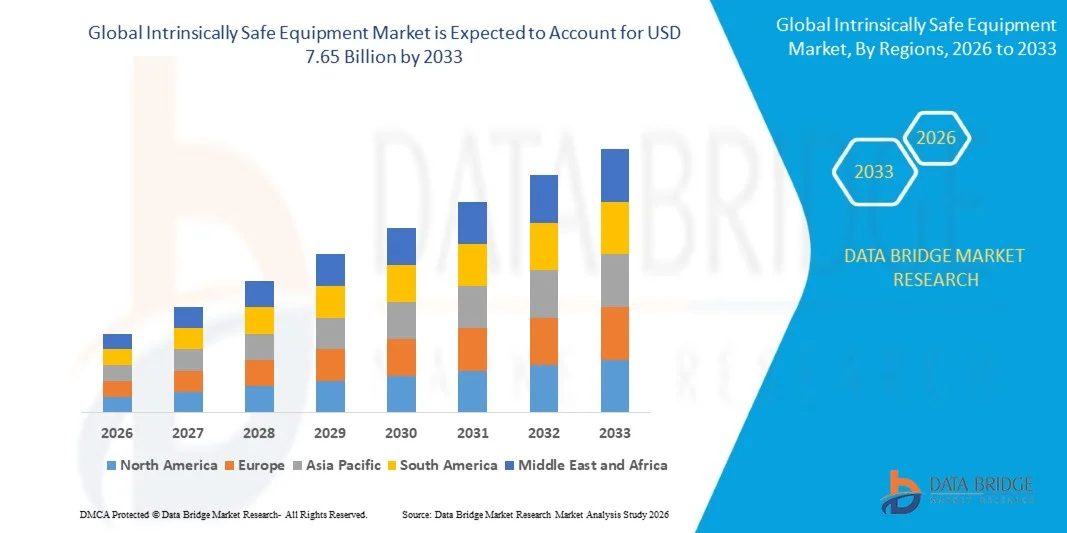
The Intrinsically Safe Equipment Market was valued at USD 4.05 billion in 2025 and is projected to reach USD 7.65 billion by 2033, growing at a CAGR of 8.25% from 2026 to 2033. The market is witnessing steady expansion driven by increasing demand for explosion-proof electrical systems in hazardous environments such as oil & gas, chemical processing, mining, and pharmaceuticals, where operational safety is critical.
The rising emphasis on workplace safety regulations and stringent compliance standards imposed by regulatory authorities is significantly boosting the adoption of intrinsically safe equipment across industrial sectors. In addition, the growing deployment of automation and smart industrial systems in high-risk environments is further accelerating the need for reliable safety-certified devices, ensuring continuous operations while minimizing ignition risks in explosive atmospheres.
Key Market Trends & Insights
- North America dominated the intrinsically safe equipment market with the largest revenue share in 2025, supported by strict regulatory compliance frameworks, advanced industrial infrastructure, and widespread deployment of safety-certified devices across high-risk industries such as oil & gas and petrochemicals.
- Asia-Pacific is expected to be the fastest-growing region, recording a strong CAGR from 2026 to 2033. Growth is driven by rapid industrialization, expanding petrochemical and manufacturing sectors, increasing mining activities, and rising adoption of industrial safety technologies in emerging economies such as China and India.
- The Sensors segment held the largest market revenue share of approximately 28.4% in 2025 driven by increasing deployment of gas, pressure, temperature, and flow sensing devices across oil & gas, chemical, and mining industries for continuous real-time hazard monitoring in explosive environments. Rising integration of IIoT-enabled intrinsically safe sensors into automated safety systems is further strengthening segment dominance. These devices are increasingly used in predictive maintenance frameworks to reduce downtime and improve operational reliability. In addition, advancements in miniaturized sensor technologies are enhancing performance in compact and remote installations.
- The Detectors segment is projected to register the fastest growth at a CAGR of 9.6% from 2026 to 2033, driven by increasing demand for gas leak detection systems, flame detectors, and smoke detection technologies in high-risk industrial operations. Expanding adoption in offshore oil platforms, underground mining facilities, and chemical storage plants is accelerating segment growth due to strict safety compliance requirements. Integration of AI-based detection systems is improving early hazard identification accuracy. Rising investments in industrial safety automation are further boosting deployment. In addition, modernization of aging industrial infrastructure is contributing to higher replacement demand.
- The Zone 1 segment held the largest market revenue share of approximately 34.1% in 2025 driven by widespread industrial operations in environments where explosive gases are likely to occur during normal operations, particularly in oil refineries, chemical plants, and offshore drilling platforms. Increasing compliance with ATEX and IECEx safety standards is further supporting adoption. Zone 1 areas require continuous safety monitoring systems, boosting demand for certified intrinsically safe devices. Expansion of petrochemical infrastructure in developing economies is also contributing to growth. In addition, retrofit projects in existing facilities are increasing equipment replacement cycles.
- The Zone 0 segment is projected to register the fastest growth at a CAGR of 10.2% from 2026 to 2033, driven by increasing safety investments in highly hazardous environments such as oil storage tanks, fuel handling systems, and confined chemical processing units where explosive atmospheres are continuously present. Demand is rising due to stricter zero-risk safety policies in critical operations. Advanced wireless intrinsically safe devices are being increasingly deployed in confined spaces. Growing offshore exploration activities are further accelerating adoption. In addition, rising automation in high-risk zones is improving monitoring efficiency and reliability.
- The Class 1 segment held the largest market revenue share of approximately 52.7% in 2025 driven by extensive use in oil & gas, petrochemical, and chemical processing industries where flammable gases and vapors are commonly present. Strict regulatory enforcement and mandatory explosion-proof equipment installation are further supporting segment dominance. Increasing upstream and downstream oil activities are boosting demand for intrinsically safe systems. Continuous modernization of refinery infrastructure is also strengthening adoption. In addition, rising investments in offshore drilling projects are contributing to growth.
- The Class 2 segment is projected to register the fastest growth at a CAGR of 8.9% from 2026 to 2033, driven by increasing adoption in mining, grain handling, and dust-prone industrial environments where combustible dust hazards require explosion-proof safety systems. Growing industrial automation in mining operations is further boosting demand. Stringent workplace safety regulations are mandating advanced dust protection systems. Expansion of food processing and grain storage facilities is also supporting segment growth. In addition, increasing awareness of industrial dust explosion risks is driving replacement of conventional systems.
- The Oil and Gas segment held the largest market revenue share of approximately 31.6% in 2025 driven by extensive deployment of intrinsically safe instrumentation across upstream, midstream, and downstream operations to ensure operational safety in explosive atmospheres. High-risk exploration activities and offshore drilling operations are major demand contributors. Strict global safety regulations are reinforcing equipment adoption. Increasing digitalization of oilfield operations is further boosting integration of smart safety systems. In addition, aging infrastructure upgrades are creating replacement demand for certified equipment.
- The Chemical and Petrochemical segment is projected to register the fastest growth at a CAGR of 9.4% from 2026 to 2033, driven by increasing production of specialty chemicals, rising automation in processing plants, and stringent safety regulations governing hazardous chemical handling and storage facilities. Expansion of chemical manufacturing hubs in Asia-Pacific is supporting market growth. Adoption of advanced process control systems is increasing demand for intrinsically safe devices. Growing investment in sustainable and green chemical production is further accelerating deployment. In addition, stricter compliance audits are pushing continuous upgrades of safety systems.
Market Size & Forecast
- Global Market Value (2025): USD 4.05 Billion
- Expected Market Value (2033): USD 7.65 Billion
- Forecast CAGR (2026–2033): 8.25%
- Leading Region in 2025: North America
- Fastest Growing Region: Asia-Pacific
Report Scope and Intrinsically Safe Equipment Market Segmentation
|
Attributes |
Intrinsically Safe Equipment Key Market Insights |
|
Segments Covered |
· By Product: Transmitters, Sensors, Detectors, Isolators, Switches, LED Indicator, and Others · By Zones: Zone 0, Zone 1, Zone 2, Zone 20, Zone 21, and Zone 22 · By Class: Class1, Class 2, and Class 3 · By End User: Oil and Gas, Chemical and Petrochemical, Power, Mining, Food and Beverages, Healthcare, Manufacturing, Wastewater Treatment Plants, and Others |
|
Countries Covered |
North America · U.S. · Canada · Mexico Europe · Germany · France · U.K. · Netherlands · Switzerland · Belgium · Russia · Italy · Spain · Turkey · Rest of Europe Asia-Pacific · China · Japan · India · South Korea · Singapore · Malaysia · Australia · Thailand · Indonesia · Philippines · Rest of Asia-Pacific Middle East and Africa · Saudi Arabia · U.A.E. · South Africa · Egypt · Israel · Rest of Middle East and Africa South America · Brazil · Argentina · Rest of South America |
|
Key Market Players |
• Adalet (U.S.) |
|
Market Opportunities |
• Expansion Of Oil & Gas Exploration Activities In High Risk Zones |
|
Value Added Data Infosets |
In addition to the insights on market scenarios such as market value, growth rate, segmentation, geographical coverage, and major players, the market reports curated by the Data Bridge Market Research also include in-depth expert analysis, geographically represented company-wise production and capacity, network layouts of distributors and partners, detailed and updated price trend analysis and deficit analysis of supply chain and demand. |
Intrinsically Safe Equipment Market Trends
Trend: Growth In Industrial Safety Digitization And Smart Hazard Monitoring Systems
Increasing demand for intrinsically safe equipment is being driven by the rapid digitization of industrial safety systems across oil & gas, chemical processing, mining, and pharmaceutical facilities. Conventional electrical systems in hazardous zones pose ignition risks, encouraging industries to shift toward certified explosion-proof and intrinsically safe devices that ensure safe operation in volatile environments while maintaining continuous monitoring capabilities.
In modern oil refineries and offshore platforms, intrinsically safe sensors and communication devices are being integrated into IoT-based monitoring networks. For instance in upstream oil extraction sites in the Middle East, wireless intrinsically safe pressure and gas detectors are being deployed to enhance real-time leak detection and reduce accident response time by improving data transmission reliability in explosive atmospheres.
In chemical and pharmaceutical manufacturing plants, intrinsically safe instrumentation is increasingly used for process automation, where precise monitoring of temperature, pressure, and chemical reactions is critical in preventing hazardous incidents. In addition, mining operations in Australia and South Africa are adopting intrinsically safe communication devices and wearable monitoring systems to enhance worker safety in underground environments with high methane and dust explosion risks.
The expansion of Industry 4.0 technologies and predictive maintenance systems is further accelerating adoption, as companies integrate intrinsically safe equipment with AI-based analytics platforms for early fault detection and operational risk reduction. Pilot safety modernization projects in 2025 across European refineries have demonstrated up to 20–25% improvement in incident detection speed through deployment of intrinsically safe smart sensor networks
Intrinsically Safe Equipment Market Dynamics
Key Market Driver: Rising Stringent Industrial Safety Regulations And Hazard PreventionStandards
Industries operating in explosive and high-risk environments are facing increasingly strict regulatory frameworks mandating the use of certified safety equipment to minimize ignition risks and workplace accidents. Government bodies and international safety organizations are enforcing compliance standards such as ATEX and IECEx, compelling companies to adopt intrinsically safe electrical systems across operational sites.
Oil & gas operators, petrochemical plants, and mining companies are increasingly investing in intrinsically safe control systems, sensors, and communication devices to ensure compliance with safety audits and reduce operational shutdown risks. For instance in offshore drilling platforms, intrinsically safe instrumentation is being widely implemented to meet zero-incident safety targets while maintaining uninterrupted production efficiency.
Similarly, pharmaceutical manufacturing and specialty chemical industries are deploying intrinsically safe automation systems to prevent accidental ignition during volatile compound processing, ensuring product safety and regulatory compliance. Industrial safety audits conducted in 2024 across North America indicated a 15–18% increase in compliance-driven adoption of explosion-proof equipment in high-risk manufacturing facilities.
Key Restraint/Challenge: High Installation Costs And Complex Certification Requirements
Intrinsically safe equipment requires specialized design, testing, and certification processes to meet international safety standards, significantly increasing overall deployment costs for end users. The need for certified components, explosion-proof enclosures, and periodic compliance validation creates financial and operational barriers, particularly for small and medium-sized enterprises.
In addition, integration of intrinsically safe systems with existing industrial infrastructure often requires extensive redesign of electrical layouts and control systems, increasing installation complexity and downtime during upgrades. Industries operating in developing regions face additional challenges due to limited availability of certified suppliers and technical expertise.
Market assessments indicate that intrinsically safe instrumentation systems can cost 25–40% more than conventional industrial equipment, primarily due to stringent certification processes and specialized manufacturing requirements, which restricts adoption in price-sensitive industrial sectors
Key Market Opportunity: Expansion Of Smart Factories And Remote Hazardous Area Monitoring Systems
The growing adoption of smart factories and automated industrial environments is creating significant opportunities for intrinsically safe equipment integrated with digital monitoring and control systems. Industries are increasingly deploying connected sensors and wireless intrinsically safe devices to enable real-time visibility of hazardous environments while minimizing human exposure..
In oil & gas facilities, intrinsically safe wireless sensor networks are being used for continuous monitoring of gas leaks, pressure variations, and temperature fluctuations in remote drilling sites. For instance in North Sea offshore operations, companies are implementing intrinsically safe IIoT systems to improve predictive maintenance and reduce unplanned shutdowns through real-time hazard analytics..
In addition, advancements in low-power electronics and energy-efficient sensor technologies are enabling the development of next-generation intrinsically safe devices for smart manufacturing ecosystems. Pilot smart factory deployments in 2025 across Germany and Japan have shown up to 22% improvement in operational safety response efficiency through integration of intrinsically safe IoT-based monitoring systems in automated production lines.
Intrinsically Safe Equipment Market Scope
The market is segmented on the basis of product, zones, class, and end-use application.
- By Product
On the basis of product, the intrinsically safe equipment market is segmented into Transmitters, Sensors, Detectors, Isolators, Switches, LED Indicator, and Others. The Sensors segment held the largest market revenue share of approximately 28.4% in 2025 driven by increasing deployment of gas, pressure, temperature, and flow sensing devices across oil & gas, chemical, and mining industries for continuous real-time hazard monitoring in explosive environments. Rising integration of IIoT-enabled intrinsically safe sensors into automated safety systems is further strengthening segment dominance. These devices are increasingly used in predictive maintenance frameworks to reduce downtime and improve operational reliability. In addition, advancements in miniaturized sensor technologies are enhancing performance in compact and remote installations.
The Detectors segment is projected to register the fastest growth at a CAGR of 9.6% from 2026 to 2033, driven by increasing demand for gas leak detection systems, flame detectors, and smoke detection technologies in high-risk industrial operations. Expanding adoption in offshore oil platforms, underground mining facilities, and chemical storage plants is accelerating segment growth due to strict safety compliance requirements. Integration of AI-based detection systems is improving early hazard identification accuracy. Rising investments in industrial safety automation are further boosting deployment. In addition, modernization of aging industrial infrastructure is contributing to higher replacement demand.
- By Zones
On the basis of zones, the market is segmented into Zone 0, Zone 1, Zone 2, Zone 20, Zone 21, and Zone 22. The Zone 1 segment held the largest market revenue share of approximately 34.1% in 2025 driven by widespread industrial operations in environments where explosive gases are likely to occur during normal operations, particularly in oil refineries, chemical plants, and offshore drilling platforms. Increasing compliance with ATEX and IECEx safety standards is further supporting adoption. Zone 1 areas require continuous safety monitoring systems, boosting demand for certified intrinsically safe devices. Expansion of petrochemical infrastructure in developing economies is also contributing to growth. In addition, retrofit projects in existing facilities are increasing equipment replacement cycles.
The Zone 0 segment is projected to register the fastest growth at a CAGR of 10.2% from 2026 to 2033, driven by increasing safety investments in highly hazardous environments such as oil storage tanks, fuel handling systems, and confined chemical processing units where explosive atmospheres are continuously present. Demand is rising due to stricter zero-risk safety policies in critical operations. Advanced wireless intrinsically safe devices are being increasingly deployed in confined spaces. Growing offshore exploration activities are further accelerating adoption. In addition, rising automation in high-risk zones is improving monitoring efficiency and reliability.
- By Class
On the basis of class, the market is segmented into Class 1, Class 2, and Class 3. The Class 1 segment held the largest market revenue share of approximately 52.7% in 2025 driven by extensive use in oil & gas, petrochemical, and chemical processing industries where flammable gases and vapors are commonly present. Strict regulatory enforcement and mandatory explosion-proof equipment installation are further supporting segment dominance. Increasing upstream and downstream oil activities are boosting demand for intrinsically safe systems. Continuous modernization of refinery infrastructure is also strengthening adoption. In addition, rising investments in offshore drilling projects are contributing to growth.
The Class 2 segment is projected to register the fastest growth at a CAGR of 8.9% from 2026 to 2033, driven by increasing adoption in mining, grain handling, and dust-prone industrial environments where combustible dust hazards require explosion-proof safety systems. Growing industrial automation in mining operations is further boosting demand. Stringent workplace safety regulations are mandating advanced dust protection systems. Expansion of food processing and grain storage facilities is also supporting segment growth. In addition, increasing awareness of industrial dust explosion risks is driving replacement of conventional systems.
- By End User
On the basis of end user, the market is segmented into Oil and Gas, Chemical and Petrochemical, Power, Mining, Food and Beverages, Healthcare, Manufacturing, Wastewater Treatment Plants, and Others. The Oil and Gas segment held the largest market revenue share of approximately 31.6% in 2025 driven by extensive deployment of intrinsically safe instrumentation across upstream, midstream, and downstream operations to ensure operational safety in explosive atmospheres. High-risk exploration activities and offshore drilling operations are major demand contributors. Strict global safety regulations are reinforcing equipment adoption. Increasing digitalization of oilfield operations is further boosting integration of smart safety systems. In addition, aging infrastructure upgrades are creating replacement demand for certified equipment.
The Chemical and Petrochemical segment is projected to register the fastest growth at a CAGR of 9.4% from 2026 to 2033, driven by increasing production of specialty chemicals, rising automation in processing plants, and stringent safety regulations governing hazardous chemical handling and storage facilities. Expansion of chemical manufacturing hubs in Asia-Pacific is supporting market growth. Adoption of advanced process control systems is increasing demand for intrinsically safe devices. Growing investment in sustainable and green chemical production is further accelerating deployment. In addition, stricter compliance audits are pushing continuous upgrades of safety systems.
Intrinsically Safe Equipment Market Regional Analysis
North America Intrinsically Safe Equipment Market Insight
North America dominated the intrinsically safe equipment market with the largest revenue share of 38.7% in 2025, supported by stringent industrial safety regulations, strong adoption of advanced oil & gas technologies, and widespread deployment of explosion-proof systems across hazardous environments. The region benefits from a highly developed industrial base, particularly in petrochemical refining, offshore drilling, and mining operations, where safety compliance is a critical operational requirement. Increasing integration of IIoT-based safety monitoring systems and real-time hazard detection solutions is further strengthening market growth. In addition, high investments in industrial automation and replacement of aging infrastructure are driving demand for certified intrinsically safe devices across key end-use industries.
U.S. Intrinsically Safe Equipment Market Insight
The U.S. intrinsically safe equipment market captured the largest revenue share in 2025 within North America, driven by rapid expansion of shale gas production, offshore exploration activities, and strict enforcement of OSHA and NFPA safety standards. Industries are increasingly adopting intrinsically safe sensors, detectors, and communication systems to enhance operational safety in explosive environments. The growing trend of digital oilfields and smart manufacturing facilities is further accelerating deployment of connected safety equipment. In addition, strong presence of leading industrial automation and safety solution providers is supporting innovation and large-scale adoption across oil & gas and chemical processing sectors.
Europe Intrinsically Safe Equipment Market Insight
The Europe intrinsically safe equipment market is expected to witness the fastest growth rate from 2026 to 2033, primarily driven by stringent ATEX and IECEx regulatory frameworks and increasing focus on industrial worker safety. Rising investments in chemical manufacturing, renewable energy infrastructure, and automated industrial systems are boosting demand for explosion-proof safety solutions. European industries are increasingly adopting smart intrinsically safe devices integrated with predictive maintenance systems to reduce operational risks. In addition, modernization of aging industrial facilities across Germany, France, and Italy is accelerating replacement demand for advanced safety-certified equipment.
U.K. Intrinsically Safe Equipment Market Insight
The U.K. intrinsically safe equipment market is expected to witness strong growth from 2026 to 2033, driven by increasing safety compliance requirements across oil & gas offshore platforms, chemical plants, and pharmaceutical manufacturing facilities. Rising focus on workplace safety and risk mitigation is encouraging adoption of intrinsically safe communication systems and monitoring devices. The growing trend of industrial digitalization and smart factory development is further supporting market expansion. In addition, refurbishment of aging North Sea oil infrastructure is creating significant demand for upgraded safety-certified instrumentation.
Germany Intrinsically Safe Equipment Market Insight
The Germany intrinsically safe equipment market is expected to witness robust growth from 2026 to 2033, fueled by strong industrial automation, strict EU safety regulations, and increasing adoption of Industry 4.0 technologies. Germany’s advanced manufacturing ecosystem, particularly in chemicals, automotive, and machinery production, is driving demand for high-performance safety systems. Intrinsically safe sensors and detectors are being widely integrated into automated production lines to ensure safe operations in hazardous zones. In addition, the country’s focus on energy efficiency and sustainable industrial operations is supporting adoption of smart safety technologies.
Asia-Pacific Intrinsically Safe Equipment Market Insight
The Asia-Pacific intrinsically safe equipment market is expected to witness the fastest growth rate from 2026 to 2033, supported by rapid industrialization, expanding oil & gas exploration activities, and increasing enforcement of workplace safety regulations. Countries such as China, India, Japan, and South Korea are witnessing strong investments in petrochemical plants, mining operations, and manufacturing facilities, driving demand for explosion-proof safety systems. Growing adoption of industrial automation and smart monitoring technologies is further accelerating market expansion. In addition, increasing foreign direct investments in industrial infrastructure are improving availability and affordability of certified safety equipment across the region.
Japan Intrinsically Safe Equipment Market Insight
The Japan intrinsically safe equipment market is expected to witness steady growth from 2026 to 2033, driven by high emphasis on industrial safety, advanced manufacturing practices, and increasing adoption of automation technologies. The country’s strong focus on precision engineering and robotics is supporting integration of intrinsically safe sensors and monitoring systems in hazardous industrial environments. Rising investments in energy infrastructure and chemical processing facilities are further boosting demand. In addition, Japan’s aging workforce is encouraging the adoption of advanced safety systems to reduce operational risks and improve workplace safety efficiency.
China Intrinsically Safe Equipment Market Insight
The China intrinsically safe equipment market accounted for the largest market revenue share in Asia-Pacific in 2025, attributed to rapid industrial expansion, strong growth in the petrochemical sector, and large-scale mining operations. Government initiatives promoting industrial safety compliance and smart manufacturing are driving widespread adoption of explosion-proof equipment. China’s growing focus on digital industrial transformation and smart city development is further accelerating demand for connected safety systems. In addition, strong domestic manufacturing capabilities and cost-effective production are making intrinsically safe devices more accessible across various industrial sectors.
Intrinsically Safe Equipment Market Share
The Intrinsically Safe Equipment industry is primarily led by well-established companies, including:
• Adalet (U.S.)
• R. STAHL AG (Germany)
• Pepperl+Fuchs AG (Germany)
• OMEGA Engineering (U.S.)
• Fluke Corporation (U.S.)
• RAE Systems (U.S.)
• Eaton (Ireland)
• CorDEX Instruments (U.K.)
• Bayco Products, Inc. (U.S.)
• Banner Engineering Corp. (U.S.)
• Kyland Technology Co., Ltd. (China)
• G.M.International srl (Italy)
• Siemens (Germany)
• Rockwell Automation, Inc. (U.S.)
• BEKA associates Ltd. (U.K.)
• Datalink Electronics Ltd. (U.K.)
• IMI Sensors (U.S.)
• ABB (Switzerland)
• Schneider Electric (France)
Latest Developments in Intrinsically Safe Equipment Market
- In May 2025, Pepperl+Fuchs Inc. announced a partnership with Samsung to develop intrinsically safe mobile devices for hazardous environments. The collaboration focuses on integrating Samsung’s 5G connectivity with Pepperl+Fuchs’ explosion-proof enclosures to enable real-time data transmission in oil refineries and chemical plants. This initiative is designed to enhance connected worker solutions in Zone 1 hazardous areas, improving operational visibility and communication reliability. The development is expected to strengthen industrial safety digitization and accelerate adoption of smart communication devices in high-risk environments, improving both safety performance and operational efficiency across critical industries.

- Interactive Data Analysis Dashboard
- Company Analysis Dashboard for high growth potential opportunities
- Research Analyst Access for customization & queries
- Competitor Analysis with Interactive dashboard
- Latest News, Updates & Trend analysis
- Harness the Power of Benchmark Analysis for Comprehensive Competitor Tracking
Global Intrinsically Safe Equipment Market, Supply Chain Analysis and Ecosystem Framework
To support market growth and help clients navigate the impact of geopolitical shifts, DBMR has integrated in-depth supply chain analysis into its Global Intrinsically Safe Equipment Market research reports. This addition empowers clients to respond effectively to global changes affecting their industries. The supply chain analysis section includes detailed insights such as Global Intrinsically Safe Equipment Market consumption and production by country, price trend analysis, the impact of tariffs and geopolitical developments, and import and export trends by country and HSN code. It also highlights major suppliers with data on production capacity and company profiles, as well as key importers and exporters. In addition to research, DBMR offers specialized supply chain consulting services backed by over a decade of experience, providing solutions like supplier discovery, supplier risk assessment, price trend analysis, impact evaluation of inflation and trade route changes, and comprehensive market trend analysis.
Data collection and base year analysis are done using data collection modules with large sample sizes. The stage includes obtaining market information or related data through various sources and strategies. It includes examining and planning all the data acquired from the past in advance. It likewise envelops the examination of information inconsistencies seen across different information sources. The market data is analysed and estimated using market statistical and coherent models. Also, market share analysis and key trend analysis are the major success factors in the market report. To know more, please request an analyst call or drop down your inquiry.
The key research methodology used by DBMR research team is data triangulation which involves data mining, analysis of the impact of data variables on the market and primary (industry expert) validation. Data models include Vendor Positioning Grid, Market Time Line Analysis, Market Overview and Guide, Company Positioning Grid, Patent Analysis, Pricing Analysis, Company Market Share Analysis, Standards of Measurement, Global versus Regional and Vendor Share Analysis. To know more about the research methodology, drop in an inquiry to speak to our industry experts.
Data Bridge Market Research is a leader in advanced formative research. We take pride in servicing our existing and new customers with data and analysis that match and suits their goal. The report can be customized to include price trend analysis of target brands understanding the market for additional countries (ask for the list of countries), clinical trial results data, literature review, refurbished market and product base analysis. Market analysis of target competitors can be analyzed from technology-based analysis to market portfolio strategies. We can add as many competitors that you require data about in the format and data style you are looking for. Our team of analysts can also provide you data in crude raw excel files pivot tables (Fact book) or can assist you in creating presentations from the data sets available in the report.













