


Invisible Orthodontics Market Size
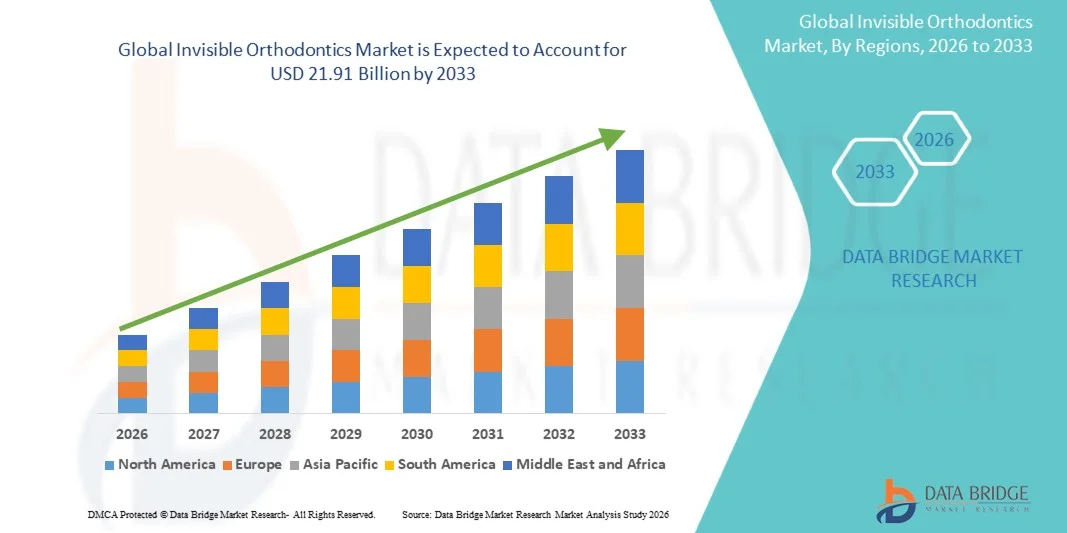
- The global Invisible Orthodontics market size was valued at USD 8.48 billion in 2025 and is expected to reach USD 21.91 billion by 2033, at a CAGR of 12.60% during the forecast period
- The global Invisible Orthodontics market is experiencing strong growth, primarily driven by increasing demand for aesthetically appealing dental treatment options and the rising preference for clear aligners over traditional metal braces. Growing awareness of dental aesthetics, especially among adults and working professionals, is further accelerating adoption across both developed and emerging healthcare markets
- Furthermore, rapid technological advancements in digital dentistry, including 3D scanning, AI-driven treatment planning, and customized aligner manufacturing, are enhancing treatment precision and patient comfort. In addition, expanding access to orthodontic care and increasing disposable incomes are establishing invisible orthodontics as a preferred modern solution, thereby significantly boosting the market’s overall growth
Invisible Orthodontics Market Analysis
- The global Invisible Orthodontics market, comprising clear aligners and advanced aesthetic orthodontic solutions, is witnessing robust expansion driven by increasing demand for discreet dental correction treatments among teens and adults, along with rising awareness of oral health and smile aesthetics across global populations
- The accelerating adoption of invisible orthodontics is primarily fueled by technological advancements in digital dentistry such as 3D intraoral scanning, AI-powered treatment planning, and customized aligner fabrication, coupled with growing patient preference for comfortable, removable, and virtually invisible alternatives to traditional braces
- North America dominated the invisible orthodontics market with the largest revenue share of approximately 38.5% in 2025, supported by high orthodontic treatment penetration, strong reimbursement awareness, early adoption of digital dentistry, and the presence of leading players, with the U.S. driving significant demand due to high cosmetic dentistry spending and advanced clinical infrastructure
- Asia-Pacific is expected to be the fastest growing region in the invisible orthodontics market during the forecast period, driven by rapid urbanization, rising disposable incomes, increasing awareness of aesthetic dental treatments, and expanding access to advanced dental care. In addition, growing dental tourism, a large young population base, and the increasing adoption of digital dentistry solutions such as 3D scanning and AI-based aligner customization are further accelerating market growth across key countries including China, India, Japan, and South Korea
- The adults segment dominated the largest market revenue share of 52.3% in 2025, driven by rising aesthetic consciousness and increasing disposable incomes among working professionals
Report Scope and Invisible Orthodontics Market Segmentation
|
Attributes |
Invisible Orthodontics Key Market Insights |
|
Segments Covered |
|
|
Countries Covered |
North America
Europe
Asia-Pacific
Middle East and Africa
South America
|
|
Key Market Players |
|
|
Market Opportunities |
|
|
Value Added Data Infosets |
In addition to the insights on market scenarios such as market value, growth rate, segmentation, geographical coverage, and major players, the market reports curated by the Data Bridge Market Research also include in-depth expert analysis, patient epidemiology, pipeline analysis, pricing analysis, and regulatory framework. |
Invisible Orthodontics Market Trends
“Enhanced Convenience Through AI, Digital Dentistry, and Remote Treatment Monitoring”
- A significant and accelerating trend in the global Invisible Orthodontics market is the integration of advanced digital dentistry tools, including artificial intelligence (AI), 3D imaging, intraoral scanning, and cloud-based treatment planning platforms. These technologies are improving diagnostic accuracy, treatment precision, and overall patient experience in clear aligner therapy
- AI-powered orthodontic software is increasingly being used to simulate tooth movement, predict treatment outcomes, and design highly customized aligner sequences, reducing manual intervention and improving efficiency for orthodontists
- For instance, platforms such as Align Technology’s ClinCheck software use AI-assisted modeling to create step-by-step tooth movement simulations and optimize aligner staging for predictable results
- The adoption of 3D printing technology is also transforming aligner manufacturing by enabling faster production cycles, improved customization, and reduced turnaround time for patients. This is significantly enhancing scalability for dental service providers and aligner manufacturers
- Another emerging trend is the growth of teledentistry and remote patient monitoring, where orthodontists track patient progress through digital scans and mobile applications, minimizing in-clinic visits while maintaining treatment effectiveness. For instance, companies such as Byte (by Dentsply Sirona) use at-home impression kits and remote monitoring systems to allow orthodontists to supervise treatment progress virtually
- In addition, digital treatment ecosystems allow seamless integration of patient records, scanning data, and treatment planning tools, enabling orthodontists to manage cases more efficiently and deliver more predictable outcomes
- This shift toward digitally driven, patient-centric orthodontic care is fundamentally reshaping expectations, with increasing demand for faster, more aesthetic, and minimally invasive dental correction solutions
Invisible Orthodontics Market Dynamics
Driver
“Rising Aesthetic Awareness and Growing Demand for Discreet Dental Treatment Options”
- The increasing emphasis on dental aesthetics and personal appearance is a major driver for the global Invisible Orthodontics market, particularly among adults and working professionals who prefer discreet alternatives to traditional metal braces
- Growing awareness of oral health and orthodontic correction benefits is further encouraging patients to seek early treatment for malocclusion, overcrowding, and misalignment issues
- For instance, increasing adoption of clear aligner systems like Invisalign in urban dental clinics across India and the U.S. reflects how patients are actively opting for aesthetic orthodontic solutions over conventional braces
- The expanding adoption of clear aligner systems by orthodontists and dental clinics is accelerating market growth, supported by improved clinical outcomes and higher patient acceptance rates
- Rising disposable income, urbanization, and increasing access to advanced dental care in emerging economies are also contributing significantly to market expansion
- Furthermore, the growing influence of social media and cosmetic dentistry trends is driving more individuals toward aesthetic orthodontic solutions that offer both functional and visual benefits
Restraint/Challenge
“High Treatment Cost and Patient Compliance Limitations”
- One of the key challenges restraining the growth of the Invisible Orthodontics market is the relatively high cost of clear aligner treatments compared to conventional braces, making them less accessible to price-sensitive populations
- Limited insurance coverage for orthodontic procedures in many regions further increases out-of-pocket expenses, reducing adoption among middle- and lower-income groups
- For instance, in many developing markets such as parts of South Asia and Africa, clear aligner treatments are often not covered under basic dental insurance plans, making them unaffordable for a large population segment
- Patient compliance is another significant challenge, as aligners require strict adherence to wearing schedules (typically 20–22 hours per day), and inconsistent usage can lead to suboptimal treatment outcomes or prolonged treatment duration
- In addition, not all complex orthodontic cases are suitable for clear aligner therapy, which can limit its applicability compared to traditional fixed braces in severe malocclusion cases
- Addressing these challenges through cost optimization, improved reimbursement policies, enhanced patient education, and continued technological advancements will be essential for sustained market growth
Invisible Orthodontics Market Scope
The market is segmented on the basis of Products & Services, Age Group, Application, End User, and Distribution Channel.
• By Products and Services
On the basis of products and services, the Invisible Orthodontics market is segmented into products and services. The products segment dominated the largest market revenue share of 44.5% in 2025, driven by strong demand for clear aligners, advanced orthodontic solutions, and increasing consumer preference for aesthetic dental correction. Rising awareness regarding minimally invasive orthodontic treatments, along with increasing adoption of digitally designed aligners, further supports segment dominance. Technological advancements such as 3D printing, AI-based treatment planning, and improved material science are enhancing product precision and comfort. The growing availability of customized aligner kits and expansion of global orthodontic brands also strengthen market presence. Increasing dental tourism and growing demand for cosmetic dentistry are further contributing to product growth. Improved affordability and wider accessibility in emerging markets continue to support segment expansion. Continuous product innovation remains a major factor driving long-term leadership in the market.
The services segment is expected to witness the fastest CAGR of 19.8% from 2026 to 2033, driven by increasing demand for orthodontic consultations, treatment planning, and remote monitoring solutions. Rapid adoption of teledentistry platforms is significantly supporting service expansion worldwide. AI-enabled treatment tracking systems are improving patient compliance and treatment efficiency. Rising subscription-based orthodontic care models are attracting new consumers. Growing use of cloud-based patient records is streamlining service delivery. Expanding access to virtual consultations is increasing convenience for patients. Hybrid care models combining in-clinic and remote support are also accelerating demand. Increasing awareness regarding preventive oral healthcare is further supporting market growth. Continuous innovation in digital workflows is expected to sustain the segment’s rapid CAGR.
• By Age Group
On the basis of age group, the Invisible Orthodontics market is segmented into adults, teenagers, and children. The adults segment dominated the largest market revenue share of 52.3% in 2025, driven by rising aesthetic consciousness and increasing disposable incomes among working professionals. Adults strongly prefer invisible aligners over traditional braces due to professional appearance requirements and lifestyle convenience. Growing awareness regarding oral health benefits is further supporting treatment adoption. Increasing access to advanced dental clinics and specialists strengthens segment growth. Rising late-age orthodontic correction trends are creating additional demand globally. Urbanization and higher spending on personal care are also boosting adoption. Availability of customized treatment solutions further supports market expansion. Strong preference for discreet orthodontic treatment continues to maintain segment dominance.
The teenagers segment is expected to witness the fastest CAGR of 21.4% from 2026 to 2033, driven by increasing parental investment in early orthodontic care. Rising prevalence of malocclusion and crowding among adolescents is creating strong treatment demand. Growing school dental screening programs are helping in early diagnosis and awareness. Increasing focus on appearance and confidence among teenagers supports aligner adoption. Technological improvements making aligners more comfortable are accelerating usage. Reduced treatment duration and higher effectiveness are attracting consumers. Expanding pediatric dental infrastructure is improving access to treatment. Social influence and digital awareness campaigns are further supporting growth. Continuous innovation in teen-focused aligner products is expected to sustain high CAGR.
• By Application
On the basis of application, the Invisible Orthodontics market is segmented into malocclusion, crowding, excessive spacing, and others. The malocclusion segment dominated the largest market revenue share of 46.8% in 2025, driven by the high prevalence of bite misalignment conditions globally. Increasing demand for corrective orthodontic procedures is strongly supporting segment growth. Advancements in digital scanning and AI-based planning are improving treatment accuracy. Growing awareness regarding long-term complications of untreated malocclusion supports adoption. Customized aligner solutions are improving patient outcomes and convenience. Rising adult orthodontic correction demand also contributes to market growth. Expanding dental clinic networks are improving treatment accessibility. Strong clinical preference for aligners in mild to moderate cases supports leadership. Continued innovation in orthodontic technologies remains a major growth factor.
The crowding segment is expected to witness the fastest CAGR of 20.6% from 2026 to 2033, driven by increasing incidence of dental overcrowding globally. Genetic factors and changing lifestyle habits are contributing to higher case volumes. Growing preference for minimally invasive correction methods is boosting aligner demand. Improved treatment predictability and shorter correction cycles are attracting patients. Rising cosmetic awareness is supporting demand for smile correction treatments. Expanding orthodontic awareness campaigns are helping diagnosis rates. Increasing affordability of treatment in emerging markets supports expansion. Growing urban populations are contributing to higher demand. Continuous innovation in aligner materials and treatment planning is expected to sustain rapid growth.
• By End User
On the basis of end user, the Invisible Orthodontics market is segmented into hospitals, dental clinics, orthodontics clinics, and others. The dental clinics segment dominated the largest market revenue share of 41.9% in 2025, driven by high patient inflow and widespread accessibility of orthodontic services. Dental clinics are early adopters of digital scanners and aligner workflows, supporting efficiency. Cost-effective treatment options compared with larger hospital setups strengthen demand. Strong referral networks also improve patient conversion rates. Increasing urbanization is driving clinic visits for cosmetic dentistry. Convenient appointment availability supports consumer preference. Expansion of private dental practices further strengthens market presence. Continuous investment in modern dental technologies supports segment leadership.
The orthodontics clinics segment is expected to witness the fastest CAGR of 22.1% from 2026 to 2033, driven by increasing demand for specialized orthodontic expertise. Rising consumer preference for expert-led aligner treatment supports segment expansion. Growing number of standalone orthodontic centers in urban markets is accelerating growth. Advanced treatment planning tools and customized care improve outcomes. Higher success rates in complex correction cases strengthen patient trust. Increasing awareness regarding specialist care benefits supports demand. Premium treatment offerings are attracting higher-income consumers. Adoption of AI-assisted orthodontic systems is improving efficiency. Continuous specialization trends are expected to maintain rapid CAGR growth.
• By Distribution Channel
On the basis of distribution channel, the Invisible Orthodontics market is segmented into direct sales and third-party distributors. The direct sales segment dominated the largest market revenue share of 58.7% in 2025, driven by strong manufacturer-to-clinic partnerships and rising direct-to-consumer aligner models. Better pricing control and faster product delivery support this segment’s leadership. Improved treatment customization through direct engagement enhances patient satisfaction. Digital orthodontic platforms are helping brands connect directly with consumers. Reduced intermediary costs strengthen profitability for manufacturers. AI-enabled treatment monitoring tools are also supporting direct channel growth. Growing trust in branded treatment ecosystems continues to boost adoption. Expansion of online sales platforms further strengthens market reach.
The third-party distributors segment is expected to witness the fastest CAGR of 18.9% from 2026 to 2033, driven by expanding supply networks and increasing penetration in emerging markets. Distributors play a key role in reaching small clinics and underserved areas. Rising demand for affordable orthodontic products supports this channel’s expansion. Improved logistics infrastructure is enabling faster deliveries. Increasing partnerships with manufacturers are strengthening product portfolios. Growing dental retail networks are boosting accessibility. Expansion into rural and semi-urban regions supports higher sales volumes. Better inventory management systems are improving channel efficiency. Continuous market expansion strategies are expected to sustain rapid CAGR growth.
Invisible Orthodontics Market Regional Analysis
- North America dominated the invisible orthodontics market with the largest revenue share of approximately 38.5% in 2025, supported by high orthodontic treatment penetration, strong reimbursement awareness, early adoption of digital dentistry, and the presence of leading players
- Consumers in the region increasingly prefer discreet and aesthetically appealing orthodontic solutions, while the U.S. continues to generate significant demand due to high cosmetic dentistry spending and advanced clinical infrastructure
- The region’s widespread adoption is further strengthened by high disposable incomes, strong awareness of oral aesthetics, favorable financing options, and the growing availability of customized clear aligner solutions, establishing invisible orthodontics as a preferred treatment option across both teenagers and adults
U.S. Invisible Orthodontics Market Insight
The U.S. invisible orthodontics market captured the largest revenue share in 2025 within North America, fueled by strong consumer demand for cosmetic dental treatments and rapid adoption of technologically advanced orthodontic solutions. Patients are increasingly prioritizing discreet, removable, and comfortable treatment options such as clear aligners. The growing presence of orthodontic service organizations, direct-to-consumer awareness, and advanced digital workflows involving intraoral scanning and AI-driven treatment planning further propel the Invisible Orthodontics industry. Moreover, the availability of experienced orthodontists and high spending on dental care significantly contribute to market expansion.
Europe Invisible Orthodontics Market Insight
The Europe invisible orthodontics market is projected to expand at a substantial CAGR throughout the forecast period, primarily driven by increasing awareness of dental aesthetics, rising demand for minimally visible treatment options, and growing adoption of digital orthodontic technologies. The increase in urbanization, coupled with expanding access to private dental care, is fostering the adoption of invisible orthodontic solutions. European consumers are also drawn to the comfort, convenience, and predictable treatment outcomes these systems offer. The region is experiencing significant growth across adolescent and adult patient groups, with invisible orthodontics increasingly incorporated into mainstream dental practices.
U.K. Invisible Orthodontics Market Insight
The U.K. invisible orthodontics market is anticipated to grow at a noteworthy CAGR during the forecast period, driven by rising interest in cosmetic dentistry and a growing desire for convenient, discreet orthodontic treatment options. In addition, increasing awareness regarding oral health and smile aesthetics is encouraging both teenagers and adults to choose clear aligner solutions. The UK’s strong private dental network, alongside robust e-commerce and digital consultation infrastructure, is expected to continue stimulating market growth.
Germany Invisible Orthodontics Market Insight
The Germany invisible orthodontics market is expected to expand at a considerable CAGR during the forecast period, fueled by increasing awareness of preventive dental care and demand for technologically advanced, precision-based orthodontic treatments. Germany’s well-developed healthcare infrastructure, combined with its emphasis on innovation and quality care, promotes the adoption of invisible orthodontics, particularly in urban centers. The integration of digital scanning, CAD/CAM manufacturing, and customized treatment planning is also becoming increasingly prevalent, aligning with local consumer expectations for effective and high-quality care.
Asia-Pacific Invisible Orthodontics Market Insight
The Asia-Pacific invisible orthodontics market is poised to grow at the fastest CAGR during the forecast period of 2026 to 2033, driven by rapid urbanization, rising disposable incomes, increasing awareness of aesthetic dental treatments, and expanding access to advanced dental care. The region's growing middle-class population, supported by improving healthcare infrastructure and government healthcare initiatives, is accelerating adoption of invisible orthodontics. Furthermore, growing dental tourism, a large young population base, and increasing adoption of digital dentistry solutions such as 3D scanning and AI-based aligner customization are further boosting market growth across countries such as China, India, Japan, and South Korea.
Japan Invisible Orthodontics Market Insight
The Japan invisible orthodontics market is gaining momentum due to the country’s high healthcare standards, growing focus on dental aesthetics, and rising demand for convenient treatment solutions. The Japanese market places significant emphasis on precision and quality, and the adoption of invisible orthodontics is driven by increasing acceptance of clear aligners among working professionals and younger populations. The integration of digital orthodontic planning and advanced imaging technologies is fueling growth. Moreover, Japan's aging population is likely to spur demand for comfortable, low-maintenance orthodontic solutions suitable for adult patients.
China Invisible Orthodontics Market Insight
The China invisible orthodontics market accounted for the largest market revenue share in Asia Pacific in 2025, attributed to the country's expanding middle class, rapid urbanization, and high rates of healthcare digitization. China stands as one of the largest markets for aesthetic dental treatments, and invisible orthodontics is becoming increasingly popular among teenagers, young professionals, and urban consumers. The push toward modern dental care, rising dental clinic networks, and the availability of affordable treatment options alongside strong domestic manufacturers are key factors propelling the market in China.
Invisible Orthodontics Market Share
The Invisible Orthodontics industry is primarily led by well-established companies, including:
- Align Technology (U.S.)
- Dentsply Sirona (U.S.)
- Envista Holdings Corporation (U.S.)
- 3M (U.S.)
- Henry Schein Orthodontics (U.S.)
- Straumann Group (Switzerland)
- Ormco Corporation (U.S.)
- SmileDirectClub (U.S.)
- Angelalign Technology Inc. (China)
- Great Lakes Dental Technologies (U.S.)
- TP Orthodontics, Inc. (U.S.)
- G&H Orthodontics (U.S.)
- DB Orthodontics (U.K.)
- Scheu Dental GmbH (Germany)
- Modern Dental Group (Hong Kong)
- Shandong Huge Dental Material Corporation (China)
- Institute Straumann AG (Switzerland)
- 3Shape A/S (Denmark)
- Planmeca Group (Finland)
Latest Developments in Global Invisible Orthodontics Market
- In September 2021, Align Technology announced the expansion of its Invisalign Virtual Care AI-powered remote monitoring system across multiple global markets. This development enabled orthodontists to track patient progress remotely using smartphone-based scanning tools, reducing the need for in-office visits and improving treatment efficiency. It marked a significant step in the digital transformation of orthodontic care and the growing adoption of tele-orthodontics following the COVID-19 pandemic
- In February 2022, Align Technology launched the Invisalign Palatal Expander System in select global markets. This was the company’s first directly 3D-printed orthodontic device designed to replace traditional metal expanders with a more comfortable, digitally guided alternative. The launch demonstrated increasing integration of additive manufacturing into orthodontic treatment workflows and expanded Invisalign’s product ecosystem beyond clear aligners
- In May 2023, market research reports indicated that the global invisible orthodontics market reached approximately USD 4.63 billion in 2022, driven by rising demand for aesthetic dental treatments and increasing adoption of clear aligner therapy. The analysis highlighted accelerating use of digital scanning technologies and AI-based orthodontic treatment planning as key factors supporting market growth across developed and emerging regions
- In November 2023, industry analysis reported strong growth in the China invisible orthodontics market, projecting an increase of approximately USD 314.9 million from 2023 to 2028. The growth was attributed to rising awareness of dental aesthetics, increasing orthodontic treatment adoption among adults and teenagers, and expanding availability of clear aligner providers across urban dental clinics
- In January 2024, Align Technology introduced enhancements to its ClinCheck digital treatment planning software, improving 3D visualization and AI-assisted treatment simulation capabilities. The upgrade allowed orthodontists to design more precise tooth movement plans and reduced treatment planning time, reinforcing the company’s leadership in digital orthodontics and AI-driven workflow optimization

- Interactive Data Analysis Dashboard
- Company Analysis Dashboard for high growth potential opportunities
- Research Analyst Access for customization & queries
- Competitor Analysis with Interactive dashboard
- Latest News, Updates & Trend analysis
- Harness the Power of Benchmark Analysis for Comprehensive Competitor Tracking
Data collection and base year analysis are done using data collection modules with large sample sizes. The stage includes obtaining market information or related data through various sources and strategies. It includes examining and planning all the data acquired from the past in advance. It likewise envelops the examination of information inconsistencies seen across different information sources. The market data is analysed and estimated using market statistical and coherent models. Also, market share analysis and key trend analysis are the major success factors in the market report. To know more, please request an analyst call or drop down your inquiry.
The key research methodology used by DBMR research team is data triangulation which involves data mining, analysis of the impact of data variables on the market and primary (industry expert) validation. Data models include Vendor Positioning Grid, Market Time Line Analysis, Market Overview and Guide, Company Positioning Grid, Patent Analysis, Pricing Analysis, Company Market Share Analysis, Standards of Measurement, Global versus Regional and Vendor Share Analysis. To know more about the research methodology, drop in an inquiry to speak to our industry experts.
Data Bridge Market Research is a leader in advanced formative research. We take pride in servicing our existing and new customers with data and analysis that match and suits their goal. The report can be customized to include price trend analysis of target brands understanding the market for additional countries (ask for the list of countries), clinical trial results data, literature review, refurbished market and product base analysis. Market analysis of target competitors can be analyzed from technology-based analysis to market portfolio strategies. We can add as many competitors that you require data about in the format and data style you are looking for. Our team of analysts can also provide you data in crude raw excel files pivot tables (Fact book) or can assist you in creating presentations from the data sets available in the report.













