


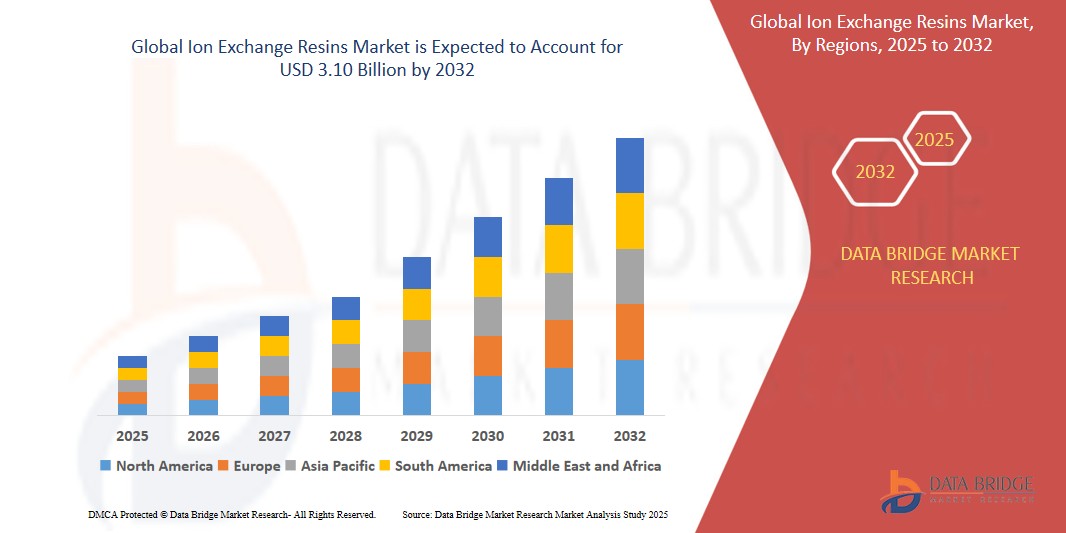
Ion Exchange Resins Market Size
- The global Ion Exchange Resins market size was valued at USD 1.95 billion in 2024 and is expected to reach USD 3.10 billion by 2032, at a CAGR of 6.0% during the forecast period
- This growth is driven by factors such as the rising demand in water treatment and pharmaceutical sectors, increasing industrialization in emerging economies, and technological advancements in resin performance and application-specific formulations.
Ion Exchange Resins Market Analysis
- Ion Exchange Resins are widely used in water purification, pharmaceuticals, food & beverage processing, and power generation due to their ability to effectively remove contaminants, ions, and impurities from liquids.
- The demand for ion exchange resins is significantly driven by growing environmental concerns, increasing demand for clean water, stringent regulations on industrial wastewater discharge, and rising applications in the pharmaceutical and chemical industries.
- North America is expected to dominate the Ion Exchange Resins market due to its mature water treatment infrastructure, strong presence of pharmaceutical manufacturers, and strict environmental regulations encouraging resin-based purification systems.
- Asia-Pacific is projected to be the fastest-growing region in the Ion Exchange Resins market during the forecast period, fueled by rapid industrialization, urban population growth, increasing water scarcity, and expanding energy production and electronics industries.
- The industrial water treatment segment is anticipated to hold a dominant share of the market, supported by growing adoption in municipal and industrial facilities, emphasis on zero liquid discharge (ZLD) systems, and demand for high-purity water in manufacturing processes.
Report Scope and Ion Exchange Resins Market Segmentation
|
Attributes |
Ion Exchange Resins Key Market Insights |
|
Segments Covered |
|
|
Countries Covered |
North America
Europe
Asia-Pacific
Middle East and Africa
South America
|
|
Key Market Players |
|
|
Market Opportunities |
|
|
Value Added Data Infosets |
In addition to the insights on market scenarios such as market value, growth rate, segmentation, geographical coverage, and major players, the market reports curated by the Data Bridge Market Research also include import export analysis, production capacity overview, production consumption analysis, price trend analysis, climate change scenario, supply chain analysis, value chain analysis, raw material/consumables overview, vendor selection criteria, PESTLE Analysis, Porter Analysis, and regulatory framework. |
Ion Exchange Resins Market Trends
“Increased Use of Ion Exchange Resins in Pharmaceutical Ingredient Purification”
- One prominent trend in the Ion Exchange Resins market is the growing utilization of resins in active pharmaceutical ingredient (API) purification due to their superior selectivity, chemical resistance, and ability to meet stringent purity standards.
- These properties make ion exchange resins ideal for removing impurities, heavy metals, and by-products in complex drug formulations, particularly in high-value biologics and specialty drugs.
- For instance, pharmaceutical companies are increasingly adopting strong acid cation and strong base anion exchange resins in antibiotic production and enzyme purification processes, where high purity and efficiency are critical.
- This trend is enhancing drug manufacturing efficiency, ensuring regulatory compliance, and supporting the expansion of high-performance purification solutions across the pharmaceutical industry.
Ion Exchange Resins Market Dynamics
Driver
“Rising Demand for Clean Water and Environmental Regulations”
- The increasing scarcity of freshwater resources and the growing need for water purification are major drivers for the Ion Exchange Resins market, especially in municipal, industrial, and power generation sectors
- Ion exchange resins are highly effective in removing undesirable ions, heavy metals, and contaminants, making them crucial for sustainable water management and zero liquid discharge (ZLD) systems.
- With stringent environmental regulations being enforced across the globe, industries are adopting advanced water treatment technologies, boosting resin consumption..
For instance,
- In June 2024, the European Environment Agency announced tighter water quality regulations across member states, increasing demand for advanced ion exchange systems in chemical and manufacturing plants.
- As a industries aim for higher operational efficiency and regulatory compliance, ion exchange resins are increasingly seen as a key solution, driving consistent market growth.
Opportunity
“Expanding Pharmaceutical and Biotech Industries Driving High-Purity Resin Demand”
- The rapid growth of the pharmaceutical and biotechnology sectors, particularly in the development of biologics, vaccines, and specialty drugs, is creating strong demand for ion exchange resins in purification and separation processes.
- These applications require high-purity, pharmaceutical-grade resins with precise selectivity, capacity, and stability to ensure drug safety and efficacy.
- Manufacturers are investing in specialized resins tailored for GMP compliance and scalable biotech manufacturing processes.
For instance,
- In February 2025, BioProcess International reported a 17% annual increase in demand for ion exchange chromatography resins used in monoclonal antibody purification.
- The biologics and precision medicine gain momentum, ion exchange resins are poised for expanded application in high-value therapeutic production.
Restraint/Challenge
“Fluctuating Raw Material Prices and Supply Chain Disruptions”
- The production of ion exchange resins relies on key raw materials such as styrene, acrylic acid, and divinylbenzene, which are subject to price volatility due to fluctuations in petroleum and chemical feedstocks.
- Global supply chain disruptions—triggered by geopolitical tensions, shipping delays, and energy crises—have led to inconsistent resin availability and increased costs.
- These issues affect the profitability of manufacturers and can deter price-sensitive end-users from switching to or expanding resin usage.
For instance,
- In August 2024, the American Chemical Council reported a 22% year-on-year increase in styrene prices due to ongoing disruptions in global petrochemical supply chains.
- Consequently, such limitations can result, raw material instability poses a major challenge to consistent market growth, particularly in regions with high import dependency.
Ion Exchange Resins Market Scope
The market is segmented on the basis application, Application, Grade, End-Use Industry, end user, and distribution channel.
|
Segmentation |
Sub-Segmentation |
|
By Type |
|
|
By Application |
|
|
By Grade |
|
In 2025, the cationic resins is projected to dominate the market with a largest share in ion exchange resins market
The cationic resins segment is expected to dominate the Ion Exchange Resins market with the largest share of 56.22% in 2025 due to their widespread use in water softening, demineralization, and wastewater treatment processes. These resins are highly effective in removing positively charged ions such as calcium, magnesium, and iron, making them essential for industrial and municipal water purification systems. Their versatility, high exchange capacity, and chemical resistance further contribute to their dominance across various end-use industries including power generation, food & beverage, and chemical processing.
The power is expected to account for the largest share during the forecast period in Grade market
In 2025, the power segment is expected to dominate the market with the largest market share of 51.31% driven by the increasing global demand for high-purity water in thermal and nuclear power plants. Ion exchange resins are crucial in boiler feedwater treatment and condensate polishing, ensuring equipment longevity and operational efficiency. As the energy sector continues to expand, especially in emerging economies, the demand for reliable and efficient water purification systems strengthens the segment’s leading position in the market.
Ion Exchange Resins Market Regional Analysis
“North America Holds the Largest Share in the Ion Exchange Resins Market”
- North America dominates the Ion Exchange Resins market, fueled by its well-established water treatment infrastructure, stringent environmental regulations, and strong presence of pharmaceutical and power generation industries.
- The United States holds the largest share in the region due to widespread adoption of ion exchange technology in municipal water treatment, nuclear and thermal power plants, and API purification in the pharmaceutical sector.
- The region also benefits from technological advancements, high awareness of sustainable practices, and federal regulations pushing for cleaner water and reduced industrial discharge.
- Additionally, the presence of leading manufacturers and resin suppliers, along with consistent R&D investment, supports North America’s leadership position in the global market..
“Asia-Pacific is Projected to Register the Highest CAGR in the Ion Exchange Resins Market”
- The Asia-Pacific region is expected to witness the highest growth rate in the Ion Exchange Resins market, driven by rapid urbanization, industrial expansion, and rising demand for clean water and energy solutions.
- Countries like China, India, and Japan are leading the regional growth, with increased investments in municipal and industrial water treatment plants, pharmaceutical manufacturing, and chemical processing.
- China, in particular, is experiencing accelerated adoption of ion exchange resins in power generation and electronics, while India is ramping up its use in pharmaceuticals and food & beverage industries.
- Government initiatives promoting clean energy, zero liquid discharge (ZLD), and industrial wastewater treatment are further boosting resin demand.
- The growing need for high-purity water in semiconductor fabrication and biotech applications also enhances market prospects across the region.
Ion Exchange Resins Market Share
The market competitive landscape provides details by competitor. Details included are company overview, company financials, revenue generated, market potential, investment in research and development, new market initiatives, global presence, production sites and facilities, production capacities, company strengths and weaknesses, product launch, product width and breadth, Type dominance. The above data points provided are only related to the companies' focus related to market.
The Major Market Leaders Operating in the Market Are:
- DowDuPont Inc. (United States)
- Lanxess (Germany)
- Purolite (United States)
- Mitsubishi Chemical Corporation (Japan)
- Thermax (India)
- Ion Exchange (India)
- ResinTech (United States)
- Novasep (France)
- SAMYANG CORPORATION (South Korea)
- Suqing Group (China)
- Dow Chemical (United States)
- Eichrom Technologies Inc. (United States)
- Rohm & Haas (United States)
- Bengbu Dongli Chemical Co. Ltd. (China)
- Evoqua Water Technologies LLC (United States)
- Aldex Chemical Company Limited (Canada)
- Bio-Rad Laboratories Inc. (United States)
- Anhui Sanxing Resin Technology Co. Ltd. (China)
- Tianjin Nankai Hecheng Science & Technology Co. Ltd. (China)
- Sunresin New Materials Co. Ltd. (China)
Latest Developments in Global Ion Exchange Resins Market
- In April 2025, Lanxess AG announced the expansion of its ion exchange resin production capacity at its Leverkusen, Germany facility to meet growing global demand from the water purification and food processing sectors. The investment includes upgraded reactors and filtration systems aimed at improving resin uniformity and increasing output by 20%. This move strengthens Lanxess’ ability to support sustainable water treatment initiatives across Europe and beyond.
- In March 2025, Purolite, an Ecolab company, launched a new pharmaceutical-grade ion exchange resin under its Praesto® line, specifically designed for monoclonal antibody (mAb) purification in biopharmaceutical applications. The new resin offers enhanced binding capacity and faster mass transfer rates, helping improve production efficiency in biologics manufacturing. This development aligns with the surge in global biologics production and precision medicine.
- In February 2025, Thermax Limited unveiled plans to set up a new ion exchange resin manufacturing plant in Gujarat, India, with an annual capacity of 20,000 metric tons. The facility, expected to be operational by 2026, will cater to rising domestic and export demand across sectors such as power, textiles, and water treatment. This move also supports India’s “Make in India” initiative by strengthening local production capabilities.
- In January 2025, ResinTech Inc. completed the construction of its new headquarters and resin production facility in Camden, New Jersey, USA. This vertically integrated facility is equipped with advanced polymerization and regeneration systems to produce high-capacity resins for municipal and industrial water treatment. The site aims to reduce U.S. dependency on imported resins and enhance supply chain resilience.

- Interactive Data Analysis Dashboard
- Company Analysis Dashboard for high growth potential opportunities
- Research Analyst Access for customization & queries
- Competitor Analysis with Interactive dashboard
- Latest News, Updates & Trend analysis
- Harness the Power of Benchmark Analysis for Comprehensive Competitor Tracking
Global Ion Exchange Resins Market, Supply Chain Analysis and Ecosystem Framework
To support market growth and help clients navigate the impact of geopolitical shifts, DBMR has integrated in-depth supply chain analysis into its Global Ion Exchange Resins Market research reports. This addition empowers clients to respond effectively to global changes affecting their industries. The supply chain analysis section includes detailed insights such as Global Ion Exchange Resins Market consumption and production by country, price trend analysis, the impact of tariffs and geopolitical developments, and import and export trends by country and HSN code. It also highlights major suppliers with data on production capacity and company profiles, as well as key importers and exporters. In addition to research, DBMR offers specialized supply chain consulting services backed by over a decade of experience, providing solutions like supplier discovery, supplier risk assessment, price trend analysis, impact evaluation of inflation and trade route changes, and comprehensive market trend analysis.
Data collection and base year analysis are done using data collection modules with large sample sizes. The stage includes obtaining market information or related data through various sources and strategies. It includes examining and planning all the data acquired from the past in advance. It likewise envelops the examination of information inconsistencies seen across different information sources. The market data is analysed and estimated using market statistical and coherent models. Also, market share analysis and key trend analysis are the major success factors in the market report. To know more, please request an analyst call or drop down your inquiry.
The key research methodology used by DBMR research team is data triangulation which involves data mining, analysis of the impact of data variables on the market and primary (industry expert) validation. Data models include Vendor Positioning Grid, Market Time Line Analysis, Market Overview and Guide, Company Positioning Grid, Patent Analysis, Pricing Analysis, Company Market Share Analysis, Standards of Measurement, Global versus Regional and Vendor Share Analysis. To know more about the research methodology, drop in an inquiry to speak to our industry experts.
Data Bridge Market Research is a leader in advanced formative research. We take pride in servicing our existing and new customers with data and analysis that match and suits their goal. The report can be customized to include price trend analysis of target brands understanding the market for additional countries (ask for the list of countries), clinical trial results data, literature review, refurbished market and product base analysis. Market analysis of target competitors can be analyzed from technology-based analysis to market portfolio strategies. We can add as many competitors that you require data about in the format and data style you are looking for. Our team of analysts can also provide you data in crude raw excel files pivot tables (Fact book) or can assist you in creating presentations from the data sets available in the report.













