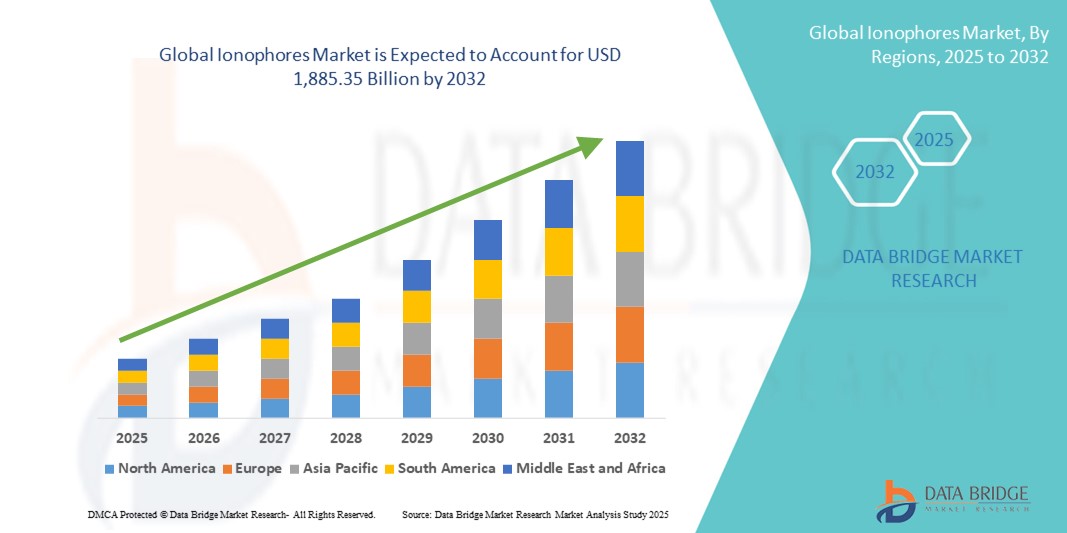
Ionophores Market Size
- The global Ionophores market size was valued at USD 1,266.4 billion in 2024 and is expected to reach USD 1,885.35 billion by 2032, at a CAGR of 5.1% during the forecast period
- The market expansion is primarily driven by the increasing usage of ionophores in cellular and molecular biology research, as well as their role in facilitating ion transport in biomedical and pharmaceutical applications
- Rising demand from hospitals and research institutions for advanced biochemical agents and the growing prevalence of chronic diseases necessitating drug discovery and diagnostics further support market growth
Ionophores Market Analysis
- The market is experiencing steady growth as researchers and clinicians seek efficient solutions for ion transport mechanisms, with ionophores gaining traction in membrane potential studies and electrophysiological applications
- Increased funding in life sciences and biotechnology R&D, along with technological advancements in cell culture media and diagnostic formulations, are bolstering demand
- North America dominated the ionophores market with the largest revenue share of 39.47% in 2024, supported by a well-established biomedical research infrastructure, growing pharmaceutical investments, and the presence of major biotech firms
- Asia-Pacific is projected to witness the fastest growth rate in the ionophores market from 2025 to 2032, driven by expanding academic and pharmaceutical R&D activities, rising healthcare investments, and a large patient base across emerging economies
- The "with Phenol Red" segment held the largest revenue share in 2024, owing to its wide adoption in cell culture systems as a pH indicator and its compatibility with commonly used biochemical assays
Report Scope and Ionophores Market Segmentation
|
Attributes |
Ionophores Key Market Insights |
|
Segments Covered |
|
|
Countries Covered |
North America
Europe
Asia-Pacific
Middle East and Africa
South America
|
|
Key Market Players |
• Thermo Fisher Scientific Inc. (U.S.) • Sigma-Aldrich Corporation (U.S.) |
|
Market Opportunities |
• Expansion Into Emerging Biomedical Research Markets |
|
Value Added Data Infosets |
In addition to the insights on market scenarios such as market value, growth rate, segmentation, geographical coverage, and major players, the market reports curated by the Data Bridge Market Research also include import export analysis, production capacity overview, production consumption analysis, price trend analysis, climate change scenario, supply chain analysis, value chain analysis, raw material/consumables overview, vendor selection criteria, PESTLE Analysis, Porter Analysis, and regulatory framework. |
Ionophores Market Trends
“Growing Use of Ionophores in Targeted Drug Delivery and Cancer Therapy”
- Ionophores are gaining prominence as key agents in targeted drug delivery systems, as they facilitate the controlled transport of ions across cell membranes, enhancing the uptake and bioavailability of therapeutic compounds. This property enables improved intracellular access for hydrophobic drugs and supports dose efficiency in complex treatment regimens. Their role is particularly crucial in delivering drugs to compartments such as mitochondria and lysosomes where ion gradients are significant
- In cancer therapy, ionophores have shown potential to disrupt cellular ion homeostasis, modulate intracellular calcium levels, and impair mitochondrial function in malignant cells. These mechanisms induce apoptosis, inhibit cell proliferation, and enhance the cytotoxicity of traditional chemotherapeutics. Ionophore compounds such as salinomycin have attracted attention for their ability to target cancer stem cells and overcome resistance mechanisms
- Researchers are increasingly focused on developing novel ionophore-based nanocarriers and polymeric conjugates to enable precision medicine applications. These delivery platforms are engineered to improve treatment specificity, reduce systemic toxicity, and allow for stimuli-responsive drug release. Such innovations are paving the way for targeted treatment of inflammatory diseases, neurodegenerative conditions, and metastatic cancers
- For instance, ongoing clinical trials involving ionophore-antibiotic combinations—such as ionomycin paired with rifampicin—are aimed at enhancing antimicrobial efficacy against multi-drug-resistant (MDR) pathogens and improving tumor suppression outcomes. Early-phase data has demonstrated improved intracellular penetration and synergistic cytotoxic effects in resistant bacterial strains and tumor models
- The growing demand for advanced oncology therapies, personalized medicine, and effective treatments against resistant pathogens is expected to significantly accelerate the development and commercial uptake of ionophore-enhanced solutions. With increasing biopharmaceutical investment and regulatory support for innovative delivery technologies, ionophores are poised to play a vital role in shaping next-generation therapeutics
Ionophores Market Dynamics
Driver
“Rising Research and Academic Investments in Molecular Biology and Biopharmaceutical Development”
• Growing government and private sector investments in life sciences are significantly boosting the utilization of ionophores in research, particularly as reagents in cellular transport studies, membrane potential assays, and ion channel exploration. These compounds are increasingly integrated into experimental workflows for investigating physiological and pathological processes at the cellular level. This trend is encouraging the development of advanced ionophore-based research kits and analytical tools
• University-driven innovation initiatives and increasing academia-industry collaborations are widening ionophore applications across diagnostics, disease modeling, and personalized therapy platforms. Institutions are engaging in joint research projects with biotech firms to develop customized ionophores for specific clinical and research applications. This partnership model is enabling rapid innovation and commercialization
• Joint efforts between pharmaceutical companies and research institutions are resulting in the identification of novel ionophores for targeted uses such as calcium signaling, neurobiological functions, and metabolic regulation. These discoveries are opening new avenues for therapeutic development, especially in areas such as neurodegenerative disorders and rare metabolic diseases. Such partnerships also help secure intellectual property and advance translational research
• For instance, U.S. National Institutes of Health (NIH) grants and European Horizon 2020 programs are actively funding projects centered on ion transport modulators and next-generation therapeutic agents. These international funding bodies are prioritizing molecular tools such as ionophores that offer potential breakthroughs in precision medicine. The support also accelerates regulatory pre-approval research phases
• These research-led investments not only expand the commercial potential of ionophores but also enhance scientific knowledge sharing, production capabilities, and international accessibility of high-grade compounds. This ecosystem fosters talent development, technology exchange, and market readiness for ionophore-based innovations. It plays a crucial role in bridging basic research with applied clinical application
Restraint/Challenge
“Stringent Regulatory Framework and Limited Commercial Production Scalability”
• The ionophores market is subject to strict regulatory protocols concerning product safety, efficacy validation, and compliance with medical usage standards, especially in human therapeutics. These regulatory hurdles vary widely across regions and require extensive documentation and clinical testing. This delays time-to-market and increases development costs for manufacturers
• Complex production procedures, high-cost purification stages, and the demand for consistent reagent quality hinder large-scale commercialization and delay product approvals. Ionophores often require multistep synthesis and specialized containment during manufacturing. These factors contribute to a high cost-per-unit and limit affordability for end users
• Further complications arise from fragmented global supply chains and heavy reliance on highly controlled laboratory environments, which restrict widespread distribution and fast-track manufacturing. Many ionophores are temperature-sensitive or prone to degradation, requiring cold chain logistics and short shelf lives. These challenges disrupt continuity in research and clinical supply.
• For instance, Suppliers also face constraints such as limited production capacity and the critical need for ultra-pure, contamination-free ionophores to meet pharmaceutical-grade requirements. This demand for absolute purity necessitates sophisticated analytical testing and batch validation protocols, further stretching production timelines. As a result, scalability is often confined to small-batch operation
• To mitigate these issues, leading manufacturers are investing in Good Manufacturing Practice (GMP)-certified infrastructure, advanced automated synthesis technologies, and long-term collaborations to align with global regulatory expectations and improve scalability. These initiatives are essential to reducing compliance risks, lowering production costs, and ensuring consistent supply to meet growing research and clinical demand
Ionophores Market Scope
The market is segmented on the basis of type and application.
- By Type
On the basis of type, the ionophores market is segmented into with Phenol Red and with HEPES. The with Phenol Red segment accounted for the highest market revenue in 2024, owing to its widespread use as a pH indicator in cell culture systems, making it essential in diagnostic and therapeutic research. This type enhances the visualization and maintenance of pH conditions during cell growth and experimentation.
The with HEPES segment is expected to witness the fastest growth rate from 2025 to 2032, driven by increasing demand for buffering agents that offer minimal interference in biological reactions. HEPES-buffered ionophores are becoming increasingly popular in sensitive applications such as live-cell imaging and electrophysiological studies, where stable pH is critical.
- By Application
On the basis of application, the market is segmented into hospital, research institutions, and other. The hospital segment dominated the market in 2024, supported by a growing number of diagnostic and therapeutic procedures requiring ion-based reagents for efficient patient care. Hospitals increasingly utilize ionophores in molecular diagnostics, blood analysis, and antimicrobial treatments.
The research institutions segment is expected to witness the fastest growth rate from 2025 to 2032, owing to intensified global efforts in genomics, proteomics, and drug discovery. Ionophores play a key role in facilitating cellular assays, membrane transport studies, and signal transduction research across academic and private research labs.
Ionophores Market Regional Analysis
• North America dominated the ionophores market with the largest revenue share of 39.47% in 2024, due to high R&D investments, advanced healthcare infrastructure, and strong presence of life sciences firms and universities leading molecular innovation
• The region benefits from robust funding initiatives by agencies such as the U.S. National Institutes of Health (NIH) and Health Canada, which support ionophore-based research in drug discovery, antimicrobial resistance, and cellular biology
• Growing collaborations between biotech startups and academic institutions across the U.S. and Canada are accelerating the development of ionophore-enabled diagnostic tools, precision therapeutics, and nanoparticle delivery platforms
U.S. Ionophores Market Insight
The U.S. ionophores market accounted for the highest revenue in North America in 2024, supported by robust academic research, NIH grants, and ongoing clinical studies involving ion channel therapies. The country’s mature biopharmaceutical landscape and presence of global life sciences firms foster widespread adoption of ionophore-based reagents. Customization in research-grade compounds and high demand from contract research organizations (CROs) also contribute to sustained market growth. Advancements in precision medicine and cellular diagnostics continue to drive innovation in ionophore technologies.
Europe Ionophores Market Insight
The Europe ionophores market is expected to witness the fastest growth rate from 2025 to 2032, supported by stringent regulatory focus on laboratory standards, expanding pharmaceutical R&D, and public health initiatives across countries such as Germany, France, and the U.K. The region's emphasis on translational medicine, ion transport studies, and electrophysiological assays is increasing market penetration. European research institutions are incorporating ionophores in drug screening platforms and membrane transport experiments. High investment in academic-industry partnerships ensures steady demand for high-quality compounds.
Germany Ionophores Market Insight
The Germany ionophores market held the largest share within Europe in 2024, attributed to its dominant pharmaceutical manufacturing sector and investment in academic research. German laboratories utilize ionophores extensively in calcium signaling, mitochondrial function, and diagnostic innovation. The country's regulatory emphasis on purity and performance has pushed suppliers to offer high-grade, contamination-free reagents. With a rising number of biotech startups and collaborative research frameworks, Germany continues to lead in ionophore-related applications.
U.K. Ionophores Market Insight
The U.K. ionophores market is expected to witness the fastest growth rate from 2025 to 2032, supported by its strong academic research base, biotechnology clusters, and national funding initiatives in life sciences. British universities and research hospitals are actively employing ionophores in ion transport, neurobiology, and cancer studies. The U.K.'s focus on translational medicine and precision diagnostics is driving demand for high-purity, research-grade reagents. In addition, government-backed innovation programs and collaboration with pharmaceutical companies are strengthening the commercial viability of ionophore-based applications across healthcare and research sectors.
Asia-Pacific Ionophores Market Insight
The Asia-Pacific ionophores market is expected to witness the fastest growth rate from 2025 to 2032, driven by increased biomedical research activities, favorable government funding, and the rapid development of biopharma manufacturing in China, India, and South Korea. The region is witnessing a shift toward localized reagent production and customized synthesis services. Growing clinical trials, academic research investments, and innovation hubs are further accelerating adoption. As demand for targeted therapeutics rises, ionophore use is expected to expand significantly.
China Ionophores Market Insight
China dominated the Asia-Pacific ionophores market in 2024, bolstered by strong investments in healthcare innovation and a growing number of research collaborations. Chinese firms are enhancing production capacity and focusing on high-volume synthesis to meet domestic and export needs. Ionophores are being widely used in antimicrobial research, oncology studies, and metabolic assays. Government-backed innovation parks and partnerships with international research entities are fostering rapid technology adoption across universities and pharmaceutical firms.
Japan Ionophores Market Insight
Japan is expected to witness the fastest growth rate from 2025 to 2032, due to its mature biotechnology ecosystem and focus on precision medicine. Japanese research institutions are integrating ionophore compounds in advanced therapeutic studies, particularly in neurological, cardiovascular, and metabolic fields. The country benefits from highly structured academic infrastructure, consistent government support, and close collaboration between universities and pharma companies. These factors position Japan as a key contributor to the region’s expanding ionophores landscape.
Ionophores Market Share
The ionophores industry is primarily led by well-established companies, including:
• Thermo Fisher Scientific Inc. (U.S.)
• Merck KGaA (Germany)
• Abcam plc (U.K.)
• Cayman Chemical Company (U.S.)
• Tocris Bioscience (U.K.)
• Sigma-Aldrich Corporation (U.S.)
• Santa Cruz Biotechnology, Inc. (U.S.)
• Tokyo Chemical Industry Co., Ltd. (Japan)
• Alfa Aesar (U.S.)
• LC Laboratories (U.S.)

- Interactive Data Analysis Dashboard
- Company Analysis Dashboard for high growth potential opportunities
- Research Analyst Access for customization & queries
- Competitor Analysis with Interactive dashboard
- Latest News, Updates & Trend analysis
- Harness the Power of Benchmark Analysis for Comprehensive Competitor Tracking
Data collection and base year analysis are done using data collection modules with large sample sizes. The stage includes obtaining market information or related data through various sources and strategies. It includes examining and planning all the data acquired from the past in advance. It likewise envelops the examination of information inconsistencies seen across different information sources. The market data is analysed and estimated using market statistical and coherent models. Also, market share analysis and key trend analysis are the major success factors in the market report. To know more, please request an analyst call or drop down your inquiry.
The key research methodology used by DBMR research team is data triangulation which involves data mining, analysis of the impact of data variables on the market and primary (industry expert) validation. Data models include Vendor Positioning Grid, Market Time Line Analysis, Market Overview and Guide, Company Positioning Grid, Patent Analysis, Pricing Analysis, Company Market Share Analysis, Standards of Measurement, Global versus Regional and Vendor Share Analysis. To know more about the research methodology, drop in an inquiry to speak to our industry experts.
Data Bridge Market Research is a leader in advanced formative research. We take pride in servicing our existing and new customers with data and analysis that match and suits their goal. The report can be customized to include price trend analysis of target brands understanding the market for additional countries (ask for the list of countries), clinical trial results data, literature review, refurbished market and product base analysis. Market analysis of target competitors can be analyzed from technology-based analysis to market portfolio strategies. We can add as many competitors that you require data about in the format and data style you are looking for. Our team of analysts can also provide you data in crude raw excel files pivot tables (Fact book) or can assist you in creating presentations from the data sets available in the report.