Global Internet of Things (IoT) Connectivity Market Size
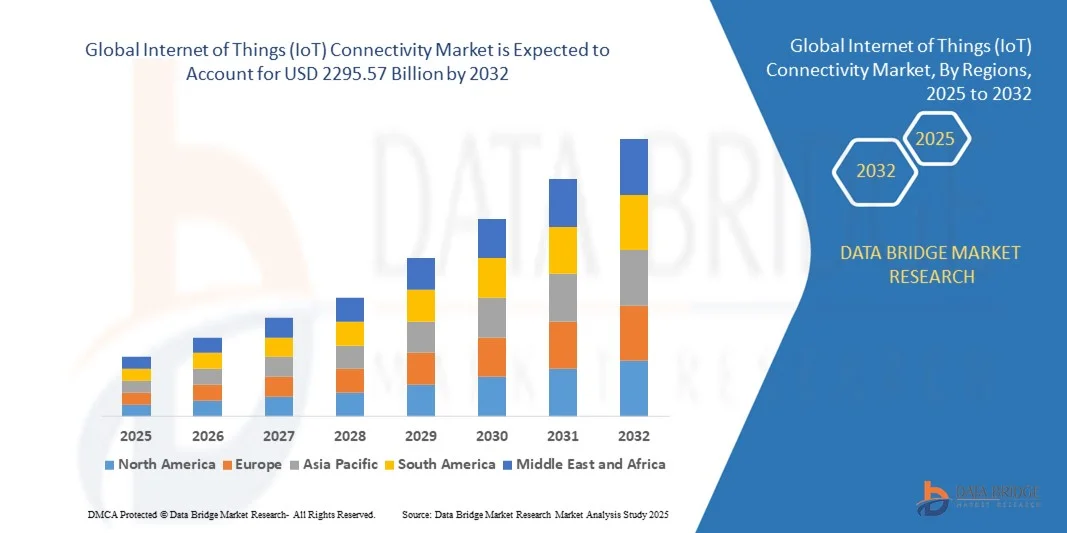
- The global Internet of Things (IoT) connectivity market was valued at USD 663.38 billion in 2024 and is projected to reach USD 2295.57 billion by 2032, growing at a CAGR of 19.10% during the forecast period.
- The surge in demand is primarily driven by the rapid expansion of connected home devices and smart home technologies, which are facilitating widespread digital transformation across both residential and commercial sectors.
- Additionally, growing consumer preference for secure, intuitive, and interoperable solutions is positioning IoT connectivity as a foundational component of modern infrastructure. This convergence is fueling adoption across industries, significantly propelling overall market growth.
Global Internet of Things (IoT) Connectivity Market Analysis
- The Global Internet of Things (IoT) Connectivity Market, which enables digital communication between interconnected devices and systems, is becoming increasingly essential across residential, commercial, and industrial environments due to its role in enabling automation, data sharing, and intelligent decision-making
- The growing demand for IoT connectivity is primarily driven by the widespread adoption of smart technologies, the expansion of 5G infrastructure, and increasing consumer and enterprise reliance on real-time data and connected solutions for enhanced efficiency and productivity
- North America dominated the IoT connectivity market with the largest revenue share of 39.5% in 2024, supported by strong technological infrastructure, early adoption of smart devices, and heavy investments in IoT platforms by leading tech giants, with the U.S. witnessing robust deployment across industries including healthcare, manufacturing, and smart cities
- Asia-Pacific is expected to emerge as the fastest-growing region in the IoT connectivity market during the forecast period, driven by rapid urban development, increasing internet penetration, and government-backed initiatives promoting digital transformation and smart infrastructure
- The platform and solution segment dominated the market in 2024, accounting for approximately 64% of the revenue share, owing to its central role in enabling seamless device communication, data integration, real-time monitoring, and remote control
Report Scope and Global Internet of Things (IoT) Connectivity Market Segmentation
|
Attributes |
Internet of Things (IoT) Connectivity Key Market Insights |
|
Segments Covered |
|
|
Countries Covered |
North America
Europe
Asia-Pacific
Middle East and Africa
South America
|
|
Key Market Players |
|
|
Market Opportunities |
|
|
Value Added Data Infosets |
In addition to the insights on market scenarios such as market value, growth rate, segmentation, geographical coverage, and major players, the market reports curated by the Data Bridge Market Research also include in-depth expert analysis, pricing analysis, brand share analysis, consumer survey, demography analysis, supply chain analysis, value chain analysis, raw material/consumables overview, vendor selection criteria, PESTLE Analysis, Porter Analysis, and regulatory framework. |
Global Internet of Things (IoT) Connectivity Market Trends
Enhanced Intelligence Through AI and Voice-Enabled IoT Integration
- A major and accelerating trend in the Global Internet of Things (IoT) Connectivity Market is the growing integration of artificial intelligence (AI) and voice-enabled platforms like Amazon Alexa, Google Assistant, and Apple Siri. This convergence is elevating the capabilities of connected devices, enabling more intuitive control, automation, and data-driven insights across smart homes, industries, and enterprises.
- For Instance, smart thermostats and lighting systems now integrate with AI-powered assistants to automatically adjust settings based on user behavior and environmental data. Devices like the Ecobee SmartThermostat use AI to optimize energy consumption while offering voice control through Alexa and Siri, showcasing the power of this interconnected ecosystem.
- In industrial IoT, AI enhances machine-to-machine communication by enabling predictive maintenance, anomaly detection, and real-time decision-making. Meanwhile, voice-enabled interfaces allow field workers to access critical data hands-free via connected wearables or smart devices, improving productivity and safety.
- By combining AI-driven analytics with IoT connectivity, organizations can unlock smarter automation, such as adaptive traffic management systems, energy-efficient building controls, and intelligent healthcare monitoring. The voice assistant integration also enables seamless interaction across devices, creating unified control hubs for homes and businesses alike.
- Companies such as Cisco, Microsoft, and IBM are developing AI-IoT solutions that incorporate natural language processing and machine learning to offer personalized experiences, optimize workflows, and enhance system responsiveness based on user input and real-time data streams.
- This ongoing fusion of AI and IoT connectivity is rapidly reshaping market expectations. As consumers and enterprises alike seek more intelligent, responsive, and voice-interactive ecosystems, demand is surging for solutions that deliver automated insights, hands-free control, and seamless integration across multiple platforms and devices.
Global Internet of Things (IoT) Connectivity Market Dynamics
Driver
Growing Demand Driven by Digital Transformation and Smart Ecosystem Expansion
-
The surge in digital transformation initiatives across sectors such as manufacturing, healthcare, logistics, and smart cities is a primary driver for the increased demand in the Global Internet of Things (IoT) Connectivity Market. Organizations are increasingly seeking real-time data, automation, and remote monitoring capabilities to enhance efficiency, productivity, and decision-making.
- For instance, in March 2024, Siemens AG expanded its industrial IoT platform, MindSphere, to offer deeper integration with edge computing and AI-based analytics. This move is part of a broader trend among leading companies to provide end-to-end IoT solutions that support scalable connectivity and intelligent data processing.
- In the consumer space, the continued rise in smart home adoption is fueling the demand for connected devices—such as smart thermostats, lighting, security cameras, and appliances—that rely on reliable IoT connectivity. Seamless integration across platforms like Amazon Alexa, Google Home, and Apple HomeKit is pushing the market forward.
- Moreover, the growing need for interconnected systems in healthcare, such as remote patient monitoring and smart medical devices, is driving investment in secure and scalable IoT infrastructure. Enterprises are also deploying IoT solutions to monitor supply chains, optimize energy consumption, and manage assets in real-time.
- The proliferation of DIY IoT platforms, increased availability of plug-and-play connectivity modules, and advancements in low-power wide-area networks (LPWAN) are making IoT adoption more accessible for startups, SMEs, and consumers alike, contributing to robust market growth across regions.
Restraint/Challenge
Cybersecurity Risks and Infrastructure Limitations
- Despite its growing adoption, the IoT connectivity market faces significant challenges, particularly around cybersecurity vulnerabilities and infrastructure readiness. As IoT devices increasingly handle sensitive data and critical operations, they become prime targets for cyberattacks, data breaches, and system hijacking.
- High-profile incidents involving compromised IoT devices—such as smart cameras, routers, and industrial sensors—have highlighted the risks of poor security protocols. These concerns are especially pronounced in sectors like healthcare, where a breach could have life-threatening consequences.
- To address these issues, companies are investing in end-to-end encryption, multi-factor authentication, and secure firmware updates. For instance, Cisco and IBM emphasize their secure IoT platforms with built-in threat detection and real-time response capabilities, aiming to reassure enterprise clients and consumers alike.
- In addition to cybersecurity, limited connectivity infrastructure in rural or underdeveloped regions presents a barrier to full IoT deployment. Many IoT applications require stable, high-speed networks—something not yet universally available, particularly in emerging economies.
- Another restraint is the high cost of initial setup, particularly for industrial IoT systems requiring specialized sensors, edge devices, and backend integration. Small businesses and budget-conscious governments may delay adoption due to these upfront investments.
- Overcoming these challenges through international standards, public-private partnerships to improve infrastructure, and consumer education on IoT security best practices will be essential for unlocking the full potential of the global IoT connectivity market.
Global Internet of Things (IoT) Connectivity Market Scope
The market is segmented on the basis 0f component, deployment, connectivity and end use.
- By Component
On the basis of component, the IoT connectivity market is segmented into Platform and Solution and Services. The Platform and Solution segment dominated the market in 2024 with a 64% revenue share, owing to its foundational role in device-to-device and device-to-cloud communication. These platforms facilitate real-time monitoring, analytics, and centralized control, enabling enterprises to build scalable IoT ecosystems across various endpoints. The segment's strength lies in its flexibility, adaptability, and integration capabilities with emerging technologies like AI and edge computing.
The Services segment is projected to witness the fastest CAGR of 20.1% from 2025 to 2032, driven by the increasing demand for consulting, implementation, system integration, and managed services. As more businesses seek to optimize IoT performance and security, they turn to service providers to ensure reliable deployments and ongoing support, especially in complex, multi-vendor environments.
- By Deployment
Based on deployment, the market is divided into Cloud and On-premise solutions. The Cloud segment led the market in 2024 with around 70% of total revenue, supported by its cost efficiency, scalability, and real-time data management capabilities. Cloud deployments are widely adopted across industries for enabling remote monitoring, analytics, and device updates without the need for extensive infrastructure. Integration with machine learning, data lakes, and digital twins has made cloud the default choice for IoT innovation.
The On-premise segment is expected to experience the fastest CAGR of 21.4% from 2025 to 2032, especially in sectors where data sovereignty, security, and latency control are crucial. Defense, manufacturing, and healthcare institutions often opt for on-premise deployments to maintain full control over data infrastructure and ensure compliance with stringent regulatory frameworks.
- By Connectivity
On the basis of connectivity, the IoT connectivity market is segmented into Zigbee, Wi-Fi, Bluetooth, Z-Wave, and Others. The Wi-Fi segment dominated the market in 2024 with a 39.5% revenue share, primarily due to its widespread infrastructure, high-speed connectivity, and ability to support data-heavy IoT applications. Wi-Fi is commonly used in smart homes, retail, and industrial settings where continuous internet connectivity and wide coverage are essential.
The Zigbee segment is projected to grow at the fastest CAGR of 23.2% from 2025 to 2032, driven by its low-power mesh networking capabilities and rising adoption in smart home and building automation systems. Zigbee’s robustness and compatibility with various IoT devices make it a preferred choice for large-scale IoT deployments requiring reliable, energy-efficient connectivity across distributed devices.
- By End-use
The IoT connectivity market spans across various end-use industries including Consumer Electronics, Wearable Devices, Automotive & Transportation, BFSI, Healthcare, Retail, Building Automation, Oil & Gas, Agriculture, Aerospace & Defense, and Others. The Consumer Electronics segment held the largest market share in 2024 at approximately 26.8%, driven by the massive adoption of smart home devices, voice assistants, connected appliances, and entertainment systems. Enhanced user experience, remote control features, and integration with mobile ecosystems drive strong demand.
The Healthcare sector is anticipated to witness the fastest CAGR of 25.3% from 2025 to 2032, fueled by increasing use of connected medical devices, telemedicine, and wearable health monitors. IoT connectivity plays a pivotal role in enabling real-time patient monitoring, early diagnostics, and health data management, while ensuring compliance with medical data privacy standards such as HIPAA. Other high-growth areas include Automotive & Transportation and Building Automation, leveraging IoT for safety, predictive maintenance, and energy optimization.
Global Internet of Things (IoT) Connectivity Market Regional Analysis
- North America dominated the global Internet of Things (IoT) connectivity market with the largest revenue share of 39.5% in 2024, driven by rapid technological advancements, strong infrastructure, and the widespread adoption of IoT-enabled devices across various industries including healthcare, manufacturing, and transportation.
- Businesses and consumers in the region place high value on real-time data analytics, automation, and operational efficiency, which are enabled through robust IoT connectivity solutions such as 5G, LPWAN, and satellite networks.
- This growth is further propelled by strong government initiatives for smart cities, high internet penetration, and increased investment in AI and cloud-based platforms, solidifying North America’s position as a leading hub for IoT innovation and deployment across both enterprise and consumer segments.
U.S. IoT Connectivity Market Insight
The U.S. IoT connectivity market captured the largest revenue share of 78% within North America in 2024, driven by the widespread deployment of smart infrastructure and growing investments in 5G and edge computing. Businesses across manufacturing, healthcare, logistics, and energy sectors are rapidly embracing IoT connectivity solutions to enhance operational efficiency and enable real-time data analytics. The rising adoption of connected vehicles, smart city initiatives, and industrial automation is further propelling demand. The presence of leading technology providers and a favorable regulatory environment also contribute significantly to the market's maturity.
Europe IoT Connectivity Market Insight
The Europe IoT connectivity market is projected to register a robust CAGR over the forecast period, supported by strong regulatory frameworks, including GDPR and smart energy directives. Increased adoption of smart grid technologies, connected mobility, and sustainable urban planning across major countries such as Germany, France, and the UK is driving the need for reliable and secure IoT connectivity. The region’s emphasis on privacy, data security, and interoperability is leading to the deployment of advanced communication protocols and cloud infrastructure, enhancing the performance and scalability of IoT networks across diverse applications.
U.K. IoT Connectivity Market Insight
The U.K. IoT connectivity market is expected to experience noteworthy growth in the coming years, driven by a surge in smart city developments, digital transformation initiatives, and robust public-private sector collaboration. Increasing demand for connected healthcare services, smart utility monitoring, and intelligent transportation systems is accelerating the deployment of LPWAN, NB-IoT, and 5G solutions. The country’s dynamic tech ecosystem and proactive government policies continue to create an enabling environment for scalable IoT infrastructure and services.
Germany IoT Connectivity Market Insight
Germany’s IoT connectivity market is poised for strong expansion, fueled by the country’s leadership in industrial automation (Industrie 4.0) and its advanced manufacturing landscape. The integration of IoT solutions into factory operations, logistics, and supply chain management is accelerating, creating a need for reliable, low-latency connectivity. Germany's focus on sustainability and digital transformation is also driving innovation in energy management and smart mobility. The strong presence of automotive and industrial IoT vendors further cements Germany’s strategic position in the European IoT ecosystem.
Asia-Pacific IoT Connectivity Market Insight
The Asia-Pacific IoT connectivity market is forecasted to grow at the fastest CAGR of 26% during the period of 2025 to 2032, driven by rapid urbanization, industrial digitization, and increasing internet penetration. Countries such as China, India, Japan, and South Korea are investing heavily in 5G infrastructure, smart cities, and IoT-enabled industries. The surge in connected devices, supported by favorable government initiatives and public funding, is enabling widespread adoption of IoT connectivity solutions across sectors like agriculture, transportation, and consumer electronics.
Japan IoT Connectivity Market Insight
Japan’s IoT connectivity market is witnessing accelerated growth, supported by the nation’s high-tech infrastructure, aging population, and focus on smart healthcare and robotics. The country's commitment to building Society 5.0—an integrated, super-smart society—is driving the adoption of advanced connectivity technologies such as 5G, AI, and edge computing. IoT connectivity is increasingly being used in elder care, disaster management systems, and precision manufacturing, with strong emphasis on reliability, efficiency, and minimal latency.
China IoT Connectivity Market Insight
China accounted for the largest market revenue share in Asia-Pacific in 2024, owing to aggressive smart city rollouts, widespread 5G deployment, and its dominant manufacturing ecosystem. As the world's largest IoT market by device volume, China is investing heavily in IoT infrastructure across sectors including transportation, energy, retail, and industrial automation. The government’s “New Infrastructure” policy, coupled with robust support for homegrown technology giants, is significantly bolstering the development and adoption of IoT connectivity solutions nationwide.
Global Internet of Things (IoT) Connectivity Market Share
The Internet of Things (IoT) Connectivity industry is primarily led by well-established companies, including:
- Renesas (Japan)
- Vodafone (U.K.)
- Linux Foundation (U.S.)
- Cisco Systems, Inc. (U.S.)
- IBM Corporation (U.S.)
- Microsoft Corporation (U.S.)
- Amazon Web Services (AWS) (U.S.)
- Google (Alphabet Inc.) (U.S.)
- Intel Corporation (U.S.)
- Siemens AG (Germany)
- SAP SE (Germany)
- Oracle Corporation (U.S.)
- Huawei Technologies Co., Ltd. (China)
- Qualcomm Technologies, Inc. (U.S.)
- Bosch.IO GmbH (Germany)
What are the Recent Developments in Global Internet of Things (IoT) Connectivity Market?
- In May 2023, Qualcomm Technologies Inc., a global leader in wireless technology, announced the launch of its Snapdragon X75 5G Modem-RF System, designed to optimize IoT connectivity across industries such as automotive, smart cities, and industrial IoT. The new system integrates AI capabilities to enhance signal performance and energy efficiency, reinforcing Qualcomm’s position as a critical enabler in the IoT connectivity landscape and accelerating the rollout of ultra-fast, low-latency connections worldwide.
- In April 2023, Cisco Systems, Inc. launched a comprehensive IoT Operations Dashboard as part of its industrial networking portfolio. The platform enables secure, real-time connectivity and device management for large-scale industrial deployments. Designed to streamline operational technology (OT) and IT convergence, the solution highlights Cisco’s focus on bridging connectivity gaps in smart manufacturing, energy, and utilities, while improving visibility and control across distributed environments.
- In March 2023, Huawei Technologies Co., Ltd. partnered with several telecom operators in Southeast Asia to deploy NB-IoT (Narrowband Internet of Things) infrastructure to support smart agriculture, utilities, and smart city projects. This collaboration aims to bring affordable and scalable connectivity to underserved regions, underscoring Huawei's commitment to advancing digital transformation through inclusive and energy-efficient IoT networks.
- In February 2023, Amazon Web Services (AWS) introduced AWS IoT FleetWise, a cloud-based service that enables automakers to collect, transform, and transfer vehicle data to the cloud in near real time. The service is aimed at improving vehicle safety, performance monitoring, and predictive maintenance. This development demonstrates AWS’s ongoing investment in connected mobility and its broader push to support scalable IoT connectivity solutions across transportation and mobility sectors.
- In January 2023, Ericsson unveiled its new IoT Accelerator Connect platform, designed to simplify and accelerate global cellular IoT connectivity for enterprises. By offering a plug-and-play solution with global reach across multiple mobile networks, the platform enables seamless integration and lifecycle management of IoT devices. This move reinforces Ericsson’s role in driving massive IoT adoption by reducing complexity and increasing interoperability across diverse markets and use cases.

- Interactive Data Analysis Dashboard
- Company Analysis Dashboard for high growth potential opportunities
- Research Analyst Access for customization & queries
- Competitor Analysis with Interactive dashboard
- Latest News, Updates & Trend analysis
- Harness the Power of Benchmark Analysis for Comprehensive Competitor Tracking
Table of Content
1 INTRODUCTION
1.1 OBJECTIVES OF THE STUDY
1.2 MARKET DEFINITION
1.3 OVERVIEW OF GLOBAL INTERNET OF THINGS (IOT) CONNECTIVITY MARKET
1.4 CURRENCY AND PRICING
1.5 LIMITATIONS
1.6 MARKETS COVERED
2 MARKET SEGMENTATION
2.1 KEY TAKEAWAYS
2.2 ARRIVING AT THE GLOBAL INTERNET OF THINGS (IOT) CONNECTIVITY MARKET
2.2.1 VENDOR POSITIONING GRID
2.2.2 TECHNOLOGY LIFE LINE CURVE
2.2.3 MARKET GUIDE
2.2.4 COMPANY POSITIONING GRID
2.2.5 MULTIVARIATE MODELLING
2.2.6 STANDARDS OF MEASUREMENT
2.2.7 TOP TO BOTTOM ANALYSIS
2.2.8 VENDOR SHARE ANALYSIS
2.2.9 DATA POINTS FROM KEY PRIMARY INTERVIEWS
2.2.10 DATA POINTS FROM KEY SECONDARY DATABASES
2.3 GLOBAL INTERNET OF THINGS (IOT) CONNECTIVITY MARKET: RESEARCH SNAPSHOT
2.4 ASSUMPTIONS
3 MARKET OVERVIEW
3.1 DRIVERS
3.2 RESTRAINTS
3.3 OPPORTUNITIES
3.4 CHALLENGES
4 EXECUTIVE SUMMARY
5 PREMIUM INSIGHTS
5.1 INDUSTRY ANALYSIS & FUTURISTIC SCENARIO
5.2 PENETRATION AND GROWTH POSPECT MAPPING
5.3 COMPETITOR KEY PRICING STRATEGIES
5.4 TECHNOLOGY ANALYSIS
5.4.1 KEY TECHNOLOGIES
5.4.2 COMPLEMENTARY TECHNOLOGIES
5.4.3 ADJACENT TECHNOLOGIES
FIGURE 1 TECHNOLOGY MATRIX
Company Product/Service offered
5.5 COMPANY COMPETITIVE ANALYSIS
5.5.1 STRATEGIC DEVELOPMENT
5.5.2 TECHNOLOGY IMPLEMENTATION PROCESS
5.5.2.1. CHALLENGES
5.5.2.2. INHOUSE IMPLEMENTATION/OUTSOURCED (THIRD PARTY) IMPLEMENTATION
5.5.3 TECHNOLOGY SPEND OF COMPANY
5.5.4 CUSTOMER BASE
5.5.5 SERVICE POSITIONING
5.5.6 CUSTOMER FEEDBACK/RATING (B2B OR B2C)
5.5.7 APPLICATION REACH
5.5.8 SERVICE PLATFORM MATRIX
FIGURE 2 COMPANY COMPARATIVE ANALYSIS
Parameters Company A
Market Share
Growth (%)
Target Audience
Price Structure
Market Strategies
Customer Feedback
Service Positioning
Customer Feedback/Rating
Strategic Development
Acquisitions & its value (USD Million)
Application Reach
FIGURE 3 COMPANY SERVICE PLATFORM MATRIX
5.6 FUNDING DETAILS—INVESTOR DETAILS , REASON OF INVESTMENT FROM INVESTOR
5.7 USED CASES & ITS ANALYSIS
FIGURE 4 USED CASE ANALYSIS
Company Product/Service offered
6 GLOBAL INTERNET OF THINGS (IOT) CONNECTIVITY MARKET, BY COMPONENT
6.1 OVERVIEW
6.2 PLATFORM
6.3 SERVICES
6.3.1 MANAGED
6.3.2 PROFESSIONAL
6.3.2.1. SUPPORT AND MAINTENANCE
6.3.2.2. TRAINING AND CONSULTING
6.3.2.3. DEPLOYMENT AND INTEGRATION
7 GLOBAL INTERNET OF THINGS (IOT) CONNECTIVITY MARKET, BY RANGE
7.1 OVERVIEW
7.2 LESS THAN 500KB
7.3 500 KB TO 1MB
7.4 1 MB TO 2MB
7.5 2 MB TO 5MB
7.6 5MB TO 10MB
7.7 10 MB TO 20MB
7.8 20 MB TO 50MB
7.9 50 MB TO 100MB
7.1 100 MB TO 200MB
7.11 200 MB TO 250MB
7.12 250 MB TO 350MB
7.13 350 MB 500MB
7.14 500 MB TO 1GB
7.15 1 GB TO 5GB
7.16 5GB TO 10GB
7.17 10 GB TO 20GB
8 GLOBAL INTERNET OF THINGS (IOT) CONNECTIVITY MARKET, BY ORGANIZATION SIZE
8.1 OVERVIEW
8.2 SMES
8.3 LARGE ORGANIZATIONS
9 GLOBAL INTERNET OF THINGS (IOT) CONNECTIVITY MARKET, BY DEPLOYMENT
9.1 OVERVIEW
9.2 CLOUD
9.3 ON-PREMISES
10 GLOBAL INTERNET OF THINGS (IOT) CONNECTIVITY MARKET, BY NETWORKING TECHNOLOGY
10.1 OVERVIEW
10.2 ZIGBEE
10.3 Z-WAVE
10.4 WI-FI
10.5 BLUETOOTH
10.6 RFID
10.7 OTHERS
11 GLOBAL INTERNET OF THINGS (IOT) CONNECTIVITY MARKET, BY APPLICATION
11.1 OVERVIEW
11.2 BUILDING AND HOME AUTOMATION
11.3 SMART ENERGY AND UTILITY
11.4 SMART MANUFACTURING
11.5 SMART GRID
11.6 SMART RETAIL
11.7 SMART TRANSPORTATION
11.8 OTHERS
12 GLOBAL INTERNET OF THINGS (IOT) CONNECTIVITY MARKET, BY END USER
12.1 OVERVIEW
12.2 BFSI
12.2.1 BY SOLUTIONS
12.2.1.1. PLATFORM
12.2.1.2. SERVICES
12.2.1.2.1. MANAGED
12.2.1.2.2. PROFESSIONAL
12.2.1.2.2.1 SUPPORT AND MAINTENANCE
12.2.1.2.2.2 TRAINING AND CONSULTING
12.2.1.2.2.3 DEPLOYMENT AND INTEGRATION
12.3 FLEET TELEMATICS
12.3.1 BY SOLUTIONS
12.3.1.1. PLATFORM
12.3.1.2. SERVICES
12.3.1.2.1. MANAGED
12.3.1.2.2. PROFESSIONAL
12.3.1.2.2.1 SUPPORT AND MAINTENANCE
12.3.1.2.2.2 TRAINING AND CONSULTING
12.3.1.2.2.3 DEPLOYMENT AND INTEGRATION
12.4 SOLAR
12.4.1 BY SOLUTIONS
12.4.1.1. PLATFORM
12.4.1.2. SERVICES
12.4.1.2.1. MANAGED
12.4.1.2.2. PROFESSIONAL
12.4.1.2.2.1 SUPPORT AND MAINTENANCE
12.4.1.2.2.2 TRAINING AND CONSULTING
12.4.1.2.2.3 DEPLOYMENT AND INTEGRATION
12.5 MANUFACTURING
12.5.1 BY SOLUTIONS
12.5.1.1. PLATFORM
12.5.1.2. SERVICES
12.5.1.2.1. MANAGED
12.5.1.2.2. PROFESSIONAL
12.5.1.2.2.1 SUPPORT AND MAINTENANCE
12.5.1.2.2.2 TRAINING AND CONSULTING
12.5.1.2.2.3 DEPLOYMENT AND INTEGRATION
12.6 AUTOMOTIVE
12.6.1 BY SOLUTIONS
12.6.1.1. PLATFORM
12.6.1.2. SERVICES
12.6.1.2.1. MANAGED
12.6.1.2.2. PROFESSIONAL
12.6.1.2.2.1 SUPPORT AND MAINTENANCE
12.6.1.2.2.2 TRAINING AND CONSULTING
12.6.1.2.2.3 DEPLOYMENT AND INTEGRATION
12.7 RETAIL AND E-COMMERCE
12.7.1 BY SOLUTIONS
12.7.1.1. PLATFORM
12.7.1.2. SERVICES
12.7.1.2.1. MANAGED
12.7.1.2.2. PROFESSIONAL
12.7.1.2.2.1 SUPPORT AND MAINTENANCE
12.7.1.2.2.2 TRAINING AND CONSULTING
12.7.1.2.2.3 DEPLOYMENT AND INTEGRATION
12.8 TRANSPORTATION AND LOGISTICS
12.8.1 BY SOLUTIONS
12.8.1.1. PLATFORM
12.8.1.2. SERVICES
12.8.1.2.1. MANAGED
12.8.1.2.2. PROFESSIONAL
12.8.1.2.2.1 SUPPORT AND MAINTENANCE
12.8.1.2.2.2 TRAINING AND CONSULTING
12.8.1.2.2.3 DEPLOYMENT AND INTEGRATION
12.9 HEALTHCARE AND PHARMACEUTICALS
12.9.1 BY SOLUTIONS
12.9.1.1. PLATFORM
12.9.1.2. SERVICES
12.9.1.2.1. MANAGED
12.9.1.2.2. PROFESSIONAL
12.9.1.2.2.1 SUPPORT AND MAINTENANCE
12.9.1.2.2.2 TRAINING AND CONSULTING
12.9.1.2.2.3 DEPLOYMENT AND INTEGRATION
12.1 ENERGY AND UTILITIES
12.10.1 BY SOLUTIONS
12.10.1.1. PLATFORM
12.10.1.2. SERVICES
12.10.1.2.1. MANAGED
12.10.1.2.2. PROFESSIONAL
12.10.1.2.2.1 SUPPORT AND MAINTENANCE
12.10.1.2.2.2 TRAINING AND CONSULTING
12.10.1.2.2.3 DEPLOYMENT AND INTEGRATION
12.11 GOVERNMENT
12.11.1 BY SOLUTIONS
12.11.1.1. PLATFORM
12.11.1.2. SERVICES
12.11.1.2.1. MANAGED
12.11.1.2.2. PROFESSIONAL
12.11.1.2.2.1 SUPPORT AND MAINTENANCE
12.11.1.2.2.2 TRAINING AND CONSULTING
12.11.1.2.2.3 DEPLOYMENT AND INTEGRATION
12.12 DEFENSE AND AEROSPACE
12.12.1 BY SOLUTIONS
12.12.1.1. PLATFORM
12.12.1.2. SERVICES
12.12.1.2.1. MANAGED
12.12.1.2.2. PROFESSIONAL
12.12.1.2.2.1 SUPPORT AND MAINTENANCE
12.12.1.2.2.2 TRAINING AND CONSULTING
12.12.1.2.2.3 DEPLOYMENT AND INTEGRATION
12.13 OTHERS
13 GLOBAL INTERNET OF THINGS (IOT) CONNECTIVITY MARKET, BY COUNTRY
13.1 GLOBAL INTERNET OF THINGS (IOT) CONNECTIVITY MARKET, (ALL SEGMENTATION PROVIDED ABOVE IS REPRESENTED IN THIS CHAPTER BY COUNTRY)
13.2 NORTH AMERICA
13.2.1 U.S.
13.2.2 CANADA
13.2.3 MEXICO
13.3 EUROPE
13.3.1 GERMANY
13.3.2 FRANCE
13.3.3 U.K.
13.3.4 ITALY
13.3.5 SPAIN
13.3.6 RUSSIA
13.3.7 TURKEY
13.3.8 BELGIUM
13.3.9 NETHERLANDS
13.3.10 SWITZERLAND
13.3.11 REST OF EUROPE
13.4 ASIA PACIFIC
13.4.1 JAPAN
13.4.2 CHINA
13.4.3 SOUTH KOREA
13.4.4 INDIA
13.4.5 AUSTRALIA
13.4.6 SINGAPORE
13.4.7 THAILAND
13.4.8 MALAYSIA
13.4.9 INDONESIA
13.4.10 PHILIPPINES
13.4.11 REST OF ASIA PACIFIC
13.5 SOUTH AMERICA
13.5.1 BRAZIL
13.5.2 ARGENTINA
13.5.3 REST OF SOUTH AMERICA
13.6 MIDDLE EAST AND AFRICA
13.6.1 SOUTH AFRICA
13.6.2 EGYPT
13.6.3 SAUDI ARABIA
13.6.4 U.A.E
13.6.5 ISRAEL
13.6.6 REST OF MIDDLE EAST AND AFRICA
14 GLOBAL INTERNET OF THINGS (IOT) CONNECTIVITY MARKET,COMPANY LANDSCAPE
14.1 COMPANY SHARE ANALYSIS: GLOBAL
14.2 COMPANY SHARE ANALYSIS: NORTH AMERICA
14.3 COMPANY SHARE ANALYSIS: EUROPE
14.4 COMPANY SHARE ANALYSIS: ASIA-PACIFIC
14.5 MERGERS & ACQUISITIONS
14.6 NEW PRODUCT DEVELOPMENT AND APPROVALS
14.7 EXPANSIONS
14.8 REGULATORY CHANGES
14.9 PARTNERSHIP AND OTHER STRATEGIC DEVELOPMENTS
15 GLOBAL INTERNET OF THINGS (IOT) CONNECTIVITY MARKET, SWOT AND DBMR ANALYSIS
16 GLOBAL INTERNET OF THINGS (IOT) CONNECTIVITY MARKET, COMPANY PROFILE
16.1 AERIS COMMUNICATIONS
16.1.1 COMPANY SNAPSHOT
16.1.2 REVENUE ANALYSIS
16.1.3 GEOGRAPHIC PRESENCE
16.1.4 PRODUCT PORTFOLIO
16.1.5 RECENT DEVELOPMENTS
16.2 KORE WIRELESS
16.2.1 COMPANY SNAPSHOT
16.2.2 REVENUE ANALYSIS
16.2.3 GEOGRAPHIC PRESENCE
16.2.4 PRODUCT PORTFOLIO
16.2.5 RECENT DEVELOPMENTS
16.3 ESEYE
16.3.1 COMPANY SNAPSHOT
16.3.2 REVENUE ANALYSIS
16.3.3 GEOGRAPHIC PRESENCE
16.3.4 PRODUCT PORTFOLIO
16.3.5 RECENT DEVELOPMENTS
16.4 HOLOGRAM
16.4.1 COMPANY SNAPSHOT
16.4.2 REVENUE ANALYSIS
16.4.3 GEOGRAPHIC PRESENCE
16.4.4 PRODUCT PORTFOLIO
16.4.5 RECENT DEVELOPMENTS
16.5 WIRELESS LOGIC
16.5.1 COMPANY SNAPSHOT
16.5.2 REVENUE ANALYSIS
16.5.3 GEOGRAPHIC PRESENCE
16.5.4 PRODUCT PORTFOLIO
16.5.5 RECENT DEVELOPMENTS
16.6 1NCE PTE LTD.
16.6.1 COMPANY SNAPSHOT
16.6.2 REVENUE ANALYSIS
16.6.3 GEOGRAPHIC PRESENCE
16.6.4 PRODUCT PORTFOLIO
16.6.5 RECENT DEVELOPMENTS
16.7 AT&T
16.7.1 COMPANY SNAPSHOT
16.7.2 REVENUE ANALYSIS
16.7.3 GEOGRAPHIC PRESENCE
16.7.4 PRODUCT PORTFOLIO
16.7.5 RECENT DEVELOPMENTS
16.8 VERIZON
16.8.1 COMPANY SNAPSHOT
16.8.2 REVENUE ANALYSIS
16.8.3 GEOGRAPHIC PRESENCE
16.8.4 PRODUCT PORTFOLIO
16.8.5 RECENT DEVELOPMENTS
16.9 CISCO SYSTEMS INC.
16.9.1 COMPANY SNAPSHOT
16.9.2 REVENUE ANALYSIS
16.9.3 GEOGRAPHIC PRESENCE
16.9.4 PRODUCT PORTFOLIO
16.9.5 RECENT DEVELOPMENTS
16.1 HUAWEI TECHNOLOGIES CO. LTD.
16.10.1 COMPANY SNAPSHOT
16.10.2 REVENUE ANALYSIS
16.10.3 GEOGRAPHIC PRESENCE
16.10.4 PRODUCT PORTFOLIO
16.10.5 RECENT DEVELOPMENTS
16.11 AT&T INTELLECTUAL PROPERTY
16.11.1 COMPANY SNAPSHOT
16.11.2 REVENUE ANALYSIS
16.11.3 GEOGRAPHIC PRESENCE
16.11.4 PRODUCT PORTFOLIO
16.11.5 RECENT DEVELOPMENTS
16.12 TELEFONICA SA
16.12.1 COMPANY SNAPSHOT
16.12.2 REVENUE ANALYSIS
16.12.3 GEOGRAPHIC PRESENCE
16.12.4 PRODUCT PORTFOLIO
16.12.5 RECENT DEVELOPMENTS
16.13 TELEFONAKTIEBOLAGET LM ERICSSON
16.13.1 COMPANY SNAPSHOT
16.13.2 REVENUE ANALYSIS
16.13.3 GEOGRAPHIC PRESENCE
16.13.4 PRODUCT PORTFOLIO
16.13.5 RECENT DEVELOPMENTS
16.14 VODAFONE GROUP PLC
16.14.1 COMPANY SNAPSHOT
16.14.2 REVENUE ANALYSIS
16.14.3 GEOGRAPHIC PRESENCE
16.14.4 PRODUCT PORTFOLIO
16.14.5 RECENT DEVELOPMENTS
16.15 ORANGE S.A.
16.15.1 COMPANY SNAPSHOT
16.15.2 REVENUE ANALYSIS
16.15.3 GEOGRAPHIC PRESENCE
16.15.4 PRODUCT PORTFOLIO
16.15.5 RECENT DEVELOPMENTS
16.16 VERIZON
16.16.1 COMPANY SNAPSHOT
16.16.2 REVENUE ANALYSIS
16.16.3 GEOGRAPHIC PRESENCE
16.16.4 PRODUCT PORTFOLIO
16.16.5 RECENT DEVELOPMENTS
16.17 SIERRA WIRELESS
16.17.1 COMPANY SNAPSHOT
16.17.2 REVENUE ANALYSIS
16.17.3 GEOGRAPHIC PRESENCE
16.17.4 PRODUCT PORTFOLIO
16.17.5 RECENT DEVELOPMENTS
16.18 HOLOGRAM INC.
16.18.1 COMPANY SNAPSHOT
16.18.2 REVENUE ANALYSIS
16.18.3 GEOGRAPHIC PRESENCE
16.18.4 PRODUCT PORTFOLIO
16.18.5 RECENT DEVELOPMENTS
16.19 TELIT
16.19.1 COMPANY SNAPSHOT
16.19.2 REVENUE ANALYSIS
16.19.3 GEOGRAPHIC PRESENCE
16.19.4 PRODUCT PORTFOLIO
16.19.5 RECENT DEVELOPMENTS
16.2 AERIS
16.20.1 COMPANY SNAPSHOT
16.20.2 REVENUE ANALYSIS
16.20.3 GEOGRAPHIC PRESENCE
16.20.4 PRODUCT PORTFOLIO
16.20.5 RECENT DEVELOPMENTS
16.21 EMNIFY GMBH
16.21.1 COMPANY SNAPSHOT
16.21.2 REVENUE ANALYSIS
16.21.3 GEOGRAPHIC PRESENCE
16.21.4 PRODUCT PORTFOLIO
16.21.5 RECENT DEVELOPMENTS
16.22 MOECO IOT INC.
16.22.1 COMPANY SNAPSHOT
16.22.2 REVENUE ANALYSIS
16.22.3 GEOGRAPHIC PRESENCE
16.22.4 PRODUCT PORTFOLIO
16.22.5 RECENT DEVELOPMENTS
16.23 SIGFOX
16.23.1 COMPANY SNAPSHOT
16.23.2 REVENUE ANALYSIS
16.23.3 GEOGRAPHIC PRESENCE
16.23.4 PRODUCT PORTFOLIO
16.23.5 RECENT DEVELOPMENTS
16.24 ARM LTD.
16.24.1 COMPANY SNAPSHOT
16.24.2 REVENUE ANALYSIS
16.24.3 GEOGRAPHIC PRESENCE
16.24.4 PRODUCT PORTFOLIO
16.24.5 RECENT DEVELOPMENTS
16.25 LANTRONIX
16.25.1 COMPANY SNAPSHOT
16.25.2 REVENUE ANALYSIS
16.25.3 GEOGRAPHIC PRESENCE
16.25.4 PRODUCT PORTFOLIO
16.25.5 RECENT DEVELOPMENTS
16.26 ACTILITY
16.26.1 COMPANY SNAPSHOT
16.26.2 REVENUE ANALYSIS
16.26.3 GEOGRAPHIC PRESENCE
16.26.4 PRODUCT PORTFOLIO
16.26.5 RECENT DEVELOPMENTS
16.27 SOFTDEL
16.27.1 COMPANY SNAPSHOT
16.27.2 REVENUE ANALYSIS
16.27.3 GEOGRAPHIC PRESENCE
16.27.4 PRODUCT PORTFOLIO
16.27.5 RECENT DEVELOPMENTS
16.28 ASL HOLDINGS
16.28.1 COMPANY SNAPSHOT
16.28.2 REVENUE ANALYSIS
16.28.3 GEOGRAPHIC PRESENCE
16.28.4 PRODUCT PORTFOLIO
16.28.5 RECENT DEVELOPMENTS
16.29 ASL HOLDINGS
16.29.1 COMPANY SNAPSHOT
16.29.2 REVENUE ANALYSIS
16.29.3 GEOGRAPHIC PRESENCE
16.29.4 PRODUCT PORTFOLIO
16.29.5 RECENT DEVELOPMENTS
16.3 FLOLIVE
16.30.1 COMPANY SNAPSHOT
16.30.2 REVENUE ANALYSIS
16.30.3 GEOGRAPHIC PRESENCE
16.30.4 PRODUCT PORTFOLIO
16.30.5 RECENT DEVELOPMENTS
16.31 ZIPIT WIRELESS, INC.
16.31.1 COMPANY SNAPSHOT
16.31.2 REVENUE ANALYSIS
16.31.3 GEOGRAPHIC PRESENCE
16.31.4 PRODUCT PORTFOLIO
16.31.5 RECENT DEVELOPMENTS
16.32 MAVOCO AG
16.32.1 COMPANY SNAPSHOT
16.32.2 REVENUE ANALYSIS
16.32.3 GEOGRAPHIC PRESENCE
16.32.4 PRODUCT PORTFOLIO
16.32.5 RECENT DEVELOPMENTS
16.33 APTILO NETWORKS
16.33.1 COMPANY SNAPSHOT
16.33.2 REVENUE ANALYSIS
16.33.3 GEOGRAPHIC PRESENCE
16.33.4 PRODUCT PORTFOLIO
16.33.5 RECENT DEVELOPMENTS
16.34 PELION
16.34.1 COMPANY SNAPSHOT
16.34.2 REVENUE ANALYSIS
16.34.3 GEOGRAPHIC PRESENCE
16.34.4 PRODUCT PORTFOLIO
16.34.5 RECENT DEVELOPMENTS
16.35 CRADLEPOINT
16.35.1 COMPANY SNAPSHOT
16.35.2 REVENUE ANALYSIS
16.35.3 GEOGRAPHIC PRESENCE
16.35.4 PRODUCT PORTFOLIO
16.35.5 RECENT DEVELOPMENTS
16.36 NABTO
16.36.1 COMPANY SNAPSHOT
16.36.2 REVENUE ANALYSIS
16.36.3 GEOGRAPHIC PRESENCE
16.36.4 PRODUCT PORTFOLIO
16.36.5 RECENT DEVELOPMENTS
16.37 TE CONNECTIVITY
16.37.1 COMPANY SNAPSHOT
16.37.2 REVENUE ANALYSIS
16.37.3 GEOGRAPHIC PRESENCE
16.37.4 PRODUCT PORTFOLIO
16.37.5 RECENT DEVELOPMENTS
16.38 OSF DIGITAL
16.38.1 COMPANY SNAPSHOT
16.38.2 REVENUE ANALYSIS
16.38.3 GEOGRAPHIC PRESENCE
16.38.4 PRODUCT PORTFOLIO
16.38.5 RECENT DEVELOPMENTS
17 CONCLUSION
18 QUESTIONNAIRE
19 RELATED REPORTS
20 ABOUT DATA BRIDGE MARKET RESEARCH

Data collection and base year analysis are done using data collection modules with large sample sizes. The stage includes obtaining market information or related data through various sources and strategies. It includes examining and planning all the data acquired from the past in advance. It likewise envelops the examination of information inconsistencies seen across different information sources. The market data is analysed and estimated using market statistical and coherent models. Also, market share analysis and key trend analysis are the major success factors in the market report. To know more, please request an analyst call or drop down your inquiry.
The key research methodology used by DBMR research team is data triangulation which involves data mining, analysis of the impact of data variables on the market and primary (industry expert) validation. Data models include Vendor Positioning Grid, Market Time Line Analysis, Market Overview and Guide, Company Positioning Grid, Patent Analysis, Pricing Analysis, Company Market Share Analysis, Standards of Measurement, Global versus Regional and Vendor Share Analysis. To know more about the research methodology, drop in an inquiry to speak to our industry experts.
Data Bridge Market Research is a leader in advanced formative research. We take pride in servicing our existing and new customers with data and analysis that match and suits their goal. The report can be customized to include price trend analysis of target brands understanding the market for additional countries (ask for the list of countries), clinical trial results data, literature review, refurbished market and product base analysis. Market analysis of target competitors can be analyzed from technology-based analysis to market portfolio strategies. We can add as many competitors that you require data about in the format and data style you are looking for. Our team of analysts can also provide you data in crude raw excel files pivot tables (Fact book) or can assist you in creating presentations from the data sets available in the report.