What is the Ips Typographus Aggregation Pheromone Market Size and Growth Rate?
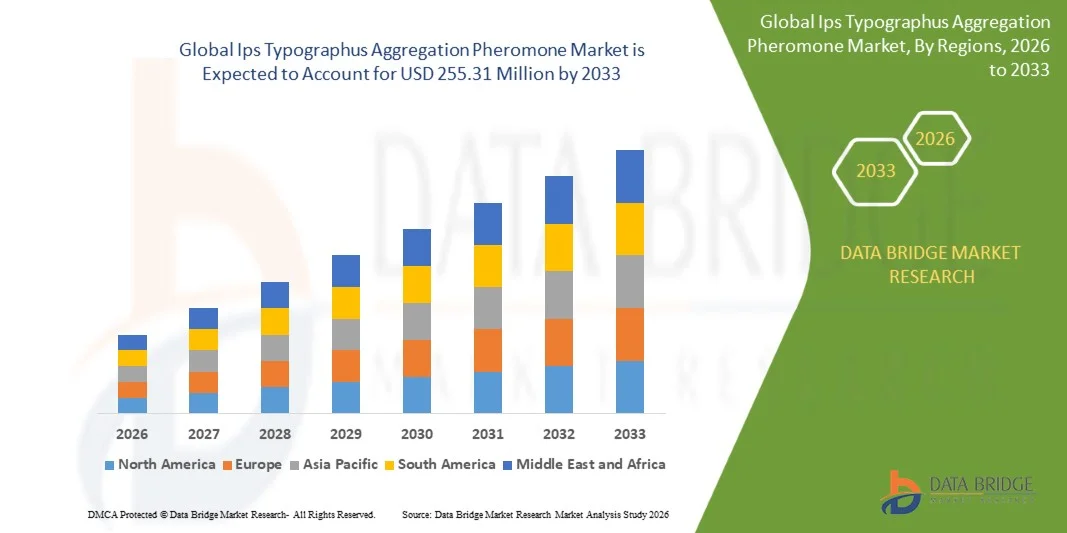
- As per Data Bridge Market Research analysis the Ips typographus aggregation pheromone market was valued at USD 140.00 million in 2025 and is projected to reach USD 255.31 million by 2033, growing at a CAGR of 7.80% from 2026 to 2033.
- The market is experiencing steady growth driven by the increasing incidence of bark beetle infestations, rising adoption of environmentally sustainable forest pest management solutions, and growing use of pheromone-based monitoring and mass trapping systems across commercial and public forests.
- Increasing government initiatives focused on forest conservation, expanding investments in sustainable forestry management, and stricter regulations encouraging reduced chemical pesticide usage are accelerating the adoption of Ips typographus aggregation pheromone products worldwide.
Market Size & Forecast
- Market Value (2025): USD 140.00 Million
- Expected Market Value (2033): USD 255.31 Million
- Forecast CAGR (2026–2033): 7.80%
- Leading Region in 2025: North America
- Fastest Growing Region: Asia-Pacific
What are the Major Takeaways of the Ips Typographus Aggregation Pheromone Market?
- North America is expected to witness steady growth in the Ips typographus aggregation pheromone market from 2026 to 2033, supported by increasing investments in forest health monitoring, integrated pest management (IPM), and sustainable forestry practices.
- Asia-Pacific Ips typographus aggregation pheromone market is expected to witness the fastest growth rate from 2026 to 2033, supported by expanding commercial forestry activities, increasing investments in forest conservation, and rising awareness of sustainable pest management solutions.
- The synthetic pheromones segment held the largest market revenue share in 2025, driven by its high consistency, longer field life, cost-effectiveness, and widespread commercialization in bark beetle monitoring and mass trapping programs. Synthetic formulations are extensively used by forestry agencies and commercial forest managers due to their standardized release rates and reliable performance.
- The natural pheromones segment is projected to register the fastest growth at a CAGR from 2026 to 2033, driven by increasing research into bio-based semiochemicals, growing demand for environmentally sustainable pest management, and expanding applications in ecological studies and conservation projects.
- The forest pest management segment accounted for the largest market revenue share in 2025, driven by increasing bark beetle outbreaks across European forests and the growing adoption of pheromone-based mass trapping programs to reduce timber losses.
- The monitoring segment is projected to register the fastest growth at a CAGR from 2026 to 2033, supported by increasing investments in early pest detection systems, digital forestry technologies, and integrated pest management programs.
Report Scope and Ips Typographus Aggregation Pheromone Market Segmentation
|
Attributes |
Ips Typographus Aggregation Pheromone Key Market Insights |
|
Segments Covered |
|
|
Countries Covered |
North America
Europe
Asia-Pacific
Middle East and Africa
South America
|
|
Key Market Players |
|
|
Market Opportunities |
|
|
Value Added Data Infosets |
In addition to the insights on market scenarios such as market value, growth rate, segmentation, geographical coverage, and major players, the market reports curated by the Data Bridge Market Research also include import export analysis, production capacity overview, production consumption analysis, price trend analysis, climate change scenario, supply chain analysis, value chain analysis, raw material/consumables overview, vendor selection criteria, PESTLE Analysis, Porter Analysis, and regulatory framework. |
What is the Key Trend in the Ips Typographus Aggregation Pheromone Market?
- Forest managers are increasingly adopting aggregation pheromone-based monitoring and mass trapping systems as part of integrated pest management (IPM) programs to detect Ips typographus outbreaks early and reduce dependence on broad-spectrum insecticides.
- For instance, in April 2025, Witasek PflanzenSchutz GmbH highlighted the continued deployment of pheromone trapping solutions for bark beetle monitoring and population management across European forestry operations, supporting sustainable forest protection.
- Advances in controlled-release pheromone dispensers and species-specific lure formulations are improving trapping efficiency, monitoring accuracy, and long-term field performance in commercial forests.
- Forestry agencies and research organizations are increasingly integrating digital forest monitoring, remote sensing, and pheromone trap networks to strengthen early warning systems for bark beetle infestations and improve forest health management.
- For instance, the European Forest Institute continues to support projects promoting integrated forest pest monitoring and climate-resilient forest management, including the use of early detection technologies for bark beetle outbreaks.
What are the Key Drivers of the Ips Typographus Aggregation Pheromone Market?
- The increasing frequency and severity of Ips typographus outbreaks, driven by climate change, drought stress, and storm-damaged forests, has significantly increased demand for aggregation pheromones for early detection and environmentally sustainable pest control.
- For instance, the European and Mediterranean Plant Protection Organization recommends pheromone traps as an important tool for monitoring Ips typographus populations and supporting integrated pest management strategies across Europe.
- Government forestry departments, commercial forest owners, and environmental agencies are increasingly investing in pheromone-based monitoring systems to minimize timber losses, improve outbreak surveillance, and reduce reliance on conventional chemical insecticides.
- For instance, the Swedish University of Agricultural Sciences continues to publish research and operational guidance supporting pheromone trapping for monitoring and management of European spruce bark beetle infestations in Scandinavian forests.
- With forest health becoming a higher priority under climate adaptation strategies, demand for pheromone-based monitoring and management solutions is expected to increase steadily across public and private forestry sectors.
Which Factors are Challenging the Growth of the Ips Typographus Aggregation Pheromone Market?
- Aggregation pheromone programs require continuous field monitoring, regular lure replacement, and proper trap placement to achieve effective bark beetle management, increasing operational complexity and recurring maintenance costs.
- These limitations reduce adoption among small private forest owners and resource-constrained forestry organizations, particularly in developing regions with limited pest monitoring infrastructure.
- For instance, the European Food Safety Authority has noted that pheromone-based monitoring systems are most effective when integrated with broader forest management practices rather than used as standalone control measures, highlighting the operational requirements associated with their implementation.
- The high operational costs, seasonal deployment requirements, and dependence on skilled forest management practices continue to restrict broader adoption, particularly in price-sensitive markets despite growing demand for sustainable pest control solutions.
How is the Ips Typographus Aggregation Pheromone Market Segmented?
The market is segmented on the basis of product type, application, formulation, end user, and distribution channel.
- By Product Type
On the basis of product type, the Ips typographus aggregation pheromone market is segmented into synthetic pheromones and natural pheromones. The synthetic pheromones segment held the largest market revenue share in 2025, driven by its high consistency, longer field life, cost-effectiveness, and widespread commercialization in bark beetle monitoring and mass trapping programs. Synthetic formulations are extensively used by forestry agencies and commercial forest managers due to their standardized release rates and reliable performance.
The natural pheromones segment is projected to register the fastest growth at a CAGR from 2026 to 2033, driven by increasing research into bio-based semiochemicals, growing demand for environmentally sustainable pest management, and expanding applications in ecological studies and conservation projects.
- By Application
On the basis of application, the Ips typographus aggregation pheromone market is segmented into forest pest management, monitoring, research, and others. The forest pest management segment accounted for the largest market revenue share in 2025, driven by increasing bark beetle outbreaks across European forests and the growing adoption of pheromone-based mass trapping programs to reduce timber losses.
The monitoring segment is projected to register the fastest growth at a CAGR from 2026 to 2033, supported by increasing investments in early pest detection systems, digital forestry technologies, and integrated pest management programs.
- By Formulation
On the basis of formulation, the Ips typographus aggregation pheromone market is segmented into dispensers, traps, sprays, and others. The dispensers segment held the largest market revenue share in 2025, owing to their controlled pheromone release, long operational life, and widespread deployment in forest monitoring and mass trapping applications.
The traps segment is expected to witness the fastest growth at a CAGR from 2026 to 2033, driven by increasing installation of pheromone trap networks for early infestation detection and large-scale forest surveillance initiatives.
- By End User
On the basis of end user, the Ips typographus aggregation pheromone market is segmented into forestry agencies, research institutes, commercial users, private landowners, and others. The forestry agencies segment dominated the market with a revenue share in 2025, driven by government-funded forest protection programs, national pest surveillance initiatives, and widespread implementation of integrated pest management strategies.
The commercial users segment is anticipated to register the fastest CAGR during the forecast period of 2026 to 2033, supported by increasing investments from commercial forestry operators seeking to minimize economic losses caused by bark beetle infestations.
- By Distribution Channel
On the basis of distribution channel, the Ips typographus aggregation pheromone market is segmented into direct sales, distributors, online retail, and others. The direct sales segment accounted for the largest market revenue share in 2025, as forestry agencies, government organizations, and large commercial forest operators primarily procure pheromone products directly from manufacturers through long-term supply agreements.
The distributors segment is projected to witness the fastest growth at a CAGR from 2026 to 2033, driven by expanding regional distribution networks, increasing availability of forestry pest management products, and rising adoption among small and medium-sized forest owners.
Which Region Holds the Largest Share of the Ips Typographus Aggregation Pheromone Market?
- North America is expected to witness steady growth in the Ips typographus aggregation pheromone market from 2026 to 2033, supported by increasing investments in forest health monitoring, integrated pest management (IPM), and sustainable forestry practices.
- Although Ips typographus is not native to North America, growing concerns over invasive bark beetle species have encouraged forestry agencies and research organizations to adopt pheromone-based monitoring technologies. Rising emphasis on reducing chemical pesticide use and expanding forest conservation initiatives further supports market growth across the region.
U.S. Ips typographus Aggregation Pheromone Market Insight
The U.S. accounted for the largest revenue share in North America in 2025, driven by extensive forestry research, government-funded forest protection programs, and increasing adoption of semiochemical-based pest monitoring technologies. Universities, federal agencies, and commercial forestry operators continue to invest in pheromone traps for early insect detection, surveillance, and ecological research. The country's strong research infrastructure and emphasis on environmentally sustainable pest management continue to support market expansion.
Europe Ips typographus Aggregation Pheromone Market Insight
Europe dominated the Ips typographus aggregation pheromone market with the largest revenue share of 63.80% in 2025, supported by the widespread occurrence of Ips typographus infestations across spruce forests in Central and Northern Europe. Increasing climate-induced bark beetle outbreaks, government-supported forest protection initiatives, and extensive adoption of pheromone-based monitoring and mass trapping systems continue to drive regional demand. Strict environmental regulations encouraging reduced insecticide usage further strengthen the adoption of aggregation pheromone technologies.
Germany Ips typographus Aggregation Pheromone Market Insight
Germany accounted for the largest market revenue share in Europe in 2025, driven by its extensive conifer forests, advanced forestry management practices, and recurring bark beetle outbreaks affecting spruce plantations. Government agencies, research institutions, and commercial forest owners actively deploy pheromone-based monitoring systems for early infestation detection and integrated pest management. Continued investments in sustainable forestry and digital forest monitoring technologies are expected to support long-term market growth.
Asia-Pacific Ips typographus Aggregation Pheromone Market Insight
The Asia-Pacific Ips typographus aggregation pheromone market is expected to witness the fastest growth rate from 2026 to 2033, supported by expanding commercial forestry activities, increasing investments in forest conservation, and rising awareness of sustainable pest management solutions. Countries across the region are strengthening forest monitoring programs while adopting environmentally friendly pest control technologies to protect timber resources and biodiversity.
Japan Ips typographus Aggregation Pheromone Market Insight
Japan is expected to witness the fastest growth rate in the Asia-Pacific market from 2026 to 2033 due to increasing investments in forest health monitoring, biodiversity conservation, and advanced pest surveillance technologies. Growing adoption of integrated pest management practices and increasing collaboration between forestry agencies and research organizations are supporting the deployment of pheromone-based monitoring systems across managed forest landscapes.
China Ips typographus Aggregation Pheromone Market Insight
China accounted for the largest market revenue share in Asia-Pacific in 2025, supported by its vast forestry resources, expanding afforestation initiatives, and increasing government investment in forest pest monitoring programs. Growing emphasis on protecting commercial forests from bark beetle infestations, combined with rising adoption of environmentally sustainable pest management technologies, continues to drive demand for aggregation pheromone products across the country.
Which are the Top Companies in Ips Typographus Aggregation Pheromone Market?
The Ips typographus aggregation pheromone industry is primarily led by well-established companies, including:
- International Pheromone Systems Ltd. (U.K.)
- Suterra LLC (U.S.)
- Trécé, Inc. (U.S.)
- Russell IPM Ltd. (U.K.)
- Pherobank B.V. (Netherlands)
- Biobest Group NV (Belgium)
- IPSOLAB Sp. z o.o. (Poland)
- Koppert Biological Systems (Netherlands)
- Pheromone Chemicals (India)
- Witasek PflanzenSchutz GmbH (Austria)
- Provivi, Inc. (U.S.)
- Synergy Semiochemicals Corp. (Canada)
- ISCA Technologies, Inc. (U.S.)
- SEDQ Healthy Crops S.L. (Spain)
- ChemTica Internacional S.A. (Costa Rica)

- Interactive Data Analysis Dashboard
- Company Analysis Dashboard for high growth potential opportunities
- Research Analyst Access for customization & queries
- Competitor Analysis with Interactive dashboard
- Latest News, Updates & Trend analysis
- Harness the Power of Benchmark Analysis for Comprehensive Competitor Tracking
Data collection and base year analysis are done using data collection modules with large sample sizes. The stage includes obtaining market information or related data through various sources and strategies. It includes examining and planning all the data acquired from the past in advance. It likewise envelops the examination of information inconsistencies seen across different information sources. The market data is analysed and estimated using market statistical and coherent models. Also, market share analysis and key trend analysis are the major success factors in the market report. To know more, please request an analyst call or drop down your inquiry.
The key research methodology used by DBMR research team is data triangulation which involves data mining, analysis of the impact of data variables on the market and primary (industry expert) validation. Data models include Vendor Positioning Grid, Market Time Line Analysis, Market Overview and Guide, Company Positioning Grid, Patent Analysis, Pricing Analysis, Company Market Share Analysis, Standards of Measurement, Global versus Regional and Vendor Share Analysis. To know more about the research methodology, drop in an inquiry to speak to our industry experts.
Data Bridge Market Research is a leader in advanced formative research. We take pride in servicing our existing and new customers with data and analysis that match and suits their goal. The report can be customized to include price trend analysis of target brands understanding the market for additional countries (ask for the list of countries), clinical trial results data, literature review, refurbished market and product base analysis. Market analysis of target competitors can be analyzed from technology-based analysis to market portfolio strategies. We can add as many competitors that you require data about in the format and data style you are looking for. Our team of analysts can also provide you data in crude raw excel files pivot tables (Fact book) or can assist you in creating presentations from the data sets available in the report.