


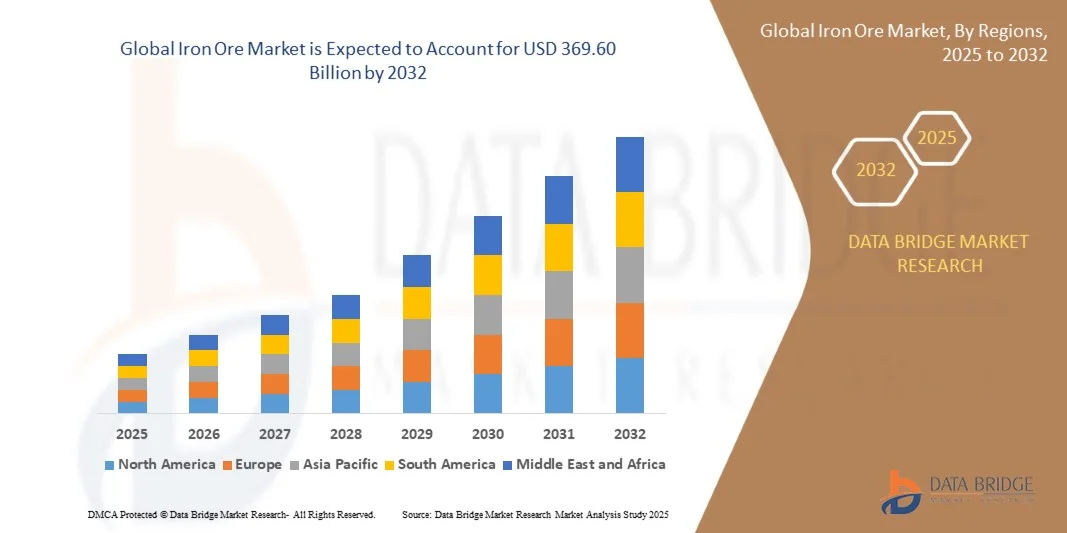
Iron Ore Market Size
- The global iron ore market size was valued at USD 268.00 billion in 2024 and is expected to reach USD 369.60 billion by 2032, at a CAGR of 4.10% during the forecast period
- The market growth is largely fuelled by the rising demand for steel in construction, automotive, and infrastructure sectors across developing economies
- Rapid urbanization, industrial expansion, and increased government investment in public infrastructure projects are driving consistent consumption of iron ore globally
Iron Ore Market Analysis
- The global iron ore market is witnessing steady growth, primarily driven by the robust expansion of the steel industry and surging construction activities in emerging markets
- The demand for high-grade iron ore is rising due to its efficiency in blast furnaces and reduced environmental impact during steel production
- Asia-Pacific dominated the iron ore market with the largest revenue share of 63.10% in 2024, driven by rapid industrialization, extensive steel production, and robust infrastructure development across major economies such as China, India, and Japan
- North America region is expected to witness the highest growth rate in the global iron ore market, driven by expanding industrial production, technological innovation in extraction methods, and supportive government initiatives for resource development
- The fines segment held the largest market revenue share in 2024, driven by its widespread use in the steel manufacturing industry due to easier processing and high availability. Iron ore fines are commonly utilized in sintering and pelletizing processes to produce feedstock for blast furnaces, making them an essential input for large-scale steel production. Their relatively lower cost and consistent supply make them a preferred choice among major steelmakers across Asia-Pacific and Europe
Report Scope and Iron Ore Market Segmentation
|
Attributes |
Iron Ore Key Market Insights |
|
Segments Covered |
|
|
Countries Covered |
North America
Europe
Asia-Pacific
Middle East and Africa
South America
|
|
Key Market Players |
|
|
Market Opportunities |
|
|
Value Added Data Infosets |
In addition to the insights on market scenarios such as market value, growth rate, segmentation, geographical coverage, and major players, the market reports curated by the Data Bridge Market Research also include import export analysis, production capacity overview, production consumption analysis, price trend analysis, climate change scenario, supply chain analysis, value chain analysis, raw material/consumables overview, vendor selection criteria, PESTLE Analysis, Porter Analysis, and regulatory framework. |
Iron Ore Market Trends
“Growing Adoption of Sustainable Mining and Green Steel Production”
- The increasing focus on sustainability in the mining sector is transforming the global iron ore market, with producers investing in low-emission extraction and processing technologies. This shift is largely driven by global efforts to reduce carbon footprints in the steel industry, which accounts for a major share of industrial emissions. Companies are adopting renewable energy sources and advanced beneficiation techniques to improve efficiency and reduce waste generation. In addition, automation and AI-driven monitoring systems are being integrated to enhance energy utilization and lower environmental risks during mining operations
- The rising demand for green steel—produced using hydrogen-based direct reduction methods—is further influencing iron ore quality requirements. High-grade iron ore is gaining preference as it enables efficient smelting and minimizes carbon output, aligning with the environmental goals of major steelmakers across Europe and Asia. This trend is prompting miners to upgrade ore quality through beneficiation and blending processes to cater to green steel producers. Furthermore, partnerships between miners and steel companies are increasing to secure a long-term supply of high-grade ore for sustainable production
- Governments are introducing stricter emission norms and sustainability frameworks, compelling mining firms to enhance operational transparency and environmental performance. These regulatory pressures are fostering innovation in ore extraction and logistics management to meet eco-friendly standards. As environmental, social, and governance (ESG) benchmarks gain importance, mining companies are adopting advanced waste management practices and water recycling technologies. Moreover, sustainability certifications and carbon reporting are becoming mandatory for global trade compliance
- For instance, in 2023, Rio Tinto launched a decarbonization initiative aimed at developing low-carbon iron ore mining processes across its Australian operations. The project, conducted in collaboration with major steel producers, is expected to set new benchmarks in sustainable ore extraction and supply chain optimization. The initiative also focuses on renewable-powered mining equipment, green transport solutions, and carbon capture technologies. This move aligns with global efforts to reduce scope 1 and 2 emissions across the mining and metal value chain
- While the adoption of sustainable mining practices presents significant opportunities, it also requires high capital investments and advanced infrastructure. Continuous innovation, technological collaboration, and regulatory support will be critical for driving sustainable transformation across the global iron ore industry. In addition, miners must balance cost efficiency with long-term sustainability goals to remain competitive. The integration of digital mining, smart logistics, and renewable energy systems will further determine the pace of progress in this transition
Iron Ore Market Dynamics
Driver
“Increasing Demand From Steel Manufacturing Industry”
- The growing demand for steel in construction, automotive, shipbuilding, and infrastructure projects is the primary driver of the global iron ore market. Steel production remains heavily reliant on iron ore as a key raw material, and ongoing industrialization in emerging economies continues to accelerate consumption. The construction of smart cities, high-speed rail networks, and renewable energy infrastructure is boosting steel use globally. Moreover, population growth and urbanization in developing countries are amplifying the long-term demand outlook for iron ore
- Expanding infrastructure development programs in regions such as Asia-Pacific and the Middle East have further strengthened demand. Governments are investing heavily in transportation networks, energy systems, and urban development projects, all of which require vast quantities of steel. For example, large-scale projects such as the Belt and Road Initiative and Saudi Arabia’s Vision 2030 are increasing the regional steel output, thereby driving ore consumption. The consistent growth in civil engineering activities continues to reinforce the role of iron ore in global industrial expansion
- The increasing use of high-strength and lightweight steel in the automotive sector, driven by fuel efficiency standards, is also contributing to the rising need for quality iron ore. Steelmakers are focusing on sourcing high-grade ore to ensure improved productivity and energy efficiency during smelting operations. The demand for electric vehicles is further influencing steel formulations that require pure, low-impurity ore inputs. This shift is encouraging miners to prioritize quality enhancement and supply consistency to meet advanced manufacturing needs
- For instance, in 2024, India’s National Steel Policy emphasized the need to expand domestic steel production capacity, indirectly driving demand for iron ore mining and processing. This initiative is expected to boost local supply chains and support economic growth in the mining sector. It also encourages public-private partnerships to modernize iron ore extraction and logistics infrastructure. Such national frameworks are expected to strengthen the global position of emerging producers in the iron ore value chain
- As global steel consumption continues to rise, iron ore producers are expanding production capacities and investing in logistics infrastructure to meet growing demand efficiently and sustainably. Companies are building new mines and upgrading rail and port facilities to enhance export capacity. In addition, automation in material handling and digitalized inventory management are improving operational throughput. These developments are essential to ensure supply reliability and maintain competitive advantage in a dynamic market
Restraint/Challenge
“Fluctuating Prices and Environmental Regulations”
- Price volatility in the global iron ore market remains a major challenge, influenced by supply-demand imbalances, geopolitical tensions, and currency fluctuations. These fluctuations affect profitability for mining companies and create uncertainty for long-term investment planning. Sudden changes in Chinese demand, shipping bottlenecks, and speculative trading activities often contribute to market instability. As a result, producers are increasingly adopting hedging strategies and long-term contracts to mitigate price-related risks
- Environmental regulations are also becoming stricter, particularly in major producing countries such as Australia, Brazil, and China. Compliance with emission standards, land rehabilitation norms, and water usage restrictions increases operational costs for mining firms, limiting profitability margins. Regulatory compliance now extends to detailed sustainability audits, waste reduction targets, and community welfare obligations. These factors not only increase expenses but also require operational restructuring and long-term sustainability reporting
- The increasing focus on sustainability has led to the closure or suspension of non-compliant mining operations, particularly small-scale producers. This has created periodic supply shortages, intensifying market instability and affecting global trade patterns. Moreover, delays in obtaining environmental clearances have slowed project approvals, further restricting production capacity. These supply constraints are forcing major steelmakers to diversify sourcing strategies and explore alternative ore markets
- For instance, in 2023, several iron ore mines in China faced temporary shutdowns due to environmental audits, disrupting domestic supply and driving short-term price hikes across the Asian market. These fluctuations underscored the growing regulatory influence on the industry’s stability. The government’s efforts to balance environmental sustainability with industrial output continue to impact short-term supply trends. This situation highlights the importance of policy coordination between producers and regulators to maintain market equilibrium
- Overcoming these challenges requires enhanced market transparency, diversification of supply chains, and the integration of green technologies. Companies that successfully balance cost efficiency with sustainability compliance will remain competitive in the evolving iron ore market. Strategic investments in recycling, carbon-neutral operations, and digital forecasting models are becoming crucial for long-term resilience. Strengthening international cooperation and innovation partnerships will also play a key role in mitigating regulatory and price-related risks
Iron Ore Market Scope
The market is segmented on the basis of type and end use.
• By Type
On the basis of type, the global iron ore market is segmented into fines, pellets, and lump. The fines segment held the largest market revenue share in 2024, driven by its widespread use in the steel manufacturing industry due to easier processing and high availability. Iron ore fines are commonly utilized in sintering and pelletizing processes to produce feedstock for blast furnaces, making them an essential input for large-scale steel production. Their relatively lower cost and consistent supply make them a preferred choice among major steelmakers across Asia-Pacific and Europe.
The pellets segment is expected to witness the fastest growth rate from 2025 to 2032, driven by the rising demand for high-grade feed material in energy-efficient steelmaking technologies. Iron ore pellets offer superior metallurgical properties, including high iron content and reduced impurities, which enhance productivity and lower carbon emissions during smelting. Growing adoption of direct reduction iron (DRI) and electric arc furnace (EAF) technologies in developed markets is further accelerating pellet consumption, particularly in regions transitioning toward green steel production.
• By End Use
On the basis of end use, the global iron ore market is segmented into the steel industry and others. The steel industry segment dominated the market in 2024, accounting for the majority of iron ore consumption globally. The increasing demand for steel in construction, automotive, and infrastructure projects continues to drive steady growth in iron ore mining and processing. Expanding industrialization in emerging economies and government-backed infrastructure investments further reinforce the segment’s dominance.
The others segment is expected to witness the fastest growth rate from 2025 to 2032. These industries use iron ore derivatives for specific production processes, including pigment and catalyst manufacturing. Although smaller in scale compared to steelmaking, ongoing diversification in industrial uses of iron ore supports incremental demand growth and promotes market stability across secondary end-use sectors.
Iron Ore Market Regional Analysis
- Asia-Pacific dominated the iron ore market with the largest revenue share of 63.10% in 2024, driven by rapid industrialization, extensive steel production, and robust infrastructure development across major economies such as China, India, and Japan
- The region’s strong demand for construction materials, automobiles, and heavy machinery continues to fuel iron ore consumption, making it the central hub of global trade and production
- Abundant natural resources, coupled with increasing investments in mining and logistics infrastructure, have further strengthened Asia-Pacific’s leadership in global iron ore supply and demand dynamics
China Iron Ore Market Insight
The China iron ore market captured the largest revenue share in 2024 within Asia-Pacific, driven by its position as the world’s leading steel producer and consumer. The nation’s extensive infrastructure projects, coupled with ongoing urbanization and manufacturing expansion, sustain high demand for iron ore imports. Domestic mining operations, though significant, often rely on imported high-grade ores to meet quality standards for advanced steelmaking processes. Moreover, China’s push toward green steel and carbon-neutral production is promoting investments in high-efficiency pellet and sinter technologies, strengthening the long-term demand for premium iron ore.
Japan Iron Ore Market Insight
The Japan iron ore market is expected to experience notable growth from 2025 to 2032, supported by a strong demand from the nation’s advanced steel industry and its continuous pursuit of technological innovation. Japan’s integrated steel producers prioritize high-grade ore imports to optimize production efficiency and reduce emissions, aligning with national decarbonization goals. The increasing adoption of hydrogen-based steelmaking processes and recycling technologies is reshaping the country’s ore consumption patterns. Furthermore, Japan’s commitment to sustainable industrial practices continues to encourage long-term partnerships with global iron ore suppliers, ensuring supply chain stability and product quality.
Europe Iron Ore Market Insight
The Europe iron ore market is expected to experience notable growth from 2025 to 2032, driven by the region’s transition toward green steel and low-carbon manufacturing. Stringent environmental regulations are compelling steel producers to adopt cleaner technologies, increasing demand for high-grade ore suitable for direct reduction processes. Countries such as Germany and Sweden are leading this shift through investments in hydrogen-based steel plants and renewable-powered smelting operations. In addition, Europe’s focus on circular economy initiatives and resource efficiency is reshaping import strategies, fostering partnerships with sustainable mining companies worldwide.
Germany Iron Ore Market Insight
The Germany iron ore market is expected to experience notable growth from 2025 to 2032, supported by the nation’s robust industrial base and its leadership in sustainable steel production. Germany’s steelmakers are increasingly sourcing high-grade iron ore to reduce energy consumption and carbon emissions. The government’s ongoing support for hydrogen-powered steelmaking and renewable energy integration further enhances the market’s sustainability outlook. Moreover, the country’s emphasis on advanced material research and innovation continues to create opportunities for efficient, eco-friendly ore utilization in the manufacturing sector.
U.K. Iron Ore Market Insight
The U.K. iron ore market is expected to witness moderate growth from 2025 to 2032, driven by the nation’s ongoing efforts to modernize its steel industry and reduce carbon emissions. Although the country relies heavily on imported iron ore, the demand remains steady due to rising investments in green steel initiatives and renewable energy-powered smelting technologies. The U.K. government’s focus on achieving net-zero emissions by 2050 is encouraging steel producers to adopt cleaner production methods, boosting demand for high-grade, low-impurity ores. Furthermore, growing construction activities and infrastructure renewal projects, such as transport and housing development, continue to support consistent iron ore consumption across the country.
North America Iron Ore Market Insight
The North America iron ore market is expected to experience notable growth from 2025 to 2032, driven by stable demand from the construction, automotive, and energy sectors. The U.S. and Canada are investing heavily in modernizing mining operations and expanding domestic steelmaking capacities to reduce dependence on imports. The adoption of electric arc furnaces (EAFs) and clean energy initiatives is promoting the use of high-grade ore and recycled materials. In addition, infrastructure renewal projects across the U.S., including transportation and renewable energy expansion, continue to support iron ore consumption and market stability.
U.S. Iron Ore Market Insight
The U.S. iron ore market is expected to experience notable growth from 2025 to 2032, propelled by increasing infrastructure investments and the rising need for sustainable steel production. Domestic mining operations in Minnesota and Michigan are key contributors, supplying high-grade ore to regional steel producers. The country’s focus on reshoring industrial production and advancing clean energy infrastructure further stimulates demand. Moreover, partnerships between mining companies and technology providers are improving productivity, energy efficiency, and environmental performance across the U.S. iron ore sector.
Iron Ore Market Share
The Iron Ore industry is primarily led by well-established companies, including:
- Anglo American (U.K.)
- Ansteel Group Corporation Limited (China)
- ArcelorMittal (Luxembourg)
- BHP (Australia)
- Cleveland-Cliffs Inc. (U.S.)
- EVRAZ plc (U.K.)
- Fortescue Metals Group Ltd (Australia)
- HBIS Group (China)
- LKAB (Sweden)
- Metalloinvest MC LLC (Russia)
- Rio Tinto (U.K.)
- Vale (Brazil)
Latest Developments in Global Iron Ore Market
- In April 2024, Strike Resources Limited (Australia) finalized the sale of its Pilbara Paulsens East Iron Ore Project to Miracle Iron Holdings for approximately USD 13.4 million. This strategic divestment allows Strike Resources to reallocate capital toward higher-value mining ventures, while Miracle Iron Holdings gains access to a resource-rich asset in one of Australia’s most productive iron ore regions, strengthening its position in the domestic market
- In February 2025, Vale (Brazil) announced a major investment of USD 12.26 billion in its Carajás complex in Pará, to be deployed through 2030. The initiative aims to increase annual iron ore production to 200 million tons and expand copper output by 32%, reinforcing Vale’s leadership in the global mining industry. This large-scale investment is expected to boost supply stability and support long-term demand for steel and base metals
- In March 2024, Vale (Brazil) and Jinnan Steel Group (China) revealed a joint investment of over USD 600 million to build an iron ore beneficiation plant at Sohar Port and Freezone in Oman. The facility will process 18 million tonnes of low-grade ore annually, yielding 12.6 million tonnes of high-grade concentrate for direct reduction pellets and briquettes. Scheduled for completion by mid-2027, the project will advance low-carbon steel production and enhance regional beneficiation capacity

- Interactive Data Analysis Dashboard
- Company Analysis Dashboard for high growth potential opportunities
- Research Analyst Access for customization & queries
- Competitor Analysis with Interactive dashboard
- Latest News, Updates & Trend analysis
- Harness the Power of Benchmark Analysis for Comprehensive Competitor Tracking
Global Iron Ore Market, Supply Chain Analysis and Ecosystem Framework
To support market growth and help clients navigate the impact of geopolitical shifts, DBMR has integrated in-depth supply chain analysis into its Global Iron Ore Market research reports. This addition empowers clients to respond effectively to global changes affecting their industries. The supply chain analysis section includes detailed insights such as Global Iron Ore Market consumption and production by country, price trend analysis, the impact of tariffs and geopolitical developments, and import and export trends by country and HSN code. It also highlights major suppliers with data on production capacity and company profiles, as well as key importers and exporters. In addition to research, DBMR offers specialized supply chain consulting services backed by over a decade of experience, providing solutions like supplier discovery, supplier risk assessment, price trend analysis, impact evaluation of inflation and trade route changes, and comprehensive market trend analysis.
Data collection and base year analysis are done using data collection modules with large sample sizes. The stage includes obtaining market information or related data through various sources and strategies. It includes examining and planning all the data acquired from the past in advance. It likewise envelops the examination of information inconsistencies seen across different information sources. The market data is analysed and estimated using market statistical and coherent models. Also, market share analysis and key trend analysis are the major success factors in the market report. To know more, please request an analyst call or drop down your inquiry.
The key research methodology used by DBMR research team is data triangulation which involves data mining, analysis of the impact of data variables on the market and primary (industry expert) validation. Data models include Vendor Positioning Grid, Market Time Line Analysis, Market Overview and Guide, Company Positioning Grid, Patent Analysis, Pricing Analysis, Company Market Share Analysis, Standards of Measurement, Global versus Regional and Vendor Share Analysis. To know more about the research methodology, drop in an inquiry to speak to our industry experts.
Data Bridge Market Research is a leader in advanced formative research. We take pride in servicing our existing and new customers with data and analysis that match and suits their goal. The report can be customized to include price trend analysis of target brands understanding the market for additional countries (ask for the list of countries), clinical trial results data, literature review, refurbished market and product base analysis. Market analysis of target competitors can be analyzed from technology-based analysis to market portfolio strategies. We can add as many competitors that you require data about in the format and data style you are looking for. Our team of analysts can also provide you data in crude raw excel files pivot tables (Fact book) or can assist you in creating presentations from the data sets available in the report.













