What is the Iron Ore Pellet Market Size and Growth Rate?
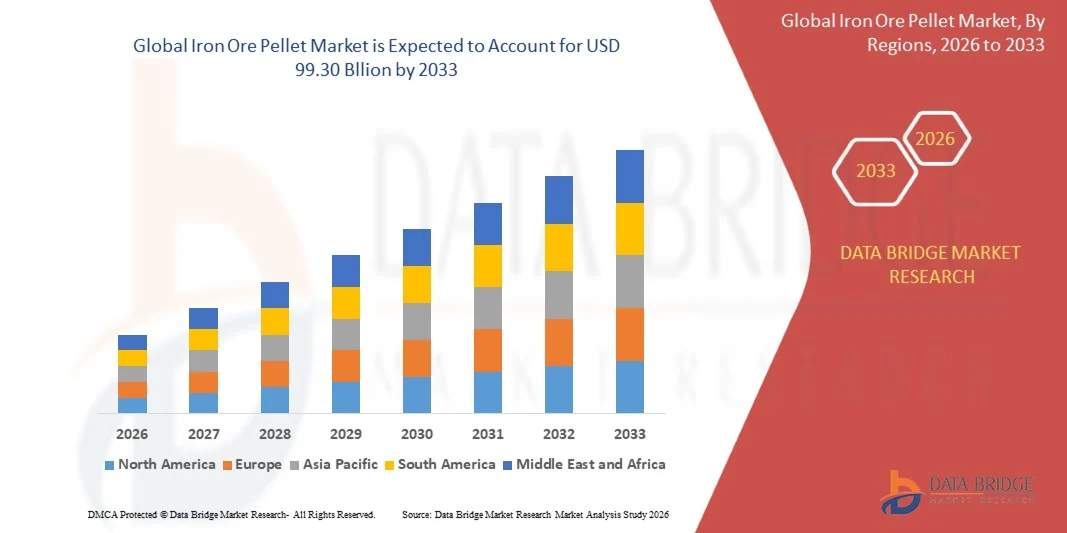
- As per Data Bridge Market Research analysis, the iron ore pellet market was valued at USD 73.12 billion in 2025 and is projected to reach USD 99.30 billion by 2033, growing at a CAGR of 3.9% from 2026 to 2033.
- The market is experiencing consistent growth driven by rising steel demand, increasing adoption of direct reduction and electric arc furnace routes, and expanding applications across construction, automotive, machinery, and energy sectors.
- The increasing shift toward high-grade iron-bearing feedstock, low-carbon steelmaking, and efficient blast furnace operations, combined with growing investment in direct reduction capacity and pelletizing plants, is supporting market adoption. Iron ore pellet is being applied across blast furnace ironmaking, direct reduced iron production, sinter blending, and electric arc furnace feed, offering steelmakers higher iron content, lower emissions, and better productivity across integrated steel operations.
Market Size & Forecast
- Global Market Value (2025): USD 73.12 Billion
- Expected Market Value (2033): USD 99.30 Billion
- Forecast CAGR (2026–2033): 3.9%
- Leading Region in 2025: Asia-Pacific
- Fastest Growing Region: Middle East and Africa
What are the Major Takeaways of the Iron Ore Pellet Market?
- Asia-Pacific dominated the iron ore pellet market with the largest revenue share of 61.80% in 2025, supported by large-scale blast furnace steel production, domestic pelletizing capacity, and strong construction and manufacturing demand across the region.
- Middle East and Africa is expected to be the fastest-growing region at a CAGR of 5.40% from 2026 to 2033, fueled by expanding direct reduction capacity, new pelletizing plants, and growing low-carbon steel investments.
- The blast furnace pellet segment led the market with a 57.9% share in 2025, driven by extensive use in integrated steel mills, productivity gains, and lower coke consumption.
- Direct reduction pellets are the fastest-growing product type, projected to register a CAGR of 5.6%, reflecting the surge in demand for high-grade feedstock for gas-based ironmaking.
- The 63–65% iron content segment dominated the grade category with a 44.7% revenue share in 2025, led by extensive use in blast furnace operations across major steel producers.
- Blast furnace ironmaking accounted for 59.4% of the market share in 2025, supported by increasing demand for efficient, high-productivity operations in integrated steel plants.
- The energy and power segment is the fastest-growing end-user category, with a CAGR of 5.3%, driven by increasing demand for steel in wind, grid, and pipeline projects.
Report Scope and Iron Ore Pellet Market Segmentation
|
Attributes |
Iron Ore Pellet Key Market Insights |
|
Segments Covered |
|
|
Countries Covered |
North America
Europe
Asia-Pacific
Middle East and Africa
South America
|
|
Key Market Players |
|
|
Market Opportunities |
|
|
Value Added Data Infosets |
In addition to the insights on market scenarios such as market value, growth rate, segmentation, geographical coverage, and major players, the market reports curated by the Data Bridge Market Research also include in-depth expert analysis, geographically represented company-wise production and capacity, network layouts of distributors and partners, detailed and updated price trend analysis and deficit analysis of supply chain and demand. |
What is the Key Trend in the Iron Ore Pellet Market?
- Iron ore pellet producers are increasingly shifting from standard blast furnace supply toward high-grade, low-impurity, direct reduction grades, combining improved beneficiation, flexible pelletizing lines, and regional processing hubs to serve low-carbon steelmaking.
- For instance, in January 2026, according to GMK Center, Vale expected a final investment decision in 2026 on a USD 5 billion mega hub in Duqm, Oman, to produce low-carbon pellets and hot briquetted iron for Middle East steel mills, with the first phase planned in 2026 and construction expected to be completed by 2029.
- Direct reduction plants are driving premium demand for pellets with low gangue and tight chemical tolerances, encouraging suppliers to dedicate pelletizing lines to DR-grade production.
- Producers are also localizing processing near steelmakers, with pelletizing plants and distribution centres in the Gulf serving regional DRI plants while supplying Asian customers, shortening logistics distance and improving supply reliability.
- For instance, in January 2026, according to The Energy Year, Vale’s pelletizing plant at Sohar, Oman, originally built for 9 million tonnes per year, had reached 9.9 million tonnes per year, supplying leading steelmakers in Saudi Arabia, the UAE, and Qatar, highlighting the growing role of Gulf-based pelletizing capacity in regional DRI supply chains.
- As direct reduction capacity, electric arc furnace adoption, and green steel investments continue to expand, iron ore pellets are expected to evolve beyond a blast furnace input into a strategic enabler of low-carbon steelmaking worldwide.
What are the Key Drivers of the Iron Ore Pellet Market?
- Rising steel demand for construction, infrastructure, and manufacturing has increased the need for high-grade iron-bearing feedstock that improves furnace productivity, lowers coke consumption, and reduces emissions.
- For instance, in November 2022, according to Reuters, Vale’s head of iron ore said seaborne demand for high-grade agglomerated products used in direct reduction could grow by 100 million tonnes over the next 15 to 20 years, supporting long-term pellet demand and investment in dedicated feedstock capacity across the Middle East and other regions.
- Steelmakers, DRI producers, and electric arc furnace operators are expanding gas-based ironmaking and low-carbon capacity, increasing consumption of premium pellets with high iron content and low impurities.
- For instance, in October 2022, Vale and Saudi Arabia’s National Industrial Development Center signed an MoU for a 4 million tonne-per-year pellet plant in Ras Al-Khair, estimated at about USD 1.1 billion, in a country where more than 16 million tonnes per year of existing steel capacity uses pellets as feedstock.
- With emission regulations tightening, pellets offer lower energy consumption and cleaner ironmaking than sinter and lump ore, supporting adoption by large integrated steel producers worldwide.
What Factors Are Challenging the Growth of the Iron Ore Pellet Market?
- Iron ore pellet production is capital-intensive and energy-intensive, requiring high-grade concentrate, pelletizing plants, and long-distance logistics, while price volatility affects the profitability of producers.
- For instance, in July 2025, according to Reuters, Vale lowered its 2025 iron ore agglomerates output forecast to 31–35 million tonnes from 38–42 million tonnes, citing oversupply and reduced demand for high-quality products, as analysts noted steelmakers prioritizing cheaper alternatives amid shrinking margins.
- Steel demand cycles, weak margins, and oversupply can push steelmakers toward cheaper feed, reduce pellet premiums, and delay investments among producers, particularly where blast furnace demand is under pressure.
- Pellet plants depend on scarce high-grade pellet feed, and long shipping routes, port constraints, and freight costs can increase delivered prices, affect contract negotiations, and limit supply flexibility for distant steel mills.
- The combination of volatile iron ore prices, uneven steel demand, high capital and energy costs, and logistics constraints can limit expansion among cost-sensitive producers, particularly where sinter and lump ore already satisfy basic ironmaking requirements.
How is the Iron Ore Pellet Market Segmented?
The iron ore pellet market is segmented on the basis of product, iron content, application, and end user.
- By Product
On the basis of product, the iron ore pellet market is segmented into blast furnace pellets and direct reduction pellets. The blast furnace pellet segment dominated the market with 57.9% share in 2025, supported by extensive use in integrated steel mills and productivity-focused ironmaking. Blast furnace pellets improve burden permeability and reduce coke consumption compared with traditional feed. They are increasingly used across large steel producers in Asia, Europe, and the Americas. Improvements in pellet strength, basicity control, and fluxed products are further strengthening demand. Integration with long-term supply contracts also enables stable raw material availability for steel plants.
The direct reduction pellet segment is projected to register the fastest growth at a CAGR of 5.6% from 2026 to 2033, driven by increasing demand for high-grade feedstock in gas-based ironmaking. DR pellets require very high iron content and low impurities, supporting efficient reduction in shaft furnaces. Their applications include DRI and hot briquetted iron production for electric arc furnaces. Increasing investment in green steel and low-carbon capacity is creating additional demand across the Middle East, Europe, and North America. Improvements in beneficiation and pelletizing technologies are enhancing quality. Dedicated DR-grade pelletizing lines and regional processing hubs are also improving supply availability. They also support new DRI modules.
- By Iron Content
On the basis of iron content, the iron ore pellet market is segmented into below 63%, 63–65%, and above 65%. The 63–65% segment dominated the market with 44.7% share in 2025, supported by extensive use in blast furnace operations across major steel producers. This grade range offers a balanced combination of productivity, cost efficiency, and availability. Its supply from multiple mines and plants expands the potential customer base. Blast furnace operators use it to maintain stable burden quality and consistent hot metal output across varied operating conditions. The segment also benefits from established long-term contracts and logistics networks.
The above 65% segment is projected to register the fastest growth at a CAGR of 5.8% from 2026 to 2033, supported by increasing adoption of direct reduction and electric arc furnace routes. Higher iron content reduces slag volumes, energy consumption, and emissions across ironmaking and steelmaking stages. High-grade pellets are particularly important for shaft furnace operations requiring low gangue. Steelmakers are increasingly securing premium supply through long-term agreements and joint investments. Improved beneficiation and quality control further strengthen the segment’s attractiveness. Limited availability of suitable pellet feed remains an important consideration for expansion, particularly outside regions with domestic supply.
- By Application
On the basis of application, the iron ore pellet market is segmented into blast furnace ironmaking, direct reduced iron production, sinter blending, and others. The blast furnace ironmaking segment dominated the application category with 59.4% share in 2025, supported by increasing demand for efficient, high-productivity operations in integrated steel plants. Pellets enable stable burden distribution and lower fuel rates. Regulatory focus on emission reduction is increasing the use of pellets in blast furnace charges. Large integrated steel producers in Asia and Europe continue to rely on pellets for productivity. Steelmakers are also seeking materials that combine strength, uniform size, and consistent chemistry.
The direct reduced iron production segment is projected to register the fastest growth at a CAGR of 5.7% from 2026 to 2033, driven by increasing demand for low-carbon steel and expanding electric arc furnace capacity. DR-grade pellets can support efficient gas-based reduction with lower emissions than conventional routes. Producers in the Middle East, North Africa, and India are investing in new modules and hubs. Hydrogen-ready plants and green steel projects are creating additional demand for high-quality pellets. Long contract cycles and strict chemistry requirements make qualified supply particularly important. Supportive policies for decarbonization can further improve project visibility across regions.
- By End User
On the basis of end user, the iron ore pellet market is segmented into construction & infrastructure, automotive, machinery & equipment, energy & power, and others. The construction & infrastructure segment dominated the end-user category with 41.3% share in 2025, supported by increasing requirements for long and flat steel products. Builders, contractors, and infrastructure developers rely on steel for strength and durability. Pellets support the efficient production of rebar, structural sections, and plates. Increasing investment in housing, transport, and urban infrastructure is creating further opportunities. Large project pipelines also make reliable steel supply an important consideration in procurement decisions.
The energy & power segment is projected to register the fastest growth at CAGR of 5.3% from 2026 to 2033, driven by increasing demand for steel in wind towers, power grids, pipelines, and generation equipment. Large structures and high-strength plates require consistent steel quality and dependable raw material supply. Developers and equipment makers are expanding renewable and grid projects worldwide. Closer collaboration between steelmakers and suppliers is accelerating development of tailored products. Government investment in clean energy is further supporting adoption. Cost competitiveness, quality, and logistics remain important considerations for large-scale deployment across projects. Offshore wind and transmission expansion are also creating large steel orders.
Which Region Holds the Largest Share of the Iron Ore Pellet Market?
- Asia-Pacific dominated the iron ore pellet market with the largest revenue share of 61.80% in 2025, supported by large-scale blast furnace steel production, domestic pelletizing capacity, and strong construction and manufacturing demand across the region.
- The region also benefits from high steel output, extensive infrastructure investment, and the presence of established mining and steel producers, along with strong demand for pellets in integrated mills. Increasing use of pellets for efficiency and emission reduction, along with expanding direct reduction projects, continues to strengthen Asia-Pacific’s position in the global market.
China Iron Ore Pellet Market Insight
The China iron ore pellet market is witnessing consistent growth due to rising investments in efficient blast furnace operations, environmental upgrades, and high-grade raw material use. Integrated steelmakers, pellet producers, and large steel groups are increasingly adopting pellets to lower fuel consumption and emissions. Moreover, domestic concentrate supply, large-scale industrial capacity, and growing electric arc furnace adoption are further contributing to market growth in China.
India Iron Ore Pellet Market Insight
The India iron ore pellet market is growing rapidly, driven by expanding steel capacity, rising infrastructure spending, and increasing adoption of direct reduction technologies across integrated and secondary producers. Growing use of pellets in blast furnaces and DRI plants is boosting market demand. In addition, strong domestic iron ore resources, new pelletizing capacity, and government support for steel self-reliance are positioning India as a key growth market for pellets across Asia-Pacific, supported by rising domestic consumption.
Middle East and Africa Iron Ore Pellet Market Insight
The Middle East and Africa iron ore pellet market is expected to witness rapid growth, driven by expanding direct reduction capacity, new pelletizing plants, and increasing investments in low-carbon steel across countries such as Saudi Arabia, the U.A.E., and Oman. Growing demand for DR-grade pellets, competitive energy supply, and strategic port locations is supporting regional market expansion. In addition, the region’s emerging mega hub projects and increasing adoption of gas-based ironmaking are accelerating demand for high-quality pellets.
South Africa Iron Ore Pellet Market Insight
The South Africa iron ore pellet market is driven by growing steel production, infrastructure development, and demand for high-grade iron-bearing materials. Pelletization supports efficient blast furnace and direct reduction processes, improving productivity and reducing emissions. Market growth depends on iron ore availability, energy costs, export demand, and global steel prices. However, infrastructure constraints, logistics challenges, and competition from other suppliers may limit expansion. Investments in beneficiation and sustainable technologies present promising opportunities for long-term growth.
UAE Iron Ore Pellet Market Insight
The UAE iron ore pellet market is supported by expanding steel production, infrastructure development, and rising demand for high-quality raw materials. Pellet imports play a vital role in supplying direct reduction iron (DRI) plants and supporting low-emission steelmaking. Market growth is influenced by construction activity, industrial investments, global iron ore prices, and supply chain efficiency. Opportunities include green steel initiatives, advanced production technologies, and increasing demand for sustainable steel across the region.
Which are the Top Companies in Iron Ore Pellet Market?
The iron ore pellet industry is primarily led by well-established companies, including:
- Vale S.A. (Brazil)
- Cleveland-Cliffs Inc. (U.S.)
- Luossavaara-Kiirunavaara AB (LKAB) (Sweden)
- Ferrexpo plc (Switzerland)
- Metalloinvest Management Company LLC (Russia)
- Samarco Mineração S.A. (Brazil)
- Bahrain Steel BSC (Bahrain)
- Iron Ore Company of Canada (Canada)
- Kudremukh Iron Ore Company Limited (India)
- ArcelorMittal S.A. (Luxembourg)
- Tata Steel Limited (India)
- JSW Steel Limited (India)
- Nippon Steel Corporation (Japan)
- POSCO Holdings Inc. (South Korea)
- China Baowu Steel Group Corporation Limited (China)
- HBIS Group Co., Ltd. (China)
- Rio Tinto plc (U.K.)
- Anglo American plc (U.K.)
- Metinvest B.V. (Netherlands)
- Gerdau S.A. (Brazil)
What are Latest Developments in Iron Ore Pellet Market?
- In July 2026, Mesabi Metallics launched its Patriot Pellet brand of premium direct-reduction-grade iron ore pellets in Minnesota, United States, targeting domestic steelmakers and supporting lower-carbon steel production.
- In January 2026, Vale indicated that a final investment decision on its USD 5 billion Oman mega hub in Duqm is expected during the year, with the complex designed to produce lower-carbon pellets and hot briquetted iron for Middle East steelmakers, first-phase implementation in 2026, and construction targeted for completion by 2029.
- In June 2026, Rio Tinto and China Baowu completed industrial-scale trials using Pilbara Blend ore in pelletization and hydrogen-based direct reduction, advancing lower-emission steelmaking.
- In April 2026, Resources Pellets and Concentrates Private Limited (RPCL) awarded SMS group a contract to supply a 2-million-tonne-per-year iron ore pellet plant in Karnataka, India, incorporating digital solutions to improve energy efficiency and production stability.
- In May 2024, U.S. Steel inaugurated its direct-reduced-grade iron ore pellet production facility at the Keetac plant in Minnesota following a $150 million investment, targeting annual production of approximately four million tons.
- In February 2024, Godawari Power & Ispat received environmental clearance to expand its iron ore pelletization capacity from 2.7 million to 4.7 million tonnes per year, strengthening its production capabilities in India's steel sector.
- Interactive Data Analysis Dashboard
- Company Analysis Dashboard for high growth potential opportunities
- Research Analyst Access for customization & queries
- Competitor Analysis with Interactive dashboard
- Latest News, Updates & Trend analysis
- Harness the Power of Benchmark Analysis for Comprehensive Competitor Tracking
Global Iron Ore Pellets Market, Supply Chain Analysis and Ecosystem Framework
To support market growth and help clients navigate the impact of geopolitical shifts, DBMR has integrated in-depth supply chain analysis into its Global Iron Ore Pellets Market research reports. This addition empowers clients to respond effectively to global changes affecting their industries. The supply chain analysis section includes detailed insights such as Global Iron Ore Pellets Market consumption and production by country, price trend analysis, the impact of tariffs and geopolitical developments, and import and export trends by country and HSN code. It also highlights major suppliers with data on production capacity and company profiles, as well as key importers and exporters. In addition to research, DBMR offers specialized supply chain consulting services backed by over a decade of experience, providing solutions like supplier discovery, supplier risk assessment, price trend analysis, impact evaluation of inflation and trade route changes, and comprehensive market trend analysis.
Data collection and base year analysis are done using data collection modules with large sample sizes. The stage includes obtaining market information or related data through various sources and strategies. It includes examining and planning all the data acquired from the past in advance. It likewise envelops the examination of information inconsistencies seen across different information sources. The market data is analysed and estimated using market statistical and coherent models. Also, market share analysis and key trend analysis are the major success factors in the market report. To know more, please request an analyst call or drop down your inquiry.
The key research methodology used by DBMR research team is data triangulation which involves data mining, analysis of the impact of data variables on the market and primary (industry expert) validation. Data models include Vendor Positioning Grid, Market Time Line Analysis, Market Overview and Guide, Company Positioning Grid, Patent Analysis, Pricing Analysis, Company Market Share Analysis, Standards of Measurement, Global versus Regional and Vendor Share Analysis. To know more about the research methodology, drop in an inquiry to speak to our industry experts.
Data Bridge Market Research is a leader in advanced formative research. We take pride in servicing our existing and new customers with data and analysis that match and suits their goal. The report can be customized to include price trend analysis of target brands understanding the market for additional countries (ask for the list of countries), clinical trial results data, literature review, refurbished market and product base analysis. Market analysis of target competitors can be analyzed from technology-based analysis to market portfolio strategies. We can add as many competitors that you require data about in the format and data style you are looking for. Our team of analysts can also provide you data in crude raw excel files pivot tables (Fact book) or can assist you in creating presentations from the data sets available in the report.