


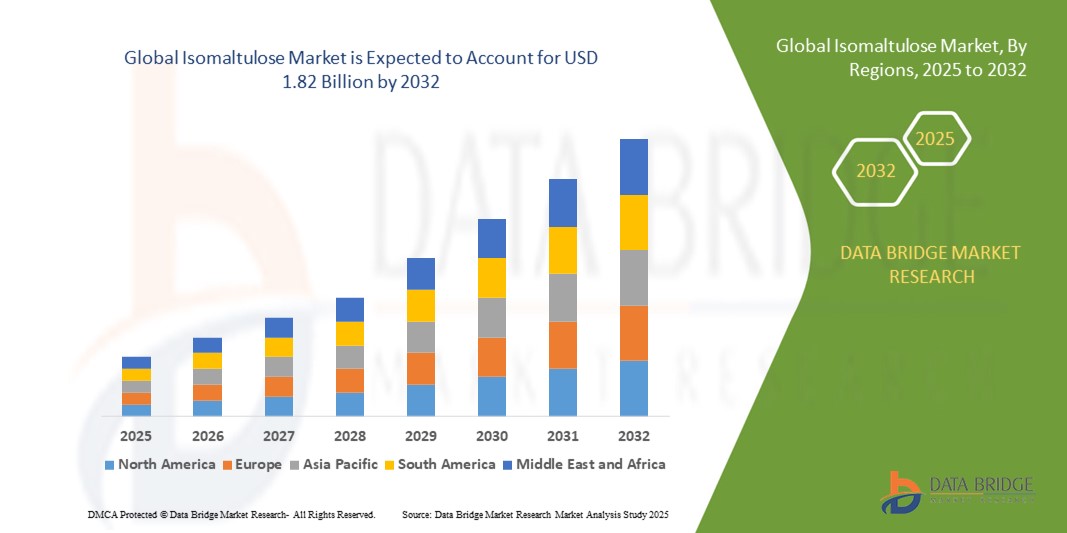
Isomaltulose Market Size
- The global isomaltulose market size was valued at USD 1.21 billion in 2024 and is expected to reach USD 1.82 billion by 2032, at a CAGR of 5.15% during the forecast period
- The market growth is largely fueled by increasing consumer preference for low-glycemic, tooth-friendly sugar alternatives and the expanding application of functional carbohydrates in sports nutrition, clinical nutrition, and health-focused food and beverage formulations
- Furthermore, rising demand for clean-label, non-cariogenic ingredients across mainstream and specialized product categories is positioning isomaltulose as a preferred substitute to traditional sugars. These converging factors are accelerating the adoption of isomaltulose across global markets, thereby significantly boosting the industry's growth
Isomaltulose Market Analysis
- Isomaltulose is a naturally derived, slow-digesting disaccharide used as a functional sweetener in food, beverage, and nutraceutical applications. It offers sustained energy release, a low glycemic index, and dental health benefits, making it suitable for diabetic-friendly and performance nutrition products
- The growing focus on metabolic health, consumer shift toward reduced-sugar diets, and increasing innovation in functional ingredients are driving widespread adoption of isomaltulose across various industries, particularly in energy drinks, dietary supplements, and meal replacements
- North America dominated the isomaltulose market with a share of 32.5% in 2024, due to heightened consumer awareness around low-glycemic and non-cariogenic sugar alternatives, especially in health-conscious segments such as sports nutrition and diabetic-friendly products
- Asia-Pacific is expected to be the fastest growing region in the isomaltulose market during the forecast period due to rising health awareness, rapid urbanization, and growing disposable incomes across countries such as China, Japan, and India
- Food grade isomaltulose segment dominated the market with a market share of 79.1% in 2024, due to its extensive application in a wide range of food and beverage products due to its mild sweetness, high stability under heat and acidity, and tooth-friendly nature. Food grade isomaltulose is increasingly preferred as a functional carbohydrate in products requiring slow energy release, making it especially popular in sports nutrition, beverages, and health-oriented snacks. Its natural origin, approval by global regulatory bodies, and clean-label compatibility further strengthen its appeal in both mass-market and specialized health product formulations
Report Scope and Isomaltulose Market Segmentation
|
Attributes |
Isomaltulose Key Market Insights |
|
Segments Covered |
|
|
Countries Covered |
North America
Europe
Asia-Pacific
Middle East and Africa
South America
|
|
Key Market Players |
|
|
Market Opportunities |
|
|
Value Added Data Infosets |
In addition to the insights on market scenarios such as market value, growth rate, segmentation, geographical coverage, and major players, the market reports curated by the Data Bridge Market Research also include in-depth expert analysis, pricing analysis, brand share analysis, consumer survey, demography analysis, supply chain analysis, value chain analysis, raw material/consumables overview, vendor selection criteria, PESTLE Analysis, Porter Analysis, and regulatory framework. |
Isomaltulose Market Trends
Rising Focus on Sustainable Production
- The isomaltulose market is increasingly shaped by sustainability-driven production methods, as manufacturers and consumers prioritize environmentally friendly sourcing and eco-efficient manufacturing processes
- For instance, companies such as BENEO and Palatinit have invested in bio-based production techniques leveraging enzymatic conversion of sucrose derived from sustainable sugar beet and cane sources, reducing carbon footprint and resource usage
- Renewable raw materials and green chemistry approaches are being integrated into isomaltulose manufacturing workflows to meet stricter environmental regulations and consumer demand for clean-label sweeteners
- Innovations in fermentation technology further lower energy consumption and water usage while scaling production, enabling more cost-effective and sustainable outputs to support broader market adoption
- Suppliers emphasize circular economy principles by minimizing waste generation and optimizing by-product reuse, thus improving the overall environmental impact of isomaltulose production chains
- Collaboration among industry stakeholders, including agricultural producers, biotechnologists, and ingredient formulators, is fostering development of next-generation sustainable isomaltulose options with improved functionality and traceability
Isomaltulose Market Dynamics
Driver
Increasing Consumer Awareness
- Growing consumer education around the health benefits of lower glycemic index sweeteners and sustainable food ingredients is driving robust demand for isomaltulose as a natural sugar alternative with favorable metabolic effects
- For instance, brands such as BENEO promote isomaltulose’s benefits in balanced energy release, dental health, and digestive tolerance through targeted marketing campaigns and scientific research partnerships, helping raise consumer and manufacturer adoption
- Rising prevalence of lifestyle diseases such as diabetes and obesity is pushing consumers to seek alternatives to conventional sugars, propelling product innovation in functional beverages, sports nutrition, and bakery segments using isomaltulose
- Increasing clean-label trends across food and beverage categories encourage manufacturers to replace artificial or highly processed sweeteners with natural options such as isomaltulose to meet stringent market demands
- The expanding global middle class in emerging markets, combined with widespread social media and health influencer outreach, accelerates awareness and willingness to pay for premium, health-focused ingredients such as isomaltulose
Restraint/Challenge
High Price Sensitivity of Isomaltulose
- Despite its health and sustainability advantages, isomaltulose faces significant market resistance due to its relatively higher price compared to conventional sugars and other alternative sweeteners, which limits widespread adoption among price-conscious consumers and manufacturers
- For instance, BENEO and Palatinit, as key producers, encounter hurdles when pricing their products competitively in cost-sensitive markets such as Asia Pacific and Latin America, constraining demand primarily to premium and specialty food segments
- The complex enzymatic production process and need for high-purity substrates contribute to elevated manufacturing costs, which are difficult to reduce without compromising quality or functionality
- Price pressures on downstream food and beverage manufacturers, notably in volume-driven categories such as confectionery and beverages, lead to cautious formulation adjustments and slower product launches featuring isomaltulose
- The absence of large-scale, low-cost production facilities and limited raw material sourcing options pose ongoing challenges to scaling production and achieving economies of scale that could lower market prices
Isomaltulose Market Scope
The market is segmented on the basis of grade and end use.
- By Grade
On the basis of grade, the isomaltulose market is segmented into food grade isomaltulose and pharma grade isomaltulose. The food grade isomaltulose segment accounted for the largest market revenue share of 79.1% in 2024, primarily driven by its extensive application in a wide range of food and beverage products due to its mild sweetness, high stability under heat and acidity, and tooth-friendly nature. Food grade isomaltulose is increasingly preferred as a functional carbohydrate in products requiring slow energy release, making it especially popular in sports nutrition, beverages, and health-oriented snacks. Its natural origin, approval by global regulatory bodies, and clean-label compatibility further strengthen its appeal in both mass-market and specialized health product formulations.
The pharma grade isomaltulose segment is projected to witness the fastest growth rate from 2025 to 2032, supported by its growing incorporation in over-the-counter (OTC) medicines, dietary supplements, and therapeutic nutrition products. Its non-cariogenic profile and low glycemic index make it suitable for diabetic formulations and controlled-energy medical nutrition, meeting increasing consumer demand for sugar alternatives with specific physiological benefits. The segment also benefits from expanding clinical research on isomaltulose’s metabolic effects, enhancing its potential in pharmaceutical and nutraceutical applications.
- By End Use
On the basis of end use, the isomaltulose market is segmented into confectionery, bakery products, breakfast cereals and bars, dairy products, frozen desserts, beverages, fluoridated salt, tabletop/spoon-for-spoon sweeteners, supplements and OTC medicine, and ingredients. The confectionery segment dominated the market in 2024, owing to isomaltulose’s favorable functional properties such as thermal stability, non-hygroscopic nature, and reduced browning during processing, which are highly desirable for candies, gums, and chewy treats. Its slow metabolization and tooth-friendly attribute also align well with the demands of health-conscious consumers, especially in sugar-free or reduced-sugar product ranges, thereby supporting its strong adoption by leading confectionery manufacturers.
The supplements and OTC medicine segment is expected to register the fastest CAGR from 2025 to 2032, driven by rising health awareness and increasing preference for functional sugars that provide sustained energy without spiking blood glucose levels. Isomaltulose is gaining traction in formulations targeting sports recovery, weight management, and diabetic-friendly products. Its suitability for energy drinks, meal replacements, and pediatric formulations further expands its reach across consumer health categories, especially as demand for clean, multi-functional, and non-synthetic ingredients continues to grow.
Isomaltulose Market Regional Analysis
- North America dominated the isomaltulose market with the largest revenue share of 32.5% in 2024, driven by heightened consumer awareness around low-glycemic and non-cariogenic sugar alternatives, especially in health-conscious segments such as sports nutrition and diabetic-friendly products
- The region exhibits strong demand across functional food and beverage categories, including energy drinks, cereals, and protein bars, supported by a well-established health and wellness industry and favorable regulatory frameworks for novel ingredients
- Growing adoption by food manufacturers and supplement brands focused on clean-label and slow-digesting carbohydrates is contributing to the increased penetration of isomaltulose in the region’s mainstream and specialty product lines
U.S. Isomaltulose Market Insight
The U.S. isomaltulose market captured the largest revenue share in 2024 within North America, fueled by increasing demand for healthier sugar alternatives in sports, clinical, and functional nutrition. The popularity of low-glycemic sweeteners among diabetic and fitness-conscious consumers, coupled with the rising influence of clean-label trends, is boosting adoption. Major U.S. food and beverage companies are integrating isomaltulose into innovative formulations, while OTC supplement producers leverage its metabolic benefits for broader consumer appeal.
Europe Isomaltulose Market Insight
The Europe isomaltulose market is projected to register a strong CAGR throughout the forecast period, driven by stringent sugar reduction regulations and a mature consumer base highly attuned to health and sustainability. Demand is concentrated in confectionery, beverages, and dairy applications, where manufacturers are actively reformulating products to include low-glycemic carbohydrates. Supportive labeling laws, ongoing research in metabolic health, and growing preference for tooth-friendly and sustained energy ingredients are shaping regional market growth.
U.K. Isomaltulose Market Insight
The U.K. isomaltulose market is expected to expand at a robust pace, supported by public health campaigns promoting reduced sugar intake and a growing appetite for functional food solutions. The ingredient’s application in breakfast cereals, wellness beverages, and sugar-free confectionery is increasing. In addition, a strong consumer shift toward plant-based and low-GI diets positions isomaltulose as a preferred ingredient among both producers and health-focused consumers.
Germany Isomaltulose Market Insight
The Germany isomaltulose market is experiencing steady growth due to the country’s proactive stance on clean nutrition, coupled with demand for scientifically backed ingredients. German consumers increasingly seek slow-digesting energy sources in sports nutrition, supplements, and breakfast products. The presence of forward-looking food manufacturers and strong institutional support for innovative food solutions further contributes to market expansion.
Asia-Pacific Isomaltulose Market Insight
The Asia-Pacific isomaltulose market is anticipated to grow at the fastest CAGR from 2025 to 2032, fueled by rising health awareness, rapid urbanization, and growing disposable incomes across countries such as China, Japan, and India. Government-backed nutritional initiatives and the increasing popularity of low-sugar diets are accelerating the adoption of isomaltulose in the region. Expansion of local production capabilities and cost-effective formulations are making the ingredient more accessible across mainstream consumer products.
Japan Isomaltulose Market Insight
The Japan isomaltulose market is gaining traction due to the nation’s advanced food technology sector and a deep-rooted cultural emphasis on balanced nutrition. The ingredient is increasingly found in energy drinks, supplements, and functional confections tailored for the aging population. Its approval as a health-promoting sugar alternative, along with compatibility with existing food systems, is driving its growth across health and wellness applications.
China Isomaltulose Market Insight
The China isomaltulose market accounted for the largest revenue share in Asia-Pacific in 2024, attributed to strong government focus on healthful eating and rapid growth in functional food and beverage segments. The country’s large base of health-conscious consumers, growing prevalence of diabetes, and increasing popularity of imported wellness trends are contributing to demand. Local food and beverage brands are incorporating isomaltulose into sugar-reduced snacks, sports drinks, and dietary supplements, benefiting from strong domestic supply chains.
Isomaltulose Market Share
The isomaltulose industry is primarily led by well-established companies, including:
- Börger GmbH (Germany)
- BENEO (Germany)
- Frusano GmbH (Germany)
- Cargill, Incorporated (U.S.)
- Merck KGaA (Germany)
- Anhui Elite Industrial Co.,Ltd (China)
- Mitsui DM Sugar Co., Ltd. (Japan)
- Fooding Group Limited (China)
- ERGO (Germany)
- Sudzucker AG (Germany)
- NOW Foods (U.S.)
- Cosucra Groupe Warcoing SA (Belgium)
- Baolingbao Biology Co., Ltd. (China)
- Shandong Longlive Bio-Technology Co., Ltd. (China)
- Ingredion Incorporated (U.S.)
- Tereos S.A. (France)
Latest Developments in Global Isomaltulose Market
- In April 2024, companies such as Südzucker and Mitsui Sugar Co., Ltd. began investigating enzyme immobilization techniques for sucrose isomerase, aiming to streamline isomaltulose production by enabling easier enzyme separation and reuse. This advancement is expected to improve manufacturing efficiency and cost-effectiveness, enhancing competitiveness in the isomaltulose market
- In 2023, BASF and Cargill planned to enhance their collaboration to offer advanced enzyme products targeting animal protein producers in the United States. This collaboration aimed to introduce cutting-edge enzyme solutions that would enhance efficiency and sustainability in animal feed production
- In 2022, Cargill expanded and modernized its Global Animal Nutrition Innovation Center in Elk River, Minnesota, near its global headquarters. This upgrade was designed to enable quicker responses to industry needs amid evolving market conditions. The Elk River facility was pivotal among Cargill's 15 global centers dedicated to nutritional research and technology development, which also included locations in Velddriel, The Netherlands, and an upcoming R&D center in Changrong, China
- In June 2020, Beneo, a Germany-based food ingredient manufacturer, expanded its market reach by exploring new applications for isomaltulose. By combining its carbohydrate product “Palatinose” with soy protein to mask the taste of soy-based formulations, the company opened up opportunities in plant-based and functional food segments, strengthening its position in emerging health-focused markets

- Interactive Data Analysis Dashboard
- Company Analysis Dashboard for high growth potential opportunities
- Research Analyst Access for customization & queries
- Competitor Analysis with Interactive dashboard
- Latest News, Updates & Trend analysis
- Harness the Power of Benchmark Analysis for Comprehensive Competitor Tracking
Global Isomaltulose Market, Supply Chain Analysis and Ecosystem Framework
To support market growth and help clients navigate the impact of geopolitical shifts, DBMR has integrated in-depth supply chain analysis into its Global Isomaltulose Market research reports. This addition empowers clients to respond effectively to global changes affecting their industries. The supply chain analysis section includes detailed insights such as Global Isomaltulose Market consumption and production by country, price trend analysis, the impact of tariffs and geopolitical developments, and import and export trends by country and HSN code. It also highlights major suppliers with data on production capacity and company profiles, as well as key importers and exporters. In addition to research, DBMR offers specialized supply chain consulting services backed by over a decade of experience, providing solutions like supplier discovery, supplier risk assessment, price trend analysis, impact evaluation of inflation and trade route changes, and comprehensive market trend analysis.
Data collection and base year analysis are done using data collection modules with large sample sizes. The stage includes obtaining market information or related data through various sources and strategies. It includes examining and planning all the data acquired from the past in advance. It likewise envelops the examination of information inconsistencies seen across different information sources. The market data is analysed and estimated using market statistical and coherent models. Also, market share analysis and key trend analysis are the major success factors in the market report. To know more, please request an analyst call or drop down your inquiry.
The key research methodology used by DBMR research team is data triangulation which involves data mining, analysis of the impact of data variables on the market and primary (industry expert) validation. Data models include Vendor Positioning Grid, Market Time Line Analysis, Market Overview and Guide, Company Positioning Grid, Patent Analysis, Pricing Analysis, Company Market Share Analysis, Standards of Measurement, Global versus Regional and Vendor Share Analysis. To know more about the research methodology, drop in an inquiry to speak to our industry experts.
Data Bridge Market Research is a leader in advanced formative research. We take pride in servicing our existing and new customers with data and analysis that match and suits their goal. The report can be customized to include price trend analysis of target brands understanding the market for additional countries (ask for the list of countries), clinical trial results data, literature review, refurbished market and product base analysis. Market analysis of target competitors can be analyzed from technology-based analysis to market portfolio strategies. We can add as many competitors that you require data about in the format and data style you are looking for. Our team of analysts can also provide you data in crude raw excel files pivot tables (Fact book) or can assist you in creating presentations from the data sets available in the report.













