


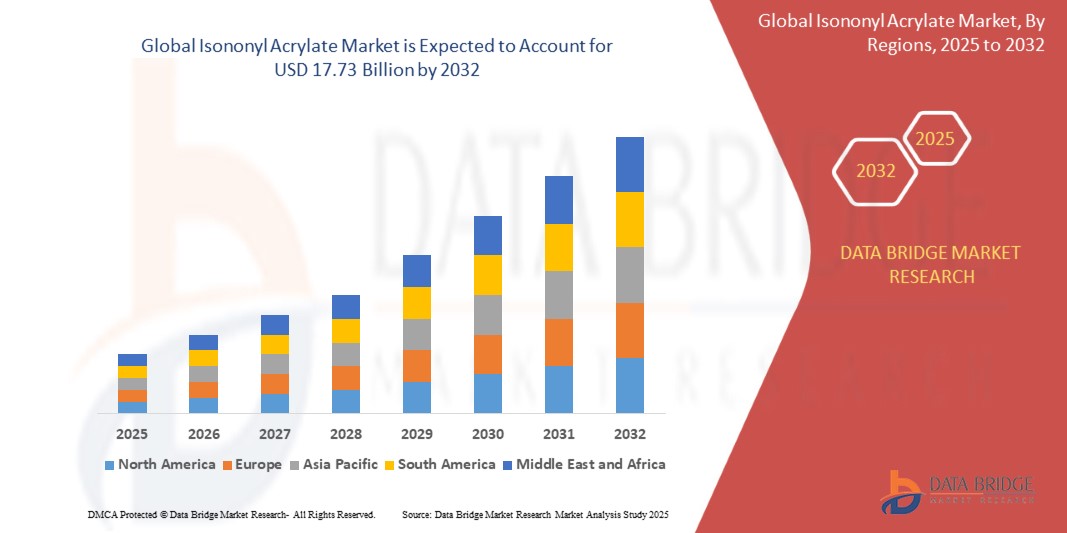
Isononyl Acrylate Market Size
- The global isononyl acrylate market size was valued at USD 13.45 billion in 2024 and is expected to reach USD 17.73 billion by 2032, at a CAGR of 3.51% during the forecast period
- The market growth is largely fuelled by the increasing use of pressure-sensitive adhesives across various industries, rising demand from electronics and packaging sectors, and the superior weatherability and adhesion properties of isononyl acrylate
- The expansion of manufacturing activities in emerging economies and growing investments in infrastructure development are further contributing to the global demand for isononyl acrylate
Isononyl Acrylate Market Analysis
- Rising environmental concerns and growing preference for low-VOC (volatile organic compound) adhesives are boosting demand for isononyl acrylate as a performance-enhancing monomer
- Growth in the automotive, medical, and consumer goods industries is generating new application opportunities, particularly in specialty coatings and sealants
- North America dominated the isononyl acrylate market with the largest revenue share in 2024, driven by robust demand from the adhesives and coatings sectors across construction, automotive, and packaging industries
- Asia-Pacific region is expected to witness the highest growth rate in the global isononyl acrylate market, driven by expanding end-use industries, infrastructure development, and rising demand for performance-enhancing materials in countries such as China, India, and Japan
- The 2-ethylhexyl acrylate segment dominated the market with the largest market revenue share in 2024, driven by its excellent flexibility, weather resistance, and low glass transition temperature. It is widely used in pressure-sensitive adhesives and coatings, especially in applications requiring durability and UV stability. The segment benefits from high demand across construction, automotive, and packaging industries due to its adhesive strength and performance in outdoor environments
Report Scope and Isononyl Acrylate Market Segmentation
|
Attributes |
Isononyl Acrylate Key Market Insights |
|
Segments Covered |
|
|
Countries Covered |
North America
Europe
Asia-Pacific
Middle East and Africa
South America
|
|
Key Market Players |
|
|
Market Opportunities |
|
|
Value Added Data Infosets |
In addition to the insights on market scenarios such as market value, growth rate, segmentation, geographical coverage, and major players, the market reports curated by the Data Bridge Market Research also include import export analysis, production capacity overview, production consumption analysis, price trend analysis, climate change scenario, supply chain analysis, value chain analysis, raw material/consumables overview, vendor selection criteria, PESTLE Analysis, Porter Analysis, and regulatory framework. |
Isononyl Acrylate Market Trends
“Growing Adoption in Electronics and Wearable Devices”
- The integration of isononyl acrylate in wearables such as smartwatches, fitness trackers, and biosensors is increasing due to its superior adhesion, skin compatibility, and resistance to moisture. These properties are essential for long-term skin contact in health-monitoring devices
- As the demand for flexible, body-conforming electronics grows, pressure-sensitive adhesives based on isononyl acrylate are preferred for their ability to maintain strong adhesion during movement, bending, and sweat exposure
- The consumer electronics industry is expanding rapidly, creating a rising need for miniaturized and efficient materials such as isononyl acrylate. It enables seamless integration of adhesives in compact wearable designs without compromising comfort or durability
- Innovation in low-irritation and hypoallergenic adhesives is helping brands meet regulatory standards while enhancing user comfort. These developments are vital for applications in continuous health monitoring and electronic skin patches
- For instance, 3M incorporates isononyl acrylate in medical-grade tapes used in biosensor patches for glucose monitoring. These adhesives ensure secure attachment over extended periods without causing skin irritation or peeling
Isononyl Acrylate Market Dynamics
Driver
“Rising Demand for Pressure-Sensitive Adhesives in Packaging and Labeling Applications”
- Isononyl acrylate is widely used in pressure-sensitive adhesives for packaging and labeling across food, pharmaceutical, and logistics sectors due to its strong adhesion, durability, and chemical resistance under varying conditions
- The adhesive’s versatility allows it to bond effectively to paper, plastic, and metal surfaces, even in fluctuating temperatures or humidity, making it highly dependable for industrial-scale packaging operations
- Its low-VOC profile and long-lasting bond strength are helping manufacturers comply with environmental standards while maintaining performance in high-throughput packaging environments
- E-commerce growth and complex logistics networks have increased the demand for tamper-proof labels and tapes that stay intact through long-distance shipping, rough handling, and temperature changes
- For instance, pharmaceutical companies utilize isononyl acrylate-based adhesive labels that retain integrity during cold-chain storage. These labels are critical for vaccines and medications that require strict temperature control
Restraint/Challenge
“Fluctuating Raw Material Prices and Environmental Concerns”
- Isononyl acrylate production depends on petrochemical feedstocks, making its cost highly sensitive to oil price volatility. Fluctuations in crude oil supply and pricing directly affect the availability and affordability of this raw material
- The compound is under increasing scrutiny for environmental concerns, including its contribution to volatile organic compound (VOC) emissions, toxicity to ecosystems, and limited biodegradability, especially in high-volume usage
- Regulatory frameworks such as the European Union’s REACH directive demand transparency, safer formulations, and eco-friendly alternatives. Compliance with these regulations often requires costly reformulations and testing processes
- With rising consumer and industry interest in sustainability, manufacturers face pressure to shift toward renewable or biodegradable adhesive alternatives, reducing reliance on fossil-based chemistries
- For instance, under REACH compliance mandates, adhesive producers in Germany have started investing in greener technologies, including bio-acrylate R&D. These efforts aim to reduce environmental impact while maintaining product performance
Isononyl Acrylate Market Scope
The market is segmented on the basis of type and application.
• By Type
On the basis of type, the isononyl acrylate market is segmented into methyl acrylate, ethyl acrylate, butyl acrylate, and 2-ethylhexyl acrylate. The 2-ethylhexyl acrylate segment dominated the market with the largest market revenue share in 2024, driven by its excellent flexibility, weather resistance, and low glass transition temperature. It is widely used in pressure-sensitive adhesives and coatings, especially in applications requiring durability and UV stability. The segment benefits from high demand across construction, automotive, and packaging industries due to its adhesive strength and performance in outdoor environments.
The butyl acrylate segment is expected to witness the fastest growth rate from 2025 to 2032, fuelled by its extensive usage in water-based adhesives and coatings. Its favorable balance between hardness and flexibility makes it ideal for applications in paints, textiles, and paper coatings. The segment is further gaining traction due to the increasing focus on low-VOC and environmentally compliant solutions.
• By Application
On the basis of application, the isononyl acrylate market is segmented into adhesives, sealants, paints, and coatings. The adhesives segment held the largest market revenue share in 2024, driven by rising demand in electronics, automotive, medical, and packaging industries. Isononyl acrylate-based adhesives offer superior tack, skin-friendliness, and moisture resistance, making them suitable for pressure-sensitive and specialty adhesive applications.
The coatings segment is expected to witness the fastest growth rate from 2025 to 2032, owing to the increasing demand for high-performance, weather-resistant coatings in the automotive and construction sectors. As regulatory focus intensifies on sustainable and low-emission coatings, isononyl acrylate’s chemical stability and durability support its growing adoption.
Isononyl Acrylate Market Regional Analysis
- North America dominated the isononyl acrylate market with the largest revenue share in 2024, driven by robust demand from the adhesives and coatings sectors across construction, automotive, and packaging industries
- The region benefits from the presence of key manufacturers, well-established industrial infrastructure, and ongoing investments in research and development of advanced acrylate-based formulations
- Rising demand for high-performance adhesives and environmentally friendly coatings further supports market growth, with regulatory compliance and innovation fostering continued expansion across the U.S. and Canada
U.S. Isononyl Acrylate Market Insight
The U.S. isononyl acrylate market held the highest share in North America in 2024, driven by increasing consumption in industrial and commercial adhesives. The market benefits from significant investments in infrastructure and the presence of large-scale producers catering to high-end applications. Moreover, stringent environmental standards are encouraging the use of acrylates with improved performance and lower emissions, making isononyl acrylate a preferred choice in next-generation coatings and sealants.
Europe Isononyl Acrylate Market Insight
The Europe isononyl acrylate market is expected to witness the fastest growth rate from 2025 to 2032, throughout the forecast period, supported by the region's strict environmental regulations and growing focus on sustainable chemical production. Rising demand for low-volatile organic compound (VOC) adhesives and coatings, especially in automotive and construction, drives the market. In addition, increasing investments in eco-friendly and energy-efficient materials in countries such as Germany and France further bolster the use of isononyl acrylate.
Germany Isononyl Acrylate Market Insight
The Germany isononyl acrylate market is expected to witness the fastest growth rate from 2025 to 2032, driven by its leadership in chemical manufacturing and innovation. Demand is rising from the automotive and electronics sectors for high-performance adhesives and coatings. The country’s focus on green chemistry and circular economy principles encourages adoption of low-toxicity, high-durability acrylate products. Local manufacturers are also emphasizing customized formulations tailored for industrial applications.
U.K. Isononyl Acrylate Market Insight
The U.K. isononyl acrylate market is projected to grow steadily during the forecast period, supported by the country's advanced manufacturing sector and increasing demand for high-performance adhesives and coatings. Growing emphasis on sustainability and low-emission construction materials is driving the adoption of eco-friendly acrylate-based products. In addition, the U.K.'s strong presence in the packaging and automotive industries contributes to consistent demand, especially for durable and weather-resistant sealants and coatings.
Asia-Pacific Isononyl Acrylate Market Insight
The Asia-Pacific isononyl acrylate market is expected to witness the fastest growth rate from 2025 to 2032, driven by rapid industrialization, growing construction activities, and expanding automotive production in China, India, and Southeast Asia. The region’s cost-effective manufacturing capabilities and increasing adoption of advanced coating technologies support robust demand. Moreover, local governments are encouraging eco-friendly product adoption, boosting the use of low-VOC acrylate-based adhesives and sealants.
China Isononyl Acrylate Market Insight
China accounted for the largest revenue share in the Asia-Pacific isononyl acrylate market in 2024, fueled by the country’s booming construction, electronics, and automotive sectors. Local demand for strong, flexible adhesives and weather-resistant coatings continues to rise, and domestic chemical producers are scaling up production capacities. Government policies promoting clean energy and green building materials are also increasing the usage of isononyl acrylate in industrial applications.
Japan Isononyl Acrylate Market Insight
The Japan isononyl acrylate market is expected to witness the fastest growth rate from 2025 to 2032, driven by the country’s established electronics, automotive, and industrial adhesives sectors. Japanese manufacturers emphasize product quality, performance, and environmental safety, making isononyl acrylate a suitable choice for advanced applications. As the country continues to invest in high-tech infrastructure and green building practices, demand for low-VOC and efficient bonding solutions using acrylate materials is likely to increase.
Isononyl Acrylate Market Share
The Isononyl Acrylate industry is primarily led by well-established companies, including:
- Angene International Limited (China)
- BOC Sciences (U.S.)
- Exxon Mobil Corporation (U.S.)
- KH Chemicals (Netherlands)
- OSAKA ORGANIC CHEMICAL INDUSTRY LTD. (Japan)
- DENKO CORPORATION (Japan)
- PHOENIX CHEMICAL, INC. (U.S.)
- Haldia Petrochemicals Limited (India)
- Arkema (France)
- BASF SE (Germany)
- NIPPON SHOKUBAI CO., LTD (Japan)
- DOW (U.S.)
- LG Chem. (South Korea)
- TAOGOSEI CO., LTD. (Japan)
- Mitsubishi Chemical Holdings Corporation (Japan)
- Evonik Corporation AG (Germany)
- Sasol Limited (South Africa)
- Momentive (U.S.)
- Lucite International (U.K.)
- Hexion (U.S.)
- 3M (U.S.)
Latest Developments in Global Isononyl Acrylate Market
- In September 2023, ExxonMobil announced the commencement of operations at two newly developed chemical production units in Baytown, Texas. This expansion, valued at USD 2 billion, represents a strategic development aimed at enhancing the company’s production capabilities along the U.S. Gulf Coast. The investment is expected to boost the output of high-value performance products, strengthen ExxonMobil’s competitive position in the global chemical market, and support growing demand across various end-use industries. The move also highlights the company’s long-term commitment to expanding its advanced manufacturing footprint in North America

- Interactive Data Analysis Dashboard
- Company Analysis Dashboard for high growth potential opportunities
- Research Analyst Access for customization & queries
- Competitor Analysis with Interactive dashboard
- Latest News, Updates & Trend analysis
- Harness the Power of Benchmark Analysis for Comprehensive Competitor Tracking
Global Isononyl Acrylate Market, Supply Chain Analysis and Ecosystem Framework
To support market growth and help clients navigate the impact of geopolitical shifts, DBMR has integrated in-depth supply chain analysis into its Global Isononyl Acrylate Market research reports. This addition empowers clients to respond effectively to global changes affecting their industries. The supply chain analysis section includes detailed insights such as Global Isononyl Acrylate Market consumption and production by country, price trend analysis, the impact of tariffs and geopolitical developments, and import and export trends by country and HSN code. It also highlights major suppliers with data on production capacity and company profiles, as well as key importers and exporters. In addition to research, DBMR offers specialized supply chain consulting services backed by over a decade of experience, providing solutions like supplier discovery, supplier risk assessment, price trend analysis, impact evaluation of inflation and trade route changes, and comprehensive market trend analysis.
Data collection and base year analysis are done using data collection modules with large sample sizes. The stage includes obtaining market information or related data through various sources and strategies. It includes examining and planning all the data acquired from the past in advance. It likewise envelops the examination of information inconsistencies seen across different information sources. The market data is analysed and estimated using market statistical and coherent models. Also, market share analysis and key trend analysis are the major success factors in the market report. To know more, please request an analyst call or drop down your inquiry.
The key research methodology used by DBMR research team is data triangulation which involves data mining, analysis of the impact of data variables on the market and primary (industry expert) validation. Data models include Vendor Positioning Grid, Market Time Line Analysis, Market Overview and Guide, Company Positioning Grid, Patent Analysis, Pricing Analysis, Company Market Share Analysis, Standards of Measurement, Global versus Regional and Vendor Share Analysis. To know more about the research methodology, drop in an inquiry to speak to our industry experts.
Data Bridge Market Research is a leader in advanced formative research. We take pride in servicing our existing and new customers with data and analysis that match and suits their goal. The report can be customized to include price trend analysis of target brands understanding the market for additional countries (ask for the list of countries), clinical trial results data, literature review, refurbished market and product base analysis. Market analysis of target competitors can be analyzed from technology-based analysis to market portfolio strategies. We can add as many competitors that you require data about in the format and data style you are looking for. Our team of analysts can also provide you data in crude raw excel files pivot tables (Fact book) or can assist you in creating presentations from the data sets available in the report.













