




Global Isothermal Nucleic Acid Amplification Tests Market
Market Size in USD Billion
CAGR :
% 
 USD
3.76 Billion
USD
9.24 Billion
2025
2033
USD
3.76 Billion
USD
9.24 Billion
2025
2033
 Forecast Period Forecast Period |
2026 - 2033 |
 Market Size (Base Year) Market Size (Base Year) |
USD 3.76 Billion |
 Market Size (Forecast Year) Market Size (Forecast Year) |
USD 9.24 Billion |
 CAGR CAGR |
% |
| Major Markets Players |
|
Isothermal Nucleic Acid Amplification Tests Market Overview
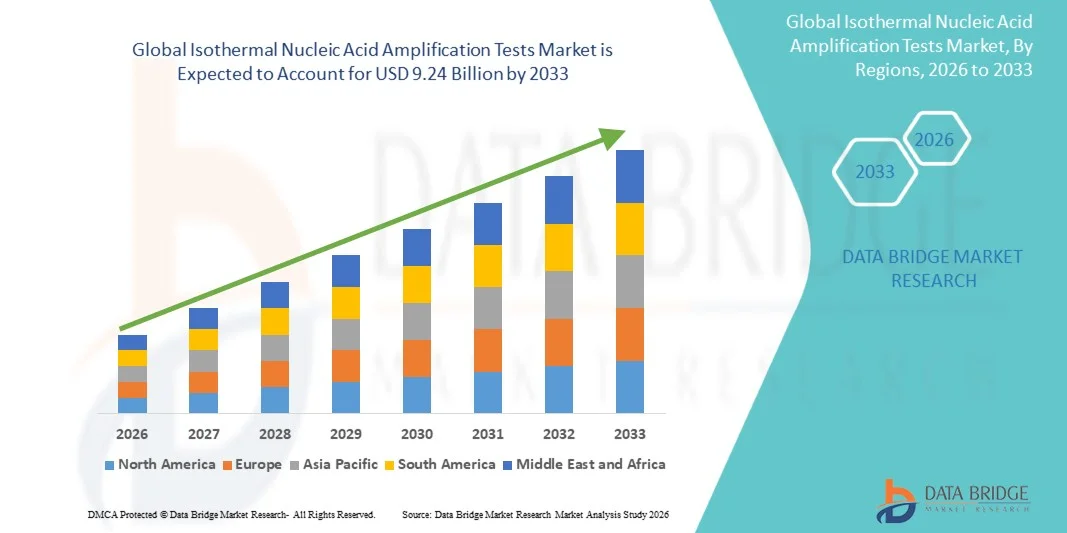
The Isothermal Nucleic Acid Amplification Tests Market was valued at USD 3.76 billion in 2025 and is projected to reach USD 9.24 billion by 2033, growing at a CAGR of 11.90% from 2026 to 2033. The market is experiencing consistent growth driven by rising demand for rapid, accurate, and point-of-care molecular diagnostic solutions, increasing prevalence of infectious diseases, and growing need for early and decentralized disease detection. Advancements in isothermal amplification technologies such as LAMP (Loop-mediated Isothermal Amplification), RPA (Recombinase Polymerase Amplification), and SDA (Strand Displacement Amplification) are enabling faster nucleic acid detection without the need for complex thermal cycling equipment. The growing adoption of portable and cartridge-based diagnostic platforms in hospitals, clinics, and field settings is further supporting market expansion.
The increasing burden of infectious diseases such as COVID-19, tuberculosis, influenza, and sexually transmitted infections, combined with rising demand for rapid testing in emergency care and remote healthcare settings, is compelling healthcare providers, diagnostic laboratories, and public health agencies to adopt isothermal nucleic acid amplification technologies. These systems offer high sensitivity, shorter turnaround time, and ease of use compared to conventional PCR methods. Expanding use in outbreak surveillance, veterinary diagnostics, and resource-limited settings is further accelerating adoption across both developed and emerging markets.
Key Market Trends & Insights
- North America dominated the Isothermal Nucleic Acid Amplification Tests Market with the largest revenue share of 34.12% in 2025, supported by advanced molecular diagnostic infrastructure, strong adoption of rapid point-of-care testing solutions, and significant investments in infectious disease detection technologies. The region benefits from high testing volumes for diseases such as HIV, influenza, and other emerging infectious pathogens, along with strong presence of leading diagnostic companies and well-established hospital laboratory networks.
- The Infectious Disease segment dominated the market with a share of 72.46% in 2025 due to the high global burden of infectious diseases and the critical need for rapid, accurate, and cost-effective diagnostic methods.
- Asia-Pacific is expected to be the fastest-growing region during the forecast period, with a CAGR of 7.42% from 2026 to 2033, fueled by expanding healthcare infrastructure, increasing awareness of early disease detection, rising infectious disease burden, and growing adoption of advanced molecular diagnostic technologies in countries such as China, India, and Japan.
- The Infectious Disease application segment dominated the market with a share of 58.36% in 2025, owing to the rising global burden of diseases such as HIV, influenza, tuberculosis, and emerging viral infections. Increasing need for rapid and accurate diagnosis, especially in decentralized healthcare settings, is significantly driving adoption of isothermal amplification technologies.
- The LAMP (Loop-Mediated Isothermal Amplification) type segment held the largest share of 41.27% in 2025, supported by its high sensitivity, simplicity, and suitability for low-resource and point-of-care testing environments. LAMP’s ability to deliver fast results without complex thermal cycling makes it widely adopted in clinical diagnostics and field testing applications.
- The Hospitals end-user segment dominated the market with a share of 49.85% in 2025, driven by increasing diagnostic workloads, rising patient admissions for infectious disease testing, and growing adoption of rapid molecular diagnostic tools for early disease detection and treatment decision-making.
Market Size & Forecast
- Global Market Value (2025): USD 3.76 Billion
- Expected Market Value (2033): USD 9.24 Billion
- Forecast CAGR (2026–2033): 11.90%
- Leading Region in 2025: North America
- Fastest Growing Region: Asia-Pacific
Report Scope and Isothermal Nucleic Acid Amplification Tests Market Segmentation
|
Attributes |
Isothermal Nucleic Acid Amplification Tests Key Market Insights |
|
Segments Covered |
|
|
Countries Covered |
North America · U.S. · Canada · Mexico Europe · Germany · France · U.K. · Netherlands · Switzerland · Belgium · Russia · Italy · Spain · Turkey · Rest of Europe Asia-Pacific · China · Japan · India · South Korea · Singapore · Malaysia · Australia · Thailand · Indonesia · Philippines · Rest of Asia-Pacific Middle East and Africa · Saudi Arabia · U.A.E. · South Africa · Egypt · Israel · Rest of Middle East and Africa South America · Brazil · Argentina · Rest of South America |
|
Key Market Players |
• Abbott Laboratories (U.S.) |
|
Market Opportunities |
· Expansion of point-of-care (POC) and decentralized testing solutions · Rising adoption for infectious disease screening and outbreak management · Technological advancements in multiplex and automated diagnostic platforms |
|
Value Added Data Infosets |
In addition to the insights on market scenarios such as market value, growth rate, segmentation, geographical coverage, and major players, the market reports curated by the Data Bridge Market Research also include in-depth expert analysis, geographically represented company-wise production and capacity, network layouts of distributors and partners, detailed and updated price trend analysis and deficit analysis of supply chain and demand. |
Isothermal Nucleic Acid Amplification Tests Market Trends
Trend: Growth in Rapid Molecular Diagnostics and Point-of-Care Testing
The increasing demand for rapid, accurate, and decentralized molecular diagnostics is significantly driving the adoption of Isothermal Nucleic Acid Amplification Tests across infectious disease screening and clinical diagnostics. Technologies such as LAMP, TMA, and NASBA are being widely deployed in point-of-care (POC) settings due to their ability to deliver results within 15–60 minutes without the need for complex thermal cycling. For instance, during the COVID-19 pandemic, isothermal amplification methods were rapidly adopted in emergency diagnostic workflows due to their speed and simplicity, particularly in resource-limited settings. Growing use of portable diagnostic devices in hospitals, clinics, and field laboratories is further expanding access to early disease detection, especially in low- and middle-income countries where centralized PCR infrastructure is limited.
Isothermal Nucleic Acid Amplification Tests Market Dynamics
Key Market Driver: Rising Global Burden of Infectious Diseases and Demand for Rapid Diagnostics
The increasing prevalence of infectious diseases such as HIV, influenza, tuberculosis, and emerging viral outbreaks is a major driver for the global INAAT market. According to the World Health Organization (WHO), infectious diseases remain among the leading causes of global mortality, with respiratory infections alone accounting for hundreds of millions of cases annually. This growing disease burden is accelerating demand for rapid molecular diagnostic tools that enable early detection and timely treatment decisions. Hospitals and diagnostic laboratories are increasingly adopting isothermal amplification platforms such as LAMP-based assays for HIV viral load testing and influenza screening due to their high sensitivity, lower cost, and minimal infrastructure requirements compared to traditional PCR systems. In addition, blood screening applications are expanding rapidly to ensure transfusion safety in both developed and emerging healthcare systems.
Key Restraint/Challenge: Limited Standardization and Infrastructure Constraints in Emerging Markets
Despite strong growth potential, the market faces challenges related to lack of standardized protocols, limited laboratory infrastructure, and variability in assay performance across different platforms. Many developing regions in Asia-Pacific, Africa, and Latin America still rely on centralized laboratory testing due to insufficient access to advanced molecular diagnostic systems. Additionally, regulatory heterogeneity across countries delays product approvals and commercialization of new INAAT-based assays. High dependency on proprietary reagents and limited interoperability between diagnostic platforms further restrict large-scale adoption. For example, while LAMP-based diagnostics are widely used in research and pilot programs, their integration into national screening programs is still limited in several low-resource healthcare systems due to quality control and validation challenges.
Key Market Opportunity: Expansion of Multiplex, Portable, and AI-Integrated Molecular Diagnostic Platforms
The integration of artificial intelligence, microfluidics, and automated sample processing into isothermal nucleic acid amplification systems presents a major market opportunity. Portable diagnostic platforms capable of multiplex detection (simultaneous identification of multiple pathogens such as HIV, influenza, and tuberculosis) are gaining significant traction in decentralized healthcare environments. For instance, WHO-supported diagnostic initiatives in Africa and Southeast Asia are increasingly evaluating rapid isothermal assays for infectious disease surveillance and outbreak response. Furthermore, companies such as Abbott, Cepheid (Danaher), and QIAGEN are investing in compact molecular diagnostic systems that combine isothermal chemistry with digital connectivity for real-time data reporting. The expansion of cloud-linked diagnostics, AI-assisted result interpretation, and battery-operated field devices is expected to significantly improve accessibility, particularly in remote and underserved regions, driving strong market growth globally.
Isothermal Nucleic Acid Amplification Tests Market Scope
The Isothermal Nucleic Acid Amplification Tests market is segmented on the basis of product, application, type, disease indication, and end user.
By Product
On the basis of product, the Isothermal Nucleic Acid Amplification Tests Market is segmented into Assay and Kit, and System. The Assay and Kit segment dominated the market with a revenue share of 64.28% in 2025 due to its widespread use in rapid molecular diagnostics, ease of deployment, and strong adoption in infectious disease screening workflows across hospitals and diagnostic laboratories. These kits offer pre-optimized reagents and simplified workflows, reducing dependency on complex instrumentation and skilled operators. Increasing demand for point-of-care testing and decentralized diagnostics further strengthens segment dominance. Rising prevalence of infectious diseases such as HIV and influenza is also boosting consumption of assay-based solutions. In addition, growing government screening programs and public health initiatives are driving large-scale procurement of test kits. However, supply chain scalability and reagent stability remain key operational considerations. The System segment, while smaller, is expanding steadily with adoption in high-throughput laboratories. The Assay and Kit segment is expected to witness steady growth due to continuous product innovation and multiplexing capabilities. The System segment is also gaining traction in centralized labs requiring automation and integration. Overall, consumable-driven revenue models strongly favor Assay and Kit dominance in the global market. The segment reflects strong recurring demand patterns across end-use settings.
The System segment is expected to register the fastest growth with a CAGR of 9.12% from 2026 to 2033 due to increasing automation in molecular diagnostics and rising adoption of integrated diagnostic platforms. Growing investment in laboratory modernization is driving demand for high-throughput and fully automated isothermal amplification systems. These systems reduce manual intervention and improve diagnostic accuracy and turnaround time. Expansion of hospital-based molecular labs is further accelerating system installations. Integration with AI-enabled diagnostic analytics and digital reporting tools is enhancing workflow efficiency. Rising demand for multiplex testing and real-time detection is also supporting system adoption. In addition, increasing funding for advanced diagnostic infrastructure in emerging economies is boosting growth. The shift toward centralized diagnostic hubs is further strengthening system penetration. Technological advancements in portable and cartridge-based systems are expanding application scope. The segment is also benefiting from partnerships between diagnostic companies and healthcare providers. Overall, automation-driven transformation is the key growth catalyst.
By Application
On the basis of application, the Isothermal Nucleic Acid Amplification Tests Market is segmented into Infectious Disease (HIV, Influenza) and Blood Screening. The Infectious Disease segment dominated the market with a share of 72.46% in 2025 due to the high global burden of infectious diseases and the critical need for rapid, accurate, and cost-effective diagnostic methods. Increasing prevalence of viral outbreaks, seasonal influenza, and chronic infections such as HIV is driving large-scale adoption of isothermal amplification technologies. These tests offer rapid turnaround time compared to traditional PCR, making them highly suitable for emergency and point-of-care settings. Government-led screening programs and public health surveillance initiatives further reinforce demand. Rising investments in pandemic preparedness and outbreak monitoring systems are also supporting segment growth. Hospitals and diagnostic labs are increasingly integrating LAMP and TMA-based assays for early detection. Blood screening applications are also growing due to increasing safety standards in transfusion services. However, infectious disease testing continues to dominate due to its broader clinical applicability. Expansion of decentralized diagnostic networks is further boosting adoption. Continuous innovation in multiplex pathogen detection is strengthening market penetration. Overall, infectious disease diagnostics remains the backbone of market demand.
The Blood Screening segment is expected to witness the fastest growth with a CAGR of 8.76% from 2026 to 2033 due to rising demand for safe blood transfusion practices and stricter regulatory standards. Increasing prevalence of transfusion-transmitted infections is driving adoption of rapid screening technologies. Blood banks and donation centers are increasingly integrating isothermal amplification methods for faster donor screening. Technological improvements in sensitivity and specificity are enhancing reliability. Growing investments in healthcare infrastructure in emerging economies are further supporting adoption. Automation in blood screening workflows is reducing processing time and human error. Rising awareness regarding blood safety is increasing screening frequency. Integration of molecular diagnostics into blood bank operations is becoming standard practice. Portable testing kits are expanding use in remote and low-resource settings. Regulatory agencies are mandating advanced screening protocols in many regions. Overall, safety-driven diagnostics is the key growth factor.
By Type
On the basis of type, the market is segmented into LAMP, SDA, NASBA, HAD, NEAR, TMA, SPIA, and Others. The LAMP (Loop-Mediated Isothermal Amplification) segment dominated the market with a share of 38.91% in 2025 due to its high sensitivity, rapid amplification capability, and minimal equipment requirement. LAMP is widely adopted in point-of-care diagnostics and resource-limited settings. Its ability to deliver results within 30–60 minutes makes it highly suitable for infectious disease detection. Strong use in field diagnostics and decentralized testing further strengthens adoption. Increasing demand for low-cost molecular testing solutions is also driving growth. The technology is extensively used in influenza and HIV detection programs. Its compatibility with colorimetric and fluorescent detection enhances usability. However, other technologies such as NEAR and TMA are gaining traction in specialized applications. LAMP remains dominant due to its simplicity and robustness. Continuous innovation in primer design is improving performance. Overall, it remains the most commercially deployed isothermal method globally.
The NEAR (Nicking Enzyme Amplification Reaction) segment is expected to register the fastest growth with a CAGR of 9.34% from 2026 to 2033 due to its ultra-fast amplification capabilities. NEAR enables detection in less than 15 minutes, making it highly attractive for emergency diagnostics. Increasing adoption in portable diagnostic devices is driving demand. Its compatibility with microfluidic platforms is expanding application scope. Rising focus on rapid infectious disease screening is further accelerating growth. Integration with digital health platforms is enhancing usability. NEAR technology is gaining traction in military and field diagnostics. Investments in next-generation molecular testing platforms are supporting adoption. Its high-speed performance is particularly valuable in outbreak situations. Growing commercialization by biotech startups is boosting innovation. Overall, speed and portability are key growth drivers.
By Disease Indication
On the basis of disease indication, the market is segmented into Coronary Angioplasty, Venous Angioplasty, Carotid Angioplasty, Renal Artery Angioplasty, and Peripheral Angioplasty. The Peripheral Angioplasty segment dominated the market with a share of 41.63% in 2025 due to the high prevalence of peripheral artery disease and increasing demand for minimally invasive vascular procedures. Growing aging population and rising incidence of diabetes are major contributing factors. Hospitals increasingly rely on advanced diagnostic testing to assess vascular conditions. Rising awareness of early diagnosis and treatment is further boosting demand. Technological advancements in vascular imaging and diagnostic integration are supporting growth. Increasing healthcare expenditure and improved access to interventional procedures are reinforcing segment dominance. Carotid and renal angioplasty segments are also growing steadily. However, peripheral vascular conditions remain the most common globally. Expansion of catheter-based diagnostic support systems is strengthening adoption. Continuous innovation in vascular diagnostics is improving clinical outcomes. Overall, high disease burden drives segment leadership.
The Carotid Angioplasty segment is expected to witness the fastest growth with a CAGR of 8.52% from 2026 to 2033 due to rising incidence of stroke and cerebrovascular diseases. Increasing adoption of early screening programs is driving demand. Advancements in neurovascular imaging technologies are improving detection rates. Growing geriatric population is contributing to higher case prevalence. Hospitals are increasingly investing in specialized vascular diagnostic tools. Rising awareness of stroke prevention is accelerating screening adoption. Integration of molecular diagnostics in vascular risk assessment is emerging. Government health initiatives are supporting early intervention programs. Expanding interventional cardiology infrastructure is boosting demand. Improved reimbursement frameworks are also supporting procedure growth. Overall, preventive cardiovascular care is a major growth driver.
By End User
On the basis of end user, the market is segmented into Hospitals, Research Laboratories, and Others. The Hospitals segment dominated the market with a share of 55.18% in 2025 due to high patient inflow and strong adoption of rapid diagnostic technologies. Hospitals are primary centers for infectious disease testing and emergency diagnostics. Availability of skilled professionals and advanced infrastructure supports high testing volumes. Increasing integration of molecular diagnostic labs within hospitals is driving demand. Rising prevalence of infectious diseases and chronic conditions is boosting usage. Government healthcare funding and insurance coverage are supporting hospital-based diagnostics. Hospitals also benefit from centralized procurement of test kits and systems. Research laboratories are expanding but remain smaller in share. Point-of-care testing adoption within hospitals is further strengthening dominance. Continuous upgrades in hospital laboratory infrastructure are improving efficiency. Overall, hospitals remain the core diagnostic hub globally.
The Research Laboratories segment is expected to register the fastest growth with a CAGR of 9.05% from 2026 to 2033 due to increasing investment in molecular biology research and genomic studies. Rising focus on infectious disease research is driving adoption of advanced amplification technologies. Academic institutions are expanding molecular diagnostic capabilities. Government funding for biomedical research is increasing globally. Demand for high-precision experimental tools is growing. Collaboration between biotech companies and research institutes is accelerating innovation. Development of next-generation diagnostic assays is supporting growth. Increasing clinical trial activity is boosting laboratory demand. Expansion of translational research programs is further supporting adoption. Integration of AI and bioinformatics is enhancing research outcomes. Overall, innovation-driven demand is the key growth catalyst.
Isothermal Nucleic Acid Amplification Tests Market Regional Analysis
North America dominated the Isothermal Nucleic Acid Amplification Tests Market with the largest revenue share of 34.12% in 2025, supported by advanced molecular diagnostic infrastructure, high adoption of rapid point-of-care testing solutions, and significant investments in infectious disease detection technologies. The region benefits from strong testing volumes for diseases such as HIV, influenza, respiratory infections, and emerging pathogens, along with the strong presence of leading diagnostic companies and well-established hospital and reference laboratory networks. Increasing focus on early disease detection, outbreak preparedness, and decentralized molecular testing continues to reinforce North America’s leadership position in the global market.
U.S. Isothermal Nucleic Acid Amplification Tests Market Insight
The U.S. Isothermal Nucleic Acid Amplification Tests market is witnessing strong growth due to rising investments in infectious disease diagnostics, hospital laboratory expansion, and point-of-care testing technologies. The country’s well-established healthcare infrastructure, along with increasing adoption of rapid molecular diagnostic platforms such as LAMP and TMA-based systems, is driving demand across hospitals, diagnostic laboratories, and research institutions. In addition, growing emphasis on pandemic preparedness, antimicrobial resistance monitoring, and early disease screening is accelerating the adoption of isothermal amplification technologies across clinical settings.
Europe Isothermal Nucleic Acid Amplification Tests Market Insight
The Europe Isothermal Nucleic Acid Amplification Tests market remains a major contributor to global revenue, driven by strong government healthcare support, advanced diagnostic infrastructure, and high demand for rapid infectious disease testing. The widespread use of molecular diagnostic platforms in hospitals, blood screening programs, and research laboratories is supporting market expansion across the region. Increasing investments in next-generation diagnostic technologies, coupled with stringent regulatory frameworks for disease detection and infection control, continue to enhance the adoption of Isothermal Nucleic Acid Amplification Tests throughout Europe.
U.K. Isothermal Nucleic Acid Amplification Tests Market Insight
The U.K. Isothermal Nucleic Acid Amplification Tests market is experiencing steady growth, supported by rising adoption of rapid molecular diagnostic testing in hospitals, public health laboratories, and research centers. Increasing investments in infectious disease surveillance systems and expansion of NHS diagnostic capabilities are contributing to market growth. Furthermore, integration of automated testing platforms and digital health technologies is improving diagnostic efficiency and turnaround time, positioning the U.K. as a key innovation hub in molecular diagnostics.
Germany Isothermal Nucleic Acid Amplification Tests Market Insight
The Germany Isothermal Nucleic Acid Amplification Tests market is expanding steadily due to the country’s strong clinical laboratory network, advanced biomedical research infrastructure, and increasing adoption of molecular diagnostic technologies. Hospitals, diagnostic centers, and research institutions are increasingly utilizing isothermal amplification methods for infectious disease detection and blood screening applications. Continuous advancements in LAMP, NASBA, and TMA technologies, along with strong government focus on healthcare innovation and early disease detection, are further driving market growth in Germany.
Asia-Pacific Isothermal Nucleic Acid Amplification Tests Market Insight
The Asia-Pacific Isothermal Nucleic Acid Amplification Tests market is expected to witness rapid growth, driven by increasing healthcare infrastructure development, rising infectious disease burden, and expanding adoption of rapid diagnostic technologies across countries such as China, India, and Japan. Growing awareness regarding early disease detection, increasing government healthcare spending, and expansion of diagnostic laboratory networks are supporting regional market expansion. In addition, rising demand for cost-effective and point-of-care molecular testing solutions is accelerating market adoption across both urban and rural healthcare systems.
Japan Isothermal Nucleic Acid Amplification Tests Market Insight
The Japan Isothermal Nucleic Acid Amplification Tests market is witnessing consistent growth due to rising investments in advanced diagnostic technologies, infectious disease control programs, and precision medicine initiatives. Hospitals, research institutes, and diagnostic laboratories are increasingly adopting high-sensitivity isothermal amplification systems for rapid pathogen detection and disease screening. Moreover, strong focus on aging population healthcare needs and integration of automated molecular diagnostic platforms are further contributing to market growth.
China Isothermal Nucleic Acid Amplification Tests Market Insight
The China Isothermal Nucleic Acid Amplification Tests market is growing rapidly, driven by expanding healthcare infrastructure, increasing government focus on infectious disease surveillance, and rising adoption of advanced molecular diagnostic technologies. Growing use of LAMP, TMA, and other isothermal amplification methods in hospitals, public health laboratories, and blood screening centers is significantly boosting market demand. In addition, rising investments in domestic diagnostic manufacturing, increasing disease burden, and rapid technological advancements are positioning China as one of the fastest-growing markets globally.
Isothermal Nucleic Acid Amplification Tests Market Share
The Isothermal Nucleic Acid Amplification Tests industry is primarily led by well-established companies, including:
- Abbott Laboratories (U.S.)
- Thermo Fisher Scientific Inc. (U.S.)
- F. Hoffmann-La Roche Ltd. (Switzerland)
- QIAGEN N.V. (Germany)
- Becton, Dickinson and Company (U.S.)
- Hologic, Inc. (U.S.)
- Meridian Bioscience, Inc. (U.S.)
- Eiken Chemical Co., Ltd. (Japan)
- Luminex Corporation (U.S.)
- QuidelOrtho Corporation (U.S.)
- BioMerieux SA (France)
- Siemens Healthineers AG (Germany)
- Danaher Corporation (U.S.)
- Sysmex Corporation (Japan)
- Agilent Technologies Inc. (U.S.)
- Takara Bio Inc. (Japan)
- Promega Corporation (U.S.)
- Seegene Inc. (South Korea)
- BGI Genomics Co., Ltd. (China)
- Co-Diagnostics, Inc. (U.S.)
- Genomica S.A.U. (Spain)
- Mobidiag Ltd. (Finland)
- Fast Track Diagnostics (Luxembourg)
- bioMérieux SA (France)
- Bio-Rad Laboratories, Inc. (U.S.)
- Tecan Group Ltd. (Switzerland)
- PerkinElmer Inc. (U.S.)
- Cepheid (Danaher) (U.S.)
- Illumina Inc. (U.S.)
- Randox Laboratories Ltd. (U.K.)
- Shenzhen Bioeasy Biotechnology Co., Ltd. (China)
Latest Developments in Isothermal Nucleic Acid Amplification Tests Market
- In February 2021, Sherlock Biosciences announced the launch of its CRISPR-based SHERLOCK™ SARS-CoV-2 rapid diagnostic test, designed to enable fast and accurate detection of COVID-19 using isothermal amplification principles. The test was developed for point-of-care settings and demonstrated high sensitivity without requiring traditional PCR instrumentation, highlighting the shift toward decentralized molecular diagnostics during the pandemic era
- In September 2021, Abbott expanded its ID NOW™ molecular platform usage across global healthcare facilities, strengthening its rapid isothermal nucleic acid amplification testing capabilities for infectious diseases including COVID-19, influenza, and RSV. The system’s ability to deliver results in minutes supported widespread adoption in urgent care and decentralized testing environments, accelerating INAAT deployment in non-laboratory settings
- In March 2023, Thermo Fisher Scientific expanded its isothermal amplification portfolio with the introduction of enhanced RT-LAMP-based molecular diagnostic reagents, aimed at improving viral pathogen detection in clinical and research applications. The development strengthened the company’s position in rapid molecular testing by enabling simplified workflows and faster turnaround times in infectious disease diagnostics
- In February 2023, Sherlock Biosciences acquired Sense Biodetection to strengthen its point-of-care molecular diagnostic capabilities, particularly in isothermal amplification-based testing platforms. The acquisition was aimed at expanding access to rapid, instrument-free molecular testing technologies for infectious diseases and reinforcing Sherlock’s position in the next-generation NAAT market
- In June 2024, QIAGEN introduced a new set of wet-lab validated digital PCR assays and expanded microbial detection workflows compatible with its molecular diagnostic platforms, supporting advanced infectious disease research and testing. While primarily focused on dPCR, the development complements QIAGEN’s broader nucleic acid amplification portfolio, including isothermal testing applications used in decentralized diagnostics
- In June 2024, Abbott upgraded its ID NOW platform to enhance rapid detection of influenza A/B and RSV using isothermal nucleic acid amplification technology, improving assay performance and expanding respiratory testing capabilities. The upgraded system delivers results in approximately 15 minutes, reinforcing its role in urgent care and point-of-care molecular diagnostics
- In February 2025, HiberGene Diagnostics announced a strategic distribution partnership with Siemens Healthineers to expand global access to its isothermal nucleic acid amplification-based diagnostic solutions, strengthening commercialization and scaling of rapid molecular testing platforms across hospitals and clinical laboratories worldwide
SKU-
Get online access to the report on the World's First Market Intelligence Cloud

- Interactive Data Analysis Dashboard
- Company Analysis Dashboard for high growth potential opportunities
- Research Analyst Access for customization & queries
- Competitor Analysis with Interactive dashboard
- Latest News, Updates & Trend analysis
- Harness the Power of Benchmark Analysis for Comprehensive Competitor Tracking
Research Methodology
Data collection and base year analysis are done using data collection modules with large sample sizes. The stage includes obtaining market information or related data through various sources and strategies. It includes examining and planning all the data acquired from the past in advance. It likewise envelops the examination of information inconsistencies seen across different information sources. The market data is analysed and estimated using market statistical and coherent models. Also, market share analysis and key trend analysis are the major success factors in the market report. To know more, please request an analyst call or drop down your inquiry.
The key research methodology used by DBMR research team is data triangulation which involves data mining, analysis of the impact of data variables on the market and primary (industry expert) validation. Data models include Vendor Positioning Grid, Market Time Line Analysis, Market Overview and Guide, Company Positioning Grid, Patent Analysis, Pricing Analysis, Company Market Share Analysis, Standards of Measurement, Global versus Regional and Vendor Share Analysis. To know more about the research methodology, drop in an inquiry to speak to our industry experts.
Customization Available
Data Bridge Market Research is a leader in advanced formative research. We take pride in servicing our existing and new customers with data and analysis that match and suits their goal. The report can be customized to include price trend analysis of target brands understanding the market for additional countries (ask for the list of countries), clinical trial results data, literature review, refurbished market and product base analysis. Market analysis of target competitors can be analyzed from technology-based analysis to market portfolio strategies. We can add as many competitors that you require data about in the format and data style you are looking for. Our team of analysts can also provide you data in crude raw excel files pivot tables (Fact book) or can assist you in creating presentations from the data sets available in the report.












