What is the Isotonic Drinks Market Size and Growth Rate?
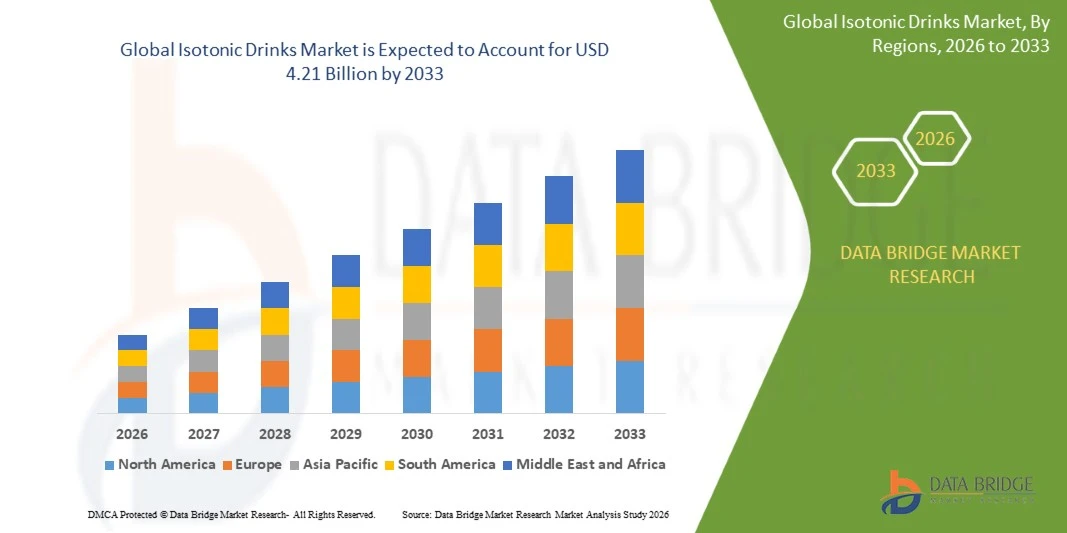
- As per Data Bridge Market Research analysis, the isotonic drinks market was valued at USD 2.45 billion in 2025 and is projected to reach USD 4.21 billion by 2033, growing at a CAGR of 7.0% from 2026 to 2033, across global sports and wellness channels.
- The market is experiencing consistent growth driven by rising participation in sports and fitness, increasing demand for lower-sugar hydration, and expanding applications across exercise, everyday wellness, recovery, and occupational use.
- The increasing shift toward active lifestyles, functional hydration, and reduced-sugar beverages, combined with growing awareness of electrolyte and carbohydrate replenishment during exercise, is supporting market adoption. Isotonic drinks are being consumed across endurance training, team sports, gym sessions, and daily wellness routines, delivering carbohydrates and electrolytes that support fluid absorption within the wider sports drinks and functional beverages categories.
Market Size & Forecast
- Global Market Value (2025): USD 2.45 Billion
- Expected Market Value (2033): USD 4.21 Billion
- Forecast CAGR (2026–2033): 7.0%
- Leading Region in 2025: North America
- Fastest Growing Region: Asia-Pacific
What are the Major Takeaways of the Isotonic Drinks Market?
- North America dominated the isotonic drinks market with the largest revenue share of 35.80% in 2025, supported by strong sports participation, established beverage brands, and wide retail availability of hydration products across the region and major sports markets.
- Asia-Pacific is expected to be the fastest-growing region at a CAGR of 8.90% from 2026 to 2033, fueled by rising health awareness, expanding fitness culture, and growing demand for electrolyte beverages across urban and emerging markets.
- The ready-to-drink segment led the market with a 71.4% share in 2025, driven by convenience, wide distribution, and strong brand presence across channels.
- Powders and tablets are the fastest-growing product type, projected to register a CAGR of 8.9%, reflecting the surge in demand for portable, customizable hydration formats.
- The PET bottles segment dominated the packaging category with a 58.7% revenue share in 2025, led by lightweight design and extensive use in retail and sports settings.
- Sports and exercise hydration accounted for 54.6% of the market share in 2025, preferred by increasing demand for performance-focused electrolyte drinks during training and events.
- The everyday hydration segment is the fastest-growing application category, with a CAGR of 8.8%, driven by increasing wellness awareness and functional beverage demand.
Report Scope and Isotonic Drinks Market Segmentation
|
Attributes |
Isotonic Drinks Key Market Insights |
|
Segments Covered |
|
|
Countries Covered |
North America
Europe
Asia-Pacific
Middle East and Africa
South America
|
|
Key Market Players |
|
|
Market Opportunities |
|
|
Value Added Data Infosets |
In addition to the insights on market scenarios such as market value, growth rate, segmentation, geographical coverage, and major players, the market reports curated by the Data Bridge Market Research also include in-depth expert analysis, pricing analysis, brand share analysis, consumer survey, demography analysis, supply chain analysis, value chain analysis, raw material/consumables overview, vendor selection criteria, PESTLE Analysis, Porter Analysis, and regulatory framework. |
What is the Key Trend in the Isotonic Drinks Market?
- Beverage companies are increasingly shifting toward lower-sugar and zero-sugar isotonic formulations, combining electrolytes, carbohydrates, and functional ingredients with cleaner labels to meet performance needs and changing health expectations across consumer groups.
- For instance, in March 2026, Gatorade launched Gatorade Lower Sugar, its first sports drink with 75% less sugar than Gatorade Thirst Quencher and no artificial flavors, sweeteners, or colors, available nationwide in four flavors and part of its Advanced Hydration System, designed for everyday movers seeking fewer sugars without compromising performance.
- Brands are widening isotonic portfolios beyond elite sport, introducing hydration products for everyday movers, gym users, and wellness consumers through new flavors, lower-sugar variants, and convenient formats designed for different occasions.
- Functional enhancements such as creatine, amino acids, and vitamins, along with electrolyte waters and mixes, are being added to broaden hydration offerings for different sweat occasions and consumer preferences.
- For instance, in early 2026, Coca-Cola’s Powerade added two zero-sugar products, Powerade Ultra and Power Water, its first new products in more than a decade, with Ultra including shelf-stabilized creatine and 50% more electrolytes than original Powerade, reflecting demand for no-sugar options and a range of hydration solutions for different sweat occasions.
- As sports participation, health awareness, and demand for lower-sugar functional beverages continue to expand, isotonic drinks are expected to evolve beyond performance drinks into mainstream hydration products that support everyday wellness and active living across regions worldwide.
What are the Key Drivers of the Isotonic Drinks Market?
- Rising participation in sports, running, gym training, and recreational fitness is increasing demand for beverages that replace fluids, electrolytes, and carbohydrates lost through sweat during training and competition.
- For instance, in March 2026, according to PepsiCo, an estimated 150 million Americans experience mild to moderate dehydration weekly, supporting demand for science-backed electrolyte beverages that hydrate better than water for everyday movers and athletes alike, as Gatorade positions hydration as relevant beyond elite athletes or extreme situations.
- Brands are investing in new launches, sports partnerships, and marketing campaigns that raise awareness of hydration and electrolyte needs among athletes and general consumers across retail, digital, and event channels.
- For instance, in 2025, according to the Food and Drink Federation, Suntory’s Lucozade Sport Ice Kick became the brand’s biggest ever new product launch, offering carbohydrates and electrolytes with less than 4.5g sugar per 100ml, while the company’s sugar reduction programme has cut sugar by 57% on average since 2013 across its portfolio.
- With consumers seeking healthier alternatives, lower-sugar isotonic drinks offer performance hydration with reduced calories, supporting adoption among health-conscious users and wider access to ready-to-drink and powder formats across retail and online channels.
What Factors Are Challenging the Growth of the Isotonic Drinks Market?
- Isotonic drinks face scrutiny over sugar, sweeteners, and additives, while rising ingredient, packaging, and logistics costs can pressure margins and limit pricing flexibility across mature and emerging markets.
- For instance, in June 2026, according to the Food and Drink Federation, Suntory Beverage & Food GB&I highlighted a wholly non-HFSS portfolio and a sugar reduction programme that has cut sugar by 57% on average since 2013, reflecting ongoing reformulation pressure.
- Competition from electrolyte waters, powders, energy drinks, and plain water can limit isotonic drink share, particularly among consumers who see them as suited only to intense exercise rather than everyday hydration.
- Consumer scepticism about artificial sweeteners, colors, and flavors can require costly reformulation, while labeling and marketing claims remain subject to regulatory scrutiny in many countries, as brands now promote products with no artificial flavors, sweeteners, or colors.
- For instance, in December 2025, Gatorade accounted for 65.5% of U.S. sports drink sales, highlighting strong brand concentration that can limit shelf space, promotional visibility, and growth opportunities for smaller isotonic competitors, regional brands, and new entrants seeking national distribution as brands compete for limited cooler space and retailer support.
- The combination of sugar-related regulation, intense competition, reformulation costs, and price-sensitive consumers can constrain expansion among smaller brands, particularly where established products dominate retail distribution or where consumers perceive plain water as sufficient for light activity.
How is the Isotonic Drinks Market Segmented?
The isotonic drinks market is segmented on the basis of product, packaging, application, and end user.
- By Product
On the basis of product, the isotonic drinks market is segmented into ready-to-drink and powders & tablets. The ready-to-drink segment dominated the market with 71.4% share in 2025, supported by convenience, wide distribution, and strong brand presence across retail and sports channels. Ready-to-drink isotonic beverages provide consistent concentration of carbohydrates and electrolytes for immediate consumption. They are widely used across endurance sports, gym sessions, and recreational activity. Improvements in flavors, lower-sugar formulations, and packaging are further strengthening demand. Integration with sports sponsorships and retail promotions also enables stronger consumer reach across supermarkets, convenience stores, and online channels.
The powders and tablets segment is projected to register the fastest growth at a CAGR of 8.9% from 2026 to 2033, driven by increasing demand for portable, customizable hydration formats. Powders and tablets are lightweight, easy to store, and allow users to adjust concentration for different activities. Their applications include endurance training, travel, outdoor sports, and everyday hydration. Increasing interest in cost-effective hydration and sustainable packaging is creating additional demand across athletes, retailers, and online platforms. Improvements in dissolvability and flavor are enhancing the user experience. Electrolyte drink mixes are also expanding commercial use. Powder formats allow concentration to be adjusted for different exercise durations, and brands are introducing electrolyte mixes designed for all-day hydration.
- By Packaging
On the basis of packaging, the isotonic drinks market is segmented into PET bottles, cans, and sachets & tubs. The PET bottles segment dominated the market with 58.7% share in 2025, supported by lightweight design, resealable caps, and extensive use in retail and sports settings. This packaging offers a balanced combination of portability, cost efficiency, and shelf appeal for high-volume beverages. Its availability across multiple sizes and suppliers expands the potential customer base. Brands use sports caps and ribbed bottle designs to improve grip and convenience during exercise. The format also supports recycling programs and recycled content initiatives across markets.
The sachets and tubs segment is projected to register the fastest growth at a CAGR of 9.4% from 2026 to 2033, supported by increasing adoption of powdered hydration products, e-commerce sales, and reduced packaging weight. Single-serve sachets enable portable, low-cost hydration and flexible dosing for athletes and travelers. Consumers are increasingly choosing formats that reduce plastic use and transport costs. Brands are developing stick packs and tubs that fit gym bags, workplace use, and subscription models. Improved flavor systems and clearer labeling further strengthen the segment’s attractiveness. Shelf life and dissolvability remain important considerations for expansion.
- By Application
On the basis of application, the isotonic drinks market is segmented into sports & exercise hydration, everyday hydration, recovery & rehydration, and others. The sports and exercise hydration segment dominated the application category with 54.6% share in 2025, supported by increasing demand for performance-focused electrolyte drinks. Isotonic drinks provide carbohydrates and sodium to support hydration during prolonged exercise. Active lifestyles are increasing consumption among runners, cyclists, and team sport participants. Growth in endurance events and fitness participation further strengthens demand. Consumers are also seeking products that combine taste, performance support, and lower sugar, supported by partnerships with clubs and athletes.
The everyday hydration segment is projected to register the fastest growth at a CAGR of 8.8% from 2026 to 2033, driven by increasing wellness awareness, demand for functional beverages, and interest in electrolytes beyond sport. Lower-sugar isotonic and electrolyte products appeal to office workers, commuters, and active families. Brands in North America, Europe, and Asia-Pacific are investing in new formats and flavors. Retail and online availability is creating additional opportunities. Clear hydration messaging makes these products particularly attractive to mainstream consumers. Supportive health trends can further improve adoption across regions and age groups, particularly where products are positioned as lower-sugar daily options.
- By End User
On the basis of end user, the isotonic drinks market is segmented into professional athletes, recreational athletes & fitness enthusiasts, general consumers, outdoor & occupational workers, and others. The recreational athletes and fitness enthusiasts segment dominated the end-user category with 41.2% share in 2025, supported by increasing requirements for convenient hydration. Gym users, runners, and amateur athletes rely on isotonic drinks to maintain performance and recover fluids. The segment purchases across retail, convenience, and online channels. Increasing participation in fitness and endurance events is creating further opportunities. Frequent consumption also makes taste, price, and availability important considerations in purchase decisions.
The general consumers segment is projected to register the fastest growth at CAGR of 8.7% from 2026 to 2033, driven by increasing wellness awareness, demand for lower-sugar hydration, and interest in electrolytes for daily routines. Everyday users are choosing flavored, functional beverages for work, travel, and leisure. Brands are expanding portfolios and retail presence to reach mainstream shoppers. Closer collaboration with retailers and online platforms is accelerating product visibility. Clear nutrition information is further supporting adoption. Price, taste, and perceived health benefits remain important considerations for repeat purchase across retail, online channels, and household shopping baskets.
Which Region Holds the Largest Share of the Isotonic Drinks Market?
- North America dominated the isotonic drinks market with the largest revenue share of 35.80% in 2025, supported by strong sports participation, established beverage brands, and wide retail availability of hydration products across the region and major sports markets.
- The region also benefits from a large sports and fitness culture, strong beverage marketing, and the presence of established hydration brands, along with growing demand for lower-sugar products. Increasing innovation, retail distribution, and sports partnerships continue to strengthen North America’s position in the global market, supported by strong retailer partnerships and consumer awareness.
U.S. Isotonic Drinks Market Insight
The U.S. isotonic drinks market is witnessing consistent growth due to rising investment in hydration innovation, lower-sugar formulations, and everyday electrolyte products. Beverage companies, retailers, and sports organizations are increasingly focusing on performance and wellness positioning. Moreover, a large sports culture and continued launches of lower-sugar and functional hydration products, supported by strong retail distribution and marketing, are further contributing to market growth in the U.S., especially among active consumers and young adults.
Canada Isotonic Drinks Market Insight
The Canada isotonic drinks market is driven by rising fitness participation, sports activities, and growing demand for functional hydration beverages. Major brands, including Gatorade and Powerade, dominate the competitive landscape. Consumers increasingly prefer reduced-sugar formulations, innovative flavours, and convenient packaging. Supermarkets, convenience stores, and e-commerce remain important distribution channels. Despite price sensitivity and competition, wellness trends offer promising growth opportunities.
Asia-Pacific Isotonic Drinks Market Insight
The Asia-Pacific isotonic drinks market is expected to witness rapid growth, driven by rising health awareness, expanding fitness culture, and increasing demand for electrolyte beverages across countries such as Japan, China, India, and Australia. Growing urban populations, hot climates, and strong convenience retail networks are supporting regional market expansion. In addition, the region’s long-established isotonic brands and increasing adoption of sports and wellness habits are accelerating demand for hydration drinks across diverse consumer groups and age segments.
Japan Isotonic Drinks Market Insight
The Japan isotonic drinks market is growing steadily, driven by a long tradition of electrolyte beverages, strong convenience store networks, and rising attention to heat illness prevention and hydration. Growing use of isotonic drinks in sports, work, and daily life is boosting market demand. In addition, the country’s strong beverage industry, focus on product quality, and rising interest in functional wellness drinks are positioning Japan as an important market across Asia-Pacific, supported by consistent consumer awareness of heat-related health risks and hydration.
China Isotonic Drinks Market Insight
The China isotonic drinks market is experiencing steady growth, supported by expanding fitness participation, growing middle-class spending, and increasing interest in functional beverages. Beverage companies, retailers, and e-commerce platforms are increasingly seeking to expand electrolyte and sports hydration ranges. Furthermore, growing awareness of exercise hydration and rapid growth in online retail, along with rising demand for convenient single-serve formats, is supporting wider adoption of isotonic drinks in China, particularly across large urban centres and among younger consumers.
Which are the Top Companies in Isotonic Drinks Market?
The isotonic drinks industry is primarily led by well-established companies, including:
- The Coca-Cola Company (U.S.)
- PepsiCo, Inc. (U.S.)
- Suntory Beverage & Food Limited (Japan)
- Otsuka Holdings Co., Ltd. (Japan)
- Kirin Holdings Company, Limited (Japan)
- Asahi Group Holdings, Ltd. (Japan)
- Keurig Dr Pepper Inc. (U.S.)
- Nestlé S.A. (Switzerland)
- Danone S.A. (France)
- Unilever PLC (U.K.)
- Abbott Laboratories (U.S.)
- Britvic plc (U.K.)
- Science in Sport plc (U.K.)
- High5 (U.K.)
- Maurten AB (Sweden)
- Glanbia plc (Ireland)
- Coca-Cola HBC AG (Switzerland)
- Uni-President Enterprises Corporation (Taiwan)
- Monster Beverage Corporation (U.S.)
- Tata Consumer Products Limited (India)
What are Latest Developments in Isotonic Drinks Market?
- In March 2026, PepsiCo’s Gatorade launched Gatorade Lower Sugar, with 75% less sugar than Gatorade Thirst Quencher and no artificial flavors, sweeteners, or colors, available nationwide in four flavors, Fruit Punch, Lemonade, Glacier Cherry, and Rain Berry, in 12, 20, and 28 fl. oz bottles priced from USD 1.89 to USD 3.39.
- In March 2026, Coca-Cola’s Powerade expanded its lineup with Powerade Ultra, made with creatine, branched-chain amino acids, vitamins B3, B6, and B12, and Power Water, both zero sugar and zero calorie, marking the brand’s first new products in more than a decade as the sports water category grows by double digits annually, with Powerade Ultra offering shelf-stabilized creatine and 50% more ION4 electrolytes than original Powerade.
- In June 2026, the Food and Drink Federation published a case study on Suntory’s Lucozade Sport Ice Kick, launched in 2025 as an isotonic, non-HFSS citrus drink with less than 4.5g sugar per 100ml, highlighting the brand’s biggest ever new product launch and Suntory’s 57% average sugar reduction since 2013, while continuing to deliver carbohydrates and electrolytes at the point of sweat during sport and exercise.
- In April 2026, The Coca-Cola Company launched its global Power Your Fate campaign for the FIFA World Cup 2026, featuring footballers Lamine Yamal and Rodrygo to reinforce the brand's performance-hydration positioning.
- In May 2026, PepsiCo relaunched its electrolyte powder portfolio with updated formulations, refreshed packaging, and new flavours across Gatorade Zero, Gatorlyte, and Propel, responding to consumer demand for simpler ingredient profiles.
- In July 2025, Otsuka Pharmaceutical launched Pocari Sweat in India, expanding its presence in the growing South Asian hydration beverage market.
- In March 2025, Coca-Cola Canada announced a multi-year partnership with the Northern Super League, naming Powerade and smartwater the official hydration partners of Canada’s first professional women’s soccer league and its six clubs. The partnership aims to strengthen brand visibility, support women’s sports, and expand consumer engagement through digital campaigns, broadcasts, and stadium promotions.
- In May 2024, CWENCH Hydration expanded its North American presence with electrolyte-enhanced, zero-sugar sports hydration products, targeting health-conscious consumers and athletes.

- Interactive Data Analysis Dashboard
- Company Analysis Dashboard for high growth potential opportunities
- Research Analyst Access for customization & queries
- Competitor Analysis with Interactive dashboard
- Latest News, Updates & Trend analysis
- Harness the Power of Benchmark Analysis for Comprehensive Competitor Tracking
Global Isotonic Drinks Market, Supply Chain Analysis and Ecosystem Framework
To support market growth and help clients navigate the impact of geopolitical shifts, DBMR has integrated in-depth supply chain analysis into its Global Isotonic Drinks Market research reports. This addition empowers clients to respond effectively to global changes affecting their industries. The supply chain analysis section includes detailed insights such as Global Isotonic Drinks Market consumption and production by country, price trend analysis, the impact of tariffs and geopolitical developments, and import and export trends by country and HSN code. It also highlights major suppliers with data on production capacity and company profiles, as well as key importers and exporters. In addition to research, DBMR offers specialized supply chain consulting services backed by over a decade of experience, providing solutions like supplier discovery, supplier risk assessment, price trend analysis, impact evaluation of inflation and trade route changes, and comprehensive market trend analysis.
Data collection and base year analysis are done using data collection modules with large sample sizes. The stage includes obtaining market information or related data through various sources and strategies. It includes examining and planning all the data acquired from the past in advance. It likewise envelops the examination of information inconsistencies seen across different information sources. The market data is analysed and estimated using market statistical and coherent models. Also, market share analysis and key trend analysis are the major success factors in the market report. To know more, please request an analyst call or drop down your inquiry.
The key research methodology used by DBMR research team is data triangulation which involves data mining, analysis of the impact of data variables on the market and primary (industry expert) validation. Data models include Vendor Positioning Grid, Market Time Line Analysis, Market Overview and Guide, Company Positioning Grid, Patent Analysis, Pricing Analysis, Company Market Share Analysis, Standards of Measurement, Global versus Regional and Vendor Share Analysis. To know more about the research methodology, drop in an inquiry to speak to our industry experts.
Data Bridge Market Research is a leader in advanced formative research. We take pride in servicing our existing and new customers with data and analysis that match and suits their goal. The report can be customized to include price trend analysis of target brands understanding the market for additional countries (ask for the list of countries), clinical trial results data, literature review, refurbished market and product base analysis. Market analysis of target competitors can be analyzed from technology-based analysis to market portfolio strategies. We can add as many competitors that you require data about in the format and data style you are looking for. Our team of analysts can also provide you data in crude raw excel files pivot tables (Fact book) or can assist you in creating presentations from the data sets available in the report.