


Jet Lag Therapy Treatment Market Size
-
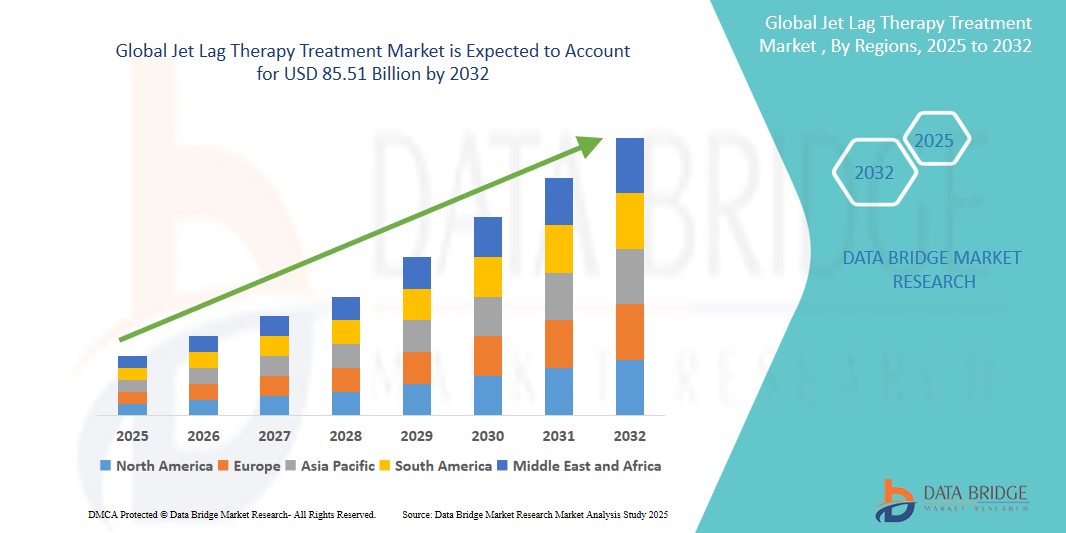
The global jet lag therapy treatment market size was valued at USD 441.1 million in 2024 and is expected to reach approximately USD 592.76 million by 2032, growing at a CAGR of 3.1% during the forecast period.
-
This growth is attributed to increasing international travel, a rise in awareness about circadian rhythm disorders, and the availability of effective treatment options such as melatonin supplements, bright light therapy, and prescription medications
Jet Lag Therapy Treatment Market Analysis
-
Jet lag therapy involves a combination of behavioral and pharmacological approaches aimed at realigning the body’s internal clock with the new time zone. These therapies are crucial for minimizing symptoms such as fatigue, insomnia, and reduced cognitive function that result from rapid travel across multiple time zones
-
The market is primarily driven by a surge in business travel, growing participation in international sports events, and the increasing number of long-haul flights taken by seasonal and leisure travelers
- North America is expected to lead the market due to high international travel frequency, strong awareness about sleep-related disorders, and easy access to treatment options
- Asia-Pacific is anticipated to witness the fastest growth during the forecast period due to the rising middle-class population, increased tourism, and growing healthcare awareness
- The business travelers segment is projected to dominate the application category with a market share of 41.35% due to frequent long-distance travel and a growing focus on maintaining performance and alertness during international business commitments.
Report Scope and Jet Lag Therapy Treatment Market Segmentation
|
Attributes |
Jet Lag Therapy Treatment Key Market Insights |
|
Segments Covered |
|
|
Countries Covered |
North America
Europe
Asia-Pacific
Middle East and Africa
South America
|
|
Key Market Players |
|
|
Market Opportunities |
|
|
Value Added Data Infosets |
In addition to the insights on market scenarios such as market value, growth rate, segmentation, geographical coverage, and major players, the market reports curated by the Data Bridge Market Research also include import export analysis, production capacity overview, production consumption analysis, price trend analysis, climate change scenario, supply chain analysis, value chain analysis, raw material/consumables overview, vendor selection criteria, PESTLE Analysis, Porter Analysis, and regulatory framework. |
Jet Lag Therapy Treatment Market Trends
“Technological Advancements in Light Therapy and Wearable Devices”
-
A prominent trend in the global jet lag therapy treatment market is the growing integration of light therapy and wearable devices designed to combat circadian rhythm disruptions caused by long-distance travel
- These devices use specialized light exposure to regulate sleep-wake cycles, offering a non-pharmacological treatment option for travelers suffering from jet lag
- For instance, portable light therapy glasses and light-emitting devices have been gaining popularity among business travelers and frequent flyers due to their convenience, portability, and effectiveness in realigning circadian rhythms, ultimately reducing the impact of jet lag symptoms
- These advancements in light therapy are expected to transform jet lag treatment, as more travelers seek drug-free, innovative solutions that offer long-term relief and prevent recurrence of symptoms. The demand for such technologies is rapidly increasing, particularly in markets with high levels of international travel.
Jet Lag Therapy Treatment Market Dynamics
Driver
“Rising International Travel and Business Travel”
- The increasing frequency of international travel, especially business travel, is a significant driver for the growth of the jet lag therapy treatment market. With globalization and the expansion of international business operations, more individuals are flying across multiple time zones, resulting in a higher incidence of jet lag
- As business professionals aim to maintain peak performance, there is a growing demand for effective treatments to mitigate jet lag and its impact on cognitive function, productivity, and overall well-being
For instance,
- According to a report published by the International Air Transport Association (IATA), the number of international air passengers is expected to grow at an annual rate of 4% through 2030, further driving the demand for effective jet lag therapies
- Consequently, the rise in international business travel and long-haul flights is fueling the demand for jet lag treatments, particularly among business travelers and athletes who need to quickly recover from the effects of long-distance travel
Opportunity
“Advancement in Personalized Jet Lag Solutions and AI Integration”
- The integration of artificial intelligence (AI) and personalized treatment plans presents a significant opportunity in the jet lag therapy treatment market.
- AI-driven applications can analyze individual travel schedules, sleep patterns, and biological rhythms to tailor treatments for each traveler, optimizing the effectiveness of jet lag recovery strategies.
For instance,
- An AI-powered app could recommend personalized light therapy sessions, melatonin dosage, and sleep routines based on the user's travel itinerary, time zone adjustments, and personal sleep data, ensuring faster and more efficient recovery from jet lag
- The development of personalized treatments powered by AI and advanced analytics can enhance the overall customer experience and expand the reach of jet lag therapies to a wider audience, including high-frequency travelers and individuals with irregular schedules
Restraint/Challenge
“High Cost of Advanced Treatments Limiting Market Access”
- One of the key challenges facing the global jet lag therapy treatment market is the high cost of advanced therapies, such as light therapy devices, wearable technologies, and personalized treatment plans
- These treatments, while effective, can be expensive, and the financial burden may deter consumers, particularly those in developing regions or with limited disposable income, from investing in these solutions. The high upfront cost of light therapy devices and wearable gadgets may also limit their adoption in less affluent markets
For instance,
- The price of light therapy devices and wearables can range from hundreds to thousands of dollars, which may be out of reach for casual travelers who are seeking affordable solutions for jet lag management
- As a result, the high cost of these advanced treatment options may hinder market penetration and restrict access to these therapies for a broader consumer base, limiting the overall growth of the market
Jet Lag Therapy Treatment Market Scope
The market is segmented on the basis application, treatment type, drugs, and end user.
|
Segmentation |
Sub-Segmentation |
|
By Application |
|
|
By Treatment Type |
|
|
By Drugs |
|
|
By Route of Administration |
|
|
By End-Users |
|
In 2025, the business travelers segment is projected to dominate the market with the largest share in the application segment
The business travelers segment is expected to dominate the global jet lag therapy treatment market with the largest share of 42.87% in 2025 due to frequent long-distance travel and the growing focus on maintaining performance and alertness during international business commitments. With globalization expanding corporate operations, the demand for quick and effective jet lag therapies is surging. Increasing awareness of the impact of circadian disruptions on productivity has led to greater adoption of treatments among this demographic, further reinforcing its market dominance.
The pharmacological therapy segment is expected to account for the largest share during the forecast period in the treatment type market
In 2025, the pharmacological therapy segment is projected to lead the market with the largest share of 53.14% due to its fast-acting benefits and widespread availability. Medications such as melatonin supplements and prescription sleep aids are highly sought after by frequent flyers seeking immediate relief from jet lag symptoms. The segment’s growth is further supported by ongoing research into chronobiology and drug formulations tailored to regulate circadian rhythms, making pharmacological solutions a preferred choice for travelers.
Jet Lag Therapy Treatment Market Regional Analysis
“North America Holds the Largest Share in the Jet Lag Therapy Treatment Market”
-
North America dominates the global jet lag therapy treatment market, primarily due to the high frequency of international travel, especially among business professionals, athletes, and government officials. The presence of a well-established healthcare system and increased consumer awareness of circadian rhythm disorders significantly contribute to market growth.
- The U.S. holds a major share of the market owing to its advanced travel infrastructure, high disposable incomes, and the widespread availability of both pharmacological and non-pharmacological treatment options. A strong inclination toward wellness and sleep health further boosts product adoption.
- Moreover, the presence of leading players offering melatonin supplements, light therapy devices, and mobile health solutions tailored to jet lag prevention supports continued market expansion. Increasing partnerships between airlines, wellness companies, and digital therapeutics providers are also reshaping jet lag management approaches in the region.
“Asia-Pacific is Projected to Register the Highest CAGR in the Jet Lag Therapy Treatment Market”
-
The Asia-Pacific region is expected to experience the fastest growth in the jet lag therapy treatment market during the forecast period, driven by an increase in outbound international travel, especially among business and leisure travelers. Rising awareness of sleep and mental health issues has accelerated the demand for jet lag solutions.
- Countries like China, India, Japan, and South Korea are emerging as major contributors due to the growing number of international travelers and rising healthcare spending.
- Japan, known for its innovation in consumer electronics and wearable technology, is witnessing strong adoption of light therapy devices and app-based jet lag management tools.
- Meanwhile, China and India are experiencing growing interest in melatonin supplements and herbal remedies, supported by expanding e-commerce platforms and wellness-focused consumer behavior. Government efforts to promote medical tourism and modernize healthcare services are further propelling regional market growth.
Jet Lag Therapy Treatment Market Share
The market competitive landscape provides details by competitor. Details included are company overview, company financials, revenue generated, market potential, investment in research and development, new market initiatives, global presence, production sites and facilities, production capacities, company strengths and weaknesses, product launch, product width and breadth, application dominance. The above data points provided are only related to the companies' focus related to market.
The Major Market Leaders Operating in the Market Are:
- Natrol LLC (U.S.)
- CV Sciences, Inc. (U.S.)
- Pharma Nord (Denmark)
- Jamieson Laboratories Ltd. (Canada)
- Nature’s Bounty Co. (U.S.)
- Vicks – Procter & Gamble (U.S.)
- Re-Timer Pty Ltd. (Australia)
- Lucimed (Belgium)
- Beurer GmbH (Germany)
- Philips Healthcare (Netherlands)
- Cipla Ltd. (India)
- Dr. Reddy’s Laboratories (India)
- Pfizer Inc. (U.S.)
- Sanofi S.A. (France)
- Takeda Pharmaceutical Company Limited (Japan)
Latest Developments in Global Jet Lag Therapy Treatment Market
- In August 2024, Re-Time Pty Ltd launched the retimer 3, a smart wearable offering blue-green light therapy to align circadian rhythms. This innovative device addresses jet lag and sleep disorders, enhancing the jet lag therapy market with personalized, app-integrated sleep management solutions.
- In July 2024, NOW introduced the JET LAG massage, a 50 or 80-minute Swedish-inspired service combining massage with Gua Sha and Summer Friday’s jet lag mask. This new offering enhances the market by addressing travel fatigue, promoting lymphatic drainage, and supporting detoxification.
- In February 2024, ALTURiX launched CEYESTO, a melatonin oral solution for jet lag treatment in the UK, with an 80% lower price. It offers a cost-effective solution for the NHS while addressing jet lag and other sleep disorders in both children and adults.

- Interactive Data Analysis Dashboard
- Company Analysis Dashboard for high growth potential opportunities
- Research Analyst Access for customization & queries
- Competitor Analysis with Interactive dashboard
- Latest News, Updates & Trend analysis
- Harness the Power of Benchmark Analysis for Comprehensive Competitor Tracking
Data collection and base year analysis are done using data collection modules with large sample sizes. The stage includes obtaining market information or related data through various sources and strategies. It includes examining and planning all the data acquired from the past in advance. It likewise envelops the examination of information inconsistencies seen across different information sources. The market data is analysed and estimated using market statistical and coherent models. Also, market share analysis and key trend analysis are the major success factors in the market report. To know more, please request an analyst call or drop down your inquiry.
The key research methodology used by DBMR research team is data triangulation which involves data mining, analysis of the impact of data variables on the market and primary (industry expert) validation. Data models include Vendor Positioning Grid, Market Time Line Analysis, Market Overview and Guide, Company Positioning Grid, Patent Analysis, Pricing Analysis, Company Market Share Analysis, Standards of Measurement, Global versus Regional and Vendor Share Analysis. To know more about the research methodology, drop in an inquiry to speak to our industry experts.
Data Bridge Market Research is a leader in advanced formative research. We take pride in servicing our existing and new customers with data and analysis that match and suits their goal. The report can be customized to include price trend analysis of target brands understanding the market for additional countries (ask for the list of countries), clinical trial results data, literature review, refurbished market and product base analysis. Market analysis of target competitors can be analyzed from technology-based analysis to market portfolio strategies. We can add as many competitors that you require data about in the format and data style you are looking for. Our team of analysts can also provide you data in crude raw excel files pivot tables (Fact book) or can assist you in creating presentations from the data sets available in the report.












