What is the K Band Radar Transmitter Market Size and Growth Rate?
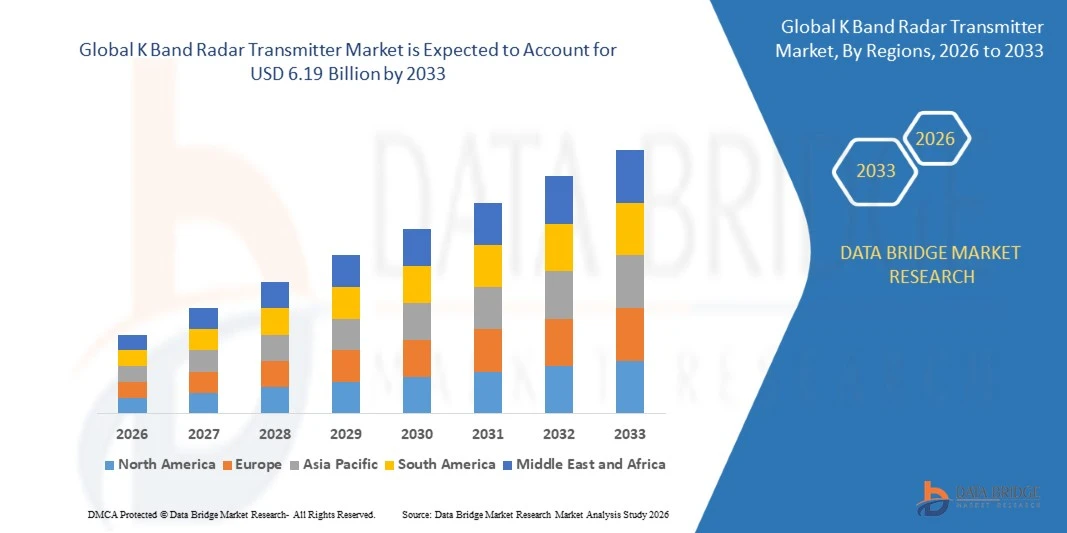
- As per Data Bridge Market Research analysis, the K band radar transmitter market was valued at USD 3.76 billion in 2025 and is projected to reach USD 6.19 billion by 2033, growing at a CAGR of 6.45% from 2026 to 2033.
- The market is experiencing consistent growth driven by rising demand for high-frequency radar systems, rapid advancements in radar transmitter technologies, and expanding applications across automotive safety, defense, aerospace, weather monitoring, and industrial sensing.
- The increasing need for precise object detection, combined with growing investments in advanced driver assistance systems, surveillance infrastructure, and defense modernization, is encouraging automotive manufacturers, defense agencies, and industrial organizations to adopt K band radar transmitter technologies. Compact, high-resolution radar systems are gaining traction due to their ability to detect nearby objects, measure speed, and support reliable monitoring in applications such as collision avoidance, perimeter security, and traffic management.
Market Size & Forecast
- Global Market Value (2025): USD 3.76 Billion
- Expected Market Value (2033): USD 6.19 Billion
- Forecast CAGR (2026–2033): 6.45%
- Leading Region in 2025: North America
- Fastest Growing Region: Asia Pacific
What are the Major Takeaways of the K Band Radar Transmitter Market?
- North America dominated the K band radar transmitter market with the largest revenue share of 31.70% in 2025, supported by advanced industrial infrastructure and strong demand for radar-based measurement technologies across oil and gas, chemicals, and water treatment industries.
- Asia-Pacific is expected to be the fastest-growing region at a CAGR of 7.28% from 2026 to 2033, fueled by industrialization, infrastructure development, and increasing automation investments.
- The non-contact type segment led the market with a 64% share in 2025, driven by its ability to provide reliable measurements without direct contact with the measured material.
- Contact type are the fastest-growing technology type, projected to register a CAGR of 6.8%, reflecting the surge in demand for reliable continuous measurement and specialized sensing solutions across industrial applications requiring direct contact with the measured medium.
- The liquid segment dominated the medium category with a 58% revenue share in 2025, led by extensive use of radar-based measurement technologies in oil and gas, chemicals, water treatment, and pharmaceutical processing
- Liquids and slurries accounted for 45% of the market share in 2025, preferred by widespread demand for accurate level monitoring across chemical processing, oil and gas, wastewater treatment, and industrial manufacturing.
- The interfaces segment is the fastest-growing application category, with a CAGR of 7.3%, driven by increasing demand for precise oil-water interface measurement and growing adoption of advanced radar-based monitoring systems across oil and gas, chemical processing, and wastewater treatment industries.
Report Scope and K Band Radar Transmitter Market Segmentation
|
Attributes |
K Band Radar Transmitter Key Market Insights |
|
Segments Covered |
|
|
Countries Covered |
North America
Europe
Asia-Pacific
Middle East and Africa
South America
|
|
Key Market Players |
|
|
Market Opportunities |
|
|
Value Added Data Infosets |
In addition to the market insights such as market value, growth rate, market segments, geographical coverage, market players, and market scenario, the market report curated by the Data Bridge Market Research team includes in-depth expert analysis, import/export analysis, pricing analysis, production consumption analysis, and pestle analysis. |
What is the Key Trend in the K Band Radar Transmitter Market?
- Manufacturers are increasingly developing compact, high-efficiency K band radar transmitters to improve signal performance, reduce power consumption, and support integration into advanced radar and satellite communication systems.
- For instance, in June 2025, Qorvo launched its QPA1722 K-band power amplifier for low Earth orbit (LEO) satellites, offering three times the instantaneous bandwidth, a 38% smaller footprint, and 10% higher efficiency than competing devices, supporting the trend toward compact, high-efficiency K-band RF solutions.
- Advances in gallium nitride (GaN) semiconductor technology are enabling higher output power, improved thermal performance, and more compact transmitter designs.
- Radar manufacturers are increasingly prioritizing integrated RF components to simplify system design and improve reliability across demanding operating environments.
- For instance, in May 2024, Diversified Technologies, Inc. introduced radar transmitter systems for solid-state modernization, covering frequency ranges from UHF to W-band and integrating transmitter components, waveguides, and cooling controls to support upgrades and new radar installations.
- As demand for high-performance radar and satellite systems increases, advances in K band amplification, miniaturization, and energy efficiency are expected to strengthen adoption across defense, aerospace, and industrial applications.
What are the Key Drivers of the K Band Radar Transmitter Market?
- The growing demand for high-frequency radar systems across defense, aerospace, and satellite communication applications is increasing the need for reliable K band transmitters capable of delivering precise signal generation and efficient power amplification.
- For instance, in June 2025, India's Defence Research and Development Organisation (DRDO), in collaboration with Aidin Technologies, developed a 6 kW solid-state power amplifier using gallium nitride on silicon carbide (GaN-on-SiC) technology to support next-generation radar transmitters, improving power efficiency, reliability, and high-power signal generation
- Defense organizations, aerospace manufacturers, and radar equipment developers are investing in advanced RF components to improve target detection, signal processing, and system reliability.
- For instance, in June 2025, Qorvo introduced its QPA1722 K-band power amplifier, operating at 17.7–20.2 GHz with up to 10 W saturated output power and more than 1 GHz of instantaneous bandwidth, addressing growing demand for compact, high-efficiency RF transmitters in low Earth orbit satellite communication systems.
- With increasing demand for high-performance radar and microwave systems, K band radar transmitters are expected to remain important components in advanced sensing, surveillance, and communication platforms.
What Factors are Challenging the Growth of the K Band Radar Transmitter Market?
- K band radar transmitters require specialized RF components, precision engineering, and advanced thermal management, increasing manufacturing complexity and overall system costs.
- For instance, in March 2023, Microwave Journal discussed thermal management challenges in high-power GaN radar transmitters, explaining that temperature increases can reduce amplifier gain by 0.5–1.0 dB during a pulse. These thermal effects can complicate transmitter design, increase cooling requirements, and constrain high-power performance.
- These high development and production costs can limit adoption among smaller radar manufacturers, research institutions, and organizations operating under restricted procurement budgets.
- The technical challenges associated with high-frequency signal amplification, power efficiency, component integration, and thermal control can increase development time and complicate large-scale manufacturing.
- For instance, in January 2025, Microwave Journal examined solid-state power amplifiers in radar and electronic warfare systems, highlighting the engineering demands of integrating microwave amplifiers with signal processing, power handling, and system-level requirements. These integration complexities can increase development costs and make advanced radar transmitter designs more challenging
- These cost and engineering barriers continue to challenge the widespread adoption of advanced radar transmitter technologies, particularly in price-sensitive applications, despite growing demand for compact and high-performance radar systems.
How is the K Band Radar Transmitter Market Segmented?
The K band radar transmitter market is segmented on the basis of technology, medium, application, and end user.
- By Technology
On the basis of technology, the K band radar transmitter market is segmented into contact type and non-contact type. The non-contact type segment is expected to dominate the market with 64% share in 2025, driven by its ability to provide reliable measurements without direct contact with the measured material. These systems are widely used in industrial environments where contamination, corrosion, and mechanical wear must be minimized. Their suitability for continuous monitoring in tanks, pipelines, and processing facilities supports widespread adoption. Non-contact radar technology also offers advantages in applications involving hazardous substances and demanding operating conditions. Increasing investments in industrial automation and process monitoring are further supporting demand.
The contact type segment is expected to witness growth at a CAGR of 6.8% from 2026 to 2033, as industries seek reliable measurement solutions for applications requiring direct interaction with the measured medium. Contact-based technologies can support specialized sensing and measurement requirements in selected industrial processes. Their adoption is influenced by application-specific operating conditions, installation requirements, and compatibility with existing equipment. Industrial facilities may use contact-based solutions where direct measurement offers practical advantages. Improvements in sensor materials and measurement technologies can support performance and durability. However, maintenance requirements and exposure to corrosive or abrasive materials may restrict adoption in certain environments. Growth will depend on the suitability of contact-based systems for individual applications.
- By Medium
On the basis of medium, the K band radar transmitter market is segmented into solid and liquid. The liquid segment is expected to dominate the market with 58% share in 2025, supported by extensive use of radar-based measurement technologies in oil and gas, chemicals, water treatment, and pharmaceutical processing. Accurate monitoring of liquid levels is essential for inventory management, process control, and operational safety. Radar-based systems can support continuous measurement in storage tanks and industrial vessels. Their ability to operate under changing temperature and pressure conditions makes them suitable for demanding processing environments. Increasing investments in industrial automation and the modernization of process facilities are further supporting demand.
The solid segment is expected to witness growth at a CAGR of 7.1% from 2026 to 2033, as industries increasingly adopt automated measurement systems for bulk materials, powders, and granular substances. Mining, cement, food processing, and power generation facilities require reliable monitoring of material levels in silos, hoppers, and storage vessels. Radar-based measurement can help improve inventory management and reduce manual inspection requirements. Increasing industrial automation is encouraging operators to integrate advanced sensing technologies into material handling systems. Improvements in signal processing and sensor design are helping address challenges associated with dust, irregular surfaces, and changing material properties. These developments are supporting adoption across bulk material applications. Growing investment in smart manufacturing is expected to further contribute to segment expansion.
- By Application
On the basis of application, the K band radar transmitter market is segmented into liquids and slurries, interfaces, and solids. The liquids and slurries segment is expected to dominate the market with 45% share in 2025, driven by widespread demand for accurate level monitoring across chemical processing, oil and gas, wastewater treatment, and industrial manufacturing. These applications require continuous measurement to maintain production efficiency and prevent overflow or equipment damage. Radar-based technologies offer advantages in environments where conventional measurement methods may be affected by changing process conditions. Their use can improve operational visibility and support automated process control. Increasing investments in industrial safety and process optimization are further contributing to demand.
The interfaces segment is expected to witness growth at a CAGR of 7.3% from 2026 to 2033, as industrial operators increasingly require accurate measurement of boundaries between immiscible liquids, such as oil and water. Interface monitoring is important in petroleum processing, chemical production, separation vessels, and wastewater treatment facilities. Reliable measurement helps improve separation efficiency and supports consistent product quality. Industrial facilities are investing in advanced monitoring technologies to reduce manual intervention and enhance process reliability. Improvements in radar signal processing can support more precise identification of material boundaries in suitable applications. Growing emphasis on automation and operational efficiency is encouraging adoption of specialized interface measurement systems. These requirements are expected to support segment growth.
- By End User
On the basis of end user, the K band radar transmitter market is segmented into oil and gas, chemicals, water and wastewater, food and beverages, pharmaceuticals, power generation, metals and mining, and others. The oil and gas segment is expected to dominate the market with 36% share in 2025, supported by extensive use of radar technologies in storage tanks, processing facilities, and industrial monitoring systems. Reliable measurement is essential for managing liquid inventories, supporting process control, and maintaining operational safety. Oil and gas facilities operate under demanding conditions that require dependable sensing technologies. Increasing investment in facility modernization and automation is encouraging the integration of advanced radar-based systems. The need to reduce operational risks and improve measurement reliability further supports demand.
The water and wastewater segment is expected to witness growth at a CAGR of 7.5% from 2026 to 2033, as municipalities and industrial facilities invest in modern monitoring and treatment infrastructure. Accurate level measurement supports reservoir management, wastewater processing, pumping operations, and flood-control systems. Increasing urbanization is placing additional pressure on water supply and sanitation infrastructure. Radar-based technologies can provide continuous measurements while reducing the need for direct contact with wastewater and contaminated materials. Investments in smart water management and automated treatment facilities are encouraging the adoption of advanced monitoring systems. Stricter environmental requirements are also increasing the need for reliable process measurement. These factors are expected to support growth in this end-user segment.
Which Region Holds the Largest Share of the K Band Radar Transmitter Market?
- North America dominated the K band radar transmitter market with the largest revenue share of 31.70% in 2025, supported by advanced industrial infrastructure and strong demand for radar-based measurement technologies across oil and gas, chemicals, and water treatment industries.
- The region also benefits from increasing defense modernization, technological advancements in radio-frequency components, and growing adoption of radar systems across automotive safety, surveillance, and industrial process monitoring applications. Rising investments in advanced semiconductor technologies and next-generation radar platforms continue to strengthen North America's position in the global market.
U.S. K Band Radar Transmitter Market Insight
The U.S. K band radar transmitter market is witnessing strong growth due to rising investments in defense modernization, advanced radar systems, and high-frequency communication technologies. The country’s established aerospace and defense ecosystem, along with increasing adoption of advanced radio-frequency components, is driving demand across surveillance, satellite communications, and industrial applications. In addition, growing emphasis on national security, precision detection, and technological innovation is accelerating the adoption of advanced radar transmitter systems across defense contractors and research institutions.
Asia-Pacific K Band Radar Transmitter Market Insight
The Asia-Pacific K band radar transmitter market is expected to witness rapid growth, driven by increasing defense expenditure, expanding aerospace capabilities, and rising investments in radar and satellite communication infrastructure across countries such as China, India, and Japan. Growing demand for advanced surveillance systems, improvements in semiconductor manufacturing, and increasing adoption of high-frequency radar technologies are supporting regional market expansion. Additionally, the development of indigenous defense electronics and growing investments in industrial automation are accelerating demand for advanced radar transmitter solutions across the region.
Japan K Band Radar Transmitter Market Insight
The Japan K band radar transmitter market is witnessing consistent growth due to rising investments in aerospace technology, advanced defense electronics, and high-frequency radar systems. Defense organizations, electronics manufacturers, and research institutions are increasingly focusing on advanced microwave components for surveillance, communication, and precision sensing applications. Moreover, continuous innovation in semiconductor technology, growing interest in satellite communication systems, and the country's emphasis on technological self-reliance are further contributing to market growth.
China K Band Radar Transmitter Market Insight
The China K band radar transmitter market is growing rapidly, driven by increasing investments in defense modernization, satellite communication infrastructure, and advanced radar development. Growing adoption of high-frequency electronic components across aerospace, surveillance, and industrial applications is significantly boosting market demand. In addition, rising investments in domestic semiconductor manufacturing, expansion of space programs, and continuous advancements in microwave engineering are strengthening China's position in the global radar transmitter industry.
U.K. K Band Radar Transmitter Market Insight
The U.K. K band radar transmitter market is experiencing steady growth, supported by rising adoption of advanced radar technologies in defense, aerospace, and satellite communication applications. Increasing investments in electronic warfare, surveillance infrastructure, and next-generation RF components are contributing to market development. Furthermore, integration of advanced semiconductor technologies and growing collaboration between defense organizations, technology developers, and research institutions are improving radar system capabilities, positioning the U.K. as an important market for advanced radar transmitter solutions.
Germany K Band Radar Transmitter Market Insight
The Germany K band radar transmitter market is expanding steadily due to the country's strong engineering capabilities, advanced industrial infrastructure, and increasing investments in defense electronics and aerospace technologies. Radar equipment manufacturers, research institutions, and industrial technology companies are increasingly focusing on high-frequency RF components for surveillance, sensing, and communication applications. Continuous advancements in semiconductor design, microwave engineering, and electronic systems, along with growing emphasis on defense modernization and industrial automation, are further supporting market growth in Germany.
Which are the Top Companies in K Band Radar Transmitter Market?
The K band radar transmitter industry is primarily led by well-established companies, including:
- Communications & Power Industries, LLC (U.S.)
- Qorvo, Inc. (U.S.)
- QuinStar Technology, Inc. (U.S.)
- MACOM Technology Solutions Inc. (U.S.)
- Microchip Technology Incorporated (U.S.)
- Paradigma Technologies d.o.o. (Slovenia)
- Skylink Microwave (China)
- DBWave Technologies (China)
- Analog Devices, Inc. (U.S.)
- Teledyne Technologies Incorporated (U.S.)
- TMD Technologies Limited (U.K.)
- Narda-MITEQ (U.S.)
- Richardson Electronics, Ltd. (U.S.)
- Smiths Interconnect (U.K.)
- L3Harris Technologies, Inc. (U.S.)
- RTX Corporation (U.S.)
- BAE Systems plc (U.K.)
- Leonardo S.p.A. (Italy)
- Thales S.A. (France)
- Rohde & Schwarz GmbH & Co. KG (Germany)
What are Latest Developments in K Band Radar Transmitter Market?
- In June 2025, Qorvo announced the launch of its QPA1722 K-band power amplifier for low Earth orbit satellite applications. Operating across 17.7–20.2 GHz, the device offers up to 10 W saturated output power, more than 1 GHz of instantaneous bandwidth, and a compact package designed to improve integration and efficiency. This development supports the growing demand for high-performance K-band RF components in satellite communication systems.
- In June 2025, MACOM Technology Solutions announced a new portfolio of RF solutions for advanced radar systems ahead of the International Microwave Symposium. The portfolio included high-power GaN-on-SiC amplifiers, integrated front-end modules, and Ku-band power amplifier components designed for demanding radar applications. The announcement reflects continued innovation in high-power RF semiconductor technologies used in modern radar transmitter architectures.
- In May 2024, Diversified Technologies, Inc. announced a range of solid-state radar transmitter systems designed to modernize existing radar installations and support new deployments. The systems cover frequencies from UHF to W-band and integrate power devices, waveguides, and cooling controls. The company reported power efficiency improvements of up to 50% compared with vacuum-tube-based systems, highlighting advances in radar transmitter reliability and modernization.
- In November 2022, GEM elettronica announced a newly developed Ka-band solid-state radar for surveillance, maritime operations, and airport surface monitoring. The system uses a 40 W solid-state power amplifier and advanced signal processing techniques to improve target detection and reduce false alarms. The development demonstrates the industry's movement toward solid-state radar architectures with improved reliability and detection performance.
- In November 2022, Empower RF Systems announced its Model 2236 S-band 120 kW pulse transmitter for radar, testing, and directed-energy applications. The liquid-cooled system uses a modular solid-state architecture designed to improve availability, simplify maintenance, and reduce ownership costs compared with traditional transmitter systems. This development illustrates broader advances in solid-state radar transmitter design and scalable high-power RF technology.
- Interactive Data Analysis Dashboard
- Company Analysis Dashboard for high growth potential opportunities
- Research Analyst Access for customization & queries
- Competitor Analysis with Interactive dashboard
- Latest News, Updates & Trend analysis
- Harness the Power of Benchmark Analysis for Comprehensive Competitor Tracking
Data collection and base year analysis are done using data collection modules with large sample sizes. The stage includes obtaining market information or related data through various sources and strategies. It includes examining and planning all the data acquired from the past in advance. It likewise envelops the examination of information inconsistencies seen across different information sources. The market data is analysed and estimated using market statistical and coherent models. Also, market share analysis and key trend analysis are the major success factors in the market report. To know more, please request an analyst call or drop down your inquiry.
The key research methodology used by DBMR research team is data triangulation which involves data mining, analysis of the impact of data variables on the market and primary (industry expert) validation. Data models include Vendor Positioning Grid, Market Time Line Analysis, Market Overview and Guide, Company Positioning Grid, Patent Analysis, Pricing Analysis, Company Market Share Analysis, Standards of Measurement, Global versus Regional and Vendor Share Analysis. To know more about the research methodology, drop in an inquiry to speak to our industry experts.
Data Bridge Market Research is a leader in advanced formative research. We take pride in servicing our existing and new customers with data and analysis that match and suits their goal. The report can be customized to include price trend analysis of target brands understanding the market for additional countries (ask for the list of countries), clinical trial results data, literature review, refurbished market and product base analysis. Market analysis of target competitors can be analyzed from technology-based analysis to market portfolio strategies. We can add as many competitors that you require data about in the format and data style you are looking for. Our team of analysts can also provide you data in crude raw excel files pivot tables (Fact book) or can assist you in creating presentations from the data sets available in the report.