


Kidney Stone Market Size
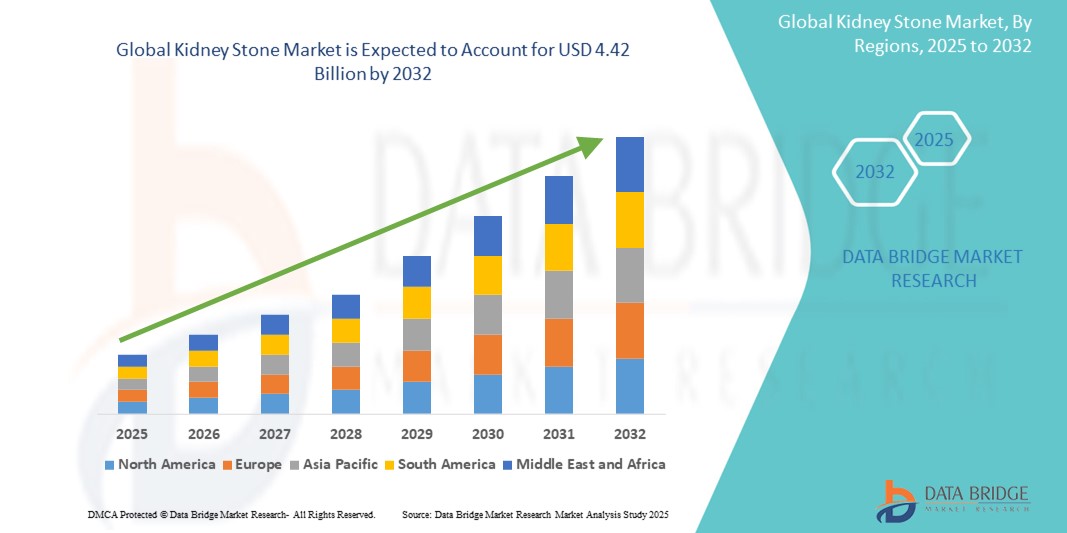
- The global Kidney Stone market was valued at USD 3.05 billion in 2024 and is expected to reach USD 4.42 billion by 2032
- During the forecast period of 2025 to 2032 the market is likely to grow at a CAGR of 4.7%, primarily driven by the increasing prevalence of kidney stone
- This growth is driven by factors such as the dietary habits, sedentary lifestyles, obesity, and an aging population
Kidney Stone Market Analysis
- Kidney stone treatment devices and technologies are critical tools used in the management and treatment of kidney stones, providing precise, effective options for patients suffering from this condition. They are essential for procedures such as extracorporeal shock wave lithotripsy (ESWL), ureteroscopy, and percutaneous nephrolithotomy
- The demand for these treatments is significantly driven by the increasing prevalence of kidney stones, influenced by dietary factors, sedentary lifestyles, obesity, and an aging population. With the rising incidence of kidney stones, particularly in regions with lifestyle diseases, the market is expanding rapidly
- North America stands out as one of the dominant markets for kidney stone treatment, driven by its advanced healthcare infrastructure, high adoption of minimally invasive techniques, and increasing public awareness of kidney stone prevention and treatment options. The U.S. is a key player, with widespread availability of the latest treatment devices and technologies
- Globally, kidney stone management systems rank as some of the most important tools in urological surgical suites, ensuring precision and minimizing patient discomfort during procedures. Their role in improving surgical outcomes and reducing recovery time has made them indispensable in modern medical practice
Report Scope and Kidney Stone Market Segmentation
|
Attributes |
Kidney Stone Key Market Insights |
|
Segments Covered |
|
|
Countries Covered |
North America
Europe
Asia-Pacific
Middle East and Africa
South America
|
|
Key Market Players |
|
|
Market Opportunities |
|
|
Value Added Data Infosets |
In addition to the insights on market scenarios such as market value, growth rate, segmentation, geographical coverage, and major players, the market reports curated by the Data Bridge Market Research also include import export analysis, production capacity overview, production consumption analysis, price trend analysis, climate change scenario, supply chain analysis, value chain analysis, raw material/consumables overview, vendor selection criteria, PESTLE Analysis, Porter Analysis, and regulatory framework. |
Kidney Stone Market Trends
“Increasing Adoption of 3D Imaging and Digital Integration in the Global Kidney Stone Market”
- One prominent trend in the global kidney stone market is the increasing adoption of 3D imaging and digital integration in both diagnostic and treatment devices
- These advanced features are significantly improving the precision and accuracy of kidney stone treatments by providing detailed, real-time images of the kidney stones, which aids in better treatment planning and stone localization
- For instance, 3D imaging technology enables healthcare professionals to view kidney stones from multiple angles, helping determine the size, shape, and location of stones, which is crucial for effective treatment options such as laser lithotripsy or extracorporeal shock wave lithotripsy (ESWL)
- Digital integration in these devices allows for seamless data storage and transfer, enabling faster diagnosis and better treatment tracking. This technology facilitates remote monitoring, data sharing between specialists, and helps in planning follow-up care
- The integration of 3D imaging and digital technologies is revolutionizing kidney stone treatment by improving the efficiency of procedures, reducing complications, and enhancing patient outcomes, contributing to the growing demand for these advanced devices in the market
Kidney Stone Market Dynamics
Driver
“Growing Prevalence of Kidney Stones and Related Disorders”
- The increasing prevalence of kidney stones globally, particularly among adults aged 30 to 60, is significantly driving the demand for kidney stone treatments and devices, including advanced diagnostic tools and surgical instruments
- Factors such as dehydration, poor dietary habits, and metabolic disorders such as obesity, diabetes, and hypercalciuria are contributing to the rising number of kidney stone cases
- In addition, an increase in the number of patients with chronic kidney disease (CKD) who are more prone to developing kidney stones further fuels the demand for specialized treatments
- As kidney stone occurrences rise, the need for effective treatment options, including lithotripsy, ureteroscopy, and minimally invasive surgeries, is also increasing
- Technological advancements, such as improved imaging techniques and robotic-assisted surgery, are ensuring more accurate diagnoses and better treatment outcomes, contributing to the growing market demand
For instance,
- In December 2022, a study published by the National Institute of Diabetes and Digestive and Kidney Diseases reported that kidney stones affect approximately 10% of people worldwide, with increasing rates due to lifestyle factors, driving the demand for better treatment options
- According to a report in January 2023 by the National Kidney Foundation, kidney stones are one of the leading causes of emergency department visits, highlighting the rising healthcare burden and increasing market demand for effective kidney stone treatments
- The increasing global prevalence of kidney stones, driven by lifestyle factors and chronic conditions, is fuelling the demand for advanced diagnostic tools, surgical treatments, and technological innovations in kidney stone management
Opportunity
“Integration of Advanced Technologies in Kidney Stone Treatment”
- The integration of cutting-edge technologies such as laser lithotripsy, robotic surgery, and 3D imaging is significantly enhancing the efficiency and precision of kidney stone treatments
- These technologies help improve patient outcomes by reducing surgical risks, recovery time, and complications, making procedures less invasive and more effective
- Artificial intelligence (AI) is also playing a growing role in enhancing diagnostic accuracy by analyzing imaging data and predicting the size and location of kidney stones in real-time, leading to more personalized treatment plans
For instance,
- In November 2023, a study published in the Journal of Urology highlighted how AI-based imaging analysis has the potential to predict kidney stone formation, allowing for early intervention and better management
- In January 2024, a company launched a 3D imaging platform for kidney stones, enabling doctors to plan the best treatment approach based on stone size and location, ultimately improving surgical precision
- The integration of advanced technologies such as laser lithotripsy, robotic surgery, 3D imaging, and AI is improving the precision, efficiency, and patient outcomes in kidney stone treatments
Restraint/Challenge
“High Treatment Costs and Limited Access to Healthcare in Emerging Markets”
- The high cost of kidney stone treatments, particularly advanced surgical procedures and diagnostic imaging technologies, remains a significant barrier to market growth, especially in emerging and low-income regions
- The cost of minimally invasive surgeries, laser lithotripsy, and robotic-assisted surgeries can be prohibitive for many healthcare facilities, especially in developing countries, where medical resources and infrastructure are limited
- Limited access to trained specialists, along with disparities in healthcare delivery, further exacerbate the challenge of providing timely and effective kidney stone treatment to patients in these regions
For instance,
- In November 2024, a report by the World Health Organization (WHO) noted that over 30% of people in low-income regions do not have access to adequate kidney stone treatment due to high treatment costs and a shortage of healthcare professionals
- Consequently, these challenges hinder the accessibility and affordability of advanced kidney stone treatment options, limiting overall market growth potential, especially in rural and underserved areas
Kidney Stone Market Scope
The market is segmented on the basis of type, treatment type and diagnosis.
|
Segmentation |
Sub-Segmentation |
|
By Type |
|
|
By Treatment Type |
|
|
By Diagnosis |
|
Kidney Stone Market Regional Analysis
“North America is the Dominant Region in the Kidney Stone Market”
- North America leads the global kidney stone market, supported by its robust healthcare infrastructure, advanced medical technologies, and the presence of prominent market players
- U.S. holds a significant share, driven by the rising prevalence of kidney stones, particularly among adults aged 30 to 60, and increasing demand for effective treatment options
- Well-established reimbursement policies and significant investments in research and development by leading medical device companies further bolster the market’s growth
- In addition, a growing number of emergency department visits due to kidney stones and the rising demand for minimally invasive treatment procedures are fuelling market expansion in the region
“Asia-Pacific is Projected to Register the Highest Growth Rate”
- Asia-Pacific is poised to experience the highest growth rate in the kidney stone market, driven by rapid improvements in healthcare infrastructure, rising awareness about kidney health, and increasing surgical volumes
- Countries such as China, India, and Japan are emerging as key markets due to the growing aging population and the increasing incidence of kidney stones, particularly in adults with underlying conditions such as obesity and diabetes
- Japan, with its advanced medical technology and skilled healthcare professionals, continues to lead in adopting high-precision treatment methods for kidney stones, including robotic surgery and laser lithotripsy
- China and India, with large populations and rising healthcare needs, are witnessing a surge in government and private sector investments in modern medical technologies, which is improving access to advanced kidney stone treatments and contributing to market growth
Kidney Stone Market Share
The market competitive landscape provides details by competitor. Details included are company overview, company financials, revenue generated, market potential, investment in research and development, new market initiatives, global presence, production sites and facilities, production capacities, company strengths and weaknesses, product launch, product width and breadth, application dominance. The above data points provided are only related to the companies' focus related to market.
The Major Market Leaders Operating in the Market Are:
- Boston Scientific Corporations (U.S.)
- Convergent Laser Technologies (U.S.)
- DirexGroup (Germany)
- Siemens Healthineers AG (Germany)
- BD (U.S.)
- Cook (U.S.)
- Dornier MedTech (Germany)
- Richard Wolf GmbH (Germany)
- Olympus Corporation (Japan)
- KARL STORZ SE & Co. KG (Germany)
- Stryker (U.S.)
- Coloplast Ltd. (Denmark)
- Lumenis Ltd. (Israel)
- EMS Urology (Switzerland)
- Medispec (U.S.)
- Focal One (U.S.)
- SonoMotion (U.S.)
- CRESENTLASER (U.S.)
- Inceler Medikal Co. Ltd. (Turkey)
Latest Developments in Global Kidney Stone Market
- In January 2025, Medtronic announced the launch of its latest HemoClear kidney stone management system in North America, which includes a new generation of stone fragmentation technology designed to increase the efficiency and precision of minimally invasive kidney stone removal procedures. The system features advanced laser technology and improved stone-breaking power, aiming to reduce procedure times and enhance patient recovery
- In November 2024, Boston Scientific introduced a new generation of its LithoVue Empower Retrieval System for the removal of kidney stones. The system features a cutting-edge, wireless video capture device that allows urologists to retrieve stones with enhanced precision while ensuring better visualization during procedures. This advancement helps improve procedural outcomes while reducing complications in kidney stone treatments
- In October 2024, Shockwave Medical presented data at the American Urological Association’s Annual Meeting, showcasing its Intravascular Lithotripsy (IVL) technology for kidney stones. The technology uses sonic waves to break up kidney stones without the need for traditional surgery. The results indicated improved stone fragment clearance and enhanced patient comfort compared to traditional methods
- In September 2024, Olympus Corporation launched the StoneBreaker Laser System, which features advanced Holmium Laser Technology for efficient stone fragmentation during minimally invasive kidney stone treatments. The system offers high precision in stone targeting and fragmentation, reducing operation time and improving recovery rates for patients. The system is now available in select markets globally

- Interactive Data Analysis Dashboard
- Company Analysis Dashboard for high growth potential opportunities
- Research Analyst Access for customization & queries
- Competitor Analysis with Interactive dashboard
- Latest News, Updates & Trend analysis
- Harness the Power of Benchmark Analysis for Comprehensive Competitor Tracking
Data collection and base year analysis are done using data collection modules with large sample sizes. The stage includes obtaining market information or related data through various sources and strategies. It includes examining and planning all the data acquired from the past in advance. It likewise envelops the examination of information inconsistencies seen across different information sources. The market data is analysed and estimated using market statistical and coherent models. Also, market share analysis and key trend analysis are the major success factors in the market report. To know more, please request an analyst call or drop down your inquiry.
The key research methodology used by DBMR research team is data triangulation which involves data mining, analysis of the impact of data variables on the market and primary (industry expert) validation. Data models include Vendor Positioning Grid, Market Time Line Analysis, Market Overview and Guide, Company Positioning Grid, Patent Analysis, Pricing Analysis, Company Market Share Analysis, Standards of Measurement, Global versus Regional and Vendor Share Analysis. To know more about the research methodology, drop in an inquiry to speak to our industry experts.
Data Bridge Market Research is a leader in advanced formative research. We take pride in servicing our existing and new customers with data and analysis that match and suits their goal. The report can be customized to include price trend analysis of target brands understanding the market for additional countries (ask for the list of countries), clinical trial results data, literature review, refurbished market and product base analysis. Market analysis of target competitors can be analyzed from technology-based analysis to market portfolio strategies. We can add as many competitors that you require data about in the format and data style you are looking for. Our team of analysts can also provide you data in crude raw excel files pivot tables (Fact book) or can assist you in creating presentations from the data sets available in the report.













