


Kids Smartwatch Market Size
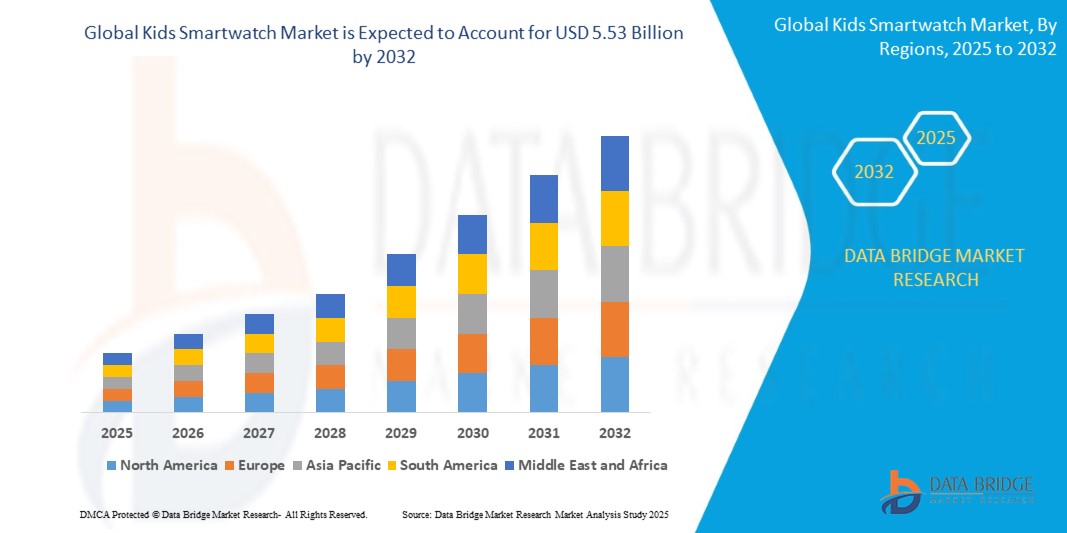
- The global kids smartwatch market size was valued at USD 1.92 billion in 2024 and is expected to reach USD 5.53 billion by 2032, at a CAGR of 14.10% during the forecast period
- The market growth is largely fuelled by the rising parental demand for real-time location tracking, communication, and safety features, as well as the increasing integration of educational and entertainment functionalities within smartwatches for children
- Continuous innovation by manufacturers in terms of design, battery life, and interactive features tailored for children aged 4 to 12 is further accelerating product adoption, making smartwatches an essential tech accessory in modern parenting
Kids Smartwatch Market Analysis
- Growing awareness among parents regarding child safety and the need for connected wearable devices to monitor location and activities are driving significant adoption of kids smartwatches globally
- Integration of features such as GPS tracking, SOS alerts, voice calling, geofencing, fitness tracking, and parental control apps is enhancing the appeal of kids smartwatches
- North America dominated the kids smartwatch market with the largest revenue share of 39.5% in 2024, driven by heightened concerns for child safety, increased parental interest in real-time tracking features, and the strong presence of smart device manufacturers
- Asia-Pacific region is expected to witness the highest growth rate in the global kids smartwatch market, driven by rapid urbanization, increasing disposable incomes, and a growing emphasis on child safety and digital learning. Countries such as China, Japan, South Korea, and India are at the forefront of this trend, supported by favorable government initiatives in technology education and innovation
- The smart type segment dominated the market with the largest market revenue share in 2024, driven by the increasing demand for feature-rich wearable devices that include GPS tracking, voice calling, SOS alerts, and educational apps. Parents increasingly prefer smart type watches for their ability to ensure child safety and provide interactive learning experiences. The integration of gamified learning, real-time communication, and parental control tools has made smart watches an essential gadget in modern parenting
Report Scope and Kids Smartwatch Market Segmentation
|
Attributes |
Kids Smartwatch Key Market Insights |
|
Segments Covered |
|
|
Countries Covered |
North America
Europe
Asia-Pacific
Middle East and Africa
South America
|
|
Key Market Players |
|
|
Market Opportunities |
|
|
Value Added Data Infosets |
In addition to the insights on market scenarios such as market value, growth rate, segmentation, geographical coverage, and major players, the market reports curated by the Data Bridge Market Research also include in-depth expert analysis, geographically represented company-wise production and capacity, network layouts of distributors and partners, detailed and updated price trend analysis and deficit analysis of supply chain and demand. |
Kids Smartwatch Market Trends
“Integration of Educational and Health Monitoring Features in Kids Smartwatches”
- Rising demand for multi-functional wearables is driving innovation in kids smartwatches. Manufacturers are integrating educational games, fitness trackers, sleep monitors, and wellness alerts to enhance the utility of these devices. This trend not only supports early learning and health awareness among children but also makes smartwatches more appealing to parents seeking all-in-one digital solutions
- The inclusion of health-focused features such as step counters, hydration reminders, and sleep tracking enables parents to monitor their child's well-being in real time. These capabilities are especially valuable in households where health and routine are priorities. Smartwatches are increasingly seen as tools for building discipline and healthier daily habits from an early age
- Gamified learning elements are transforming kids’ smartwatches into engaging educational tools. Apps with vocabulary building, math puzzles, and interactive storytelling help boost cognitive development while maintaining screen-time control. This adds a layer of constructive entertainment, aligning tech usage with learning goals
- For instance, Garmin’s Bounce smartwatch offers real-time tracking, fitness goals, and education-linked challenges that reward physical activity. Similarly, Fitbit Ace includes sleep tracking and step goals, motivating children through virtual badges and personalized insights. These innovations reflect a growing market trend toward development-oriented smart wearables
- As parents look for safer, more enriching digital experiences for their children, educational and health-enhancing features are shaping the future of the kids smartwatch market. This trend positions smartwatches not just as gadgets but as essential tools in modern child development and well-being
Kids Smartwatch Market Dynamics
Driver
“Rising Demand for Real-Time Location Tracking and Safe Communication”
- Parents are increasingly relying on kids’ smartwatches to monitor their child’s location and ensure secure communication. These devices offer real-time GPS tracking, two-way calling, and SOS alerts, providing reassurance and control to guardians. As child safety remains a top priority, smartwatches are becoming an essential digital parenting tool
- The use of smartwatches enables controlled digital interaction, allowing parents to limit access to apps and screen time while still maintaining connectivity. This appeals to households seeking a balance between safety and independence for their children. The demand is particularly high among working parents and urban families
- Schools and child-care centers are also promoting smartwatch usage for added security during field trips or daily commutes. These endorsements enhance credibility and adoption rates, especially in countries with high urban density and safety concerns
- For instance, the adoption of smartwatches among school-going children in China surged in recent years due to concerns about student safety during commutes. Brands responded with models featuring electronic fencing, video calling, and class-mode settings, ensuring both safety and academic discipline
- As the need for dependable child tracking and supervised communication grows, kids’ smartwatches are evolving from optional gadgets to mainstream family tools. This growing reliance is expected to drive consistent market expansion in the coming years
Restraint/Challenge
“Growing Concerns Around Data Privacy and Device Vulnerabilities”
- Despite growing popularity, privacy concerns surrounding kids' smartwatches remain a significant restraint to market growth. These devices often track precise location data, store voice messages, and collect biometric or behavioral data, raising questions about data security and parental consent
- Many low-cost smartwatch models lack robust security protocols, making them vulnerable to hacking, data leaks, and unauthorized surveillance. This poses potential safety risks and legal implications, especially when data is stored on unsecured servers or transmitted without encryption
- Strict data protection regulations across regions such as Europe and North America demand compliance from manufacturers regarding children’s data. Failing to meet these legal standards can lead to recalls, lawsuits, or bans, affecting brand reputation and financial stability
- For instance, the Norwegian Consumer Council’s 2019 investigation found major security flaws in popular kids’ smartwatches, revealing weak encryption and exploitable GPS data. The report triggered EU-wide scrutiny and led to several brands pulling their products from online platforms
- The concern for privacy and security is reshaping buyer behavior, with consumers prioritizing devices that guarantee data protection and parental control. Unless manufacturers significantly enhance cybersecurity standards, this issue will continue to challenge the widespread adoption of kids’ smartwatches
Kids Smartwatch Market Scope
The market is segmented on the basis of type, compatibility, product, connectivity, end user, and distribution channel.
• By Type
On the basis of type, the kids smartwatch market is segmented into functional type and smart type. The smart type segment dominated the market with the largest market revenue share in 2024, driven by the increasing demand for feature-rich wearable devices that include GPS tracking, voice calling, SOS alerts, and educational apps. Parents increasingly prefer smart type watches for their ability to ensure child safety and provide interactive learning experiences. The integration of gamified learning, real-time communication, and parental control tools has made smart watches an essential gadget in modern parenting.
The functional type segment is expected to witness the fastest growth from 2025 to 2032, supported by demand for simpler and more affordable options. These watches generally offer basic features such as digital timekeeping, alarms, and reminders, making them suitable for very young children or households seeking budget-friendly alternatives.
• By Compatibility
On the basis of compatibility, the market is segmented into iOS, Android, and others. The Android segment held the largest revenue share in 2024, owing to the global dominance of Android smartphones and the broad compatibility of Android-based applications. Kids smartwatches that pair seamlessly with Android phones offer users cost-effective and flexible options with extensive feature integration.
The iOS segment is expected to witness the fastest growth from 2025 to 2032, driven by rising adoption in developed economies such as the U.S. and the U.K. where iPhones are more prevalent. Watches compatible with iOS devices typically emphasize premium design and ecosystem integration, attracting consumers in higher-income segments.
• By Product
On the basis of product, the kids smartwatch market is segmented into integrated and standalone. The standalone segment dominated the market in 2024, supported by strong demand for devices that operate independently without requiring constant connection to smartphones. Standalone watches with built-in SIM support, GPS, and calling features provide parents peace of mind while allowing children greater independence.
The integrated segment is expected to witness the fastest growth from 2025 to 2032, owing to increasing interest in devices that pair with smartphones for enhanced functionality and parental monitoring. These products often rely on connected apps to deliver insights into a child’s activity, safety, and behavior patterns.
• By Connectivity
On the basis of connectivity, the market is segmented into Bluetooth, Wi-Fi, cellular networks, and NFC. The cellular networks segment held the largest revenue share in 2024, driven by the need for real-time communication, GPS tracking, and emergency response features. Cellular-enabled smartwatches are highly preferred by parents for their independent functionality without relying on nearby smartphones.
The Bluetooth segment is expected to witness the fastest growth from 2025 to 2032, fuelled by its low energy consumption and ease of local device pairing. Bluetooth connectivity enables seamless syncing with smartphones for app notifications, fitness tracking, and data transfers without draining battery quickly.
• By End User
On the basis of end user, the kids smartwatch market is segmented into 7–12 years old and 0–6 years old. The 7–12 years old segment dominated the market in 2024, as older children benefit more from communication, navigation, and educational features. Smartwatches for this age group often include fitness trackers, gamified learning tools, and messaging apps to foster independence under parental supervision.
The 0–6 years old segment is expected to witness the fastest growth from 2025 to 2032, particularly in urban households seeking early safety tools. Wearables for this younger demographic focus on simplified interfaces, limited functionality, and robust tracking, with a strong emphasis on security and ease of use.
• By Distribution Channel
On the basis of distribution channel, the market is segmented into supermarket/hypermarket, convenience stores, specialty stores, and online sales channel. The online sales channel dominated the market in 2024, supported by growing e-commerce penetration and the convenience of browsing multiple brands, features, and price ranges from home. Online platforms also offer access to global products and reviews that guide consumer decisions.
The specialty stores segment is expected to witness the fastest growth from 2025 to 2032, driven by the need for personalized customer support, product demonstrations, and after-sales service. Parents often prefer brick-and-mortar stores for high-involvement purchases, especially when seeking quality assurance and product compatibility guidance.
Kids Smartwatch Market Regional Analysis
- North America dominated the kids smartwatch market with the largest revenue share of 39.5% in 2024, driven by heightened concerns for child safety, increased parental interest in real-time tracking features, and the strong presence of smart device manufacturers
- Parents across the region increasingly favor kids smartwatches for their ability to offer GPS tracking, two-way calling, geofencing, and health monitoring in a single wearable device
- The market’s expansion is further propelled by high smartphone penetration, a tech-savvy population, and the growing trend of child-focused digital wellness products, particularly for children aged 7–12
U.S. Kids Smartwatch Market Insight
The U.S. kids smartwatch market captured the largest revenue share in 2024 within North America, propelled by strong demand for child safety devices and the rising popularity of smart wearables among school-aged children. Parental demand for smart solutions that allow controlled communication and activity monitoring is fostering rapid adoption. The presence of advanced network infrastructure, high awareness of child-focused tech innovations, and frequent product launches by major technology brands are also bolstering market growth across the country
Europe Kids Smartwatch Market Insight
The Europe kids smartwatch market is expected to witness the fastest growth from 2025 to 2032, supported by increasing parental concerns over child security and a growing emphasis on regulated screen time and physical activity. Demand is particularly strong in countries with high digital adoption rates and structured school environments. Moreover, rising disposable incomes and expanding retail penetration of smart devices for children are driving product accessibility across residential and educational segments
U.K. Kids Smartwatch Market Insight
The U.K. kids smartwatch market is expected to witness the fastest growth from 2025 to 2032, driven by increased demand for GPS-enabled safety solutions and child-friendly communication tools. Parents are seeking wearables that allow tracking and emergency calls without granting full smartphone access. Government support for child safety initiatives and a rising trend toward digital education and outdoor activity monitoring are further contributing to market demand
Germany Kids Smartwatch Market Insight
The Germany kids smartwatch market is expected to witness the fastest growth from 2025 to 2032, fueled by the country’s strong emphasis on security, digital literacy, and data privacy. German consumers are showing growing interest in smart devices designed for children, especially those offering non-intrusive safety features and parental controls. Local brands and European manufacturers are focusing on launching GDPR-compliant, health-conscious smartwatches that appeal to both parents and educators
Asia-Pacific Kids Smartwatch Market Insight
The Asia-Pacific kids smartwatch market is expected to witness the fastest growth from 2025 to 2032, driven by a rising child population, expanding middle-class incomes, and increasing digital connectivity in countries such as China, India, and South Korea. Smartwatches are being adopted as affordable alternatives to smartphones for kids, offering communication and safety features. Government digitalization drives and strong local manufacturing capabilities are enhancing accessibility and product diversity across both urban and semi-urban areas
Japan Kids Smartwatch Market Insight
The Japan kids smartwatch market is expected to witness the fastest growth from 2025 to 2032, due to the country’s early tech adoption culture and emphasis on safety and education. With a growing number of nuclear families, demand for reliable child-tracking and communication tools is rising. Manufacturers are focusing on ergonomic designs and multifunctional features such as classroom modes and health tracking, aligning with Japan’s focus on discipline and student wellbeing
China Kids Smartwatch Market Insight
The China kids smartwatch market accounted for the largest revenue share in Asia-Pacific in 2024, attributed to strong domestic production, competitive pricing, and widespread consumer acceptance. Chinese brands dominate the local market, offering advanced features such as real-time location tracking, video calls, and AI-enabled learning aids at affordable prices. The government's push toward smart education, coupled with urban parental demand for child surveillance and digital learning tools, is significantly fueling growth across both metropolitan and tier-2 cities
Kids Smartwatch Market Share
The Kids Smartwatch industry is primarily led by well-established companies, including:
- Apple Inc. (U.S.)
- Alphabet Inc. (U.S.)
- Sony Corporation (Japan)
- SAMSUNG (South Korea)
- Google LLC (U.S.)
- Microsoft (U.S.)
- LG Electronics (South Korea)
- Xiaomi (China)
- Fossil Group, Inc. (U.S.)
- Garmin Ltd. (Switzerland)
- Fitbit, Inc. (U.S.)
- Huawei Technologies Co., Ltd. (China)
- Motorola Mobility LLC (U.S.)
- Tomtom International BV. (Netherlands)
- Giorgio Armani S.p.A (Italy)
- ASUSTeK Computer Inc. (ASUS) (Taiwan)
- Michael Kors (U.S.)
- Polar Electro (Finland)
- adidas America Inc. (U.S.)
- Dexcom, Inc. (U.S.)
Latest Developments in Global Kids Smartwatch Market
- In September 2022, VTech Holdings Limited introduced new additions to its children's electronics portfolio, including the My First Kidi Smartwatch and KidiGo NexTag. This product development aims to support time management and mindfulness in kids through features such as a breathing app. The expansion is expected to strengthen VTech's market presence by aligning with rising demand for educational and wellness-focused wearables, driving global sales and enhancing its brand position in the kids smartwatch segment
- In March 2021, VTech launched a series of smartwatches for children featuring voice calling, messaging, and activity tracking capabilities. This strategic development was designed to combine entertainment with safety and learning, appealing to tech-savvy parents and digitally engaged children. The move reinforces VTech’s focus on the educational gadget market and supports continued growth in the wearables space
- In June 2021, Garmin expanded its wearables portfolio with the launch of vívofit Jr. 3 and vívofit Jr. 2, smartwatches tailored for kids. These devices offer interactive activity tracking, games, and reward-based features to encourage physical movement and responsibility. The product launch allows Garmin to tap into the growing market for child-focused fitness technology, enhancing brand visibility and diversification in the smartwatch segment

- Interactive Data Analysis Dashboard
- Company Analysis Dashboard for high growth potential opportunities
- Research Analyst Access for customization & queries
- Competitor Analysis with Interactive dashboard
- Latest News, Updates & Trend analysis
- Harness the Power of Benchmark Analysis for Comprehensive Competitor Tracking
Global Kids Smartwatch Market, Supply Chain Analysis and Ecosystem Framework
To support market growth and help clients navigate the impact of geopolitical shifts, DBMR has integrated in-depth supply chain analysis into its Global Kids Smartwatch Market research reports. This addition empowers clients to respond effectively to global changes affecting their industries. The supply chain analysis section includes detailed insights such as Global Kids Smartwatch Market consumption and production by country, price trend analysis, the impact of tariffs and geopolitical developments, and import and export trends by country and HSN code. It also highlights major suppliers with data on production capacity and company profiles, as well as key importers and exporters. In addition to research, DBMR offers specialized supply chain consulting services backed by over a decade of experience, providing solutions like supplier discovery, supplier risk assessment, price trend analysis, impact evaluation of inflation and trade route changes, and comprehensive market trend analysis.
Data collection and base year analysis are done using data collection modules with large sample sizes. The stage includes obtaining market information or related data through various sources and strategies. It includes examining and planning all the data acquired from the past in advance. It likewise envelops the examination of information inconsistencies seen across different information sources. The market data is analysed and estimated using market statistical and coherent models. Also, market share analysis and key trend analysis are the major success factors in the market report. To know more, please request an analyst call or drop down your inquiry.
The key research methodology used by DBMR research team is data triangulation which involves data mining, analysis of the impact of data variables on the market and primary (industry expert) validation. Data models include Vendor Positioning Grid, Market Time Line Analysis, Market Overview and Guide, Company Positioning Grid, Patent Analysis, Pricing Analysis, Company Market Share Analysis, Standards of Measurement, Global versus Regional and Vendor Share Analysis. To know more about the research methodology, drop in an inquiry to speak to our industry experts.
Data Bridge Market Research is a leader in advanced formative research. We take pride in servicing our existing and new customers with data and analysis that match and suits their goal. The report can be customized to include price trend analysis of target brands understanding the market for additional countries (ask for the list of countries), clinical trial results data, literature review, refurbished market and product base analysis. Market analysis of target competitors can be analyzed from technology-based analysis to market portfolio strategies. We can add as many competitors that you require data about in the format and data style you are looking for. Our team of analysts can also provide you data in crude raw excel files pivot tables (Fact book) or can assist you in creating presentations from the data sets available in the report.













