What is the Kitchen Ventilation Market Size and Growth Rate?
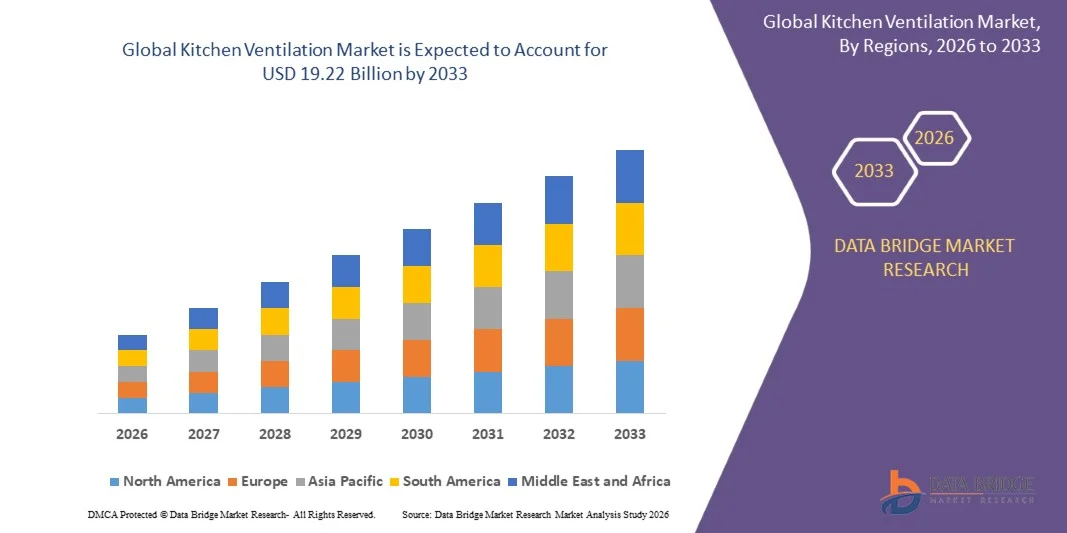
- As per Data Bridge Market Research analysis, the kitchen ventilation market was valued at USD 11.53 billion in 2025 and is projected to reach USD 19.22 billion by 2033, growing at a CAGR of 6.60% from 2026 to 2033.
- The market is experiencing steady growth due to the increasing demand for improved indoor air quality, rising adoption of energy-efficient ventilation systems, and expanding residential and commercial construction activities worldwide.
- Stringent building regulations, growing investments in commercial kitchens across restaurants, hotels, and cloud kitchens, along with increasing consumer preference for smart and low-noise ventilation solutions, are accelerating market growth. In addition, technological advancements such as IoT-enabled range hoods, demand-controlled ventilation, and energy-efficient exhaust systems are supporting the market's long-term expansion.
Market Size & Forecast
- Market Value (2025): USD 11.53 Billion
- Expected Market Value (2033): USD 19.22 Billion
- Forecast CAGR (2026–2033): 6.60%
- Leading Region in 2025: North America
- Fastest Growing Region: Asia-Pacific
What are the Major Takeaways of the Kitchen Ventilation Market?
- North America dominated the kitchen ventilation market and accounted for the largest revenue share of 52.6% in 2025, supported by stringent indoor air quality regulations, high consumer adoption of premium kitchen appliances, and the presence of a well-established commercial foodservice industry. The region also benefits from increasing investments in residential remodeling, smart home technologies, and energy-efficient ventilation solutions.
- Asia-Pacific kitchen ventilation market is expected to witness the fastest growth rate from 2026 to 2033. The market growth is driven by rapid urbanization, increasing residential and commercial construction activities, and the expansion of restaurants, hotels, cloud kitchens, and hospitality facilities across China, India, Japan, and Southeast Asia.
- The wall-mounted canopy hoods segment held the largest market revenue share in 2025 driven by its widespread installation across restaurants, hotels, cafeterias, and other commercial kitchens. These hoods offer efficient removal of smoke, grease, heat, and cooking fumes while providing cost-effective installation and compatibility with wall-mounted cooking equipment. Their reliable performance, ease of maintenance, and compliance with commercial kitchen ventilation standards continue to support their market leadership.
- The proximity hoods segment is expected to witness the fastest growth during the forecast period from 2026 to 2033 driven by increasing demand for energy-efficient ventilation solutions, superior capture efficiency, and lower exhaust airflow requirements. Growing investments in modern commercial kitchen infrastructure, stricter indoor air quality regulations, and the adoption of demand-controlled ventilation technologies are expected to further accelerate segment growth.
- The type I hood segment held the largest market revenue share in 2025 driven by its mandatory use above grease-producing cooking appliances such as fryers, grills, ranges, and charbroilers. Increasing compliance with fire safety regulations, commercial kitchen ventilation standards, and the growing number of foodservice establishments continue to support the widespread adoption of type I hood systems.
- The type II hood segment is expected to witness the fastest growth during the forecast period from 2026 to 2033 driven by increasing installation above heat- and steam-generating equipment in hospitals, institutional kitchens, cafeterias, and corporate foodservice facilities. Rising emphasis on indoor air quality, energy efficiency, and sustainable building practices is expected to further strengthen market demand.
Report Scope and Kitchen Ventilation Market Segmentation
|
Attributes |
Kitchen Ventilation Key Market Insights |
|
Segments Covered |
|
|
Countries Covered |
North America
Europe
Asia-Pacific
Middle East and Africa
South America
|
|
Key Market Players |
|
|
Market Opportunities |
|
|
Value Added Data Infosets |
In addition to the insights on market scenarios such as market value, growth rate, segmentation, geographical coverage, and major players, the market reports curated by the Data Bridge Market Research also include in-depth expert analysis, pricing analysis, brand share analysis, consumer survey, demography analysis, supply chain analysis, value chain analysis, raw material/consumables overview, vendor selection criteria, PESTLE Analysis, Porter Analysis, and regulatory framework. |
What is the Key Trend in the Kitchen Ventilation Market?
- Smart, connected, and energy-efficient kitchen ventilation systems are becoming a major trend as residential and commercial users increasingly prioritize indoor air quality (IAQ), lower energy consumption, and automated ventilation. Manufacturers are integrating IoT connectivity, occupancy sensors, and demand-controlled ventilation technologies to optimize airflow while reducing operating costs.
- For instance, in December 2024, Panasonic launched its BalancedHome Elite Energy Recovery Ventilator (ERV) Series, offering high-efficiency ventilation solutions designed to improve indoor air quality while meeting modern residential building codes. The new ERV series expands Panasonic's portfolio of energy-efficient ventilation systems for healthier indoor environments.
- Demand-controlled ventilation (DCV) and smart range hoods equipped with automatic sensing technologies are gaining traction in residential and commercial kitchens. These systems automatically adjust fan speed based on heat, smoke, humidity, or cooking activity, improving ventilation performance while minimizing electricity consumption.
- Manufacturers are also focusing on low-noise operation, brushless DC motors, and energy recovery technologies to comply with increasingly stringent building energy-efficiency regulations and green building certifications. These innovations improve user comfort while lowering lifecycle operating costs.
- For instance, in February 2025, Panasonic showcased its OASYS Whole Home Air Quality Management Solution at the NAHB International Builders' Show (IBS) 2025. The solution integrates ventilation, air purification, and smart controls to deliver enhanced indoor air quality, energy efficiency, and regulatory compliance for modern residential buildings.
- As governments continue to strengthen indoor air quality standards and consumers increasingly adopt smart home technologies, the demand for intelligent, energy-efficient, and connected kitchen ventilation systems is expected to accelerate throughout the forecast period.
What are the Key Drivers of the Kitchen Ventilation Market?
- The growing focus on indoor air quality (IAQ), rising adoption of energy-efficient ventilation systems, and increasingly stringent building ventilation regulations are significantly driving demand for kitchen ventilation solutions across residential and commercial sectors. The expansion of restaurants, hotels, cloud kitchens, and modern housing projects is further accelerating market growth.
- For instance, in December 2024, Panasonic launched its BalancedHome Elite and Elite Plus Energy Recovery Ventilator (ERV) Series, designed to improve indoor air quality while meeting ASHRAE 62.2 ventilation standards. The new systems offer energy-efficient airflow management and support healthier indoor environments in residential buildings.
- Commercial foodservice operators are increasingly adopting smart demand-controlled ventilation (DCV) systems that automatically regulate airflow based on cooking activity, helping reduce energy consumption, improve operational efficiency, and comply with environmental and fire safety regulations.
- For instance, in September 2024, Halton reported that its M.A.R.V.E.L. Demand Controlled Ventilation technology reduced kitchen ventilation energy consumption by up to 51% based on data collected from nearly 700 commercial kitchens, while its connected platform currently monitors more than 3,700 smart kitchen hoods across 39 countries.
- As governments strengthen indoor air quality standards and consumers increasingly prioritize healthier, energy-efficient living spaces, manufacturers continue investing in IoT-enabled range hoods, low-noise exhaust systems, and intelligent ventilation technologies, supporting the long-term growth of the global kitchen ventilation market.
Which Factors are Challenging the Growth of the Kitchen Ventilation Market?
- Advanced kitchen ventilation systems require high upfront investment due to the integration of energy-efficient motors, demand-controlled ventilation (DCV), IoT-enabled controls, make-up air systems, and compliance with stringent fire safety and indoor air quality regulations.
- These high installation and maintenance costs limit adoption among small restaurants, independent foodservice operators, and households, particularly in developing economies where budget constraints remain a key concern.
- For instance, in April 2025, Greenheck highlighted that optimized commercial kitchen ventilation systems require integrated hood controls, exhaust fan automation, temperature sensing, and make-up air coordination to comply with modern building and fire codes, increasing the overall installation complexity and project costs.
- The substantial capital investment, rising energy costs, and ongoing maintenance requirements associated with advanced kitchen ventilation systems continue to restrain market growth, particularly among small and medium-sized foodservice establishments. Although smart demand-controlled ventilation technologies can reduce long-term operating costs, the higher initial investment remains a significant barrier to widespread adoption in price-sensitive markets.
How is the Kitchen Ventilation Market Segmented?
The kitchen ventilation market is segmented on the basis of product, type, application type, and fan type.
- By Product Type
On the basis of product, the kitchen ventilation market is segmented into wall-mounted canopy hoods, proximity hoods, and island canopy hoods. The wall-mounted canopy hoods segment held the largest market revenue share in 2025 driven by its widespread installation across restaurants, hotels, cafeterias, and other commercial kitchens. These hoods offer efficient removal of smoke, grease, heat, and cooking fumes while providing cost-effective installation and compatibility with wall-mounted cooking equipment. Their reliable performance, ease of maintenance, and compliance with commercial kitchen ventilation standards continue to support their market leadership.
The proximity hoods segment is expected to witness the fastest growth during the forecast period from 2026 to 2033 driven by increasing demand for energy-efficient ventilation solutions, superior capture efficiency, and lower exhaust airflow requirements. Growing investments in modern commercial kitchen infrastructure, stricter indoor air quality regulations, and the adoption of demand-controlled ventilation technologies are expected to further accelerate segment growth.
- By Type
On the basis of type, the kitchen ventilation market is segmented into type I hood and type II hood. The type I hood segment held the largest market revenue share in 2025 driven by its mandatory use above grease-producing cooking appliances such as fryers, grills, ranges, and charbroilers. Increasing compliance with fire safety regulations, commercial kitchen ventilation standards, and the growing number of foodservice establishments continue to support the widespread adoption of type I hood systems.
The type II hood segment is expected to witness the fastest growth during the forecast period from 2026 to 2033 driven by increasing installation above heat- and steam-generating equipment in hospitals, institutional kitchens, cafeterias, and corporate foodservice facilities. Rising emphasis on indoor air quality, energy efficiency, and sustainable building practices is expected to further strengthen market demand.
- By Application Type
On the basis of application type, the kitchen ventilation market is segmented into restaurants, hospitals, corporate offices, and others. The restaurants segment held the largest market revenue share of approximately 38% in in 2025 driven by the rapid expansion of quick-service restaurants (QSRs), fine dining establishments, cloud kitchens, and independent foodservice outlets worldwide. Increasing compliance with fire safety regulations, stringent indoor air quality requirements, and the growing demand for efficient grease, smoke, and odor extraction systems continue to drive the adoption of advanced kitchen ventilation solutions across restaurant kitchens.
The hospitals segment is expected to witness the fastest growth during the forecast period from 2026 to 2033 driven by expanding healthcare infrastructure, increasing investments in institutional foodservice facilities, and stringent hygiene and infection-control requirements. Growing demand for safe food preparation environments, improved indoor air quality, and energy-efficient ventilation systems is expected to further support market expansion.
- By Fan Type
On the basis of fan type, the kitchen ventilation market is segmented into low speed fans, axial fans, centrifugal fan sets, bifurcated fan sets, belt driven axial fans, in-line centrifugal and mixed flow impellers, and roof extract fans.The centrifugal fan sets segment held the largest market revenue share in 2025 driven by their ability to deliver high airflow capacity, operate efficiently under high static pressure conditions, and effectively handle grease-laden exhaust air. Their robust performance, durability, and widespread deployment across restaurants, hotels, hospitals, and institutional kitchens continue to reinforce their leading market position.
The in-line centrifugal and mixed flow impellers segment is expected to witness the fastest growth during the forecast period from 2026 to 2033 driven by increasing demand for compact, low-noise, and energy-efficient ventilation systems. Continuous advancements in HVAC technologies, rising adoption of smart commercial ventilation solutions, and growing emphasis on sustainable building design are expected to further accelerate the adoption of these advanced fan systems during the forecast period.
Which Region Holds the Largest Share of the Kitchen Ventilation Market?
- North America dominated the kitchen ventilation market and accounted for the largest revenue share of 52.6% in 2025, supported by stringent indoor air quality regulations, high consumer adoption of premium kitchen appliances, and the presence of a well-established commercial foodservice industry. The region also benefits from increasing investments in residential remodeling, smart home technologies, and energy-efficient ventilation solutions.
- The region continues to strengthen its market position through the widespread adoption of advanced range hoods, demand-controlled ventilation systems, and energy-efficient exhaust technologies across residential and commercial kitchens. Furthermore, strict building codes, growing awareness of healthy indoor environments, and the expansion of restaurants, hotels, and cloud kitchens are expected to support sustained market growth across North America during the forecast period.
U.S. Kitchen Ventilation Market Insight
The U.S. kitchen ventilation market holds a significant share of the North American market, driven by the country's well-established foodservice industry, stringent building and fire safety regulations, and increasing demand for energy-efficient ventilation solutions. The growing number of restaurants, hotels, hospitals, corporate cafeterias, and cloud kitchens continues to drive the adoption of advanced kitchen ventilation systems. In addition, rising investments in commercial building renovations, increasing focus on indoor air quality (IAQ), and the adoption of smart ventilation technologies such as demand-controlled ventilation (DCV), IoT-enabled hood controls, and high-efficiency exhaust systems are supporting market growth.
Asia-Pacific Kitchen Ventilation Market Insight
The Asia-Pacific kitchen ventilation market is expected to witness the fastest growth rate from 2026 to 2033. The market growth is driven by rapid urbanization, increasing residential and commercial construction activities, and the expansion of restaurants, hotels, cloud kitchens, and hospitality facilities across China, India, Japan, and Southeast Asia. Rising disposable incomes, growing consumer awareness of indoor air quality, and increasing adoption of modular kitchens are further supporting market expansion. In addition, government initiatives promoting energy-efficient buildings and the growing availability of smart, energy-efficient kitchen ventilation systems are accelerating product adoption across both residential and commercial sectors during the forecast period.
Japan Kitchen Ventilation Market Insight
The Japan kitchen ventilation market is expected to witness the fastest growth rate from 2026 to 2033, driven by increasing demand for energy-efficient home appliances, rising adoption of smart kitchen technologies, and stringent indoor air quality and building efficiency standards. The country's growing focus on sustainable housing, premium residential developments, and modern commercial kitchens is supporting the adoption of advanced kitchen ventilation systems. Furthermore, continuous innovation in low-noise range hoods, IoT-enabled ventilation solutions, and high-efficiency exhaust technologies is enhancing product performance and strengthening market growth across both residential and commercial sectors.
China Kitchen Ventilation Market Insight
The China kitchen ventilation market is expected to witness the fastest growth rate from 2026 to 2033, supported by rapid urbanization, expanding residential construction, and the continuous growth of the foodservice and hospitality industries. Increasing consumer spending on premium kitchen appliances, rising awareness of indoor air quality, and the widespread adoption of modular kitchens are significantly boosting demand for advanced kitchen ventilation systems. In addition, strong domestic manufacturing capabilities, government initiatives promoting energy-efficient buildings, and continuous product innovations in smart range hoods and ventilation technologies are positioning China as one of the largest and fastest-growing markets for kitchen ventilation solutions globally.
Europe Kitchen Ventilation Market Insight
The Europe kitchen ventilation market is expected to witness the fastest growth rate from 2026 to 2033, driven by stringent environmental, fire safety, and indoor air quality regulations across commercial foodservice establishments. The expanding hospitality sector, increasing investments in restaurants, hotels, hospitals, and institutional kitchens, and the growing adoption of energy-efficient ventilation systems are supporting market expansion. Rising renovation activities in commercial buildings, increasing demand for sustainable HVAC solutions, and the integration of smart ventilation technologies, including demand-controlled ventilation (DCV) and IoT-enabled monitoring systems, are further accelerating market growth.
U.K. Kitchen Ventilation Market Insight
The U.K. kitchen ventilation market is expected to witness the fastest growth rate from 2026 to 2033, driven by increasing consumer awareness of indoor air quality, rising adoption of energy-efficient kitchen appliances, and growing investments in residential renovation and commercial foodservice infrastructure. The expansion of restaurants, hotels, cloud kitchens, and quick-service restaurants (QSRs), along with stringent building ventilation and energy-efficiency regulations, continues to support market demand. Furthermore, the increasing adoption of smart range hoods, demand-controlled ventilation systems, and low-noise exhaust technologies is enhancing energy efficiency and user convenience, positioning the U.K. as a key market for advanced kitchen ventilation solutions in Europe.
Germany Kitchen Ventilation Market Insight
The Germany kitchen ventilation market is expected to witness the fastest growth rate from 2026 to 2033, supported by the country's strong focus on energy-efficient buildings, stringent indoor air quality regulations, and high adoption of premium kitchen appliances. Rising residential renovation activities, increasing construction of modern housing, and the expansion of commercial foodservice establishments are driving demand for advanced kitchen ventilation systems. Furthermore, the growing adoption of smart range hoods, demand-controlled ventilation technologies, and sustainable HVAC solutions is enhancing energy efficiency and indoor comfort, reinforcing Germany's position as one of Europe's leading markets for kitchen ventilation equipment.
Which are the Top Companies in Kitchen Ventilation Market?
The kitchen ventilation industry is primarily led by well-established companies, including:
- Broan-NuTone LLC (U.S.)
- Whirlpool Corporation (U.S.)
- Haier Group (China)
- BSH Hausgeräte GmbH (Germany)
- AB Electrolux (Sweden)
- Samsung Electronics Co., Ltd. (South Korea)
- LG Electronics Inc. (South Korea)
- Panasonic Holdings Corporation (Japan)
- Midea Group (China)
- Faber S.p.A. (Italy)
- Elica S.p.A. (Italy)
- Fujioh International Trading Pte. Ltd. (Singapore)
- Vatti Corporation Limited (China)
- ROBAM Appliances Co., Ltd. (China)
- Greenheck Fan Corporation (U.S.)
- Systemair AB (Sweden)
- CaptiveAire Systems, Inc. (U.S.)
- Halton Group (Finland)
- Franke Holding AG (Switzerland)
What are Latest Developments in Kitchen Ventilation Market?
- In January 2023, Daikin Industries, Ltd. launched a new range of energy-efficient kitchen ventilation hoods designed to enhance indoor air quality while reducing energy consumption. The introduction strengthened the company's portfolio of advanced ventilation solutions and supported growing demand for sustainable kitchen airflow management systems.
- In March 2023, Greenheck Fan Corporation expanded its ventilation solutions portfolio through the acquisition of a ventilation technology company. The move enhanced the company's capabilities in commercial kitchen exhaust and air management systems, reinforcing its presence in the kitchen ventilation industry.

- Interactive Data Analysis Dashboard
- Company Analysis Dashboard for high growth potential opportunities
- Research Analyst Access for customization & queries
- Competitor Analysis with Interactive dashboard
- Latest News, Updates & Trend analysis
- Harness the Power of Benchmark Analysis for Comprehensive Competitor Tracking
Data collection and base year analysis are done using data collection modules with large sample sizes. The stage includes obtaining market information or related data through various sources and strategies. It includes examining and planning all the data acquired from the past in advance. It likewise envelops the examination of information inconsistencies seen across different information sources. The market data is analysed and estimated using market statistical and coherent models. Also, market share analysis and key trend analysis are the major success factors in the market report. To know more, please request an analyst call or drop down your inquiry.
The key research methodology used by DBMR research team is data triangulation which involves data mining, analysis of the impact of data variables on the market and primary (industry expert) validation. Data models include Vendor Positioning Grid, Market Time Line Analysis, Market Overview and Guide, Company Positioning Grid, Patent Analysis, Pricing Analysis, Company Market Share Analysis, Standards of Measurement, Global versus Regional and Vendor Share Analysis. To know more about the research methodology, drop in an inquiry to speak to our industry experts.
Data Bridge Market Research is a leader in advanced formative research. We take pride in servicing our existing and new customers with data and analysis that match and suits their goal. The report can be customized to include price trend analysis of target brands understanding the market for additional countries (ask for the list of countries), clinical trial results data, literature review, refurbished market and product base analysis. Market analysis of target competitors can be analyzed from technology-based analysis to market portfolio strategies. We can add as many competitors that you require data about in the format and data style you are looking for. Our team of analysts can also provide you data in crude raw excel files pivot tables (Fact book) or can assist you in creating presentations from the data sets available in the report.