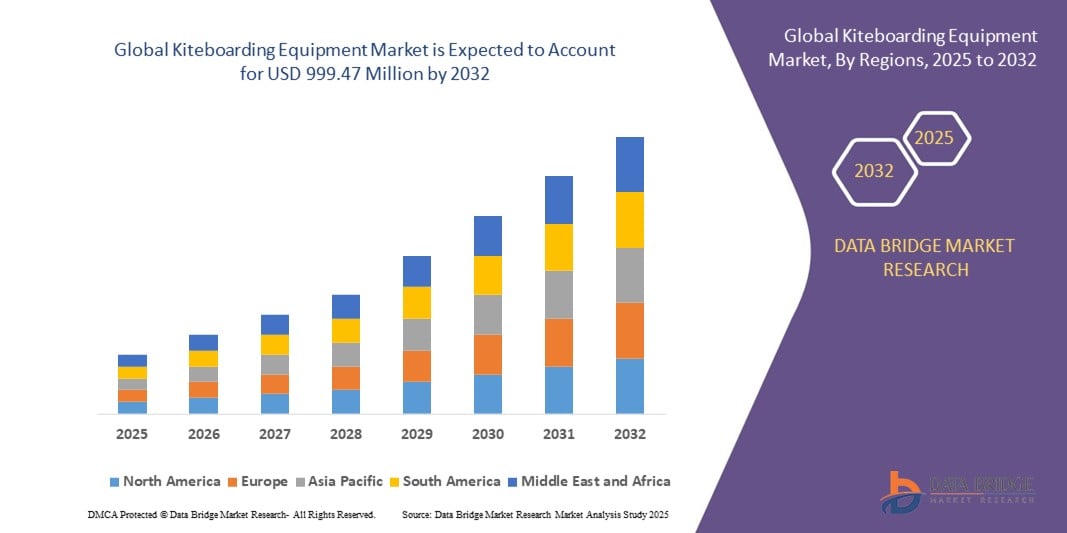
Kiteboarding Equipment Market Size
- The global kiteboarding equipment market size was valued at USD 459.53 million in 2024 and is expected to reach USD 999.47 million by 2032, at a CAGR of 10.20% during the forecast period
- The market growth is largely fuelled by the increasing popularity of adventure water sports, rising disposable income among consumers in developed and developing economies, and expanding tourism activities in coastal regions
- Technological advancements in kiteboarding gear, including lightweight materials and enhanced safety features, are further boosting product adoption among beginners and professionals alike
Kiteboarding Equipment Market Analysis
- The global kiteboarding equipment market is witnessing significant momentum due to a surge in recreational and competitive kiteboarding activities, particularly in regions such as North America, Europe, and parts of Asia-Pacific
- Growing awareness of the sport through social media, global competitions, and eco-tourism campaigns is encouraging participation among younger demographics
- North America dominated the kiteboarding equipment market with the largest revenue share of 39.2% in 2024, driven by a strong presence of water sports culture, high consumer spending on recreational activities, and well-established infrastructure across coastal regions
- Asia-Pacific region is expected to witness the highest growth rate in the global kiteboarding equipment market, driven by expanding beach tourism, growing youth interest in adventure sports, and increasing accessibility to affordable gear through local and international suppliers
- The kiteboards segment held the largest market revenue share in 2024, driven by the core requirement of boards in every kiteboarding setup. Rising consumer preference for performance-optimized and terrain-specific boards is fuelling demand, with twin-tip and directional boards seeing widespread usage among both professionals and hobbyists. Technological enhancements in material durability and lightweight construction also contribute to the dominance of this segment
Report Scope and Kiteboarding Equipment Market Segmentation
|
Attributes |
Kiteboarding Equipment Key Market Insights |
|
Segments Covered |
|
|
Countries Covered |
North America
Europe
Asia-Pacific
Middle East and Africa
South America
|
|
Key Market Players |
|
|
Market Opportunities |
• Rising Participation in Extreme Water Sports Across Emerging Economies |
|
Value Added Data Infosets |
In addition to the insights on market scenarios such as market value, growth rate, segmentation, geographical coverage, and major players, the market reports curated by the Data Bridge Market Research also include in-depth expert analysis, pricing analysis, brand share analysis, consumer survey, demography analysis, supply chain analysis, value chain analysis, raw material/consumables overview, vendor selection criteria, PESTLE Analysis, Porter Analysis, and regulatory framework. |
Kiteboarding Equipment Market Trends
Rise of Modular and Inflatable Kiteboarding Gear
- The increasing demand for portable and easily transportable sports equipment is driving the popularity of modular and inflatable kiteboarding gear. Inflatable boards and kites offer reduced storage requirements and enhanced travel convenience, particularly appealing to hobbyists and international travelers
- These lightweight designs are being embraced by both beginners and professionals who seek flexibility without compromising on performance. The ease of setup and breakdown associated with inflatable products further enhances user experience, especially in remote or tourist-heavy locations
- Manufacturers are also investing in durable materials and hybrid innovations to improve performance while retaining the flexibility and portability benefits. This has expanded product access to broader consumer segments, including casual participants
- For instance, in 2023, several European startups launched inflatable twin-tip boards with carbon-reinforced cores that combine traditional board responsiveness with the convenience of compact designs. These gained traction among kiteboarding schools and rental services
- While the modular gear trend is reshaping consumer expectations, its long-term success depends on durability standards, repair support, and consumer education regarding maintenance and performance limitations
Kiteboarding Equipment Market Dynamics
Driver
Growing Popularity of Water-Based Adventure Sports and Expanding Coastal Tourism
• The surge in adventure tourism and increased interest in experiential travel are fuelling participation in water sports, especially kiteboarding. Coastal countries across Europe, Asia-Pacific, and Latin America are promoting kiteboarding as part of eco-tourism and sports tourism strategies
• Young and health-conscious consumers are seeking adrenaline-driven activities that combine fitness and leisure, and kiteboarding fits this shift in recreational preferences. This behavioral trend is resulting in higher equipment demand from both beginners and skilled athletes
• The presence of global competitions, training camps, and social media influencers is further elevating sport visibility and encouraging participation. In turn, this fuels growth in equipment rentals, purchases, and second-hand sales across regions
• For instance, in 2024, Brazil’s northeastern coastal cities saw a 20% rise in kiteboarding-related tourism, prompting local businesses to expand rental operations and stock up on training-friendly gear
• Governments are also supporting the trend by investing in infrastructure and safety regulations to attract both domestic and international water sports enthusiasts. These developments are directly translating into higher product sales and wider brand visibility
Restraint/Challenge
High Initial Cost of Equipment and Seasonality Constraints
• Despite growing interest, the high initial investment required for quality kiteboarding equipment remains a key barrier for entry-level consumers. Complete setups, including kites, boards, harnesses, and safety gear, can be prohibitively expensive, deterring adoption among casual or first-time users
• Seasonality of the sport further limits usage opportunities, especially in non-tropical climates where kiteboarding is only viable during a few months annually. This short active window reduces perceived return on investment for many prospective buyers
• In colder or landlocked regions, lack of consistent wind and suitable water bodies discourages regular practice, often relegating the sport to travel-based participation. This limits local market expansion and affects year-round demand consistency
• For instance, in 2023, surveys conducted in northern U.S. and parts of Canada showed that over 60% of kiteboarding gear purchases were delayed due to seasonal concerns and upfront pricing challenges
• To overcome these barriers, brands are exploring installment-based purchasing models, rental services, and entry-level kits. However, affordability and environmental adaptability remain vital for achieving broader market penetration across diverse geographies
Kiteboarding Equipment Market Scope
The market is segmented on the basis of type, distribution channel, equipment, kiteboards size, and kite size.
- By Type
On the basis of type, the kiteboarding equipment market is segmented into kiteboards, accessories, protective gear, and others. The kiteboards segment held the largest market revenue share in 2024, driven by the core requirement of boards in every kiteboarding setup. Rising consumer preference for performance-optimized and terrain-specific boards is fuelling demand, with twin-tip and directional boards seeing widespread usage among both professionals and hobbyists. Technological enhancements in material durability and lightweight construction also contribute to the dominance of this segment.
The accessories segment is expected to witness the fastest growth from 2025 to 2032, propelled by increasing consumer awareness regarding safety and performance optimization. Accessories such as board leashes, pumps, fins, and travel bags are becoming essential add-ons for both casual users and frequent travellers. The trend toward complete gear kits and personalization is also elevating the significance of accessory purchases.
- By Distribution Channel
On the basis of distribution channel, the market is divided into online and offline. The offline segment dominated the market with the highest revenue share in 2024, due to consumer preference for physical inspection of products, expert consultation, and in-store fitting before purchase. Retail outlets and specialty sports stores provide hands-on assistance, which is particularly important for new users seeking tailored gear solutions.
The online segment is expected to witness the fastest growth from 2025 to 2032, supported by increasing digital penetration and the convenience of home delivery. E-commerce platforms offer a wide range of products, price comparisons, and user reviews, which appeal to tech-savvy consumers and international buyers. Seasonal discounts and the growth of brand-owned online stores further enhance online sales momentum.
- By Equipment
Based on equipment, the kiteboarding equipment market is categorized into kiteboards, kites, kite bars, kite harness, safety gears, and accessories. The kites segment led the market in 2024, as kites are the central propulsion component in the sport. High-performance kites with aerodynamic improvements and responsive control are being favored across skill levels, contributing to segment growth.
The safety gears segment is expected to witness the fastest growth from 2025 to 2032, driven by rising safety concerns and awareness campaigns. Products such as impact vests, helmets, and flotation aids are witnessing increased adoption, particularly in training centers and competitive environments where protective equipment is mandatory.
- By Kiteboards Size
In terms of kiteboards size, the market is segmented into <130 cm kiteboards, 131–140 cm kiteboards, 141–150 cm kiteboards, and >150 cm kiteboards. The 131–140 cm kiteboards segment accounted for the largest share in 2024, as this size range offers optimal balance between maneuverability and stability, making it suitable for a broad range of riders, especially intermediates and all-round users.
The <130 cm kiteboards segment is expected to witness the fastest growth from 2025 to 2032, driven by increasing demand among lighter and younger riders, as well as for freestyle and high-wind conditions where agility and control are prioritized.
- By Kite Size
By kite size, the market is divided into <8 meter kites, 9–13 meter kites, 14–18 meter kites, and >18 meter kites. The 9–13 meter kites segment held the largest revenue share in 2024, owing to its versatility in moderate wind conditions and broad user compatibility. This kite size range is favored for all-around riding, making it the preferred choice for both training and recreational use.
The >18 meter kites segment is expected to witness the fastest growth from 2025 to 2032, driven by increasing participation in light-wind kiteboarding and racing disciplines. These large kites provide improved lift and efficiency in low-wind environments, which is attracting advanced users looking to maximize performance in varied conditions.
Kiteboarding Equipment Market Regional Analysis
• North America dominated the kiteboarding equipment market with the largest revenue share of 39.2% in 2024, driven by a strong presence of water sports culture, high consumer spending on recreational activities, and well-established infrastructure across coastal regions
• The region benefits from widespread participation in adventure tourism, with consumers increasingly investing in premium gear, supported by the availability of certified training centers and rental services along the coasts of California, Florida, and Hawaii
• The growing popularity of eco-conscious travel, rising interest in fitness-based leisure activities, and the influence of social media and sports influencers further contribute to the market’s expansion across both recreational and professional segments
U.S. Kiteboarding Equipment Market Insight
The U.S. kiteboarding equipment market held the largest revenue share in 2024 within North America, supported by a high level of consumer awareness, strong e-commerce presence, and robust demand for modular and performance-optimized equipment. The presence of national kiteboarding associations, expanding sports tourism, and greater participation in certified training programs have significantly boosted equipment sales. In addition, demand for compact, travel-friendly gear continues to grow due to the increasing number of kiteboarding enthusiasts exploring both domestic and international destinations.
Asia-Pacific Kiteboarding Equipment Market Insight
The Asia-Pacific kiteboarding equipment market is expected to witness the fastest growth from 2025 to 2032, driven by a surge in coastal tourism, supportive government initiatives promoting adventure sports, and rising disposable income levels in emerging economies. Countries such as Thailand, Indonesia, and the Philippines are becoming popular kiteboarding hubs, attracting both beginners and professional athletes. The increasing availability of budget-friendly gear, expansion of online distribution, and rapid development of training facilities are further boosting the regional market.
China Kiteboarding Equipment Market Insight
The China kiteboarding equipment market accounted for the largest revenue share in the Asia-Pacific region in 2024, supported by a growing middle-class population, rising interest in outdoor activities, and increasing government investments in marine tourism and water sports infrastructure. The emergence of domestic manufacturers offering affordable and durable gear, along with expanding coastal resorts in provinces such as Hainan and Guangdong, are key factors driving the market. Social media-driven sports trends and collaboration with international gear brands also support China's rapid adoption of kiteboarding.
Japan Kiteboarding Equipment Market Insight
The Japan kiteboarding equipment market is expected to witness the fastest growth from 2025 to 2032, driven by a technologically advanced consumer base, high safety standards, and increasing popularity of beachside sports in locations such as Okinawa and Chiba. Japan’s emphasis on precision and quality aligns with the demand for high-performance kiteboarding gear. Moreover, the country’s strong sporting culture and infrastructure, coupled with rising participation from younger age groups, are helping foster steady market expansion.
Europe Kiteboarding Equipment Market Insight
The Europe kiteboarding equipment market is projected to grow at a notable pace during the forecast period, backed by well-developed water sports tourism, regulatory support, and widespread consumer participation in marine activities. Countries including France, Spain, and Portugal are key contributors to regional growth due to their extensive coastlines, favorable wind conditions, and strong instructor networks. The European market is also benefiting from growing interest in sustainable and locally manufactured gear, with eco-conscious consumers prioritizing brands with environmental credentials.
Germany Kiteboarding Equipment Market Insight
The Germany kiteboarding equipment market is expected to witness the fastest growth from 2025 to 2032, supported by a strong outdoor recreation culture, well-established sports retail network, and increasing popularity of water sports vacations. While the country’s inland conditions limit daily participation, German consumers actively travel to European coastal destinations and invest in high-quality, durable equipment. The market is also influenced by innovation in eco-friendly materials and growing awareness about sustainable sports practices.
U.K. Kiteboarding Equipment Market Insight
The U.K. kiteboarding equipment market is expected to witness the fastest growth from 2025 to 2032, driven by expanding interest in coastal sports, improved access to training schools, and supportive weather conditions in areas such as Cornwall and the South Coast. The rise of sports tourism, combined with the influence of social media and televised competitions, is encouraging new users to enter the sport. Online retail growth, coupled with the availability of affordable gear bundles, is also contributing to wider product accessibility across the region.
Kiteboarding Equipment Market Share
The Kiteboarding Equipment industry is primarily led by well-established companies, including:
- F-ONE (France)
- GoPro (U.S.)
- North Kiteboarding (Austria)
- Litewave Designs (U.S.)
- GoFoil (U.S.)
- Roberto Ricci Designs (Italy)
- Hyperflex Wetsuits (U.S.)
- Peter Lynn Kiteboarding (New Zealand)
- Cabrinha (U.S.)
- F-ONE (France)
- Naish International (U.S.)
- Slingshot Sports (U.S.)
- Airush Kiteboarding (New Zealand)
- Liquid Force Kiteboarding (U.S.)
- CrazyFly (Czech Republic)
Latest Developments in Global Kiteboarding Equipment Market
- In June 2022, Aluula Composites Inc. unveiled a pioneering innovation in the Global Kiteboarding Equipment Market. By leveraging proprietary UHMWPE fabrics and a patented fusion process with polymer films, they introduced ultra-strong, lightweight composite materials. These advanced materials offer an exceptional eight times the strength-to-weight ratio of steel, significantly outperforming traditional materials such as nylon, polyester, or aramid. The technology enhances both performance and durability, effectively withstanding sun exposure and beach conditions

- Interactive Data Analysis Dashboard
- Company Analysis Dashboard for high growth potential opportunities
- Research Analyst Access for customization & queries
- Competitor Analysis with Interactive dashboard
- Latest News, Updates & Trend analysis
- Harness the Power of Benchmark Analysis for Comprehensive Competitor Tracking
Data collection and base year analysis are done using data collection modules with large sample sizes. The stage includes obtaining market information or related data through various sources and strategies. It includes examining and planning all the data acquired from the past in advance. It likewise envelops the examination of information inconsistencies seen across different information sources. The market data is analysed and estimated using market statistical and coherent models. Also, market share analysis and key trend analysis are the major success factors in the market report. To know more, please request an analyst call or drop down your inquiry.
The key research methodology used by DBMR research team is data triangulation which involves data mining, analysis of the impact of data variables on the market and primary (industry expert) validation. Data models include Vendor Positioning Grid, Market Time Line Analysis, Market Overview and Guide, Company Positioning Grid, Patent Analysis, Pricing Analysis, Company Market Share Analysis, Standards of Measurement, Global versus Regional and Vendor Share Analysis. To know more about the research methodology, drop in an inquiry to speak to our industry experts.
Data Bridge Market Research is a leader in advanced formative research. We take pride in servicing our existing and new customers with data and analysis that match and suits their goal. The report can be customized to include price trend analysis of target brands understanding the market for additional countries (ask for the list of countries), clinical trial results data, literature review, refurbished market and product base analysis. Market analysis of target competitors can be analyzed from technology-based analysis to market portfolio strategies. We can add as many competitors that you require data about in the format and data style you are looking for. Our team of analysts can also provide you data in crude raw excel files pivot tables (Fact book) or can assist you in creating presentations from the data sets available in the report.