What is the Kosher Salt Market Size and Growth Rate?
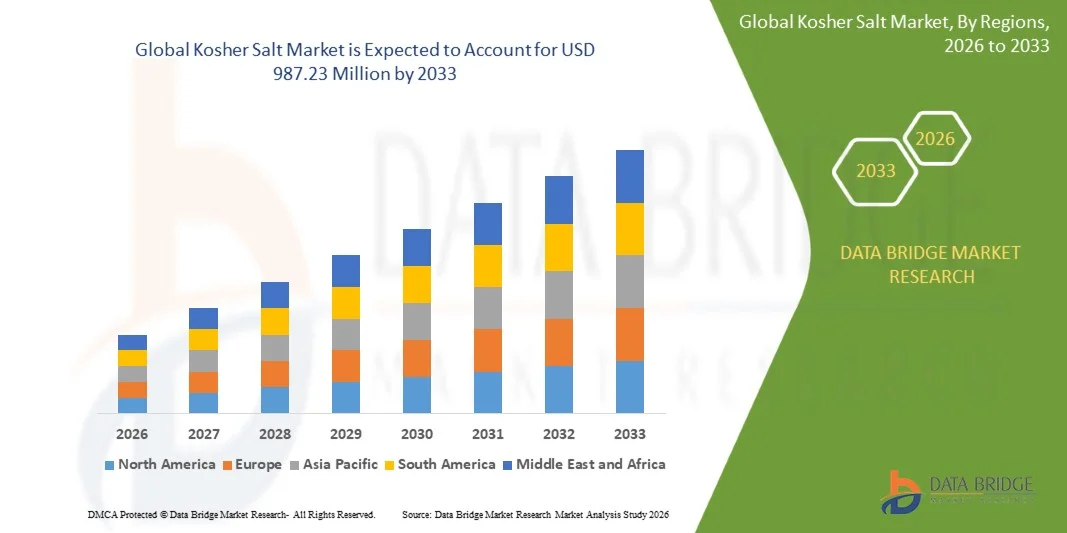
- As per Data Bridge Market Research Analysis the global kosher salt market size was valued at USD 481.15 million in 2025 and is expected to reach USD 987.23 million by 2033, at a CAGR of 9.40% during the forecast period
- The market growth is largely fueled by the rising consumer preference for premium, natural, and specialty culinary ingredients, with kosher salt being widely adopted in home kitchens, restaurants, and foodservice applications due to its texture, purity, and flavor-enhancing properties
- Furthermore, the increasing popularity of gourmet cooking, international cuisines, and baking at home is establishing kosher salt as a preferred seasoning and finishing ingredient in both residential and commercial culinary settings. These converging factors are accelerating the adoption of kosher salt, thereby significantly boosting the industry’s growth
Market Size & Forecast
- Global Market Value (2025): USD 481.15 million
- Expected Market Value (2033): USD 987.23 million
- Forecast CAGR (2026–2033): 9.40%
What are the Major Takeaways of Kosher Salt Market?
- Kosher salt, offering coarse, pure, and additive-free grains, is increasingly recognized as a versatile ingredient for seasoning, brining, and finishing dishes, making it a vital component in modern culinary practices across homes, restaurants, and food manufacturers
- The escalating demand for kosher salt is primarily fueled by the growth of the foodservice and restaurant industry, rising consumer awareness of natural and high-quality ingredients, and the expanding retail and e-commerce channels that facilitate easier access to premium salt products
- North America dominated the kosher salt market in 2025, due to the growing consumption of processed and gourmet foods, as well as increased awareness of high-quality culinary ingredients
- Asia-Pacific is expected to be the fastest growing region in the kosher salt market during the forecast period due to increasing urbanization, rising disposable incomes, and growing culinary awareness in countries such as China, Japan, and India
- Plastics segment dominated the market with a market share of 52.6% in 2025, due to its durability, moisture resistance, and convenience in storage and handling. Plastic packaging ensures product freshness for extended periods, which is critical for both retail consumers and food service companies. It also allows for resealable and portion-controlled designs that enhance usability in kitchens and restaurants. Manufacturers prefer plastics for bulk and retail packaging due to their cost-effectiveness and ability to withstand transport without damage. In addition, plastic containers are compatible with automated packaging processes, reducing operational costs and improving efficiency. The convenience of plastic packaging contributes to consistent consumer preference and strengthens its market share
Report Scope and Kosher Salt Market Segmentation
|
Attributes |
Kosher Salt Key Market Insights |
|
Segments Covered |
|
|
Countries Covered |
North America
Europe
Asia-Pacific
Middle East and Africa
South America
|
|
Key Market Players |
|
|
Market Opportunities |
|
|
Value Added Data Infosets |
In addition to the insights on market scenarios such as market value, growth rate, segmentation, geographical coverage, and major players, the market reports curated by the Data Bridge Market Research also include in-depth expert analysis, pricing analysis, brand share analysis, consumer survey, demography analysis, supply chain analysis, value chain analysis, raw material/consumables overview, vendor selection criteria, PESTLE Analysis, Porter Analysis, and regulatory framework. |
What is the Key Trend in the Kosher Salt Market?
“Rising Demand for Premium and Specialty Culinary Salts”
- A significant trend in the kosher salt market is the increasing adoption of premium and specialty culinary salts in both home kitchens and professional foodservice applications, driven by growing consumer preference for high-quality ingredients and gourmet cooking experiences. This trend is elevating the role of kosher salt as a key seasoning and finishing ingredient across a wide range of dishes, from baked goods to specialty entrees
- For instance, brands such as Diamond Crystal and Redmond are introducing finely milled and specialty kosher salts designed to enhance flavor, texture, and presentation, strengthening product appeal among home chefs and culinary professionals. Such innovations enable consistent seasoning, ease of use, and visual enhancement, positioning kosher salt as a preferred alternative to standard table salt
- The adoption of kosher salt is also increasing in baking and gourmet meal preparation, where its coarse texture and purity contribute to better flavor distribution and food aesthetics. This is driving higher usage in residential cooking, specialty restaurants, and catering services
- Consumer awareness of natural and additive-free ingredients is reinforcing demand, as kosher salt is widely perceived as a cleaner and more authentic seasoning option. The trend toward health-conscious and premium dining choices is shaping stronger preference for kosher salt over traditional salts
- The rise of international cuisine and culinary experimentation is further fueling the adoption of kosher salt, as its versatile texture and taste enhancement properties are critical for diverse dishes. Restaurants and gourmet kitchens are increasingly integrating kosher salt into their menus to meet evolving customer expectations
- The market is witnessing increased product innovation, including flavored and fine-grain kosher salts, which cater to specialized culinary needs. These developments are strengthening the overall market by expanding the application scope and increasing consumer engagement
Kosher Salt Market Dynamics
Driver
“Growing Adoption in Foodservice and Restaurant Applications”
- The increasing use of kosher salt in restaurants, hotels, and catering services is a key driver of market growth, driven by the need for consistent flavor, texture, and presentation across large-scale food preparation. Kosher salt’s coarse grain and purity make it ideal for seasoning, brining, and finishing dishes in professional kitchens
- For instance, foodservice providers such as True Salt and Morton Salt supply bulk kosher salt products tailored for commercial kitchens, enabling chefs to maintain quality standards across multiple dishes and large volumes. This professional adoption supports higher sales volumes and reinforces the position of kosher salt in the premium ingredient segment
- The expanding global restaurant industry and growing focus on gourmet dining experiences are further boosting demand. Commercial kitchens prefer kosher salt for its ease of handling, versatility, and consistent performance under high-volume cooking conditions
- Rising interest in artisanal foods and specialty culinary applications is encouraging more widespread use of kosher salt in fine dining and catering services. Chefs increasingly rely on kosher salt for its visual appeal and flavor-enhancing properties
- The combination of increased foodservice adoption, product innovation, and consumer preference for high-quality ingredients is establishing kosher salt as a standard ingredient in professional kitchens and supporting overall market expansion
Restraint/Challenge
“Price Volatility and Supply Chain Dependence on Raw Salt Sources”
- The kosher salt market faces challenges due to fluctuations in raw salt prices and dependence on specific geographic sources for high-quality salt. Variability in mining, evaporation conditions, and transportation costs can affect supply stability and overall product pricing
- For instance, companies such as Cargill and Redmond must manage sourcing from multiple locations to ensure consistent product quality, but disruptions caused by environmental factors or logistical delays can impact production and availability. Such volatility can limit profit margins and affect market growth
- In addition, the reliance on natural salt deposits or coastal evaporation processes exposes manufacturers to regulatory and environmental constraints, which may restrict output or increase operational costs
- Manufacturers must also balance the demand for premium, specialty kosher salts with the cost implications of sourcing high-quality raw material, which can be higher than for standard table salt. These supply-side challenges require careful planning and risk management to maintain stable production and pricing
- The market continues to face pressure from price-sensitive buyers and fluctuating raw material availability, making it essential for companies to optimize supply chains and ensure consistent product delivery to sustain growth
How is the Kosher Salt Market Segmented?
The market is segmented on the basis of product, packaging materials, and application.
• By Product
On the basis of product, the Kosher Salt market is segmented into Kosher Salt Flakes, Smoked Kosher Salt, and Kosher Salt Crystals. The Kosher Salt Flakes segment dominated the market with the largest market revenue share in 2025, driven by its widespread use in both home kitchens and professional culinary settings. Flake salt is favored for its texture, ease of sprinkling, and ability to dissolve quickly, which enhances flavor in cooking and finishing dishes. Chefs and home cooks often prefer flake forms due to their superior handling and aesthetic appeal for garnishing. The high adoption in restaurants and gourmet food preparation contributes significantly to revenue growth. In addition, Kosher Salt Flakes are compatible with a wide range of culinary applications, from baking to brining, increasing their demand across various segments. The segment’s established reputation for quality and consistency reinforces its market dominance.
The Smoked Kosher Salt segment is anticipated to witness the fastest growth rate from 2026 to 2033, driven by rising consumer preference for unique flavors and gourmet cooking experiences. For instance, companies such as Maldon Smokehouse have popularized smoked salt for enhancing meats, vegetables, and snacks with distinct smoky notes. The growing interest in artisanal and specialty foods fuels demand, particularly among food enthusiasts and boutique restaurants. Smoked Kosher Salt provides both seasoning and presentation value, making it attractive in high-end culinary applications. Its adoption is further encouraged by the expanding influence of cooking shows and social media trends showcasing exotic and premium ingredients. The versatility in flavor infusion and visual appeal supports its rapid market growth.
• By Packaging Materials
On the basis of packaging materials, the Kosher Salt market is segmented into Cardboard and Paper and Plastics. The Plastics segment dominated the market with the largest share of 52.6% in 2025, driven by its durability, moisture resistance, and convenience in storage and handling. Plastic packaging ensures product freshness for extended periods, which is critical for both retail consumers and food service companies. It also allows for resealable and portion-controlled designs that enhance usability in kitchens and restaurants. Manufacturers prefer plastics for bulk and retail packaging due to their cost-effectiveness and ability to withstand transport without damage. In addition, plastic containers are compatible with automated packaging processes, reducing operational costs and improving efficiency. The convenience of plastic packaging contributes to consistent consumer preference and strengthens its market share.
The Cardboard and Paper segment is expected to witness the fastest growth rate from 2026 to 2033, driven by increasing demand for sustainable and eco-friendly packaging options. For instance, Morton Salt has introduced paper-based packaging solutions to appeal to environmentally conscious consumers. The growing awareness regarding plastic waste and stricter environmental regulations are encouraging brands to adopt biodegradable and recyclable packaging formats. Cardboard and paper options provide a premium and natural appeal that resonates with modern consumers, especially in gourmet and specialty retail markets. The trend toward sustainability in packaging supports long-term adoption and rapid growth for this segment.
• By Application
On the basis of application, the Kosher Salt market is segmented into Retail, Food Service Companies, Food and Beverage Manufacturers, and Others. The Food Service Companies segment dominated the market in 2025, driven by large-scale usage in restaurants, hotels, and catering services. These companies rely on Kosher Salt for its consistent quality, ease of use, and ability to enhance flavor across a variety of cuisines. Bulk purchases from food service companies contribute significantly to market revenue, making it a major application segment. In addition, the versatility of Kosher Salt in seasoning, brining, and finishing dishes makes it a staple in professional kitchens. The growing global restaurant industry and increasing emphasis on culinary quality further strengthen demand in this segment. Established partnerships between salt manufacturers and food service providers help maintain steady market dominance.
The Retail segment is anticipated to witness the fastest growth rate from 2026 to 2033, fueled by the rising trend of home cooking and gourmet meal preparation. For instance, companies such as Diamond Crystal are expanding retail distribution of premium Kosher Salt to meet consumer demand for high-quality cooking ingredients. Social media and culinary content promoting home-based gourmet recipes are encouraging consumers to experiment with specialty salts. The convenience of ready-to-use retail packaging and the perception of premium quality drive sales growth in supermarkets and online retail platforms. The segment benefits from increasing consumer spending on high-quality food products and the rising popularity of cooking at home. Retail adoption continues to accelerate due to these evolving culinary trends.
Which Region Holds the Largest Share of the Kosher Salt Market?
- North America dominated the kosher salt market with the largest revenue share in 2025, driven by the growing consumption of processed and gourmet foods, as well as increased awareness of high-quality culinary ingredients
- Consumers in the region highly value the purity, texture, and flavor-enhancing properties offered by kosher salt in both home cooking and professional kitchens
- This widespread adoption is further supported by high disposable incomes, a large base of food service companies, and the increasing popularity of home cooking and gourmet recipes, establishing kosher salt as a preferred choice for culinary applications
U.S. Kosher Salt Market Insight
The U.S. kosher salt market captured the largest revenue share in 2025 within North America, fueled by rising demand from restaurants, hotels, and catering services. Consumers are increasingly prioritizing premium-quality salts for both flavor and presentation in dishes. The growing preference for specialty salts in home kitchens, combined with robust demand for branded products and gourmet cooking trends, further propels the market. In addition, strong retail and e-commerce distribution channels make kosher salt easily accessible across regions, supporting continued growth.
Europe Kosher Salt Market Insight
The Europe kosher salt market is projected to expand at a substantial CAGR throughout the forecast period, driven by increasing culinary sophistication and the rising popularity of premium and natural food ingredients. Growing demand from food service companies and gourmet restaurants, coupled with the adoption of healthy cooking practices, is encouraging kosher salt usage. European consumers are drawn to its texture, flavor, and visual appeal in finished dishes. The region is witnessing growth across retail, food service, and food manufacturing applications, with kosher salt incorporated into both traditional and modern cuisine.
U.K. Kosher Salt Market Insight
The U.K. kosher salt market is anticipated to grow at a noteworthy CAGR during the forecast period, driven by the rising trend of home cooking and increased demand from restaurants and catering services. Concerns regarding food quality, ingredient purity, and culinary presentation are encouraging consumers and food service providers to choose kosher salt. The country’s strong retail and online distribution infrastructure, alongside increasing consumer awareness of premium ingredients, is expected to continue to stimulate market growth.
Germany Kosher Salt Market Insight
The Germany kosher salt market is expected to expand at a considerable CAGR during the forecast period, fueled by increasing demand from the hospitality sector and rising interest in high-quality culinary ingredients. Germany’s well-developed food service and retail infrastructure, combined with a focus on healthy eating and gourmet cuisine, promotes the adoption of kosher salt. The integration of kosher salt into professional kitchens, restaurants, and home cooking demonstrates its growing relevance in both commercial and residential applications.
Asia-Pacific Kosher Salt Market Insight
The Asia-Pacific kosher salt market is poised to grow at the fastest CAGR during the forecast period of 2026 to 2033, driven by increasing urbanization, rising disposable incomes, and growing culinary awareness in countries such as China, Japan, and India. The region’s growing interest in international cuisines and gourmet cooking is driving the adoption of kosher salt. Furthermore, expanding retail and food service networks, along with the influence of cooking shows and social media, are increasing accessibility and demand for premium salts across the region.
Japan Kosher Salt Market Insight
The Japan kosher salt market is gaining momentum due to the country’s appreciation for culinary quality, gourmet cuisine, and home cooking trends. Consumers are increasingly using kosher salt for seasoning, finishing, and enhancing the flavor of traditional and international dishes. The growing number of restaurants, catering services, and retail availability further contributes to market expansion. Japan’s high culinary standards and demand for premium ingredients are expected to continue supporting market growth.
China Kosher Salt Market Insight
The China kosher salt market accounted for the largest market revenue share in Asia-Pacific in 2025, attributed to rapid urbanization, rising disposable incomes, and expanding food service and retail sectors. The adoption of international cuisines, growing restaurant chains, and increasing interest in gourmet cooking are key factors driving demand. Availability of imported and domestic kosher salt brands, alongside the rise of e-commerce platforms, ensures easy access for consumers and commercial buyers. The push for premium food ingredients and the rising culinary awareness are expected to sustain strong market growth in China.
Which are the Top Companies in Kosher Salt Market?
The kosher salt industry is primarily led by well-established companies, including:
- San Francisco Salt Co. (U.S.)
- Morton Salt, Inc. (U.S.)
- Cargill, Incorporated (U.S.)
- Redmond, Inc. (U.S.)
- Flavor Delite (U.S.)
- Qingdao Huifenghe MSG Co., Ltd. (China)
- THAI REFINED SALT CO., LTD. (Thailand)
- The Marblehead Salt Co. LLC (U.S.)
- Saltworks Technologies Inc. (Canada)
- K+S Windsor Salt Ltd. (Canada)
- Natural Minerals (U.K.)
- Atisale Spa (Italy)
- INEOS (Switzerland)
- United Salt Corporation (U.S.)
- Wacker Chemie AG (Germany)
- CK Life Sciences Int’l., (Holdings) Inc. (Hong Kong)
- Redmond Life (U.S.)
- Celtic Sea Salt (U.S.)
- Special Purity (U.S.)
- Usb Chemicals (U.S.)
- Pursuit Industries Pvt. Ltd. (India)
What are Latest Developments in Kosher Salt Market?
- In October 2025, True Salt expanded its private label program to meet surging demand from grocery chains and foodservice distributors for premium sea salt products, including kosher salt. The company scaled up production capacity and introduced larger packaging formats for Kosher Grain, Crystal Grain, and iodized salt, catering to both retail and commercial needs. This expansion strengthens True Salt’s market presence by making high-quality kosher salt more accessible across multiple distribution channels and meeting the growing demand for premium and versatile salt products in professional kitchens and households alike
- In January 2025, True Salt increased the production of its Kosher Grain and Crystal Blend Grain products to satisfy rising demand from foodservice providers. This move ensures a reliable supply of high-performing salts specifically designed for professional kitchens, where consistent texture, flavor, and performance are critical. By addressing the growing preference for premium ingredients in the culinary sector, True Salt reinforces its position in the foodservice segment and also supports broader adoption of kosher salt as a preferred seasoning for commercial and gourmet cooking
- In November 2024, True Salt introduced its Crystal Blend Grain sea salt designed for professional chefs, offering a carefully crafted texture and consistent flavor performance. The product caters to high-volume kitchens, enabling chefs to achieve superior seasoning results with each use. This innovation strengthens True Salt’s portfolio in the premium kosher salt segment, meeting specialized culinary demands, and enhances the brand’s competitive position in both the commercial and high-end retail markets
- In October 2023, Diamond Crystal Salt Co. launched its Fine Kosher Baking Salt specifically for baking applications, featuring finer-cut crystals that dissolve and blend more quickly and evenly in batters and doughs. This development improves taste and texture in baked goods, providing home chefs and culinary professionals with a more reliable and high-performing option than traditional table salt. The introduction of this product broadens the utility of kosher salt, expanding its adoption in both domestic kitchens and professional baking settings, and reinforces the market’s growth in premium and specialty salt products.

- Interactive Data Analysis Dashboard
- Company Analysis Dashboard for high growth potential opportunities
- Research Analyst Access for customization & queries
- Competitor Analysis with Interactive dashboard
- Latest News, Updates & Trend analysis
- Harness the Power of Benchmark Analysis for Comprehensive Competitor Tracking
Global Kosher Salt Market, Supply Chain Analysis and Ecosystem Framework
To support market growth and help clients navigate the impact of geopolitical shifts, DBMR has integrated in-depth supply chain analysis into its Global Kosher Salt Market research reports. This addition empowers clients to respond effectively to global changes affecting their industries. The supply chain analysis section includes detailed insights such as Global Kosher Salt Market consumption and production by country, price trend analysis, the impact of tariffs and geopolitical developments, and import and export trends by country and HSN code. It also highlights major suppliers with data on production capacity and company profiles, as well as key importers and exporters. In addition to research, DBMR offers specialized supply chain consulting services backed by over a decade of experience, providing solutions like supplier discovery, supplier risk assessment, price trend analysis, impact evaluation of inflation and trade route changes, and comprehensive market trend analysis.
Data collection and base year analysis are done using data collection modules with large sample sizes. The stage includes obtaining market information or related data through various sources and strategies. It includes examining and planning all the data acquired from the past in advance. It likewise envelops the examination of information inconsistencies seen across different information sources. The market data is analysed and estimated using market statistical and coherent models. Also, market share analysis and key trend analysis are the major success factors in the market report. To know more, please request an analyst call or drop down your inquiry.
The key research methodology used by DBMR research team is data triangulation which involves data mining, analysis of the impact of data variables on the market and primary (industry expert) validation. Data models include Vendor Positioning Grid, Market Time Line Analysis, Market Overview and Guide, Company Positioning Grid, Patent Analysis, Pricing Analysis, Company Market Share Analysis, Standards of Measurement, Global versus Regional and Vendor Share Analysis. To know more about the research methodology, drop in an inquiry to speak to our industry experts.
Data Bridge Market Research is a leader in advanced formative research. We take pride in servicing our existing and new customers with data and analysis that match and suits their goal. The report can be customized to include price trend analysis of target brands understanding the market for additional countries (ask for the list of countries), clinical trial results data, literature review, refurbished market and product base analysis. Market analysis of target competitors can be analyzed from technology-based analysis to market portfolio strategies. We can add as many competitors that you require data about in the format and data style you are looking for. Our team of analysts can also provide you data in crude raw excel files pivot tables (Fact book) or can assist you in creating presentations from the data sets available in the report.