


Global Lab-Grown Diamond Market Size
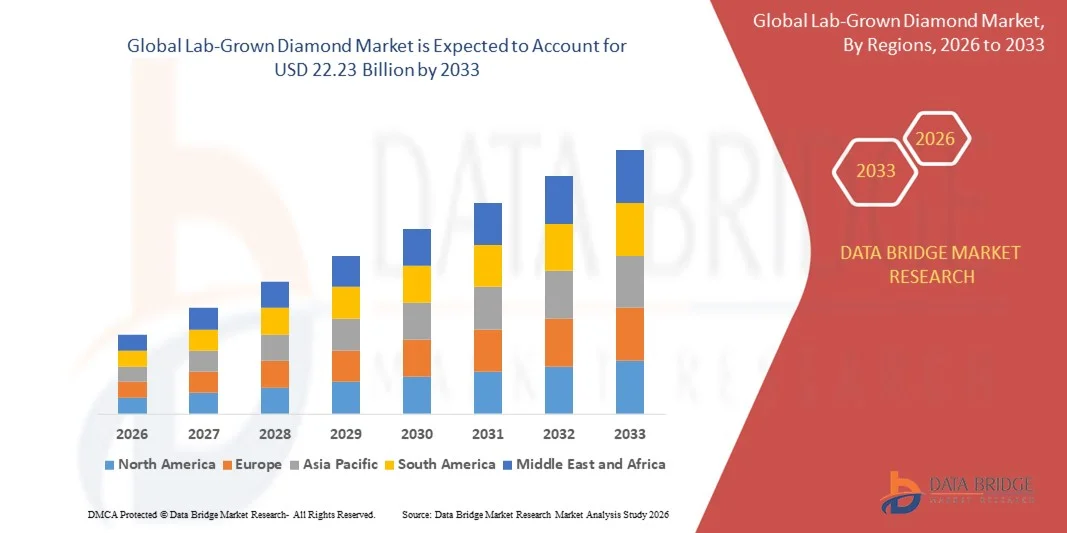
- As per Data Bridge Market Research Analysis the global Lab-Grown Diamond Market size was valued at USD 12.84 billion in 2025 and is expected to reach USD 22.23 billion by 2033, at a CAGR of 7.10% during the forecast period.
- The market growth is largely driven by increasing consumer preference for ethically sourced and sustainable jewelry, coupled with advancements in diamond synthesis technologies that allow for higher quality and lower-cost production.
- Additionally, growing awareness of environmental impact and the rising popularity of customized and certified lab-grown diamonds are encouraging adoption among millennials and high-income consumers, thereby accelerating market expansion and reinforcing the industry’s growth trajectory.
Market Size & Forecast
- Global Market Value (2025): USD 12.84 billion
- Expected Market Value (2033): USD 22.23 billion
- Forecast CAGR (2026–2033): 7.10%
Global Lab-Grown Diamond Market Analysis
- Lab-grown diamonds, created through advanced technological processes such as High Pressure High Temperature (HPHT) and Chemical Vapor Deposition (CVD), are becoming increasingly important in the jewelry and industrial sectors due to their ethical sourcing, environmental sustainability, and comparable quality to natural diamonds.
- The growing demand for lab-grown diamonds is primarily fueled by increased consumer awareness of conflict-free alternatives, rising disposable incomes, and a preference for customizable and certified diamond options.
- Asia-Pacific dominated the Global Lab-Grown Diamond Market with the largest revenue share of 34.8% in 2025, supported by high consumer spending on luxury goods, strong awareness of sustainable products, and a well-established presence of key industry players, with the U.S. experiencing significant growth in lab-grown diamond adoption for jewelry, particularly engagement rings and high-end fashion accessories.
- North America is expected to be the fastest growing region in the Global Lab-Grown Diamond Market during the forecast period due to expanding urbanization, increasing disposable incomes, and growing acceptance of sustainable luxury products among millennials and Gen Z consumers.
- The HPHT segment dominated the market with the largest revenue share of 55.3% in 2025, owing to its ability to produce high-quality diamonds at a relatively lower cost and with consistent physical and optical properties.
Report Scope and Global Lab-Grown Diamond Market Segmentation
|
Attributes |
Lab-Grown Diamond Key Market Insights |
|
Segments Covered |
|
|
Countries Covered |
North America
Europe
Asia-Pacific
Middle East and Africa
South America
|
|
Key Market Players |
• De Beers Group (Luxembourg) |
|
Market Opportunities |
|
|
Value Added Data Infosets |
In addition to the insights on market scenarios such as market value, growth rate, segmentation, geographical coverage, and major players, the market reports curated by the Data Bridge Market Research also include import export analysis, production capacity overview, production consumption analysis, price trend analysis, climate change scenario, supply chain analysis, value chain analysis, raw material/consumables overview, vendor selection criteria, PESTLE Analysis, Porter Analysis, and regulatory framework. |
Global Lab-Grown Diamond Market Trends
Enhanced Personalization Through AI and Digital Platforms
- A significant and accelerating trend in the global Lab-Grown Diamond Market is the growing integration of artificial intelligence (AI) and digital platforms in the diamond selection and customization process. This fusion of technologies is significantly enhancing customer convenience, personalization, and engagement in purchasing diamonds.
- For instance, platforms such as Brilliant Earth and MiaDonna allow customers to virtually design engagement rings and jewelry pieces, leveraging AI-driven suggestions for cut, color, and clarity to match individual preferences. Similarly, Diamond Foundry provides online customization tools powered by AI that guide users through selecting ethically sourced lab-grown diamonds tailored to their tastes.
- AI integration in the lab-grown diamond industry enables features such as predicting consumer preferences, recommending optimal diamond characteristics, and providing real-time visualizations of the final jewelry product. For example, some platforms use AI to suggest combinations of diamond shapes and settings that enhance brilliance while remaining within budget constraints. Furthermore, digital tools allow users to visualize their jewelry in 3D or augmented reality (AR), enhancing confidence in purchase decisions.
- The seamless integration of lab-grown diamonds with digital and AI-driven platforms facilitates a highly personalized shopping experience, allowing customers to design, compare, and order diamonds entirely online while ensuring ethical sourcing and certification transparency.
- This trend toward more intelligent, customized, and digitally interactive diamond buying experiences is fundamentally reshaping consumer expectations in the jewelry market. Consequently, companies such as ALTR Created Diamonds and Lusix are developing AI-powered design platforms and AR visualization tools that enable fully personalized, ethically sourced jewelry.
- The demand for lab-grown diamonds with AI-assisted customization and digital engagement is growing rapidly across global markets, as consumers increasingly prioritize sustainability, personalization, and a seamless online shopping experience.
Global Lab-Grown Diamond Market Dynamics
Driver
Growing Demand Driven by Ethical Awareness and Sustainable Luxury Trends
- The increasing consumer preference for ethically sourced and environmentally sustainable products, coupled with rising disposable incomes, is a significant driver for the heightened demand for lab-grown diamonds.
- For instance, in 2025, Brilliant Earth expanded its lab-grown diamond offerings, emphasizing conflict-free sourcing and carbon-neutral production, reflecting a broader industry focus on ethical and sustainable practices. Such initiatives by key companies are expected to drive market growth during the forecast period.
- As consumers become more aware of the environmental and social impacts of mined diamonds, lab-grown diamonds offer a compelling alternative, providing the same quality, brilliance, and certification while reducing ecological and ethical concerns.
- Furthermore, the growing popularity of customizable jewelry and online platforms is making lab-grown diamonds an integral part of modern luxury purchases, offering consumers greater flexibility in design, shape, and setting.
- The combination of sustainability, affordability compared to natural diamonds, and the ability to purchase personalized pieces online are key factors propelling the adoption of lab-grown diamonds across both residential (consumer jewelry) and commercial (luxury retail and corporate gifting) sectors. The trend toward digital buying experiences and increased awareness of lab-grown alternatives further contributes to market growth.
Restraint/Challenge
Concerns Regarding Consumer Perception and High Initial Costs
- Perceptions that lab-grown diamonds are less “authentic” or carry lower prestige compared to mined diamonds pose a significant challenge to broader market adoption. While quality and brilliance are comparable, traditional consumer preferences can influence purchase decisions, particularly in luxury markets.
- For instance, some high-end jewelers have historically emphasized mined diamonds for their rarity and heritage, making certain consumers hesitant to adopt lab-grown alternatives.
- Addressing these perception challenges through education, marketing campaigns highlighting ethical sourcing, and certification transparency is crucial for building consumer confidence. Companies such as ALTR Created Diamonds and Diamond Foundry emphasize these factors in their branding to reassure potential buyers. Additionally, the relatively high price of larger or premium-quality lab-grown diamonds compared to smaller or lower-carat stones can be a barrier for budget-conscious consumers, particularly in emerging markets.
- While prices for lab-grown diamonds are gradually decreasing due to technological advancements and scale of production, the perception of a “premium” for ethically sourced or technologically advanced stones can still limit adoption among certain consumer segments.
- Overcoming these challenges through enhanced consumer education, innovative marketing, and the development of competitively priced offerings will be vital for sustained growth in the global lab-grown diamond market.
Global Lab-Grown Diamond Market Scope
The market is segmented on the basis of Manufacturing Method, nature, size, and application.
- By Manufacturing Method
On the basis of manufacturing method, the Global Lab-Grown Diamond Market is segmented into High Pressure High Temperature (HPHT) and Chemical Vapor Deposition (CVD). The HPHT segment dominated the market with the largest revenue share of 55.3% in 2025, owing to its ability to produce high-quality diamonds at a relatively lower cost and with consistent physical and optical properties. HPHT diamonds are widely preferred in both jewelry and industrial applications due to their durability and polished finish.
The CVD segment is expected to witness the fastest CAGR of 21.8% from 2026 to 2033, driven by technological advancements that allow for larger, high-purity diamonds with better color consistency. Increasing adoption in premium jewelry and the rise of innovative CVD-based lab-grown diamonds with unique color and clarity options are contributing to its rapid growth.
- By Nature
On the basis of nature, the Global Lab-Grown Diamond Market is segmented into colorless and colored diamonds. The colorless segment dominated the market with a revenue share of 62.4% in 2025, primarily due to strong demand for traditional jewelry such as engagement rings and high-end accessories. Colorless lab-grown diamonds are highly sought after for their clarity, brilliance, and versatility in classic jewelry designs.
The colored segment is expected to witness the fastest CAGR of 23.1% from 2026 to 2033, fueled by growing consumer interest in unique and personalized jewelry pieces, including fancy-colored diamonds for fashion-forward designs. Technological improvements in coloring processes and rising awareness of ethical alternatives are driving the adoption of colored lab-grown diamonds globally.
- By Size
On the basis of size, the Global Lab-Grown Diamond Market is segmented into below 2 carat, 2–4 carat, and above 4 carat. The below 2 carat segment dominated the market with the largest revenue share of 68.7% in 2025, driven by strong demand for engagement rings, earrings, and everyday jewelry that balances quality and affordability. Smaller diamonds are widely produced through both HPHT and CVD methods, catering to mass-market consumers and online jewelry platforms.
The 2–4 carat segment is expected to witness the fastest CAGR of 20.7% from 2026 to 2033, fueled by increasing demand for luxury pieces, high-end custom designs, and larger statement rings. Rising disposable incomes and the availability of high-quality lab-grown diamonds in larger sizes are supporting this growth trend.
- By Application
On the basis of application, the Global Lab-Grown Diamond Market is segmented into fashion and industrial use. The fashion segment dominated the market with the largest revenue share of 74.5% in 2025, owing to high consumer demand for engagement rings, necklaces, bracelets, and other luxury jewelry. Ethical sourcing, customizable designs, and online availability are major drivers of growth in fashion applications.
The industrial segment is expected to witness the fastest CAGR of 22.5% from 2026 to 2033, driven by the increasing utilization of lab-grown diamonds in cutting, grinding, drilling, and electronics applications. Advancements in CVD and HPHT manufacturing have enabled the production of ultra-hard diamonds tailored for industrial purposes, boosting adoption in emerging sectors such as semiconductor and precision engineering industries.
Global Lab-Grown Diamond Market Regional Analysis
- Asia-Pacific dominated the Global Lab-Grown Diamond Market with the largest revenue share of 34.8% in 2025, driven by growing consumer awareness of ethical sourcing, sustainability, and the availability of high-quality lab-grown diamonds.
- Consumers in the region highly value the combination of environmental responsibility, customization options, and competitive pricing offered by lab-grown diamonds compared to mined diamonds.
- This widespread adoption is further supported by high disposable incomes, strong demand for luxury goods among millennials and Gen Z, and the presence of key market players, establishing lab-grown diamonds as a preferred choice for engagement rings, fine jewelry, and high-end fashion accessories in both retail and e-commerce channels.
U.S. Lab-Grown Diamond Market Insight
The U.S. lab-grown diamond market captured the largest revenue share of 81% in 2025 within North America, fueled by increasing consumer awareness of ethical sourcing and sustainable luxury. Buyers are prioritizing environmentally responsible alternatives to mined diamonds without compromising on quality or brilliance. The growing popularity of customizable jewelry, online platforms, and e-commerce options further propels the market. Moreover, the rising preference for certified and conflict-free diamonds, combined with innovative marketing by key players, is significantly contributing to market expansion across engagement rings, fashion jewelry, and high-end accessories.
Europe Lab-Grown Diamond Market Insight
The Europe lab-grown diamond market is projected to expand at a substantial CAGR throughout the forecast period, primarily driven by growing sustainability awareness and stricter regulations on responsible sourcing. Increasing urbanization, rising disposable incomes, and the demand for unique, personalized jewelry are fostering adoption. Consumers across Western and Northern Europe are drawn to lab-grown diamonds for their ethical appeal and affordability, with notable growth in retail and e-commerce channels, as well as incorporation into bespoke jewelry and luxury fashion applications.
U.K. Lab-Grown Diamond Market Insight
The U.K. lab-grown diamond market is anticipated to grow at a noteworthy CAGR during the forecast period, driven by the increasing trend of ethical consumerism and demand for sustainable luxury. Rising concerns regarding environmental impact and responsible sourcing are encouraging both individual buyers and jewelry retailers to adopt lab-grown alternatives. The U.K.’s robust e-commerce infrastructure, combined with growing awareness of certification standards and digital customization platforms, is expected to continue supporting market growth in engagement rings, necklaces, and fashion jewelry.
Germany Lab-Grown Diamond Market Insight
The Germany lab-grown diamond market is expected to expand at a considerable CAGR during the forecast period, fueled by increasing consumer awareness of sustainability, technological advancements in diamond synthesis, and the demand for high-quality, certified alternatives to mined diamonds. Germany’s well-developed retail and luxury infrastructure, along with emphasis on innovation and environmentally conscious products, promotes adoption across jewelry and industrial applications. Personalized and customizable lab-grown jewelry is witnessing strong demand among environmentally aware consumers.
Asia-Pacific Lab-Grown Diamond Market Insight
The Asia-Pacific lab-grown diamond market is poised to grow at the fastest CAGR of 24% during the forecast period of 2026 to 2033, driven by rising disposable incomes, growing urbanization, and increasing awareness of sustainable luxury in countries such as China, Japan, and India. The region’s expanding e-commerce ecosystem and rising preference for customizable and ethically sourced jewelry are driving adoption. Furthermore, advancements in local manufacturing and technology are making lab-grown diamonds more accessible and affordable, stimulating demand across residential, commercial, and industrial applications.
Japan Lab-Grown Diamond Market Insight
The Japan lab-grown diamond market is gaining momentum due to high consumer interest in ethical luxury, technological sophistication, and urban lifestyle trends. The adoption of lab-grown diamonds is driven by the increasing number of digitally connected consumers, a focus on personalization, and the desire for sustainable, certified alternatives. Additionally, Japan’s aging population is likely to drive demand for smaller, high-quality diamonds suitable for jewelry gifts, fashion accessories, and engagement rings, across both residential and commercial channels.
China Lab-Grown Diamond Market Insight
The China lab-grown diamond market accounted for the largest revenue share in Asia-Pacific in 2025, attributed to rapid urbanization, a growing middle class, and high rates of technological adoption. Lab-grown diamonds are becoming increasingly popular for engagement rings, fashion jewelry, and luxury accessories. The push toward sustainable luxury, availability of affordable options, and strong domestic manufacturers are key factors propelling market growth in China. Increasing online and retail availability, alongside rising consumer awareness of ethical sourcing, further supports the expansion of the market.
Global Lab-Grown Diamond Market Share
The Lab-Grown Diamond industry is primarily led by well-established companies, including:
• De Beers Group (Luxembourg)
• Diamond Foundry (U.S.)
• ALTR Created Diamonds (U.S.)
• MiaDonna (U.S.)
• Brilliant Earth (U.S.)
• Pure Grown Diamonds (U.S.)
• Lusix Group (Israel)
• Sarai Diamonds (U.S.)
• D.NEA Diamonds (Belgium)
• Scio Diamond Technology (U.S.)
• Leibish & Co. (U.S.)
• New Diamond Technology (Russia)
• Vrai & Oro (U.S.)
• Lumera Diamonds (U.S.)
• CVD Diamond Corp (Canada)
• Asteria Diamonds (U.K.)
• Synthetic Diamond Company (U.K.)
• Shining Star Diamonds (India)
• Stellaris Diamonds (U.S.)
• Natural Diamond Alternatives (U.S.)
What are the Recent Developments in Global Lab-Grown Diamond Market?
- In April 2024, De Beers Group, a global leader in diamond mining and jewelry, launched a strategic initiative in South Africa to expand its lab-grown diamond offerings. This initiative focuses on providing ethically sourced, high-quality diamonds for both jewelry and industrial applications, highlighting De Beers’ commitment to sustainability and innovation. By leveraging its global expertise and advanced production technologies, the company is addressing regional consumer demand for sustainable luxury while reinforcing its position in the rapidly growing global Lab-Grown Diamond Market.
- In March 2024, Diamond Foundry, a U.S.-based innovator in lab-grown diamonds, introduced a new collection of customizable engagement rings and high-end fashion jewelry. The initiative leverages advanced Chemical Vapor Deposition (CVD) technology to produce larger, high-purity diamonds with unique color and clarity options. This launch underscores Diamond Foundry’s dedication to providing ethically sourced, premium-quality diamonds that meet evolving consumer preferences for sustainable luxury and personalized designs.
- In March 2024, ALTR Created Diamonds successfully expanded its online platform to cater to global customers, enabling fully customizable lab-grown jewelry with real-time 3D visualization. This initiative harnesses advanced digital tools to create a seamless, interactive buying experience, reflecting ALTR’s commitment to technological innovation in the jewelry sector and highlighting the increasing significance of ethical and sustainable alternatives in luxury markets.
- In February 2024, MiaDonna, a leading provider of lab-grown diamonds and conflict-free jewelry, announced a strategic partnership with several North American luxury jewelry retailers to create a curated collection of lab-grown diamond pieces. The collaboration aims to enhance accessibility, drive consumer awareness, and promote sustainable luxury. The initiative underscores MiaDonna’s focus on expanding market reach while emphasizing ethical sourcing and responsible production practices.
- In January 2024, Brilliant Earth, a key player in ethically sourced jewelry, unveiled a new line of premium lab-grown diamond engagement rings and necklaces at a major U.S. jewelry trade show. The collection features high-quality, certified diamonds produced using both HPHT and CVD methods. Brilliant Earth’s launch highlights its commitment to combining advanced technology, sustainability, and design excellence, offering consumers luxury options that align with modern ethical and environmental values.

- Interactive Data Analysis Dashboard
- Company Analysis Dashboard for high growth potential opportunities
- Research Analyst Access for customization & queries
- Competitor Analysis with Interactive dashboard
- Latest News, Updates & Trend analysis
- Harness the Power of Benchmark Analysis for Comprehensive Competitor Tracking
Global Lab Grown Diamond Market, Supply Chain Analysis and Ecosystem Framework
To support market growth and help clients navigate the impact of geopolitical shifts, DBMR has integrated in-depth supply chain analysis into its Global Lab Grown Diamond Market research reports. This addition empowers clients to respond effectively to global changes affecting their industries. The supply chain analysis section includes detailed insights such as Global Lab Grown Diamond Market consumption and production by country, price trend analysis, the impact of tariffs and geopolitical developments, and import and export trends by country and HSN code. It also highlights major suppliers with data on production capacity and company profiles, as well as key importers and exporters. In addition to research, DBMR offers specialized supply chain consulting services backed by over a decade of experience, providing solutions like supplier discovery, supplier risk assessment, price trend analysis, impact evaluation of inflation and trade route changes, and comprehensive market trend analysis.
Data collection and base year analysis are done using data collection modules with large sample sizes. The stage includes obtaining market information or related data through various sources and strategies. It includes examining and planning all the data acquired from the past in advance. It likewise envelops the examination of information inconsistencies seen across different information sources. The market data is analysed and estimated using market statistical and coherent models. Also, market share analysis and key trend analysis are the major success factors in the market report. To know more, please request an analyst call or drop down your inquiry.
The key research methodology used by DBMR research team is data triangulation which involves data mining, analysis of the impact of data variables on the market and primary (industry expert) validation. Data models include Vendor Positioning Grid, Market Time Line Analysis, Market Overview and Guide, Company Positioning Grid, Patent Analysis, Pricing Analysis, Company Market Share Analysis, Standards of Measurement, Global versus Regional and Vendor Share Analysis. To know more about the research methodology, drop in an inquiry to speak to our industry experts.
Data Bridge Market Research is a leader in advanced formative research. We take pride in servicing our existing and new customers with data and analysis that match and suits their goal. The report can be customized to include price trend analysis of target brands understanding the market for additional countries (ask for the list of countries), clinical trial results data, literature review, refurbished market and product base analysis. Market analysis of target competitors can be analyzed from technology-based analysis to market portfolio strategies. We can add as many competitors that you require data about in the format and data style you are looking for. Our team of analysts can also provide you data in crude raw excel files pivot tables (Fact book) or can assist you in creating presentations from the data sets available in the report.













