


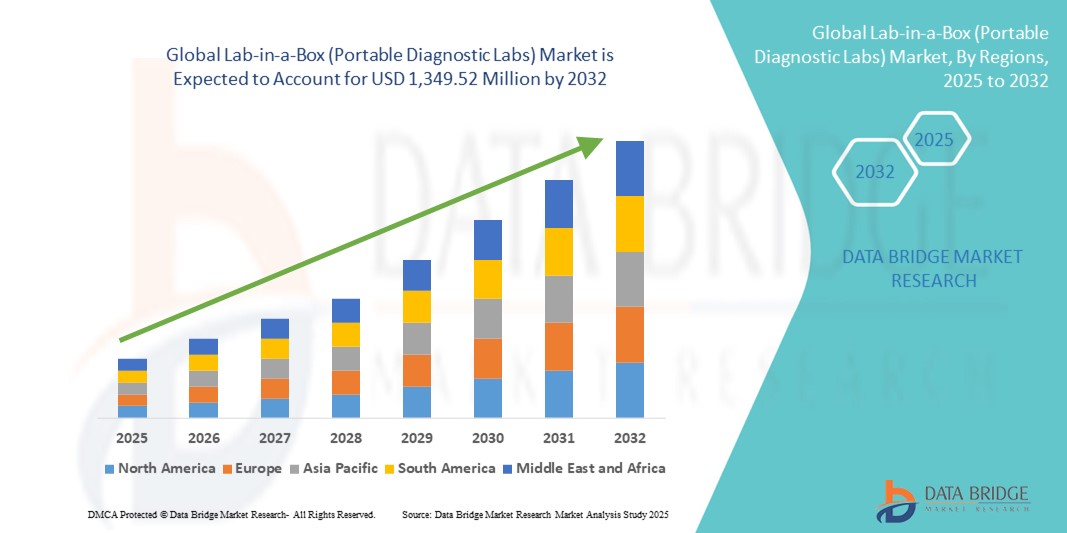
Lab-in-a-Box (Portable Diagnostic Labs) Market Size
- The global Lab-in-a-Box (Portable Diagnostic Labs) market size was valued at USD 411.64 million in 2024 and is expected to reach USD 1,349.52 million by 2032, at a CAGR of 16.00% during the forecast period
- The market growth is largely driven by increasing demand for rapid, decentralized diagnostic solutions across remote, emergency, and underserved regions, aligning with global healthcare digitization and outreach efforts
- Furthermore, the growing prevalence of infectious diseases, chronic conditions, and disaster-response needs is establishing portable labs as vital tools for real-time diagnostics and point-of-care testing. These converging factors are accelerating the adoption of Lab-in-a-Box solutions, thereby significantly boosting the industry's growth
Lab-in-a-Box (Portable Diagnostic Labs) Market Analysis
- Lab-in-a-Box systems, offering compact and mobile diagnostic capabilities, are becoming increasingly vital components of modern healthcare delivery across clinical, emergency, and remote settings due to their rapid test turnaround, field deployability, and ability to function independently in low-resource environments
- The accelerating demand for Lab-in-a-Box solutions is primarily fueled by the rising need for point-of-care diagnostics, increasing prevalence of infectious and chronic diseases, and expanding global initiatives aimed at improving healthcare accessibility in underserved regions
- North America dominated the Lab-in-a-Box market with the largest revenue share of 38.5% in 2024, supported by strong healthcare infrastructure, high diagnostic spending, and early adoption of mobile diagnostic technologies, particularly in rural outreach, disaster response, and military healthcare operations
- Asia-Pacific is expected to be the fastest growing region in the Lab-in-a-Box market during the forecast period due to increasing government healthcare investments, expanding mobile medical services, and growing demand for rapid diagnostics in densely populated areas
- Vehicle-based labs dominated the Lab-in-a-Box market with a market share of 55.1% in 2024, driven by their flexibility, ease of deployment, and suitability for both urban and remote field operations across clinical and non-clinical applications
Report Scope and Lab-in-a-Box (Portable Diagnostic Labs) Market Segmentation
|
Attributes |
Lab-in-a-Box (Portable Diagnostic Labs) Key Market Insights |
|
Segments Covered |
|
|
Countries Covered |
North America
Europe
Asia-Pacific
Middle East and Africa
South America
|
|
Key Market Players |
|
|
Market Opportunities |
|
|
Value Added Data Infosets |
In addition to the insights on market scenarios such as market value, growth rate, segmentation, geographical coverage, and major players, the market reports curated by the Data Bridge Market Research also include in-depth expert analysis, pricing analysis, brand share analysis, consumer survey, demography analysis, supply chain analysis, value chain analysis, raw material/consumables overview, vendor selection criteria, PESTLE Analysis, Porter Analysis, and regulatory framework. |
Lab-in-a-Box (Portable Diagnostic Labs) Market Trends
“Technology Integration for Rapid, Decentralized, and AI-Powered Diagnostic”
- A significant and accelerating trend in the global Lab-in-a-Box market is the increasing integration of artificial intelligence (AI), cloud computing, and telehealth platforms into portable diagnostic labs. This advancement is drastically enhancing real-time testing capabilities, data sharing, and decision-making, particularly in remote and emergency care environments
- For instance, several mobile lab units now feature AI-powered diagnostic algorithms for rapid disease identification, including tuberculosis, malaria, and COVID-19, with automatic cloud syncing for instant transmission to central health databases. Companies such as Boditech Med and Truvian Health are incorporating AI-enabled analyzers into mobile diagnostic units, improving accuracy and speed
- AI integration within Lab-in-a-Box systems enables advanced features such as image recognition in pathology, predictive analytics for outbreak surveillance, and smart sample triage. Furthermore, cloud platforms allow seamless sharing of results with healthcare providers, enabling remote consultations and faster interventions
- The convergence of Lab-in-a-Box technologies with telemedicine, mobile apps, and edge computing is creating a more connected and responsive diagnostic ecosystem. Through a single mobile unit, healthcare professionals can collect, analyze, and transmit critical diagnostic data, enhancing efficiency and treatment accuracy in rural clinics or disaster zones
- This trend toward more intelligent, mobile, and data-integrated diagnostic solutions is redefining expectations for diagnostic accessibility. Consequently, companies are developing field-deployable units with modular testing capabilities, wireless data sharing, and solar-powered operation, catering to both emerging markets and global health initiatives
- The demand for Lab-in-a-Box systems with AI-driven diagnostics and remote connectivity is growing rapidly across humanitarian, military, and public health sectors, as organizations prioritize speed, portability, and precision in diagnostic response
Lab-in-a-Box (Portable Diagnostic Labs) Market Dynamics
Driver
“Rising Demand for Decentralized and Field-Ready Diagnostic Solutions”
- The increasing need for rapid, on-site testing in both routine and crisis scenarios, along with growing public health initiatives for underserved regions, is significantly driving the adoption of Lab-in-a-Box solutions
- For instance, in 2024, the WHO and various NGOs collaborated on a mobile diagnostics initiative to deploy container-based labs across sub-Saharan Africa for infectious disease surveillance. These efforts demonstrate rising demand for self-contained labs that reduce reliance on centralized infrastructure
- With growing global health concerns including pandemics, chronic disease management, and outbreak containment Lab-in-a-Box systems offer a vital solution through their ability to provide rapid diagnostics in areas with limited access to healthcare facilities
- In addition, the shift toward point-of-care diagnostics and the expansion of mobile healthcare services are positioning Lab-in-a-Box units as essential tools in modern medical outreach strategies. Their ease of use, transportability, and multi-disease diagnostic capabilities make them attractive for emergency medical services, military operations, and rural clinics
- The ability to perform laboratory-grade diagnostics in the field combined with AI-powered insights, real-time reporting, and compatibility with digital health platforms is further accelerating adoption among government agencies and global health organizations
Restraint/Challenge
“Operational and Regulatory Complexities in Multi-Setting Deployment”
- Despite their benefits, the deployment of Lab-in-a-Box systems faces challenges related to equipment standardization, skilled personnel availability, and regulatory approvals, especially in diverse and resource-constrained environments
- For instance, the variability in diagnostic regulations across countries can delay the approval of portable diagnostic kits, limiting global scalability. In addition, the need for electricity, refrigeration, or environmental control in some units can restrict use in extreme or low-resource settings without proper infrastructure
- Training healthcare workers to operate advanced diagnostic equipment and interpret AI-generated results also remains a critical barrier in certain regions, where laboratory literacy may be limited
- Moreover, cost remains a challenge for widespread adoption, particularly for advanced systems equipped with high-end diagnostic capabilities and cloud connectivity. While governments and aid organizations are beginning to subsidize these technologies, budget constraints can still hinder market expansion in developing economies
- Overcoming these challenges through modular system designs, localized training programs, streamlined regulatory pathways, and public-private partnerships will be vital for the sustained growth of the Lab-in-a-Box market globally
Lab-in-a-Box (Portable Diagnostic Labs) Market Scope
The market is segmented on the basis of device type, technology, application, and end user.
- By Device Type
On the basis of device type, the Lab-in-a-Box market is segmented into vehicle-based labs, trailer-based labs, container-based labs, handheld diagnostic devices, wearable diagnostic devices, and portable imaging devices. The vehicle-based labs segment dominated the market with the largest revenue share of 55.1% in 2024, driven by their operational flexibility, mobility, and ease of deployment in field operations. These mobile labs are widely used in remote diagnostics, outbreak responses, and rural healthcare outreach programs. Their ability to be equipped with full laboratory setups, power systems, and connectivity tools has made them the preferred platform across emergency healthcare services and government missions.
The wearable diagnostic devices segment is anticipated to witness the fastest growth rate from 2025 to 2032, fueled by the increasing demand for real-time health monitoring, rising adoption in personalized medicine, and the evolution of compact biosensor technology. Wearables enable continuous monitoring of physiological parameters and are gaining traction among both healthcare providers and consumers, especially in chronic disease management and remote care scenarios.
- By Technology
On the basis of technology, the market is segmented into electrochemical biosensors, optical biosensors, piezoelectric biosensors, thermal biosensors, immunoassay-based technology, and AI and cloud-integrated platforms. The electrochemical biosensors segment held the largest revenue share in 2024, owing to their high sensitivity, cost-effectiveness, and suitability for a wide range of point-of-care applications. These biosensors are commonly used in diagnostic kits for detecting glucose, infections, and biomarkers in portable settings.
The AI and cloud-integrated platforms segment is expected to witness the fastest CAGR from 2025 to 2032, driven by the growing need for real-time analytics, smart diagnostics, and remote data sharing. These technologies enable Lab-in-a-Box systems to operate more intelligently, offering faster diagnostics, predictive analytics, and secure cloud-based storage and transmission of patient data.
- By Application
On the basis of application, the market is segmented into disease diagnostics, clinical research, emergency response, disaster relief, environmental testing, food & beverage quality control, pharmaceutical and biotechnology applications, and industrial testing. The disease diagnostics segment dominated the market with the largest share in 2024, supported by the growing demand for rapid, field-based testing during outbreaks and routine health screening programs. These labs are widely utilized for infectious disease detection, chronic disease monitoring, and basic pathology services.
The emergency response segment is anticipated to grow at the fastest rate from 2025 to 2032, driven by increasing global incidences of natural disasters, pandemics, and humanitarian crises. Lab-in-a-Box systems provide quick deployment in high-risk zones, enabling frontline responders to perform diagnostics without delay, significantly improving treatment outcomes and containment measures.
- By End User
On the basis of end user, the Lab-in-a-Box market is segmented into hospitals, clinics, diagnostic laboratories, emergency medical services, home healthcare providers, research institutes, government agencies, and non-governmental organizations (NGOs). The hospitals segment held the largest revenue share in 2024, as these institutions increasingly adopt mobile labs to extend diagnostic capabilities to satellite clinics, rural areas, and in-hospital emergency setups. Their integration with centralized data systems allows seamless patient data synchronization and streamlined diagnostic workflows.
The government agencies segment is expected to witness the fastest growth during the forecast period, owing to growing investments in pandemic preparedness, field surveillance programs, and mobile healthcare infrastructure. National and international public health bodies are deploying Lab-in-a-Box systems as part of strategic health response plans, especially in low-resource and border areas.
Lab-in-a-Box (Portable Diagnostic Labs) Market Regional Analysis
- North America dominated the Lab-in-a-Box market with the largest revenue share of 38.5% in 2024, supported by strong healthcare infrastructure, high diagnostic spending, and early adoption of mobile diagnostic technologies, particularly in rural outreach, disaster response, and military healthcare operations
- Healthcare providers and government agencies in the region prioritize flexible, on-site diagnostic solutions that enhance accessibility and responsiveness, particularly in rural, disaster-prone, or underserved communities
- This widespread adoption is further supported by advanced healthcare systems, high R&D spending, and growing interest in AI-enabled, field-deployable diagnostics, positioning Lab-in-a-Box solutions as a critical component of modern decentralized healthcare delivery across the U.S. and Canada
U.S. Lab-in-a-Box (Portable Diagnostic Labs) Market Insight
The U.S. Lab-in-a-Box market captured the largest revenue share of 79.3% in 2024 within North America, driven by the country’s focus on rapid, decentralized diagnostics and emergency preparedness. The rising demand for field-deployable diagnostic solutions across disaster response, rural healthcare, and military applications is propelling market growth. Integration of AI and cloud-based technologies with mobile labs is enhancing diagnostic speed and accuracy, while increasing public health initiatives and partnerships with federal agencies further solidify the U.S. as a leader in portable lab deployment.
Europe Lab-in-a-Box Market Insight
The Europe Lab-in-a-Box market is projected to witness strong CAGR throughout the forecast period, driven by increased investment in mobile healthcare infrastructure and stringent regulations regarding diagnostic accuracy and disease surveillance. Demand is rising for portable diagnostics in public health, environmental testing, and refugee and disaster support settings. In addition, growing emphasis on digital health transformation and AI-powered diagnostics is fostering adoption across EU countries for both routine and emergency applications.
U.K. Lab-in-a-Box Market Insight
The U.K. Lab-in-a-Box market is anticipated to grow at a notable CAGR during the forecast period, backed by robust NHS support for mobile diagnostics, aging infrastructure in rural areas, and rising demand for rapid disease detection. Public-private collaborations are driving innovation in AI-integrated and container-based diagnostic labs. The country’s expanding use of portable labs for infectious disease surveillance, including during pandemics, has reinforced their value in public health infrastructure.
Germany Lab-in-a-Box Market Insight
The Germany Lab-in-a-Box market is expected to expand at a considerable CAGR over the forecast period, fueled by the country’s push for precision diagnostics and strong investments in biotech and medtech. Germany is leveraging containerized and vehicle-based labs for clinical trials, pharmaceutical testing, and remote diagnostics. Its highly developed healthcare infrastructure and strict regulatory standards are encouraging the development of mobile labs with advanced biosensing technologies and data connectivity features.
Asia-Pacific Lab-in-a-Box Market Insight
The Asia-Pacific Lab-in-a-Box market is projected to grow at the fastest CAGR of 23.6% from 2025 to 2032, driven by expanding healthcare access needs, government health missions, and the rising demand for point-of-care diagnostics. Countries such as China, India, and Japan are investing in portable labs to reach remote communities and respond to public health crises. Growing awareness of rapid diagnostics and AI-powered testing solutions is increasing adoption across both public and private healthcare sectors.
Japan Lab-in-a-Box Market Insight
The Japan Lab-in-a-Box market is gaining traction due to high R&D capabilities, strong demand for rapid testing, and a preference for compact, high-tech diagnostic equipment. The integration of cloud-based data platforms and robotics in mobile labs is appealing to Japan’s aging population and tech-savvy healthcare system. The country is deploying lab-in-a-box systems in environmental monitoring and pharmaceutical R&D, emphasizing speed, accuracy, and automation.
India Lab-in-a-Box Market Insight
The India Lab-in-a-Box market accounted for the largest revenue share in Asia-Pacific in 2024, driven by the country’s large rural population, growing demand for mobile healthcare solutions, and rising investments under government health initiatives such as Ayushman Bharat. The need for low-cost, portable diagnostics across public health, pandemic response, and mobile clinics is accelerating growth. Domestic manufacturers are playing a key role in making lab-in-a-box solutions accessible, scalable, and aligned with local diagnostic needs.
Lab-in-a-Box (Portable Diagnostic Labs) Market Share
The Lab-in-a-Box (Portable Diagnostic Labs) industry is primarily led by well-established companies, including:
- Everlywell (U.S.)
- BioFire Diagnostics (U.S.)
- Siemens Healthineers AG (Germany)
- Abbott (U.S.)
- Fujifilm Holdings Corporation (Japan)
- BD (U.S.)
- QuantuMDx Group Ltd (U.K.)
- Chembio Diagnostics, Inc. (U.S.)
- Visby Medical (U.S.)
- Biomerieux (France)
- Thermo Fisher Scientific Inc. (U.S.)
- GenWorks Health (India)
- MedTech Global (Australia)
- Cepheid (U.S.)
- LumiraDx (U.K.)
- Molbio Diagnostics (India)
- iCubate Inc. (U.S.)
- Infectious Disease Connect (U.S.)
What are the Recent Developments in Global Lab-in-a-Box (Portable Diagnostic Labs) Market?
- In May 2024, Cue Health Inc., a leading innovator in portable diagnostics, launched the Cue Lab-in-a-Box system, a fully integrated mobile testing platform capable of performing molecular diagnostic tests in remote locations. Designed for use in disaster zones, rural communities, and military field operations, the platform emphasizes rapid deployment, real-time data transmission, and AI-assisted analysis. This launch underscores Cue Health’s commitment to decentralized, accessible healthcare through next-gen mobile diagnostic solutions
- In April 2024, MedTech Global, in partnership with the World Health Organization, introduced mobile diagnostic containers across parts of sub-Saharan Africa for disease surveillance and outbreak response. These container-based labs are equipped with biosensor technologies and solar power capabilities to ensure continuity in low-resource settings. The initiative aims to improve real-time data collection and pathogen detection, reinforcing global health preparedness and response mechanisms
- In February 2024, Everlywell, a digital health company, unveiled a new line of handheld diagnostic devices designed for Lab-in-a-Box deployments in home healthcare and rural clinics. These compact devices support rapid testing for infectious diseases and chronic conditions, integrating with cloud platforms for remote data access and telemedicine. This development reflects Everlywell’s push to expand decentralized diagnostic care, particularly in underdiagnosed and underserved populations
- In January 2024, Biofire Diagnostics, a subsidiary of bioMérieux, launched its next-generation FilmArray Mobile Lab System, a portable RT-PCR testing unit aimed at emergency response teams and mobile clinical trials. The new system reduces turnaround times while ensuring laboratory-grade accuracy in field settings. Biofire’s innovation highlights the growing demand for reliable, field-deployable molecular diagnostics in both public health and private sectors
- In December 2023, Siemens Healthineers introduced an AI-powered Lab-on-Wheels platform for use in clinical research and diagnostic outreach programs. Integrated with advanced biosensing technologies and telepathology systems, the platform allows for immediate test result interpretation and real-time consultation with remote specialists. The move strengthens Siemens’ position in mobile diagnostics, demonstrating its focus on scalable, intelligent diagnostic infrastructure to reach global populations

- Interactive Data Analysis Dashboard
- Company Analysis Dashboard for high growth potential opportunities
- Research Analyst Access for customization & queries
- Competitor Analysis with Interactive dashboard
- Latest News, Updates & Trend analysis
- Harness the Power of Benchmark Analysis for Comprehensive Competitor Tracking
Data collection and base year analysis are done using data collection modules with large sample sizes. The stage includes obtaining market information or related data through various sources and strategies. It includes examining and planning all the data acquired from the past in advance. It likewise envelops the examination of information inconsistencies seen across different information sources. The market data is analysed and estimated using market statistical and coherent models. Also, market share analysis and key trend analysis are the major success factors in the market report. To know more, please request an analyst call or drop down your inquiry.
The key research methodology used by DBMR research team is data triangulation which involves data mining, analysis of the impact of data variables on the market and primary (industry expert) validation. Data models include Vendor Positioning Grid, Market Time Line Analysis, Market Overview and Guide, Company Positioning Grid, Patent Analysis, Pricing Analysis, Company Market Share Analysis, Standards of Measurement, Global versus Regional and Vendor Share Analysis. To know more about the research methodology, drop in an inquiry to speak to our industry experts.
Data Bridge Market Research is a leader in advanced formative research. We take pride in servicing our existing and new customers with data and analysis that match and suits their goal. The report can be customized to include price trend analysis of target brands understanding the market for additional countries (ask for the list of countries), clinical trial results data, literature review, refurbished market and product base analysis. Market analysis of target competitors can be analyzed from technology-based analysis to market portfolio strategies. We can add as many competitors that you require data about in the format and data style you are looking for. Our team of analysts can also provide you data in crude raw excel files pivot tables (Fact book) or can assist you in creating presentations from the data sets available in the report.













