


What is the Label Applicator Market Size and Overview?
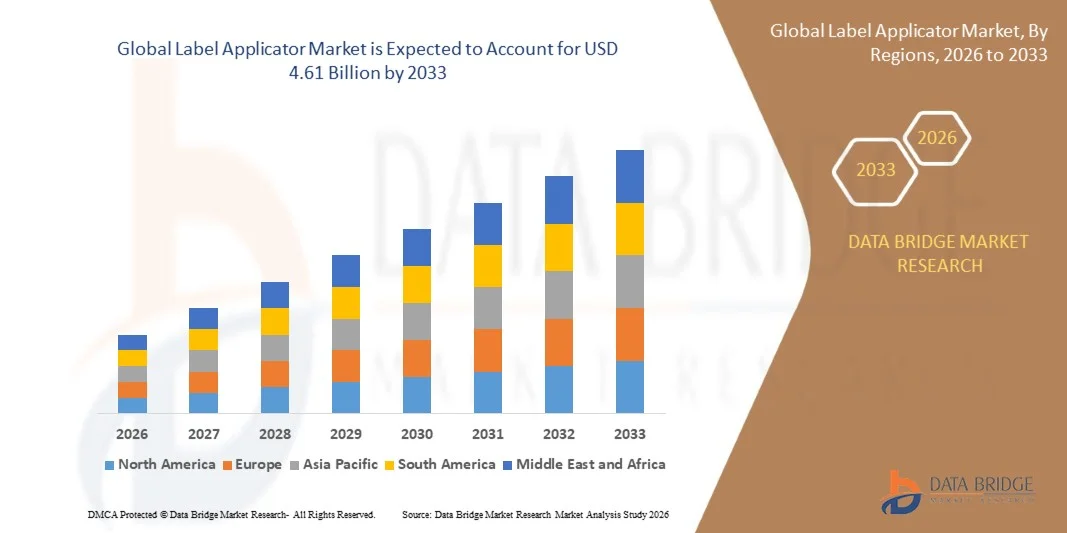
The Label Applicator Market was valued at USD 3.05 billion in 2025 and is projected to reach USD 4.61 billion by 2033, growing at a CAGR of 5.30% from 2026 to 2033. The market is witnessing steady expansion driven by rising demand for automated packaging solutions, increasing adoption of labeling systems across manufacturing and logistics industries, and growing emphasis on product identification, traceability, and regulatory compliance.
The growing shift toward high-speed production lines in industries such as food and beverages, pharmaceuticals, cosmetics, and consumer goods is significantly boosting the adoption of advanced label applicators. In addition, the integration of smart technologies, such as sensor-based systems and IoT-enabled labeling equipment, is enhancing accuracy, efficiency, and operational productivity, further supporting market growth across both developed and emerging economies.
Market Size & Forecast
- Global Market Value (2025): USD 3.05 Billion
- Expected Market Value (2033): USD 4.61 Billion
- Forecast CAGR (2026–2033): 5.30%
- Leading Region in 2025: North America
- Fastest Growing Region: Asia-Pacific
Key Market Trends & Insights
- North America dominated the label applicator market with the largest revenue share in 2025, supported by strong industrial automation adoption, high demand from packaging and logistics sectors, and early integration of advanced labeling technologies in manufacturing operations.
- Asia-Pacific is expected to be the fastest-growing region, recording a CAGR of 6.20% from 2026 to 2033. Growth is driven by rapid industrialization, expansion of manufacturing activities, rising e-commerce penetration, and increasing adoption of automated packaging solutions across emerging economies
- The Integrated Automated segment held the largest market revenue share in 2025 driven by its strong adoption across high-volume production lines in food and beverages, pharmaceuticals, and logistics industries. Integrated systems are widely preferred due to their seamless integration with packaging lines, higher operational efficiency, and reduced manual intervention, making them suitable for large-scale industrial labeling operations.
- The Semi-Automated segment is projected to register steady growth during the forecast period, supported by increasing demand from small and medium-scale manufacturers seeking cost-effective automation solutions without fully transitioning to complete automation systems. The Stand Alone segment is also witnessing stable adoption, particularly in flexible production environments where independent labeling units are required.
- The Wipe-On segment held the largest market revenue share in 2025, driven by its widespread use in high-speed packaging lines such as bottles, cartons, and boxes in food and beverage and personal care industries. This method is preferred due to its simplicity, reliability, and compatibility with continuous production systems.
- The Air Blow segment is projected to register the fastest growth from 2026 to 2033, driven by increasing demand for non-contact labeling solutions in pharmaceuticals, fragile packaging, and high-precision applications. Rising adoption in sterile and contamination-sensitive environments is further supporting segment expansion, while the Tamp Blow segment continues to maintain steady usage in industrial and logistics labeling operations.
- The 500 IPM - 1000 IPM segment held the largest market revenue share in 2025, driven by its optimal balance between operational efficiency and accuracy, making it suitable for medium to large-scale packaging lines across food and beverage, pharmaceuticals, and logistics sectors.
- The 1500 IPM - 2000 IPM and 2000 IPM & Above segments are projected to register the fastest growth during the forecast period, driven by rising demand for ultra-high-speed packaging automation in large manufacturing facilities. Increasing adoption of high-throughput production systems in e-commerce fulfillment centers and industrial packaging units is further accelerating segment expansion.
- The Bottles segment held the largest market revenue share in 2025, driven by extensive use in food and beverages, pharmaceuticals, and personal care industries where consistent and high-speed labeling is essential for regulatory compliance and branding.
- The Boxes and Cartons segment is projected to register the fastest growth from 2026 to 2033, supported by rapid expansion of e-commerce, retail packaging, and logistics operations. Increasing demand for automated carton labeling in warehousing and distribution centers is further driving segment growth, while vials and pouches continue to see strong adoption in pharmaceutical and flexible packaging applications.
- The Food and Beverages segment held the largest market revenue share in 2025, driven by high-volume packaging requirements, stringent labeling regulations, and increasing demand for automated packaging lines.
- The Pharmaceuticals segment is projected to register the fastest growth from 2026 to 2033, driven by rising demand for accurate, traceable, and compliance-driven labeling solutions. Increasing adoption of serialization, anti-counterfeiting requirements, and expansion of global drug manufacturing are further accelerating segment growth, while Logistics and Warehousing is also witnessing strong adoption due to rapid growth in e-commerce fulfillment operations.
Report Scope and Label Applicator Market Segmentation
|
Attributes |
Label Applicator Key Market Insights |
|
Segments Covered |
|
|
Countries Covered |
North America
Europe
Asia-Pacific
Middle East and Africa
South America
|
|
Key Market Players |
|
|
Market Opportunities |
|
|
Value Added Data Infosets |
In addition to the insights on market scenarios such as market value, growth rate, segmentation, geographical coverage, and major players, the market reports curated by the Data Bridge Market Research also include import export analysis, production capacity overview, production consumption analysis, price trend analysis, climate change scenario, supply chain analysis, value chain analysis, raw material/consumables overview, vendor selection criteria, PESTLE Analysis, Porter Analysis, and regulatory framework. |
What is the Key Trend in the Label Applicator Market?
Trend: Growth In Automation-Driven Labeling Systems And Smart Packaging Technologies
Increasing demand for high-speed, accurate, and consistent product identification across manufacturing, logistics, pharmaceuticals, food and beverages, and consumer goods sectors is driving the adoption of advanced label applicator systems. Traditional manual labeling processes are increasingly being replaced due to higher labor costs, labeling errors, and inefficiencies in large-scale production environments, encouraging industries to shift toward automated and semi-automated labeling solutions.
In modern packaging lines, manufacturers are integrating advanced label applicators, For instance pressure-sensitive and print-and-apply systems in high-volume bottling and pharmaceutical packaging units to achieve labeling speeds exceeding 200 to 500 products per minute while maintaining high precision and compliance with serialization requirements. In logistics and warehousing operations, automated labeling systems are being deployed to improve barcode accuracy and real-time tracking efficiency, reducing shipment errors and improving supply chain visibility.
The rapid expansion of e-commerce and global trade is also increasing demand for flexible and high-speed labeling solutions capable of handling diverse packaging formats and rapid SKU changes. In addition, the integration of smart technologies such as IoT-enabled sensors, vision inspection systems, and AI-based quality control is enhancing operational efficiency and reducing downtime in production lines. Growing industry validation through industrial deployments in 2025 across North America and Asia-Pacific shows labeling accuracy improvements of nearly 15–25% and reduction in operational waste by up to 10–18% in automated packaging facilities.
Label Applicator Market Dynamics
Key Market Driver: Rising Adoption Of Automated Packaging And High-Speed Production Systems
The increasing demand for efficiency, accuracy, and scalability in packaging operations across industries such as food and beverages, pharmaceuticals, cosmetics, and logistics is driving the adoption of automated label applicator systems. Manual labeling processes are being phased out due to higher error rates, labor dependency, and inability to support large-scale production requirements, pushing manufacturers toward advanced automated solutions.
Manufacturing facilities are increasingly deploying high-speed label applicators, For instance pressure-sensitive, wrap-around, and print-and-apply systems in beverage bottling plants and pharmaceutical packaging lines to achieve throughput levels of over 300 to 600 units per minute while maintaining consistent labeling accuracy and regulatory compliance. In logistics hubs and e-commerce fulfillment centers, automated labeling systems integrated with conveyor lines are improving real-time tracking and reducing mislabeling errors by up to 20–30% in large-scale distribution networks.
In addition, the expansion of global supply chains and rising demand for serialized product tracking are accelerating the need for intelligent labeling systems. Industrial deployments in 2025 across Europe and Asia-Pacific have demonstrated productivity improvements of around 18–25% and significant reductions in labeling downtime in automated production environments.
Key Market Restraint/Challenge: High Initial Investment And Integration Complexity
Despite strong adoption potential, the high upfront cost of advanced label applicator systems remains a major barrier, particularly for small and medium-sized enterprises. Costs associated with automated labeling machines, integration with existing production lines, and maintenance infrastructure increase overall capital expenditure requirements, limiting widespread adoption in price-sensitive markets.
In addition, integrating advanced labeling systems with legacy manufacturing equipment and ERP-driven production environments can be technically complex and time-consuming. Compatibility issues between hardware, software, and packaging line configurations often lead to operational delays and increased implementation costs.
Industry assessments indicate that fully automated label applicator systems can require initial setup investments ranging from tens of thousands to several hundred thousand dollars depending on system complexity, with integration timelines extending up to 3–6 months in large-scale manufacturing facilities, creating adoption challenges for mid-sized production units.
Key Market Opportunity: Expansion Of Smart Labeling Solutions And Industry 4.0 Integration
The increasing shift toward Industry 4.0 and smart manufacturing is creating significant opportunities for advanced label applicator systems integrated with IoT, AI-based vision inspection, and real-time data tracking capabilities. Modern production environments require intelligent labeling solutions that can ensure traceability, compliance, and operational efficiency across complex supply chains.
Manufacturers are increasingly adopting smart label applicators, For instance systems equipped with machine vision and barcode verification technologies in pharmaceutical and electronics packaging lines to ensure 100% labeling accuracy and compliance with global serialization standards. In warehouse automation, AI-enabled labeling systems are being used to dynamically adjust label placement and content based on SKU variations and shipment requirements.
In addition, rapid growth in e-commerce, cross-border trade, and personalized packaging is accelerating demand for flexible labeling systems capable of handling multiple packaging formats and variable production batches. Pilot deployments in 2025 across North America and Japan have reported reduction in labeling errors by 20–28% and improved packaging line efficiency by 15–22% through smart applicator integration.
How is the Label Applicator Market Segmented?
The market is segmented on the basis of product type, process type, speed, application, and end-use industry.
- By Product Type
On the basis of product type, the label applicator market is segmented into Integrated Automated, Stand Alone, and Semi-Automated. The Integrated Automated segment held the largest market revenue share in 2025 driven by its strong adoption across high-volume production lines in food and beverages, pharmaceuticals, and logistics industries. Integrated systems are widely preferred due to their seamless integration with packaging lines, higher operational efficiency, and reduced manual intervention, making them suitable for large-scale industrial labeling operations.
The Semi-Automated segment is projected to register steady growth during the forecast period, supported by increasing demand from small and medium-scale manufacturers seeking cost-effective automation solutions without fully transitioning to complete automation systems. The Stand Alone segment is also witnessing stable adoption, particularly in flexible production environments where independent labeling units are required.
- By Process Type
On the basis of process type, the label applicator market is segmented into Wipe-On, Air Blow, and Tamp Blow. The Wipe-On segment held the largest market revenue share in 2025, driven by its widespread use in high-speed packaging lines such as bottles, cartons, and boxes in food and beverage and personal care industries. This method is preferred due to its simplicity, reliability, and compatibility with continuous production systems.
The Air Blow segment is projected to register the fastest growth from 2026 to 2033, driven by increasing demand for non-contact labeling solutions in pharmaceuticals, fragile packaging, and high-precision applications. Rising adoption in sterile and contamination-sensitive environments is further supporting segment expansion, while the Tamp Blow segment continues to maintain steady usage in industrial and logistics labeling operations.
- By Speed
On the basis of speed, the label applicator market is segmented into 100 IPM - 500 IPM, 500 IPM - 1000 IPM, 1000 IPM - 1500 IPM, 1500 IPM - 2000 IPM, and 2000 IPM & Above. The 500 IPM - 1000 IPM segment held the largest market revenue share in 2025, driven by its optimal balance between operational efficiency and accuracy, making it suitable for medium to large-scale packaging lines across food and beverage, pharmaceuticals, and logistics sectors.
The 1500 IPM - 2000 IPM and 2000 IPM & Above segments are projected to register the fastest growth during the forecast period, driven by rising demand for ultra-high-speed packaging automation in large manufacturing facilities. Increasing adoption of high-throughput production systems in e-commerce fulfillment centers and industrial packaging units is further accelerating segment expansion.
- By Application
On the basis of application, the label applicator market is segmented into Bottles, Vials, Pouches, Boxes and Cartons, Trays, and Others. The Bottles segment held the largest market revenue share in 2025, driven by extensive use in food and beverages, pharmaceuticals, and personal care industries where consistent and high-speed labeling is essential for regulatory compliance and branding.
The Boxes and Cartons segment is projected to register the fastest growth from 2026 to 2033, supported by rapid expansion of e-commerce, retail packaging, and logistics operations. Increasing demand for automated carton labeling in warehousing and distribution centers is further driving segment growth, while vials and pouches continue to see strong adoption in pharmaceutical and flexible packaging applications.
- By End Use
On the basis of end use, the label applicator market is segmented into Chemicals, Personal Care and Cosmetics, Food and Beverages, Pharmaceuticals, Electrical and Electronics, Logistics and Warehousing, and Others. The Food and Beverages segment held the largest market revenue share in 2025, driven by high-volume packaging requirements, stringent labeling regulations, and increasing demand for automated packaging lines.
The Pharmaceuticals segment is projected to register the fastest growth from 2026 to 2033, driven by rising demand for accurate, traceable, and compliance-driven labeling solutions. Increasing adoption of serialization, anti-counterfeiting requirements, and expansion of global drug manufacturing are further accelerating segment growth, while Logistics and Warehousing is also witnessing strong adoption due to rapid growth in e-commerce fulfillment operations.
Label Applicator Market Regional Analysis
North America Label Applicator Market Insight
North America dominated the label applicator market with the largest revenue share of 39.85% in 2025, supported by strong demand from packaging, logistics, and manufacturing industries. The region benefits from high adoption of automation in labeling processes, driven by the need for efficiency, accuracy, and high-speed production lines. Increasing use of smart packaging solutions and regulatory requirements for clear product identification further support market growth. In addition, well-established industrial infrastructure, high labor costs encouraging automation, and rapid integration of advanced labeling systems across end-use industries continue to strengthen market expansion.
U.S. Label Applicator Market Insight
The U.S. label applicator market captured the largest revenue share in North America in 2025, driven by the rapid expansion of e-commerce, food and beverage processing, and pharmaceutical packaging industries. Companies are increasingly adopting automated labeling systems to improve traceability, reduce operational errors, and enhance production efficiency. Growing preference for RFID-enabled and barcode labeling solutions is further accelerating demand. Moreover, integration of labeling systems with Industry 4.0 technologies, such as IoT-based monitoring and automated production lines, is significantly contributing to market growth.
Europe Label Applicator Market Insight
The Europe label applicator market is expected to witness the fastest growth rate from 2026 to 2033, driven by strict packaging regulations, rising demand for product traceability, and increasing adoption of automation in manufacturing facilities. The region’s strong focus on sustainability and standardized labeling requirements is encouraging industries to invest in advanced labeling systems. Growth in pharmaceuticals, cosmetics, and food packaging sectors is further supporting adoption. In addition, increasing investment in smart factories and connected production systems is enhancing the deployment of automated label applicators across multiple industries.
U.K. Label Applicator Market Insight
The U.K. label applicator market is expected to witness strong growth from 2026 to 2033, supported by rising demand for efficient packaging solutions and expanding retail and e-commerce sectors. Businesses are increasingly focusing on automation to improve labeling accuracy and reduce operational costs. The growing need for compliance with labeling standards in food, beverages, and pharmaceuticals is further driving adoption. In addition, increasing deployment of smart manufacturing systems and digital supply chain solutions is accelerating the integration of advanced label applicators in production environments.
Germany Label Applicator Market Insight
The Germany label applicator market is expected to witness significant growth from 2026 to 2033, driven by the country’s strong industrial base and emphasis on automation and precision engineering. High adoption of advanced manufacturing technologies and increasing demand for high-speed labeling in automotive, chemicals, and consumer goods sectors are supporting market expansion. Germany’s focus on sustainable packaging and strict regulatory frameworks is also encouraging the use of accurate and efficient labeling systems. In addition, integration of labeling equipment with automated production lines is becoming increasingly common across industries.
Asia-Pacific Label Applicator Market Insight
The Asia-Pacific label applicator market is expected to witness the fastest growth rate from 2026 to 2033, supported by rapid industrialization, expanding manufacturing activities, and rising demand for packaged goods. Countries such as China, India, and Japan are experiencing strong growth in food processing, pharmaceuticals, and logistics sectors, which is driving adoption of automated labeling systems. Increasing foreign investments and government initiatives promoting smart manufacturing are further supporting market expansion. In addition, the availability of cost-effective labeling solutions is enhancing adoption across small and medium enterprises.
Japan Label Applicator Market Insight
The Japan label applicator market is expected to witness steady growth from 2026 to 2033 due to the country’s advanced manufacturing ecosystem and strong focus on automation and precision. High demand for efficient labeling in electronics, automotive, and healthcare industries is supporting market growth. The integration of label applicators with robotics and smart factory systems is becoming increasingly common. Moreover, Japan’s aging workforce is encouraging industries to adopt automated solutions to maintain productivity and operational efficiency.
China Label Applicator Market Insight
The China label applicator market accounted for the largest revenue share in Asia-Pacific in 2025, driven by rapid industrial expansion, strong e-commerce growth, and large-scale manufacturing activities. The increasing demand for packaged consumer goods, food products, and pharmaceuticals is significantly boosting the need for automated labeling systems. Government initiatives supporting smart manufacturing and industrial automation are further accelerating market adoption. In addition, the presence of strong domestic manufacturers and cost-effective production capabilities is making advanced label applicators widely accessible across industries.
Which are the Top Companies in Label Applicator Market?
The Label Applicator industry is primarily led by well-established companies, including:
• Label Power (Australia)
• ID Technology, LLC (U.S.)
• Automatic Identification Systems Ltd (U.K.)
• Shree Bhagwati Machtech (India) Pvt. Ltd. (India)
• Matthews Australasia Pvt. Ltd. (Australia)
• Resource Label Group (U.S.)
• Crown Labels Limited (U.K.)
• FoxJet (U.S.)
• Illinois Tool Works Inc (U.S.)
• VIDEOJET TECHNOLOGIES (U.S.)
• Result Group GmbH (Germany)
• Hunkar Technologies (U.S.)
• Peacock Bros. Pvt Ltd (Australia)
• Label-Aire, Inc. (U.S.)
• ALTech UK Labeling Technologies Ltd. (U.K.)
• CTM Labeling Systems (U.S.)
• Novexx Solutions GmbH (Germany)
• Accent Packaging Equipment (U.S.)
• Auto Labe (U.S.)
• Accraply (U.S.)
• RJ Packaging Corporation (U.S.)
What are the Recent Developments in Label Applicator Market?
- In October, 2024, SATO Holdings Corporation launched its LR4NX print and apply labeling machines across Europe, marking a product expansion development aimed at strengthening high-volume automated labeling capabilities. The solution is designed to enhance efficiency in manufacturing, food production, and e-commerce environments by improving labeling speed, accuracy, and operational flexibility. This development is expected to support wider adoption of automated labeling systems across industrial workflows and strengthen SATO’s regional presence in the advanced labeling market
- In 2021, Epson partnered with United Automation in a collaborative development initiative to design and deliver integrated automated labeling applicator solutions combining Epson’s printing technology with robotic automation systems. The development focuses on improving precision, speed, and consistency in labeling operations across industrial applications. This partnership is expected to accelerate automation adoption in packaging and logistics sectors while enhancing workflow efficiency and reducing manual intervention in labeling processes

- Interactive Data Analysis Dashboard
- Company Analysis Dashboard for high growth potential opportunities
- Research Analyst Access for customization & queries
- Competitor Analysis with Interactive dashboard
- Latest News, Updates & Trend analysis
- Harness the Power of Benchmark Analysis for Comprehensive Competitor Tracking
Global Label Applicator Market, Supply Chain Analysis and Ecosystem Framework
To support market growth and help clients navigate the impact of geopolitical shifts, DBMR has integrated in-depth supply chain analysis into its Global Label Applicator Market research reports. This addition empowers clients to respond effectively to global changes affecting their industries. The supply chain analysis section includes detailed insights such as Global Label Applicator Market consumption and production by country, price trend analysis, the impact of tariffs and geopolitical developments, and import and export trends by country and HSN code. It also highlights major suppliers with data on production capacity and company profiles, as well as key importers and exporters. In addition to research, DBMR offers specialized supply chain consulting services backed by over a decade of experience, providing solutions like supplier discovery, supplier risk assessment, price trend analysis, impact evaluation of inflation and trade route changes, and comprehensive market trend analysis.
Data collection and base year analysis are done using data collection modules with large sample sizes. The stage includes obtaining market information or related data through various sources and strategies. It includes examining and planning all the data acquired from the past in advance. It likewise envelops the examination of information inconsistencies seen across different information sources. The market data is analysed and estimated using market statistical and coherent models. Also, market share analysis and key trend analysis are the major success factors in the market report. To know more, please request an analyst call or drop down your inquiry.
The key research methodology used by DBMR research team is data triangulation which involves data mining, analysis of the impact of data variables on the market and primary (industry expert) validation. Data models include Vendor Positioning Grid, Market Time Line Analysis, Market Overview and Guide, Company Positioning Grid, Patent Analysis, Pricing Analysis, Company Market Share Analysis, Standards of Measurement, Global versus Regional and Vendor Share Analysis. To know more about the research methodology, drop in an inquiry to speak to our industry experts.
Data Bridge Market Research is a leader in advanced formative research. We take pride in servicing our existing and new customers with data and analysis that match and suits their goal. The report can be customized to include price trend analysis of target brands understanding the market for additional countries (ask for the list of countries), clinical trial results data, literature review, refurbished market and product base analysis. Market analysis of target competitors can be analyzed from technology-based analysis to market portfolio strategies. We can add as many competitors that you require data about in the format and data style you are looking for. Our team of analysts can also provide you data in crude raw excel files pivot tables (Fact book) or can assist you in creating presentations from the data sets available in the report.













