


Label Printing Market Overview
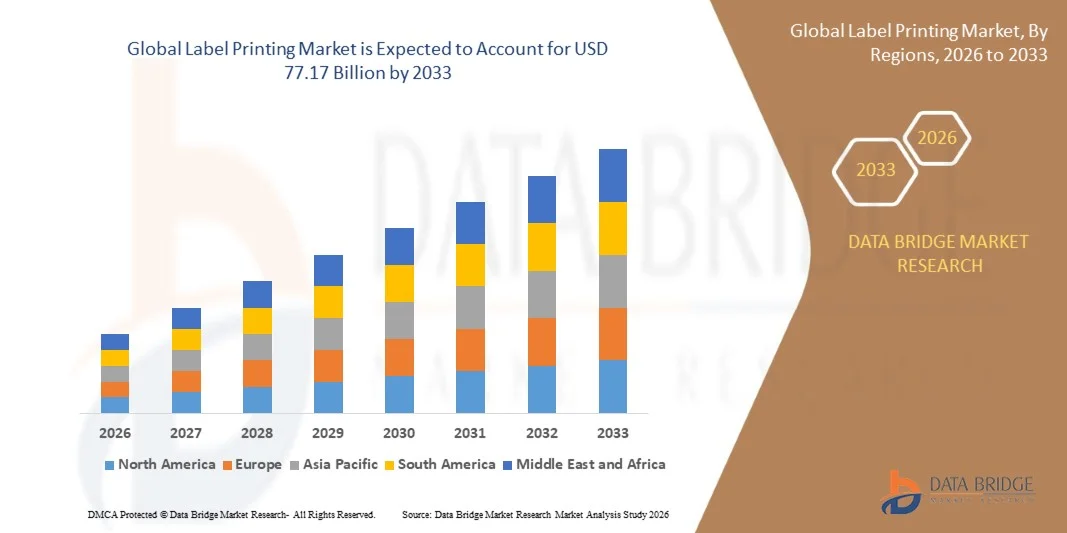
As per Data Bridge Market Research Analysis the label printing market was valued at USD 53.44 billion in 2025 and is projected to reach USD 77.17 billion by 2033, growing at a CAGR of 4.70% from 2026 to 2033. Growth is supported by rising consumption of packaged food and beverages, pharmaceuticals, personal care products, household goods, and e-commerce shipments. Labels are increasingly used not only for branding and mandatory product information but also for traceability, authentication, inventory control, and direct consumer engagement.
Label printing includes the production of pressure-sensitive, wet-glue, linerless, tracking, and other label formats using conventional and digital printing processes. High-volume flexographic, gravure, and offset systems remain important for standardized packaging, while digital inkjet and electrophotographic presses are gaining attention for short runs, variable data, faster design changes, and personalized campaigns. Sustainability is also reshaping the market as brand owners and converters move toward recyclable face stocks, wash-off adhesives, thinner materials, liner reduction, low-migration inks, and labels designed to support package recycling.
Market Size & Forecast
- Market Value (2025): USD 53.44 Billion
- Expected Market Value (2033): USD 77.17 Billion
- Forecast CAGR (2026-2033): 4.70%
- Leading Region: North America
- Fastest-Growing Region: Asia-Pacific
Key Market Trends & Insights
- North America dominated the label printing market with the largest revenue share of 38.6% in 2025, supported by advanced converting infrastructure, high packaged-goods demand, stringent food and healthcare information requirements, large parcel volumes, and early adoption of digital, RFID, serialized, and recycling-compatible label technologies.
- Asia-Pacific is expected to be the fastest-growing region, recording a CAGR of 6.6% from 2026 to 2033. Growth is driven by expanding manufacturing, food processing, pharmaceutical production, organized retail, e-commerce fulfillment, and investment in modern printing and converting capacity across China, Japan, India, South Korea, and Southeast Asia.
- The Pressure-Sensitive Labels segment held the largest market revenue share of approximately 44.12% in 2025, driven by established dispensing lines, versatile adhesive constructions, conformability, and broad use across food, beverage, healthcare, cosmetics, household, logistics, and industrial packaging.
- The Linerless Labels segment is projected to register the fastest growth at a CAGR of 6.06% from 2026 to 2031, driven by release-liner elimination, reduced waste, higher roll density, lower freight requirements, and expanding use in logistics, retail, food service, and variable-information applications.
- The Flexography segment held the largest market revenue share of approximately 32.42% in 2025, driven by efficient roll-to-roll operation, high production speeds, substrate versatility, and cost-effective output for repeat and long-run label jobs.
- The Inkjet segment is projected to register the fastest growth at a CAGR of 5.8% from 2026 to 2031, driven by short-run economics, variable-data capability, rapid changeovers, declining equipment costs, and improving white-ink opacity, color consistency, and substrate compatibility.
Report Scope and Label Printing Market Segmentation
|
Attributes |
Label Printing Key Market Insights |
|
Segments Covered |
|
|
Countries Covered |
North America
Europe
Asia-Pacific
Middle East and Africa
South America
|
|
Key Market Players |
|
|
Market Opportunities |
|
|
Value Added Data Infosets |
In addition to the insights on market scenarios such as market value, growth rate, segmentation, geographical coverage, and major players, the market reports curated by the Data Bridge Market Research also include import export analysis, production capacity overview, production consumption analysis, price trend analysis, climate change scenario, supply chain analysis, value chain analysis, raw material/consumables overview, vendor selection criteria, PESTLE Analysis, Porter Analysis, and regulatory framework. |
Label Printing Market Trends
Trend: Rising Adoption Of Digital, Smart, And Recycling-Compatible Label Solutions
Growing demand for product traceability, packaging personalization, connected packaging, and sustainable labeling is accelerating the adoption of digital, smart, and recycling-compatible label solutions across global consumer goods, pharmaceutical, logistics, and industrial sectors. Brand owners are increasingly utilizing digital printing technologies to support shorter production runs, regional product variations, promotional campaigns, and variable-data printing while reducing setup times and inventory costs. The integration of QR codes, RFID, NFC, serialized identifiers, and intelligent tracking features is further transforming labels into tools for authentication, consumer engagement, supply-chain visibility, and inventory management.
The rapid expansion of e-commerce, SKU proliferation, regulated product labeling, and sustainability initiatives is creating sustained demand for advanced label printing technologies. Manufacturers are increasingly investing in digital presses that improve production flexibility while maintaining high print quality and operational efficiency. For instance, in March 2024, HP announced the general commercial availability of the HP Indigo V12 Digital Press, capable of operating at speeds of up to 120 meters per minute while incorporating intelligent automation features for label and packaging production. The development reflects growing industry investment in high-productivity digital printing solutions that support variable-data capabilities and rapid job changeovers.
The increasing adoption of digital printing, smart labeling technologies, and recycling-compatible packaging solutions is expected to reinforce long-term demand for label printing services, positioning manufacturers to benefit from growing requirements for traceability, sustainability, and packaging innovation across multiple end-use industries.
Label Printing Market Dynamics
Key Market Driver: Expanding Demand For Packaged Goods, Retail Distribution, And E-Commerce Logistics
The global label printing industry continues to benefit from rising demand for packaged food, beverages, pharmaceuticals, cosmetics, household products, consumer goods, and industrial products that require branding, regulatory information, barcodes, traceability data, and product authentication. Increasing product diversification and shorter product life cycles are encouraging manufacturers to adopt flexible label printing solutions capable of handling frequent design changes and variable information requirements.
The rapid expansion of e-commerce and logistics networks is creating additional demand for high-quality labeling solutions used for shipment tracking, inventory management, returns processing, and supply-chain visibility. Major label manufacturers continue investing in regional production capacity to support growing packaging demand. For instance, on April 29, 2025, Multi-Color Corporation announced that its new in-mold label manufacturing facility in Louveira, São Paulo, Brazil, had become operational, strengthening production capacity and improving service capabilities for packaging customers across Latin America.
As packaged goods production, retail distribution networks, pharmaceutical manufacturing, and e-commerce activities continue to expand globally, label printing companies are expected to benefit from sustained demand driven by increasing product complexity, traceability requirements, and growing investments in packaging infrastructure.
Key Restraint/Challenge: Raw Material Volatility And Increasing Sustainability Compliance Requirements
Label printing manufacturers remain highly dependent on raw materials such as paper, polymer films, adhesives, release liners, inks, coatings, and specialty substrates, exposing production costs to fluctuations in commodity prices, energy costs, transportation expenses, and supply chain disruptions. Changes in material specifications can also affect print quality, adhesion performance, recyclability, durability, and regulatory compliance, creating additional operational challenges for converters and brand owners.
In addition, sustainability regulations and packaging recyclability requirements are becoming increasingly complex across global markets. Label manufacturers must ensure that label constructions, adhesives, coatings, and substrates remain compatible with recycling processes while meeting performance expectations across various packaging applications. Industry developments illustrate the growing importance of material validation and sustainability certification. For instance, in May 2026, Avery Dennison became the first company to achieve OCC-E certification and How2Recycle pre-qualification for selected thermal paper label constructions used on corrugated packaging, demonstrating compatibility with recovered-fiber recycling streams.
Despite strong market demand, raw material price volatility, evolving regulatory requirements, and increasing sustainability compliance costs are expected to remain significant challenges, impacting profitability, product development timelines, and operational efficiency throughout the forecast period.
Key Market Opportunity: Expansion Of Smart Labels, Connected Packaging, And Regulated Product Applications
Governments, retailers, manufacturers, and logistics providers are increasingly adopting smart labeling technologies to improve traceability, authentication, inventory management, consumer engagement, and supply-chain transparency. Technologies such as QR codes, GS1 DataMatrix codes, RFID tags, NFC-enabled labels, tamper-evident solutions, and temperature-sensitive indicators are creating substantial opportunities for label printing companies serving pharmaceutical, healthcare, food, beverage, electronics, automotive, and logistics sectors.
The ongoing transition toward advanced barcode systems and item-level traceability is further supporting market expansion. Industry initiatives promoting the adoption of 2D barcodes and connected packaging solutions are encouraging investment in digital printing technologies capable of producing unique identifiers and serialized information at production scale. Companies that combine high-quality printing capabilities with data management, RFID integration, code verification, and sustainable material expertise are well positioned to capture growing demand from regulated and high-value packaging applications.
As connected packaging adoption accelerates and traceability requirements become increasingly important across global supply chains, smart labeling technologies are expected to create substantial long-term growth opportunities for the global label printing market.
Label Printing Market Scope
The label printing market is segmented on the basis of label format, print process, end-user industry, type, raw materials, and nature.
- By Label Format
On the basis of label format, the market is segmented into wet-glue labels, pressure-sensitive labels, linerless labels, multi-part tracking labels, and other formats. The Pressure-Sensitive Labels segment held the largest market revenue share of approximately 44.12% in 2025, driven by established dispensing lines, versatile adhesive constructions, conformability, and broad use across food, beverage, healthcare, cosmetics, household, logistics, and industrial packaging.
The Linerless Labels segment is projected to register the fastest growth at a CAGR of 6.06% from 2026 to 2031, driven by release-liner elimination, reduced waste, higher roll density, lower freight requirements, and expanding use in logistics, retail, food service, and variable-information applications.
- By Print Process
On the basis of print process, the market is segmented into offset lithography, gravure, flexography, screen printing, letterpress, electrophotography and inkjet, and other technologies. The Flexography segment held the largest market revenue share of approximately 32.42% in 2025, driven by efficient roll-to-roll operation, high production speeds, substrate versatility, and cost-effective output for repeat and long-run label jobs.
The Inkjet segment is projected to register the fastest growth at a CAGR of 5.8% from 2026 to 2031, driven by short-run economics, variable-data capability, rapid changeovers, declining equipment costs, and improving white-ink opacity, color consistency, and substrate compatibility.
- By End-User Industry
On the basis of end-user industry, the market is segmented into food and beverages, healthcare, cosmetics, household, industrial, logistics, and other end users. The Food and Beverages segment held the largest market revenue share of approximately 30.24% in 2025, driven by high packaging volumes and mandatory requirements for ingredients, nutrition, allergens, expiry dates, storage instructions, origin, branding, and traceability.
The Healthcare segment is projected to register the fastest growth at a CAGR of 5.4% from 2026 to 2031, driven by serialization, tamper evidence, cold-chain distribution, dosage and safety information, high legibility standards, and increasing pharmaceutical and medical-product production.
- By Type
On the basis of type, the market is segmented into branding labels, weatherproof labels, equipment asset labels, warning/security labels, and others. The Weatherproof Labels segment held the largest market revenue share of approximately 72.1% in 2026, driven by demand for labels that maintain adhesion and readability under moisture, abrasion, temperature variation, chemicals, outdoor exposure, and extended industrial service.
The Equipment Asset Labels segment, including track-and-trace smart tags, is projected to register the fastest growth at an indicative CAGR of 6.66% from 2026 to 2031, driven by warehouse automation, maintenance tracking, RFID integration, inventory visibility, and digital identification of tools, machinery, and industrial assets.
- By Raw Materials
On the basis of raw materials, the market is segmented into plastic/polymer labels and metal labels. The Plastic/Polymer Labels segment held the largest market revenue share of approximately 65.82% in 2025, driven by moisture resistance, print clarity, conformability, chemical durability, and compatibility with high-speed applicators across consumer and industrial packaging.
The Metal Labels segment is projected to register faster growth in line with the broader industrial-label market CAGR of 5.64% from 2026 to 2031, driven by harsh-environment asset identification, automotive and machinery applications, long service-life requirements, heat resistance, chemical resistance, and permanent nameplate demand.
- By Nature
On the basis of nature, the market is segmented into permanent, repositionable, and removable labels. The Permanent segment held the largest market revenue share of approximately 52.3% in 2025, driven by durable branding, regulatory compliance, safety information, asset identification, and applications where the label must remain attached throughout the product life cycle.
The Repositionable segment is projected to register the fastest growth at a CAGR of 6.3% from 2025 to 2035, driven by temporary promotions, reusable graphics, logistics relabeling, peel-and-reapply applications, and demand for clean removal without adhesive residue or surface damage.
Label Printing Market Regional Analysis
North America Label Printing Market Insight
North America dominated the label printing market with the largest revenue share of 38.6% in 2025, supported by advanced converting infrastructure, high packaged-goods consumption, stringent product-information requirements, and early adoption of digital, RFID, and smart-label technologies across the U.S. and Canada. The region has large food, beverage, pharmaceutical, personal-care, retail, industrial, and logistics sectors, while brand owners frequently require seasonal campaigns, multiple SKUs, short runs, and serialized information. Sustainability programs are also accelerating wash-off adhesives, recyclable constructions, liner recovery, and labels compatible with corrugated and plastic recycling streams.
U.S. Label Printing Market Insight
The U.S. labels market is projected to grow at approximately 5.7% from 2026 to 2033, supported by consumer-goods manufacturing, a large pharmaceutical industry, advanced retail, and high parcel-shipping volumes. Nutrition, allergen, medicine, chemical, and safety requirements create consistent demand for accurate and durable printing. U.S. converters are early adopters of inkjet, electrophotography, hybrid presses, RFID converting, automated finishing, and inspection, while investments increasingly focus on sustainable thermal labels, personalized packaging, smart product identification, and rapid turnaround across many stock-keeping units.
Asia-Pacific Label Printing Market Insight
Asia-Pacific is expected to be the fastest-growing regional market at a CAGR of 6.7% from 2026 to 2033. Growth is supported by expanding food processing, pharmaceuticals, electronics, consumer-goods manufacturing, organized retail, and e-commerce fulfillment. China, Japan, India, South Korea, and Southeast Asian countries are investing in digital presses, automated inspection, smart labels, and recycling-compatible materials, while greater use of branded packaging is increasing demand for standardized product information and traceability.
China Label Printing Market Insight
China is a high-growth country market, with the broader labels market projected to expand at a CAGR of 8.4% from 2026 to 2033. Its large manufacturing base for food, beverages, electronics, apparel, cosmetics, household goods, and pharmaceuticals generates substantial demand for branding, shipping, barcode, security, and variable-data labels. Domestic converters are expanding UV inkjet, digital electrophotography, flexographic, hybrid, finishing, and inspection capacity to support rapid SKU changes, export packaging, QR-coded information, and increasingly sophisticated anti-counterfeit and recycling requirements.
Japan Label Printing Market Insight
Japan is expected to witness the fastest growth rate from 2026 to 2033. Food, convenience retail, cosmetics, electronics, automotive, pharmaceuticals, and healthcare require precise color, clean finishing, high legibility, and dependable performance on automated lines. Strong material-science and equipment capabilities support thin films, specialty adhesives, security features, and high-resolution digital printing, while recycling policies encourage lighter constructions and improved compatibility between labels and containers.
Europe Label Printing Market Insight
Europe is expected to witness the fastest growth rate from 2026 to 2033 an established market supported by advanced packaging converters, food and beverage brands, pharmaceutical manufacturing, specialty products, and strict product-information requirements. The region is strongly influencing label design through circular-packaging rules, material reduction, recycled content, and requirements that labels should not interfere with bottle, carton, tray, and film recycling. Multiple languages, country-specific artwork, wine and spirits, cosmetics, healthcare, and premium food applications support digital and hybrid printing, while regulatory change is encouraging earlier collaboration among brand owners, converters, adhesive suppliers, and recyclers.
Germany Label Printing Market Insight
Germany is expected to witness the fastest growth rate from 2026 to 2033, supported by large food, beverage, pharmaceutical, chemical, automotive, industrial, and logistics sectors. Manufacturers require labels that withstand heat, chemicals, abrasion, outdoor exposure, and extended product life cycles, together with precise barcode performance in automated factories and warehouses. Sustainability regulation is accelerating recyclable materials, reduced liner waste, and labels that separate effectively during package recycling, while digital and hybrid presses help converters manage shorter runs and complex product portfolios.
U.K. Label Printing Market Insight
The U.K. labels market is expected to witness the fastest growth rate from 2026 to 2033, supported by food and beverages, private-label retail, pharmaceuticals, cosmetics, e-commerce, and logistics. Retailers frequently refresh promotions, seasonal ranges, and own-brand portfolios, which strengthens demand for short runs, versioning, and rapid artwork changes. Sustainability commitments are increasing interest in linerless labels, recycled paper, wash-off adhesives, and recycling-compatible materials, while healthcare, chemical, and industrial customers require durable labels that retain compliance information throughout distribution and use.
Label Printing Market Share
The label printing industry is primarily led by well-established companies, including:
- CCL Industries Inc. (Canada and U.S.)
- Avery Dennison Corporation (U.S.)
- Multi-Color Corporation (U.S.)
- Mondi plc (U.K.)
- 3M Company (U.S.)
- Brady Corporation (U.S.)
- Huhtamaki Oyj (Finland)
- Fuji Seal International, Inc. (Japan)
- Constantia Flexibles Group GmbH (Austria)
- Autajon Group (France)
- Ahlstrom Oyj (Finland)
- Taylor Corporation (U.S.)
- Coveris (Austria)
Latest Developments in Label Printing Market
- In May 2026, Avery Dennison became the first company reported to achieve Old Corrugated Container equivalency certification and How2Recycle pre-qualification for selected thermal paper label constructions used on corrugated boxes. The certification indicates that the labels can be recycled with the fiber stream without creating problematic adhesive deposits, supporting logistics, retail, and e-commerce customers seeking improved circularity without changing thermal-printing operations.
- In April 2025, Multi-Color Corporation announced that its new in-mold-label production plant in Louveira, São Paulo, Brazil, was operational. The investment expands local IML capacity, improves regional supply responsiveness, reduces transport distance for Latin American customers, and supports demand from food, household, personal-care, and other consumer-product packaging applications.
- In March 2024, HP announced general commercial availability of the HP Indigo V12 Digital Press and presented an expanded portfolio of intelligent automation for labels and packaging. The V12 can operate at up to 120 metres per minute and demonstrates the movement toward connected digital factories that can handle variable data, rapid job changes, and medium- to long-run label production with fewer manual touchpoints.

- Interactive Data Analysis Dashboard
- Company Analysis Dashboard for high growth potential opportunities
- Research Analyst Access for customization & queries
- Competitor Analysis with Interactive dashboard
- Latest News, Updates & Trend analysis
- Harness the Power of Benchmark Analysis for Comprehensive Competitor Tracking
Global Label Printing Market, Supply Chain Analysis and Ecosystem Framework
To support market growth and help clients navigate the impact of geopolitical shifts, DBMR has integrated in-depth supply chain analysis into its Global Label Printing Market research reports. This addition empowers clients to respond effectively to global changes affecting their industries. The supply chain analysis section includes detailed insights such as Global Label Printing Market consumption and production by country, price trend analysis, the impact of tariffs and geopolitical developments, and import and export trends by country and HSN code. It also highlights major suppliers with data on production capacity and company profiles, as well as key importers and exporters. In addition to research, DBMR offers specialized supply chain consulting services backed by over a decade of experience, providing solutions like supplier discovery, supplier risk assessment, price trend analysis, impact evaluation of inflation and trade route changes, and comprehensive market trend analysis.
Data collection and base year analysis are done using data collection modules with large sample sizes. The stage includes obtaining market information or related data through various sources and strategies. It includes examining and planning all the data acquired from the past in advance. It likewise envelops the examination of information inconsistencies seen across different information sources. The market data is analysed and estimated using market statistical and coherent models. Also, market share analysis and key trend analysis are the major success factors in the market report. To know more, please request an analyst call or drop down your inquiry.
The key research methodology used by DBMR research team is data triangulation which involves data mining, analysis of the impact of data variables on the market and primary (industry expert) validation. Data models include Vendor Positioning Grid, Market Time Line Analysis, Market Overview and Guide, Company Positioning Grid, Patent Analysis, Pricing Analysis, Company Market Share Analysis, Standards of Measurement, Global versus Regional and Vendor Share Analysis. To know more about the research methodology, drop in an inquiry to speak to our industry experts.
Data Bridge Market Research is a leader in advanced formative research. We take pride in servicing our existing and new customers with data and analysis that match and suits their goal. The report can be customized to include price trend analysis of target brands understanding the market for additional countries (ask for the list of countries), clinical trial results data, literature review, refurbished market and product base analysis. Market analysis of target competitors can be analyzed from technology-based analysis to market portfolio strategies. We can add as many competitors that you require data about in the format and data style you are looking for. Our team of analysts can also provide you data in crude raw excel files pivot tables (Fact book) or can assist you in creating presentations from the data sets available in the report.













