


Labeling Equipment Market Overview
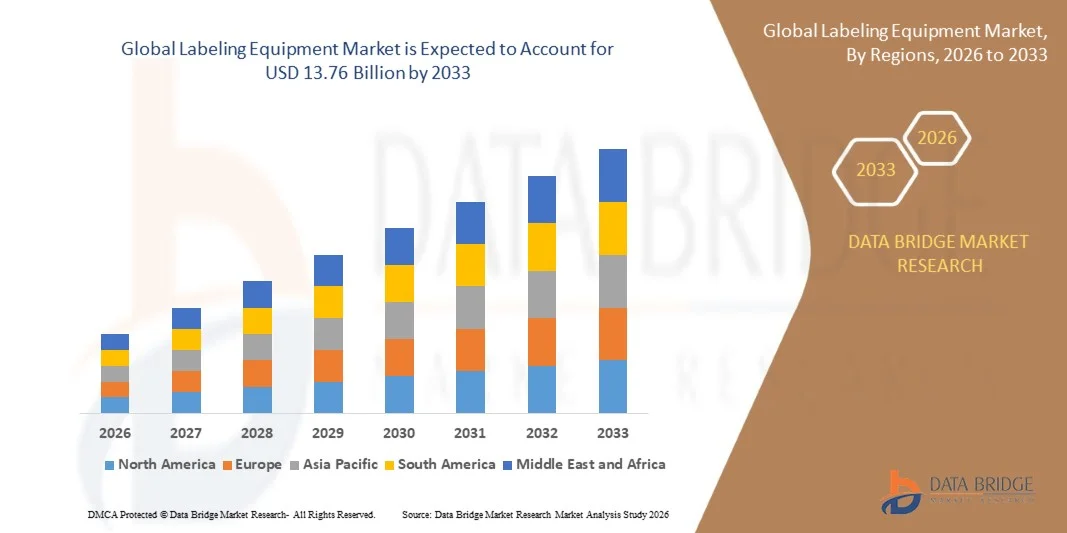
As per Data Bridge Market Research analysis the labeling equipment market was valued at USD 8.84 billion in 2025 and is projected to reach USD 13.76 billion by 2033, growing at a CAGR of 5.70% from 2026 to 2033. The market is witnessing steady growth driven by increasing demand for automated packaging solutions, stringent product identification and traceability regulations, and rising adoption of smart labeling technologies across food and beverages, pharmaceuticals, consumer goods, and logistics industries.
The growing emphasis on supply chain transparency, regulatory compliance, and brand differentiation is encouraging manufacturers to invest in advanced labeling systems that offer higher speed, accuracy, and flexibility. Automated pressure-sensitive, shrink sleeve, and RFID-enabled labeling equipment is increasingly replacing conventional manual processes, enabling businesses to improve operational efficiency, reduce labeling errors, and support high-volume production requirements. Furthermore, the expansion of e-commerce and the increasing need for serialized packaging and anti-counterfeiting measures are expected to further strengthen demand for labeling equipment across markets throughout the forecast period.
Market Size & Forecast
- Market Value (2025): USD 8.84 Billion
- Expected Market Value (2033): USD 13.76 Billion
- Forecast CAGR (2026–2033): 5.70%
- Leading Region in 2025: North America
- Fastest Growing Region: Asia-Pacific
Key Market Trends & Insights
- North America dominated the labeling equipment market with the largest revenue share of 40.5% in 2025, supported by the widespread adoption of packaging automation technologies and stringent labeling regulations across the food, beverage, pharmaceutical, and consumer goods industries.
- Asia-Pacific labeling equipment market is expected to witness the fastest growth rate from 2026 to 2033, holding approximately 25.5% of the share, supported by rapid industrialization, increasing packaged goods consumption, and rising investments in manufacturing infrastructure across China, India, and Southeast Asia.
- The automatic segment held the largest market revenue share of approximately 61.5% in 2025, driven by increasing adoption across high-volume manufacturing facilities in the food and beverage, pharmaceutical, and consumer goods industries. Automatic labeling systems are preferred due to their high speed, precision, reduced labor dependency, and seamless integration with smart factory and packaging line operations.
- The semi-automatic segment is projected to register the fastest growth at a CAGR from 2026 to 2033, driven by growing demand from small and medium-sized enterprises seeking cost-effective automation solutions. Rising investments in flexible packaging operations and increasing adoption among regional manufacturers are accelerating segment expansion.
- The adhesive based labeling segment held the largest market revenue share of approximately 82% in 2025, driven by extensive use of pressure-sensitive and self-adhesive labels across packaged foods, pharmaceuticals, and personal care products. The segment benefits from superior label durability, ease of application, and compatibility with a wide range of substrates and packaging formats.
- The non-adhesive based labeling segment is projected to register the fastest growth at a CAGR from 2026 to 2033, driven by increasing demand for sleeve and in-mold labeling technologies that offer enhanced aesthetics, 360-degree branding opportunities, and sustainability advantages in premium packaging applications.
Report Scope and Labeling Equipment Market Segmentation
|
Attributes |
Labeling Equipment Key Market Insights |
|
Segments Covered |
|
|
Countries Covered |
North America
Europe
Asia-Pacific
Middle East and Africa
South America
|
|
Key Market Players |
|
|
Market Opportunities |
|
|
Value Added Data Infosets |
In addition to the insights on market scenarios such as market value, growth rate, segmentation, geographical coverage, and major players, the market reports curated by the Data Bridge Market Research also include import export analysis, production capacity overview, production consumption analysis, price trend analysis, climate change scenario, supply chain analysis, value chain analysis, raw material/consumables overview, vendor selection criteria, PESTLE Analysis, Porter Analysis, and regulatory framework. |
Labeling Equipment Market Trends
Trend: Growing Adoption Of Smart, Digital, And Automated Labeling Technologies
The increasing need for product traceability, regulatory compliance, and operational efficiency is accelerating the adoption of advanced labeling equipment across manufacturing industries. Companies are increasingly investing in automated and digitally integrated labeling systems capable of handling variable data printing, QR codes, RFID tags, and serialized labels to support evolving packaging requirements. The growing emphasis on Industry 4.0 and connected production environments is further strengthening demand for intelligent labeling solutions that can seamlessly integrate with enterprise systems.
The rapid expansion of pharmaceuticals, food and beverages, e-commerce, and logistics sectors is creating sustained demand for high-speed labeling equipment that delivers accuracy, flexibility, and minimal downtime. For instance, in September 2025, Domino Printing Sciences announced the first-ever sale of its N730i digital label press in India during Labelexpo Europe 2025. The 1200 DPI press is capable of printing at speeds of up to 90 meters per minute and is designed to support short-to-medium print runs across pharmaceutical, health, beauty, and industrial applications. This milestone highlights increasing investments in digital label production technologies globally.
The growing transition toward smart labeling and continued investments in digital printing infrastructure are expected to reinforce long-term demand for labeling equipment, positioning manufacturers to benefit from increasing requirements for traceability, customization, and production automation.
Labeling Equipment Market Dynamics
Key Market Driver: Increasing Demand For Product Traceability And Regulatory Compliance
Manufacturers across industries continue to face stringent regulations related to product identification, serialization, and supply chain transparency. Labeling equipment has become essential for ensuring compliance with food safety standards, pharmaceutical track-and-trace requirements, and logistics labeling mandates while improving production efficiency and reducing human error.
Major equipment suppliers continue to introduce advanced systems designed for connected manufacturing environments. According to Domino Printing Sciences, its Mx350i-T print-and-apply labeling system supports GS1-compliant labels and offers seamless integration with ERP, WMS, and MES platforms, enabling automated labeling across food, beverage, life sciences, and industrial applications. The increasing deployment of such technologies reflects growing demand for intelligent labeling systems that support high-volume manufacturing operations.
As regulatory requirements and supply chain visibility initiatives continue to expand globally, manufacturers of labeling equipment are expected to benefit from sustained demand driven by automation trends, serialization mandates, and increasing investments in smart manufacturing infrastructure.
Key Restraint/Challenge: High Initial Investment And Integration Complexity
Labeling equipment manufacturers and end users continue to face challenges associated with the substantial capital investment required for advanced automated systems. The implementation of high-speed labeling equipment often requires modifications to existing production lines, employee training, software integration, and ongoing maintenance, creating barriers for small and medium-sized enterprises.
In addition, companies must address compatibility issues between labeling systems and broader factory automation environments. Advanced solutions incorporating RFID, machine vision, and variable data capabilities require seamless integration with ERP and warehouse management systems, increasing implementation complexity and project costs. These factors continue to impact purchasing decisions, particularly among cost-sensitive manufacturers operating across multiple facilities. Market participants remain focused on balancing automation benefits with capital expenditure considerations across manufacturing sectors.
Despite strong demand fundamentals, high implementation costs and integration challenges are expected to remain significant restraints, limiting adoption rates among smaller manufacturers and creating operational complexities throughout the forecast period.
Key Market Opportunity: Expansion Of Smart Packaging And Digital Labeling Solutions
Governments, brand owners, and manufacturers are increasingly adopting smart packaging technologies to enhance consumer engagement, improve supply chain visibility, and combat product counterfeiting. QR codes, RFID-enabled labels, and digitally printed packaging are creating significant opportunities for labeling equipment manufacturers capable of delivering flexible, high-performance solutions.
Leading industry participants continue to expand investments in digital labeling capabilities. For instance, in September 2025, Scancode Auto ID Technology announced the launch of its digital printing division, IMPRENTA, supported by the Domino N610i-H Hybrid Digital Label Press. The platform is designed to address growing demand for multi-SKU, short-run, and high-value packaging solutions across pharmaceutical, food, cosmetics, automotive, and industrial sectors, reflecting broader industry adoption of digital labeling technologies.
As industries accelerate the adoption of smart packaging and connected manufacturing initiatives, increasing investments in digital labeling technologies are expected to create substantial long-term growth opportunities for the labeling equipment market.
Labeling Equipment Market Scope
The market is segmented on the basis of technology, type, product, and end user.
- By Technology
On the basis of technology, the labeling equipment market is segmented into automatic, semi-automatic, and manual. The automatic segment held the largest market revenue share of approximately 61.5% in 2025, driven by increasing adoption across high-volume manufacturing facilities in the food and beverage, pharmaceutical, and consumer goods industries. Automatic labeling systems are preferred due to their high speed, precision, reduced labor dependency, and seamless integration with smart factory and packaging line operations.
The semi-automatic segment is projected to register the fastest growth at a CAGR from 2026 to 2033, driven by growing demand from small and medium-sized enterprises seeking cost-effective automation solutions. Rising investments in flexible packaging operations and increasing adoption among regional manufacturers are accelerating segment expansion.
- By Type
On the basis of type, the labeling equipment market is segmented into adhesive based labeling and non-adhesive based labeling. The adhesive based labeling segment held the largest market revenue share of approximately 82% in 2025, driven by extensive use of pressure-sensitive and self-adhesive labels across packaged foods, pharmaceuticals, and personal care products. The segment benefits from superior label durability, ease of application, and compatibility with a wide range of substrates and packaging formats.
The non-adhesive based labeling segment is projected to register the fastest growth at a CAGR from 2026 to 2033, driven by increasing demand for sleeve and in-mold labeling technologies that offer enhanced aesthetics, 360-degree branding opportunities, and sustainability advantages in premium packaging applications.
- By Product
On the basis of product, the labeling equipment market is segmented into pressure sensitive, roll fed, sleeve, rotary, and combination. The pressure sensitive segment held the largest market revenue share in 2025, driven by its versatility, ease of deployment, and widespread adoption across food, beverage, pharmaceutical, and logistics applications. Pressure-sensitive labeling equipment remains the preferred choice due to its ability to support multiple container shapes and deliver high-speed, accurate label placement.
The sleeve segment is projected to register the fastest growth at a CAGR from 2026 to 2033, driven by rising demand for full-body decorative labels, tamper-evident packaging, and premium product differentiation. Growing adoption across beverages and personal care products is further contributing to segment growth.
- By End User
On the basis of end user, the labeling equipment market is segmented into food, beverages, pharmaceuticals and personal care products, chemicals, and others. The food segment held the largest market revenue share of approximately 29% in 2025, driven by increasing consumption of packaged foods, stringent labeling regulations, and growing demand for product traceability. Manufacturers continue to invest in advanced labeling systems to support high-volume production and comply with evolving food safety standards across markets.
The pharmaceuticals and personal care products segment is projected to register the fastest growth at a CAGR from 2026 to 2033, driven by increasing serialization requirements, anti-counterfeiting initiatives, and rising demand for premium packaging. Expansion of pharmaceutical manufacturing and growing consumer spending on personal care products are expected to further accelerate segment growth.
Labeling Equipment Market Regional Analysis
North America Labeling Equipment Market Insight
North America dominated the labeling equipment market with the largest revenue share of 40.5% in 2025, supported by the widespread adoption of packaging automation technologies and stringent labeling regulations across the food, beverage, pharmaceutical, and consumer goods industries. Manufacturers in the region place significant emphasis on operational efficiency, product traceability, and compliance with FDA and GS1 standards. This strong demand is further supported by advanced manufacturing infrastructure, high capital investment capabilities, and increasing implementation of Industry 4.0 initiatives, establishing labeling equipment as a critical component of modern packaging operations.
U.S. Labeling Equipment Market Insight
The U.S. labeling equipment market captured the largest revenue share in 2025 within North America, fueled by the rapid expansion of automated manufacturing and increasing demand for serialized and traceable packaging solutions. Companies are increasingly investing in high-speed labeling systems to comply with food safety and pharmaceutical regulations while improving production efficiency. The growing adoption of smart factories, combined with robust demand for RFID-enabled and digitally connected labeling technologies, continues to support market expansion across multiple industrial sectors.
Europe Labeling Equipment Market Insight
The Europe labeling equipment market is expected to witness the fastest growth rate from 2026 to 2033, accounting for approximately 30.5% of the market share, primarily driven by stringent packaging and sustainability regulations, as well as increasing demand for environmentally responsible labeling solutions. The region's emphasis on circular economy initiatives and product transparency is encouraging manufacturers to adopt advanced labeling technologies. Significant growth is being observed across food processing, pharmaceuticals, and personal care applications, with labeling equipment increasingly integrated into highly automated production environments.
U.K. Labeling Equipment Market Insight
The U.K. labeling equipment market is expected to witness the fastest growth rate from 2026 to 2033, driven by increasing investments in packaging automation and growing demand for product traceability. The country's well-established food and beverage sector, coupled with expanding pharmaceutical manufacturing activities, continues to support demand for advanced labeling systems. In addition, the growing adoption of digital printing and smart packaging technologies is expected to further stimulate market growth throughout the forecast period.
Germany Labeling Equipment Market Insight
The Germany labeling equipment market is expected to witness the fastest growth rate from 2026 to 2033, fueled by the country's strong industrial base and leadership in manufacturing automation. Germany's emphasis on precision engineering and Industry 4.0 adoption promotes the deployment of intelligent labeling systems across production facilities. The increasing integration of machine vision, RFID, and automated inspection technologies within packaging lines is further contributing to market expansion, particularly across pharmaceutical, automotive, and industrial applications.
Asia-Pacific Labeling Equipment Market Insight
The Asia-Pacific labeling equipment market is expected to witness the fastest growth rate from 2026 to 2033, holding approximately 25.5% of the share, supported by rapid industrialization, increasing packaged goods consumption, and rising investments in manufacturing infrastructure across China, India, and Southeast Asia. The region's expanding food processing, pharmaceutical, and e-commerce sectors are accelerating the adoption of automated labeling solutions. Furthermore, APAC's emergence as a
manufacturing hub is improving the affordability and accessibility of labeling equipment, supporting widespread deployment across both large enterprises and small manufacturers.
Japan Labeling Equipment Market Insight
The Japan labeling equipment market is expected to witness the fastest growth rate from 2026 to 2033 due to the country's advanced manufacturing ecosystem and strong focus on quality assurance. Japanese manufacturers continue to prioritize precision, automation, and production efficiency, driving demand for technologically advanced labeling systems. The increasing use of smart factories and connected production environments, coupled with rising requirements for traceability in food and pharmaceutical products, is expected to contribute significantly to market growth.
China Labeling Equipment Market Insight
The China labeling equipment market accounted for the largest market revenue share in Asia-Pacific in 2025, attributed to the country's extensive manufacturing capabilities, growing middle-class consumption, and rapid expansion of packaged goods production. China remains one of the world's largest markets for food, beverages, and consumer products, creating substantial demand for automated labeling technologies. Government support for industrial modernization, combined with the presence of major domestic equipment manufacturers and increasing investments in smart manufacturing, continues to propel the market across residential, commercial, and industrial supply chains.
Labeling Equipment Market Share
The labeling equipment industry is primarily led by well-established companies, including:
- ProMach Inc. (U.S.)
- Barry-Wehmiller Companies, Inc. (U.S.)
- Weiler Labeling Systems, LLC (U.S.)
- Labeling Systems, LLC (U.S.)
- CVC Technologies, Inc. (Taiwan)
- CTM Labeling Systems (U.S.)
- Quadrel Labeling Systems (U.S.)
- Accu-Label, Inc. (U.S.)
- B & H Manufacturing Company, Inc. (U.S.)
- Inline Filling Systems, Inc. (U.S.)
- Fuji Seal International, Inc. (Japan)
- CCL Industries Inc. (Canada)
- Krones AG (Germany)
- HERMA GmbH (Germany)
- Sacmi Imola S.C. (Italy)
Latest Developments in Labeling Equipment Market
- In September 2022, Markem-Imaje launched the eTouch-S intelligent print-and-apply labeling system as an expansion of its 2200 Series portfolio. The solution incorporates artificial intelligence and eliminates the need for plant air while maintaining supply chain traceability and GS1 compliance. Capable of processing over 150 packs per minute, it helps reduce operational costs, improve sustainability, and minimize downtime. The launch reflects the industry's growing focus on smart, environmentally responsible, and high-speed labeling technologies, supporting broader adoption of advanced labeling equipment across manufacturing sectors.

- Interactive Data Analysis Dashboard
- Company Analysis Dashboard for high growth potential opportunities
- Research Analyst Access for customization & queries
- Competitor Analysis with Interactive dashboard
- Latest News, Updates & Trend analysis
- Harness the Power of Benchmark Analysis for Comprehensive Competitor Tracking
Global Labeling Equipment Market, Supply Chain Analysis and Ecosystem Framework
To support market growth and help clients navigate the impact of geopolitical shifts, DBMR has integrated in-depth supply chain analysis into its Global Labeling Equipment Market research reports. This addition empowers clients to respond effectively to global changes affecting their industries. The supply chain analysis section includes detailed insights such as Global Labeling Equipment Market consumption and production by country, price trend analysis, the impact of tariffs and geopolitical developments, and import and export trends by country and HSN code. It also highlights major suppliers with data on production capacity and company profiles, as well as key importers and exporters. In addition to research, DBMR offers specialized supply chain consulting services backed by over a decade of experience, providing solutions like supplier discovery, supplier risk assessment, price trend analysis, impact evaluation of inflation and trade route changes, and comprehensive market trend analysis.
Data collection and base year analysis are done using data collection modules with large sample sizes. The stage includes obtaining market information or related data through various sources and strategies. It includes examining and planning all the data acquired from the past in advance. It likewise envelops the examination of information inconsistencies seen across different information sources. The market data is analysed and estimated using market statistical and coherent models. Also, market share analysis and key trend analysis are the major success factors in the market report. To know more, please request an analyst call or drop down your inquiry.
The key research methodology used by DBMR research team is data triangulation which involves data mining, analysis of the impact of data variables on the market and primary (industry expert) validation. Data models include Vendor Positioning Grid, Market Time Line Analysis, Market Overview and Guide, Company Positioning Grid, Patent Analysis, Pricing Analysis, Company Market Share Analysis, Standards of Measurement, Global versus Regional and Vendor Share Analysis. To know more about the research methodology, drop in an inquiry to speak to our industry experts.
Data Bridge Market Research is a leader in advanced formative research. We take pride in servicing our existing and new customers with data and analysis that match and suits their goal. The report can be customized to include price trend analysis of target brands understanding the market for additional countries (ask for the list of countries), clinical trial results data, literature review, refurbished market and product base analysis. Market analysis of target competitors can be analyzed from technology-based analysis to market portfolio strategies. We can add as many competitors that you require data about in the format and data style you are looking for. Our team of analysts can also provide you data in crude raw excel files pivot tables (Fact book) or can assist you in creating presentations from the data sets available in the report.













